The Annotated Nightstand: What Anne Enright is Reading Now, And Next
Featuring Niamh Campbell, Sally Hayden, Louise Kennedy, and More
Anne Enright, the author of several novels and winner of the Carnegie Medal for The Forgotten Waltz and the Booker for The Gathering, loves a joyful barb, often at her own expense. Case in point, her description of her Booker-winning novel: “the intellectual equivalent of a Hollywood weepie.” (A judge described it as “an unflinching look at a grieving family in tough and striking language.”)
Despite her undeniable prowess as a novelist, Enright has written nonfiction prose in publications of note for nearly as long. Her new book Attention is broken into three sections, “Voices,” “Bodies,” and “Time,” with pieces that attend to topics as various as Toni Morrison’s The Bluest Eye to Enright’s descriptions of traveling with her husband. The volume collects work from the last decade, each with a brief preface from the author, giving us a puncture of the present into her words of the past. “The year I stayed home waiting for my Covid vaccine was also the year I turned to face a book I had been both reading and running away from all my life,” she says of her essay on Ulysses. Throughout the book, Enright’s essays shine a light in her work on Irish writers and thinkers of whom Americans might otherwise remain ignorant or only hold scant knowledge, including Maeve Brennan, John McGahern, and Edna O’Brien. (And, while some might say one or two things about a book as well-known as Ulysses, like Enright before the pandemic, fewer have ever attempted it.)
Above all, Enright, as in her fiction, is most interested in privileging the nuances of human behavior. This is perhaps most clear in her essay on Alice Munro. The posthumous revelation that Munro’s husband, Gerald Fremlin, had assaulted her daughter Andrea Skinner as a child and that Munro was dismissive of this fact hit the literary world like a wrecking ball. Enright does what many did in her essay—she considers the horrors of Munro’s response and the examples of cognitive dissonance (or evidence) in Munro’s body of work.
Yet, while Munro’s denial was a horrible violence, Fremlin’s deplorable acts were the original brutality. Enright thus makes a particular effort to have him take up space in her piece, as “we sometimes speak, with justified fury, about people connected to an abuser and are silent about the perpetrator himself—as though he were a horror beyond discussion.” Katheryn Hughes writes in her review at The Guardian, “A decade ago most of these pieces would probably have been called ‘personal essays,’ but that now seems redundant. Everything is personal with Enright, which is what makes you want to read her even on subjects that don’t initially appeal.”
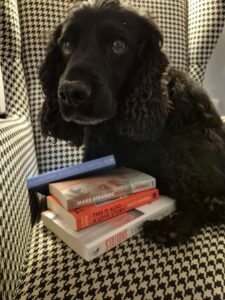
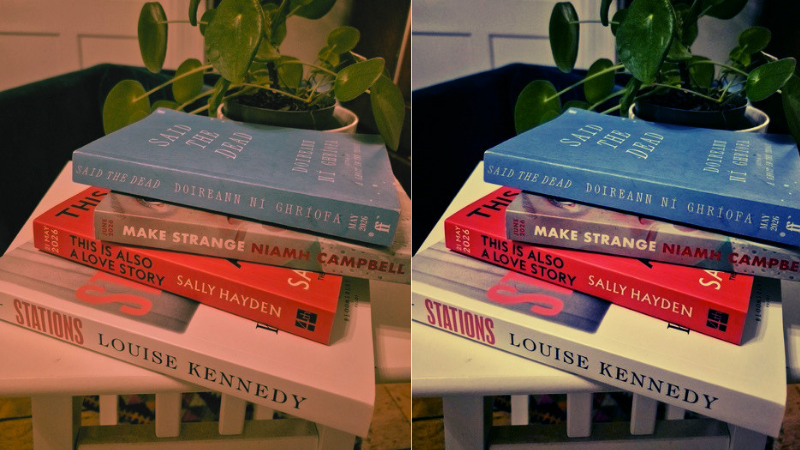
Enright describes her to-be read pile as “Four forthcoming books by Irish writers, with book-loving dog.”
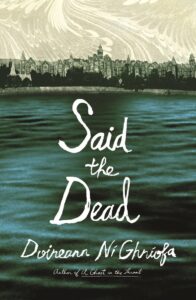
Doireann Ní Ghríofa, Said the Dead
If you, like me, thrillingly took in Ní Ghríofa’s incredible book A Ghost in the Throat in what felt like a single breath (excerpted here at Lit Hub), you are like me and cannot wait for her next book. Said the Dead is about a former Victorian mental hospital-turned-apartment building and the haunting traces that surround it in Ní Ghríofa’s home city of Cork. Lucy Caldwell writes of Said the Dead, “You can feel the bravery of these acts of psychic trespass, and their sincerity makes for a mysterious and beautiful and thoroughly absorbing book.”
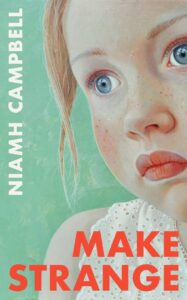
Niamh Campbell, Make Strange
Anyone with a small child in consistent proximity will feel how thin the veil is between them and wherever they came from—a kind of darker, more nebulous underside of “kids say the darndest things.” In 2024, I read and was absorbed by a long-form article entitled “The Children Who Remember Their Past Lives” that investigated the specific titular phenomenon. Campbell’s novel attends to it head-on when a four-year-old girl in Campbell’s novel Make Strange asks “Mama, do you remember when I died?” This pitches the family into a year-long journey of the child referencing her past lives—and deaths.
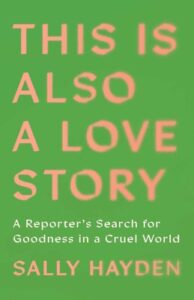
Sally Hayden, This Is Also a Love Story: A Reporter’s Search for Goodness in a Cruel World
Hayden is an award-winning foreign correspondent who, in this book, turns her eye toward the expressions of love she has encountered in her years as a reporter. Nathan Thrall writes in praise of This Is Also a Love Story, “Sally Hayden’s gorgeous work of reportage shows us that in the midst of war, around the most acute suffering, there is also tremendous heroism. For every act of cruelty and dehumanization and indifference, there is resistance and rebellion that takes the form of compassion, humanity, and love.”
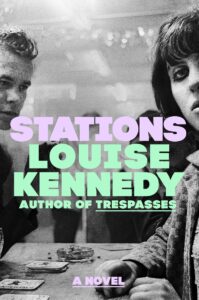
Louise Kennedy, Stations
Kennedy describes her latest novel to The Irish Times, stating, “Stations opens in a small town in the Irish midlands in 1982, when teenagers Róisín and Red strike up an unlikely but ardent friendship. The book follows them to London, a journey many of us made then, where they eventually take very different paths. Spanning twenty-five years, it’s about love and loyalty and the choices we blithely make when we are young, unaware that the consequences will reverberate through our lives.”
Diana Arterian
Diana Arterian is the author of the recent poetry collection Agrippina the Younger (Northwestern UP, 2025) and editor and co-translator of Smoke Drifts (World Poetry Books, 2025), a collection of Nadia Anjuman's poetry. A Poetry Editor at Noemi Press, Diana has received fellowships from the Banff Centre, Millay Arts, and Yaddo. She writes “The Annotated Nightstand” column at Lit Hub and lives in Los Angeles.