The 29 Best (Old) Books We Read in 2025
Other Stuff We Read This Year
It is the hallowed tradition of every cultural publication under the sun to, come December, curate a list of their favorite books of the year. (No shade, we did it too.) But at Literary Hub, we also like to celebrate the older books we encountered for the first time in the last twelve months—from 19th-century classics to snubbed bestsellers from the last few years. So in case you too like to read outside what everyone else is reading (or just can’t keep up the pace, after all who could), here is a list of books that our staff members loved in 2025 that were published in any other year. Tell us what older books you’ve discovered recently in the comments, and happy list season.
*
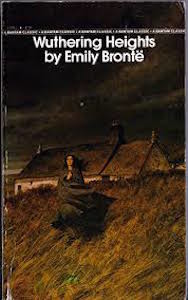
Emily Brontë, Wuthering Heights (1847)
The first literary classic that made me feel bad this year (see my blurb for Strangers on a Train below) was Wuthering Heights, which I had never read, in large part because of its reputation: that is, when I was the correct age to read it for the first time, I was against both swoony romances and anything enjoyed by more than six other people. Reading it this year, I was surprised by both aspects: I found it not remotely romantic or sexy, but rather quite deranged and dark-sided, a pessimist’s (and indeed a virgin’s) book. I also found it, not unrelatedly, fairly difficult and thorny, that is, not the kind of book I’d assume every reader to enjoy, much less swoon over. This is a novel about doomed people dragging each other to hell. It is angry and disappointed and gloomy as hell. Clearly it’s a masterpiece, but not, I think, in the way we like to pretend. –Emily Temple, Managing Editor
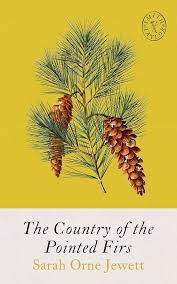
Sarah Orne Jewett, The Country of the Pointed Firs (1896)
I was visiting the midcoast of Maine this summer and, as I am wont to do on trips, found myself in a number of cute bookstores. One of them, Arctic Tern in Rockland, had a little display of local Maine stories and something about this book just called to me. (The lovely Smith & Taylor edition also helped catch my eye, I’m sure.)
What a delight to discover a book that could easily have been written yesterday, a book with little “plot” to speak of besides the age-old tale of an author who has headed to the country in order to work on her next book… but who ends up spending her time hanging out with the townsfolk and enjoying country living instead of working on said book. But therein lies the joy of this slim novel: the richly drawn characters, all of whom felt as real as can be, as though I might run into them while puttering around on my holiday. A perfect depiction of place, of time, of human interaction. It charmed me effortlessly, and not just because I was reading it nearly exactly where it was set. –Drew Broussard, Podcasts Editor
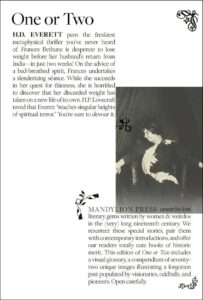
H.D. Everett, One or Two (1907)
Mandylion Press is putting out incredible books. Not only are they resurfacing some fascinating writing, but their editions are gorgeous: great design, cool accompanying images, and wrapped in these gauzy slip covers.
One book I loved from Mandylion that I’ve been consistently talking up to folks is One or Two, a strange speculative novel from 1907 that feels like a Twilight Zone premise glimpsed through a Victorian dream.
Frances Bethune’s husband is coming home sooner than she expects and she’s desperate to lose weight, and fast. In a 19th century Substance move, she enlists a friend to perform a slimming séance. It works—sort of. Frances gets her wish but horrifyingly, the pounds she sheds reappear as Fancy, a younger version of herself. This sets up a fascinating and bizarre morality drama. Some of the book is dated in places, but the 1907 ideas and anxieties are extremely recognizable. –James Folta, Staff Writer

Ursula Parrott, Ex-Wife (1929)
Parrott’s Jazz Age novel of life as a divorced woman is probably my favorite book I read all year. Ex-Wife was originally published in 1929, but it feels as relevant and vivid and true as any book published in the last few years. It’s as funny and juicy as a conversation with a particularly cool friend, but it’s also deeply-felt and honest and at times genuinely heartbreaking. The novel is considered semi-autobiographical and deals with divorce (obviously), abortion, love, class dynamics, women’s rights, and the complexities of a rapidly changing world. Parrott was a prolific writer in her time, but she’s now generally forgotten—Ex-Wife, her most popular work, has been out of print for decades. This novel is the perfect rediscovery for our times, the kind of book that feels like it’s speaking directly to you across the past, with the kind of narrator you’d love to meet reapplying her lipstick in the bathroom of a bar. –McKayla Coyle, Publishing Coordinator
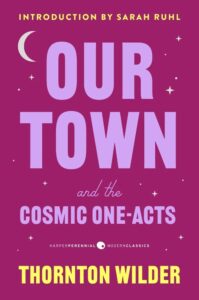
Thornton Wilder, Our Town and the Cosmic One-Acts (1931/1938)
I am on record that more people need to be reading plays and treating them like the literature that they are—and Thornton Wilder is perhaps the perfect writer to dive into right now. The only writer to win a Pulitzer Prize for both fiction and drama, he’s always been far weirder than the high-school-drama-department-Our-Town image you’re conjuring in your mind—Our Town itself is a spectacularly strange play, one that re-wrote many of the rules of theater so fully that we now can’t see how radical it was when it premiered. Harper did a lovely thing this year by putting it into a collection alongside three of Wilder’s so-called “Cosmic One-Acts”: shorter plays that feature similar time-bending magical realism and deep, warm appreciation for the human experience. I’ve had the pleasure of hearing (and, once, participating in) a reading of The Long Christmas Dinner at the holidays for nearly a decade now and it always warms my heart—you ought to give it a try with your friends, and I guarantee you’ll understand why I’m always on about people reading more plays!! –DB
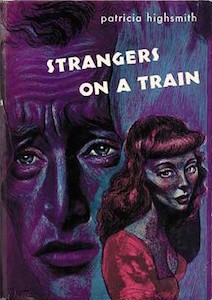
Patricia Highsmith, Strangers on a Train (1950)
I have to admit that I did not really enjoy reading Strangers on a Train. It stressed me out. The Talented Mr. Ripley stresses me out too, but at least you’re in Europe, to compensate. Also, you trust Tom and his skills in a way you do not remotely trust either Guy or Bruno, the titular strangers who meet on a train and do not exactly, I was surprised to find after decades of cultural osmosis to the contrary, decide to execute one another’s desired murders. So yes, I found this book, in which things get worse and worse for Guy, mostly because of the unrelenting, unwanted attention of Bruno, to be deeply uncomfortable to read, but of course this is as intended. Highsmith is a genius, and she wanted me to feel bad, and I did, and this, friends, is art. I admire it very much. –ET
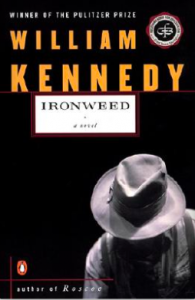
William Kennedy, Ironweed (1983)
Ironweed, which won Kennedy the Pulitzer Prize back in 1984, is one of those novels I’ve been meaning to read for the better part of a decade. I really should have got to it sooner. Set in Albany at the tail end of the Great Depression, it’s the story of loquacious career bum Francis Phelan, a native of New York’s capital who, in a previous life, abandoned his family after accidentally dropping and killing his infant son. Returned now to his old stomping ground, with his broken dove girlfriend Helen and his sweet natured pal Rudy in-tow, the puckish Francis wanders the desolate city streets trailed by visions of the dead. A lyrical underworld odyssey, poignant and nightmarish in equal measure, this novel hypnotized and then gutted me. –Dan Sheehan, Book Marks Editor-in-Chief
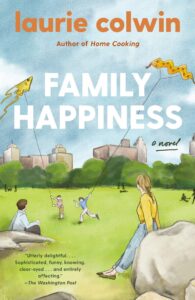
Laurie Colwin, Family Happiness (1984)
Polly Solo-Miller Demarest has a picture-perfect life—the daughter of an illustrious, stable family, she has two perfect children, is married to a handsome, successful lawyer, and still finds the time for a weekly brunch with her parents. But Polly is also having an affair with an artist, her meetings in his downtown studio the only times when she can feel truly happy. Polly lives a double life, trying to mask her daily unhappiness and her loss of self, desperate to be adored by a man who doesn’t want any part of her other life. Colwin is an Ephron contemporary, without the acrid humor, but of the same Manhattan kitchens and family dinner tables, perhaps more attuned to quiet, lonely suffering. It’s a lovely book even if modern readers might bristle with the self-contortions of someone trying to be a “good wife.” –Emily Firetog, Deputy Editor
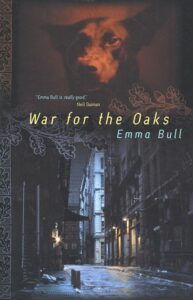
Emma Bull, War for the Oaks (1987)
Kelly Link recommended this book to me on Bluesky and this is an important name-drop because not only did I love this novel, but it gave me an even deeper appreciation of Kelly’s work in the process. You can see aspects of The Book of Love in particular growing out of the soil of this book—but, as I say this, I think you can also see aspects of the entire urban fantasy genre (Harry Dresden would have a ball in this world) getting their footing here. It’s about a war between fairy courts playing out in Minneapolis, where an unsuspecting musician finds herself roped into the war and finds that her musical talents might be just the thing to turn the tide. It’s a great music book, a great city book, a great fantasy book. –DB
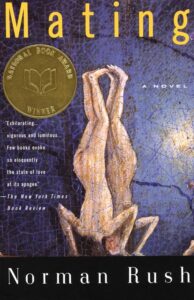
Norman Rush, Mating (1991)
I think it was 2023 when every cool girl and their mother got simultaneously Rush pilled, but I’ve always been a late bloomer. Anyway, happy December: I am one more woman here to tell you that Mating, the chronicle of a young anthropologist’s first big love, is a masterpiece. Our narrator is a wise and wise-cracking post-doc on assignment in Botswana. Her eventual object is Nelson Denoon, a charismatic social engineer trying to create a matriarchal utopian society in the countryside. Heroine chases, hero hedges. Deserts get crossed. Like the scientist she aspires to be, Rush’s unnamed protagonist examines the collision. The result is a moving study of how two simpaticos can crash together, and bend social structures to accommodate their profound feeling. How can we love, inside and against the pressures of “civilization?”
This novel’s hard to pitch because the feat is in the ideas (huge!) and the sentences (marvelous!). I love that Rush treats romance—or, “intellectual love”—like the world forming force that it is. We parse that world in conversations. Our lovers meditate at length on utopia, and have lively arguments about the practicalities of Marxism. For the erudite, I-live-IN-my-body types, and for anyone who’s ever flirted with “sapiosexual” as an identity, I present catnip. CC: Helen DeWitt-ers, the cautiously heteroptimistic. –Brittany Allen, Staff Writer
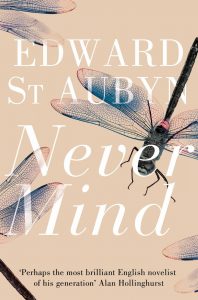
Edward St. Aubyn, Never Mind (1992)
The first Patrick Melrose novel is a slim, spiny thing. It takes place over a single harrowing summer day in the South of France, at the Melrose family estate, and it contains multitudes, most of them dagger sharp: Its prose is spare and beautiful, its observations about the British upper-class are very funny and perfectly acid, and its portrayal of young Patrick, the neglected and horribly abused son, is absolutely wrenching. If you love upper-crust evisceration and have the stomach for childhood misery (I did find I had to step away a number of times), this one’s for you. –Jessie Gaynor, Senior Editor
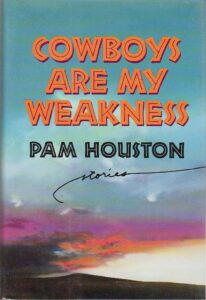
Pam Houston, Cowboys are My Weakness (1992)
I am about as indoor girl as indoor girls get, but this witty, warm collection starring scrappy adventurers and the taciturn wrecking balls that scuttle their peace had me dreaming of wilderness and wide open plains. The hardscrabble landscape suits its subjects. Most of the narrators in these stories are self-sufficient women who know they should know better, but just can’t seem to quit the Marlboro Man. (“You will spend every night in this man’s bed asking yourself why he listens to top-forty country…”) There are emotionally unavailable hunters, and white water rafting trips that indicate the end of love. Next to Mating, a reading theme emerges: can two wild things come together and each get out alive?
Though Houston is so elegant on the abjection attending desire, there’s a lot of sharp hope in these stories. I’d foist this one onto Lorrie Moore and Leigh Newman fans. –BA
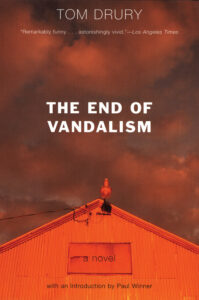
Tom Drury, The End of Vandalism (1994)
Genuinely funny novels are so rare (if you’re a humor novelist reading this, obviously I thought your book was among the very funny minority). The End of Vandalism, first published in 1994 and reissued in 2006, takes place in (fictional) Grouse County, Iowa, skipping between residents of the sleepy setting, paying meticulous attention to the daily struggles and triumphs of everyone on whom its narrative gaze rests. Much of the magic lies in the dialogue, which is some of the finest I’ve ever read. Also, crucially, the novel is extremely funny while also taking seriously the stakes it presents for its characters’ lives: love, petty crime, unruly birds, senior portraits. I hung on every tiny, perfect detail. –JG
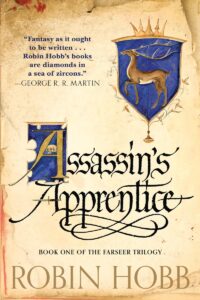
Robin Hobb, Assassin’s Apprentice (1995)
Over the course of this calendar year, multiple people have gone out of their way to tell me it was a travesty that I’d never read Robin Hobb—everyone from a writer who works for the Ursula K. Le Guin foundation to my old boss from The Public, on social media and over text message and in person. What’s wild is that I’d never even heard of her before this year? And the thing is, I used to be all about a big epic fantasy series. I’m talking Weis & Hickman Dragonlance, R.A. Salvatore’s Drizzt Do’Urden novels, Terry Brooks’ Shannara series, Glen Cook’s The Black Company… but sometime in high school or maybe early college, I lost the taste for it. Maybe it was because of the rise of the Brandon Sanderson school of rules-rules-rules and gotta-catch-em-all interlinking, or because I culturally felt obligated to put aside my love of genre for a time in the mid 00s… But I’ve been itching to sink into a multi-part long-running fantasy world and Hobb’s Farseer books have been the perfect salve. Beautifully written, richly layered, deeply in love with animals and honor and the costs of care. I’ll be in the Six Duchies for the foreseeable, I think. –DB
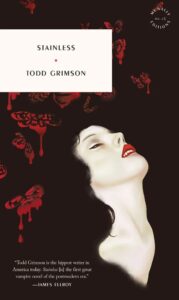
Todd Grimson, Stainless (1996)
Vampires! Still so hot! I’m on record as an Anne Rice stan and V.E. Schwab’s Bury Our Bones in the Midnight Soil gave me such life this year—but I love to find a type of vampire story I’ve never encountered before. Enter Stainless, reissued by the unerring McNally Editions, which is not only a great late-90s LA novel (it stands alongside Less Than Zero in capturing That Time, imo) and a great vampire novel, but also a structurally fascinating read. From chapter to chapter, Grimson has no problem jumping in time or point of view, which takes a moment to get used to… but once you’re in, oh baby, you’re in. And if it culminates in bloodshed that might make even Patrick Bateman pause…. Well, welcome back to the 90s, I suppose. –DB
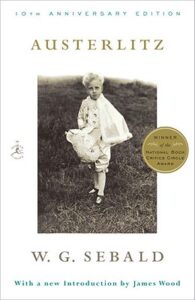
W.G. Sebald, Austerlitz (2001)
Sebald’s last novel has an unlikely framing device, apparently disliked by Michiko Kakutani when she reviewed it for the New York Times. This frame is a conversation between an unnamed narrator and Jacques Austerlitz that takes place over thirty years in train stations and cities across Europe. Austerlitz is an architectural historian but adrift in that his true identity—that is, his Jewish identity, his parentage, and his native language—have been hidden from him most of his life. I love rereading books I read in college because I am older and more emotionally available to be wrecked by literature, but also less academically inclined to “figure it out” and “get it right” the way I would have been in a seminar. Rereading Austerlitz now, I’m no longer dizzied by the postmodern marvel of the novel, the photographs throughout the text (both true, as they are real people, and untrue, as they are not Austerlitz), nor by seven-page-long sentences. Really, I cannot stop thinking about four-year-old Jacques in the summer of 1939, the Kindertransport from Prague on his way to meet his new family—the Welsh minister and his sad wife. The book is so much sadder to me now, but still just as perfect. –EF
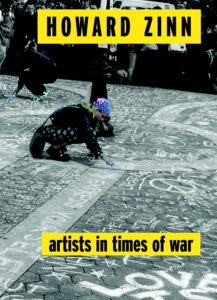
Howard Zinn, Artists in Times of War (2003)
This book has remained close at hand for me this year. I wrote a longer reflection on this collection of essays in the summer, but Zinn’s provocations make these four essays about American dissent essential reading for anyone on the left, or in the arts, or with a conscience in Trump’s America.
The essays are adapted from lectures Zinn gave, and their language is very direct. In his discussion of history, America’s War on Terror, and creative resistance, Zinn’s essays are plain spoken but polemical, challenging us to not limit ourselves and never accept the story we’re offered.
Similar to the open invite of this year’s Fall of Freedom project of creative response to authoritarianism, Zinn dismantles the idea that any of us should count our voice out. Zinn’s essays challenge us to consider what we value and how we can be honest in our expression. The best artists, he argues, are always citizens and human beings, rejecting the framing that we have to constrain ourselves or defer to others on the basis of profession or expertise.
“All of us, no matter what we do,” he says, “have the right to make moral decisions about the world.” –JF
Curtis Sittenfeld, Prep (2005)
One cool thing about being alive is that you think you know what your favorite book is, and then you stumble across one that’s been on the scene (prominently, might I add) for a good twenty years, and all that you once knew goes out the window. A new (old) favorite book! We’re so lucky! If you, like me, have been living under a rock for the past two decades, let me be the one to share the news that Curtis Sittenfeld’s debut is nothing short of perfection. It’s hilarious, it’s incisive, it’s embarrassing, it’s soul-searching: it is, in short, a completely accurate depiction of being a teenager. This book rocketed Sittenfeld to literary stardom, and reading it after all this time only makes it crystal clear how deserved, how eloquent and how precise that rocketship truly was. –Julia Hass, Book Marks Associate Editor
Isabelle Wilkerson, The Warmth of Other Suns (2010)
Isabel Wilkerson’s historical epic about the Great Migration is by no definition an under-the-radar book, but it wasn’t until the New York Times put it at number two on its Best Books of the 21st Century list that I finally picked it up. And in case you need the urging of one more person amid the, again, very loud chorus of voices telling you to read this book: Read this book. It’s the most novelesque nonfiction book I’ve ever read—an absolute page-turner, and beautifully written, while at the same time so deeply and thoroughly researched that the entirety of it took my breath away. The majority of the book follows three Black Americans who moved north at various points during the Great Migration, which makes it both deeply personal and completely universal. It should be required reading for all Americans. –JG
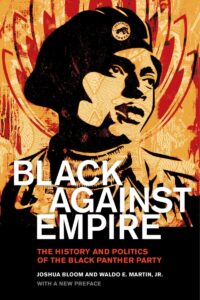
Joshua Bloom and Waldo Martin, Black Against Empire (2013)
I loved this comprehensive history of the rise and fall of the Black Panther Party. The book re-examines a lot you may have heard about the Panthers, and pushes back against bad faith, often FBI-backed narratives and histories designed to undermine the BPP. This is a rigorous book, though it isn’t as academically historiographic as it could be. I always like history that can legibly translate discussions within academia for a lay reader.
The political theory is also accessible and thorough. Bloom and Martin explain the Panthers’s revolutionary theory and how it found inspiration in action and text: the energetic and spontaneous revolts happening in American cities alongside their deep readings of Fanon, SNCC, and others. By aligning the Black American struggle with global anti-imperialist revolutionary movements while also attending to material conditions, systems of care, and principled resistance, the Black Panthers built something that was able to act locally to better their neighbors’s lives and to exert influence globally by drawing attention to interlocking systems of exploitation and oppression. –JF
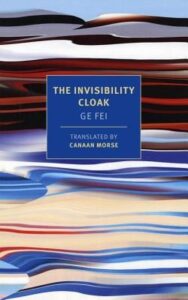
Ge Fei, tr. Canaan Morse, The Invisibility Cloak (2016)
One of my lifelong reading projects is building out a syllabus of comic novels. A truly funny novel is a hard feat to pull off, and I’m forever interested in the different ways that authors attempt to craft a book that is dramatic and funny.
Ge Fei’s The Invisibility Cloak immediately shot to the top of my funny list. The book is narrated by a bitter, opinionated loser—a great start for comedy—who is out of step with the competition and judgement of contemporary Bejing. He’s divorced, living with his sister, and struggling to make money as a specialist in building and repairing old-school sound systems for rich people. His only two loves are amps and a very select list of classical music. Nothing is really working out for this guy, so he doesn’t think twice when a friend puts him on to a risky specialty job.
Some of Fei’s humor comes from the touch of strange daydream to this book, but what I really find funny is his narrator. A loser who thinks too highly of themselves is a real comedic sweet spot—think of high status, dumb characters like Michael Scott on The Office, Colbert on The Colbert Report, or anyone on I Think You Should Leave. Fei’s narrator is part of that venerable comedic tradition, and I loved being inside this bitchy audiophile’s head. –JF
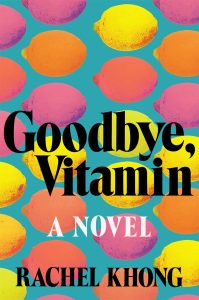
Rachel Khong, Goodbye, Vitamin (2017)
Goodbye, Vitamin is a rare thing: a genuinely funny book. The concept—a woman moves home to help her mother care for a father in the early stages of dementia—doesn’t sound very funny. But believe me when I say that I had to put this book down several times because I was laughing so hard. Khong is so sharp and an incredibly keen observer. The book is loaded with tiny moments that are so perfectly seen and reported that you can feel them zinging through your brain. It’s so funny and so grounded and so emotional and so real. Goodbye, Vitamin is a book that knows that the funniest moments are often the sad ones, that humor and tragedy go hand-in-hand, and the book never shies away from that knowledge. Khong has beautifully captured how it feels to be alive, to struggle through all the contradictions and the unexpected twists and the silly, stupid things we have to do to keep ourselves going. –MC
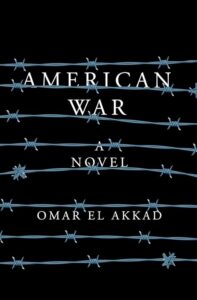
Omar El Akkad, American War (2017)
Omar El Akkad’s National Book Award-winning cri de coeur, One Day, Everyone Will Always Have Been Against This, is, to my mind, the most profound and important piece of literature to emerge from this horrific period: required reading for all of us desperately trying to make sense of the senseless. After setting it down, I decided to pick up El-Akkad’s 2017 debut novel and discovered that his fiction is every bit as enthralling and devastating. A dystopian epic set in the closing decades of the 21st century—during and after the brutal Second American Civil War—American War follows Sarat Chestnut, a grieving young refugee whose repeated brutalization by Northern forces sparks a terrible, inevitable radicalization. El Akkad takes the atrocities committed by the American war machine in the Middle East and brings them home, to an empire in flames. –DS
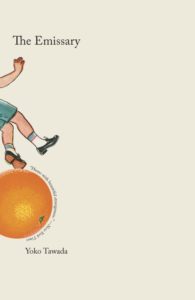
Yoko Tawada, tr. Margaret Mitsutani, The Emissary (2018)
This short novel takes place in a near future after “the contamination,” when Japan has isolated itself from the rest of the world. Here, children are born sickly, unable to walk by the time they are teenagers, and die young. The elderly continue to work into their 100s; they don’t get sick or weak, and it’s possible they may never even die. Yoshiro, an author, is taking care of his great-grandson Mumei. Much of the book is concerned with the small day-to-day of Yoshiro’s life—making soft food for Mumei that he can digest easily, taking him to school (he can only walk a few feet before needing to be taken on the bike), sharing stories of old Japan, including teaching him words that are no longer allowed to be used. Their relationship is tender, delicate, and filled with worry. The world-building elements may not satisfy a sci-fi obsessive, but I loved the hints as to this new dystopian future. Winner of the 2018 National Book Award for Translated Literature, this is not Tawada’s most popular work, but a nice place to start (especially if you enjoyed this year’s release of her excellent essays, Exophony: Voyages Outside the Mother Tongue). –EF
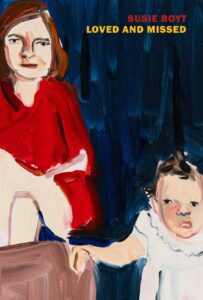
Susie Boyt, Loved and Missed (2021)
A lot of people seem to get more interested in the literature of parenthood after they become parents; for me it’s been the opposite. I get enough parenting in my real life, thank you. So I resisted this novel for a few years, despite everyone (and their mother) chattering excitedly about how good it was, and how much I wouldn’t really mind the parenting of it all, even though it definitely was about that. They were right and I was wrong: I loved Ruth’s voice, so sharp and so tender, and maybe in the before-times I wouldn’t have cried at the end, but in the now-times I didn’t even mind. –ET
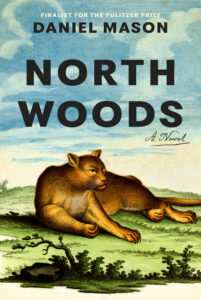
Daniel Mason, North Woods (2023)
There’s something humbling about falling deeply in love with a book that appeared on every best book of the year list and was a finalist for the Pulitzer Prize, but I’ll attempt to add to those accolades anyway: North Woods is a masterpiece. I read the first page and decided I wasn’t the audience for a book about Puritan runaways, but I was on an airplane and had no other option, I stayed in the book’s world, and am utterly, fall-to-my-knees grateful for it. The story blooms and lengthens and sprawls, going from generation to generation, reckoning with the weight of lineage and history and wounds. With the weight of what it is to love and be loved: the goodness in it. The inherent cruelty in it, in attempting to possess anything, even if we love it, especially if we love it. Mason doesn’t attempt to delineate black from white, good from evil. He never tells us what it all means, what to take away from this horrifying and majestic story. It’s heavy. It’s awe-inspiring. It’ll stay with me for a long time. –JH
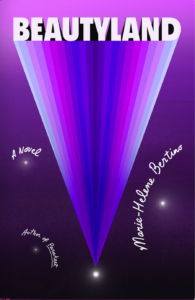
Marie-Helene Bertino, Beautyland (2024)
Beautyland has been the tie that binds the literary taste of all my friends this year. The book that’s been constantly pressed into each other’s hands: a surefire hit every time I’ve recommended it. It’s not always that a book is able to bridge across that varied range of opinions, but Beautyland has managed it. I think it’s something about its undeniable understanding of humanness that gets at the very heart of every single existence. It’s a unique voice, but also a general voice, that Marie-Helene Bertino employs to communicate the story of the protagonist, an alien stuck on earth named Adina. I’m not a speculative-leaning gal, and so I resisted this book last year, stuck on the alien-ness of it all. How naive I was! Thinking this book was about another world, when really that other worldliness of the protagonist is what makes it even realer, even more grounded, a telescopic eye on the facts of humanity that we take for granted, the good, the light, the sad, the brutal. Read it to remember that we are, all of us, aliens in this land: attempting to live and love and create in the face of the relentless strangeness we can feel in our homes and bodies and families. If we’re all aliens, then maybe none of us are. –JH
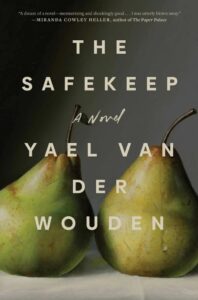
Yael van der Wouden, The Safekeep (2024)
The Safekeep is only a year old, but it’s one of those rare books that feels like it could have been written this year or 50 years ago. This is a novel about obsession, and it’s a sexy novel, and beautifully, delicately written, all true. But for me its chief brilliance lies in the fact that it is more than anything a novel of hinges, a story that brings itself repeatedly to the breaking point, only to be reborn as something else. I don’t want to say much more, because it’s the kind of book I’d recommend coming to cold (to fully appreciate the weight and skill in those hinges without prior knowledge) but those who haven’t read it really should. –ET
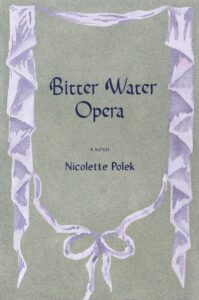
Nicolette Polek, Bitter Water Opera (2024)
This book is everything I love: a ghost story, an examination of art and the artistic process, a vibey, moody work, a novella. I read Bitter Water Opera on the plane from Seattle to Palm Springs and I was fully locked in the entire time. I considered rereading it immediately upon landing in Palm Springs, both because I loved it so much and because it’s the perfect desert book. Polek’s novella follows a woman who, in a post-breakup depression haze, begins spending time with the ghost of the artist Marta Becket—the creator of the Amargosa Opera House in Death Valley. Bitter Water Opera is an odd little book, and it’s hard to pin down. Reading it feels like reading a hymn or a poem. It’s beautiful and urgent and present and full of desire. A truly lovely book. –MC