I think I’ve always written stories because I spent all my school vacations at my aunt’s. When normal life started up again, I was elsewhere, far away, in another town, another place, with other friends. Throughout my childhood, I was always the absent one. From the first day of the holidays, the children at my school stopped seeing me, and the children in Gueugnon saw me once again, as soon as the bell announced the start of their freedom.
She’s arriving tomorrow.
The adults called me “the vacation girl” or “Colette Septembre’s niece.” The kids my age called me by my name.
People would set off for Fréjus, Quiberon, or Spain. For the sea, for the mountains. And me, for Gueugnon. My parents rarely departed from the rule. Even after the death of my father. Until I came of age, I got landed with the shoe-repair shop, the Rue Jean-Jaurès, the Rue de la Liberté, the Place de l’Église, the footbridge, the municipal swimming pool, the matches at the Jean-Laville stadium.
“Where are you going?”
“To Gueugnon. Saône-et-Loire.”
“Is that far?”
“Not very.”
I was never very far from Colette. My friends in Gueugnon could be counted on the fingers of one hand. Hervé, Adèle, and Ilyas. The children of storekeepers, who’d meet up during the day while their parents were hard at work. The hours had to be filled. We’d split up for lunch. Half an hour, and we were done. At the end of the day, we had to be home at around six. Have a wash, maybe lay the table while awaiting parents. At Colette’s, I only had to jump into her hip bath. Then, I’d dive into her collection of Tintin books, which I adored. She’d order them for me from the tabac. I was forever rereading The Castafiore Emerald, because it’s the only one that’s set entirely in Marlinspike Hall. I found that reassuring, somehow. I don’t know why. And when I needed to travel, when boredom and missing my parents became too oppressive, it was Tintin in Tibet, The Blue Lotus, or Prisoners of the Sun.
On summer evenings, Ilyas, Adèle, Hervé, and I would go back outdoors until nine. And on really hot days, we were allowed an extra hour. We’d hang out on the banks of the Arroux, near the footbridge. We’d skip stones. We’d listen to the radio or to music from my cassette recorder. We’d imagine our futures. Me, I wanted to be a reporter. Ilyas, a professional footballer and to play for France. Adèle, a Médecin du Monde, a doctor of the world. Hervé, an explorer.
“What d’you want to explore, Hervé?”
“Don’t know yet.”
“Why a doctor of the world, Adèle? Why not just a doctor?”
Sometimes, Mom and Dad would come and fetch me in the middle of the vacation, like picking at a plate of food, to take me somewhere for two or three days at short notice. Otherwise, Ilyas and I would spend the month of August together. His father didn’t close his grocery store, and my aunt didn’t think it possible to leave Gueugnon, except when the team played away.
Hervé and Adèle would be off to spend three weeks by the sea with their parents, who would pull down the shutters and hang up the “Annual vacation” sign. Not the same sea. The Mediterranean for Hervé, the Atlantic for Adèle.
“You could never bump into each other swimming,” Ilyas would say.
In August, Gueugnon was empty. A dead, hot, deserted town, like in the Westerns, when the hero or villain rides into town and everyone’s hiding.
*
They’re there. All three of them. Sitting in the entrance hall of the Monge hotel. Lightly dressed because it’s still warm for October. Adèle, Ilyas, Hervé. We’d lost touch. A word on Facebook every now and then, a “like” or a heart emoji on a comment about some photo that touches us.
Apart from Hervé, who has broadened out, whose features have thickened with age, they haven’t changed. Adèle still has a youthful figure, and Ilyas a childlike beauty.
It’s Adèle who speaks first. The opposite of when we were young. She was the one who said nothing. “We heard you were here. News travels fast in this place.” She stands up and hugs me. She smells of honeysuckle. Like before. I’m in a complete daze. Instead of saying hello or good evening, nice of you to come, how are you, I blurt, right out of the blue:
“My aunt who’s buried, it isn’t my aunt. Mine died two days ago.”
The two boys look questioningly at me as they stand up. They hug me in turn, silently. Ilyas has a whiff of ambergris about him, Hervé of vetiver cologne.
“I should have realized when I collected her belongings back then, there was almost nothing to do with her football team, the FCG. And mainly, not a trace of her collection, which included dozens of scrapbooks. She’d cut out all the articles in the newspaper. Had done so for decades. Do you think that’s normal? What a total idiot I am . . . Can you believe that you went to my aunt’s funeral three years ago, and it wasn’t her?”
“Impossible,” they all reply, in unison.
“I’ve just seen her at the morgue!”
“You’re sure?”
“Sure. I spent enough years with her to recognize her . . . Even dead.”
They remain silent. Lost in thought.
“But then, who is it? In the cemetery?” Hervé asks.
“It’s a mystery.”
“D’you think the coffin’s empty?”
“No idea. The captain from the gendarmerie told me they’re going to compare Colette’s DNA with mine, and they’ll be exhuming ‘the person.’”
“It’s not right to disturb the dead,” Adèle whispers.
“But we need to know the truth.”
Adèle shrugs.
“For all that the truth can tell us.”
“What are you doing this evening?” Hervé asks.
“It’s your birthday,” Ilyas chips in.
“We must do something, we’re not leaving you all on your own.”
“I’m not in the mood for celebrating.”
“All the more reason,” Hervé says, smiling.
“I have an appointment tomorrow morning on the Rue des Fredins. At the house Colette apparently lived in for the past few years . . . ”
“Rue des Fredins? Whereabouts?”
“At No. 19 . . . ”
“This is completely insane.”
“You lot, did none of you ever come across her? See her again?”
“Never,” Adèle replies.
“Maybe we don’t see the dead. I mean, when we think someone’s dead, even if we come across them somewhere, we can’t see them. Our brain isn’t ready.”
“Shall we go have a drink? We don’t need to stick around here.”
“Should we book a table here for later?” Adèle asks.
“No need to book, not a soul around.”
*
We’re all at the age of having teenagers. That is, at the age of having some time to oneself in the evening, even when it’s not really late. No more bathtime, supper to prepare, homework to supervise. Our offspring know how to warm something up and shut themselves in their rooms to pretend they’re studying.
“And with mobile phones, it’s handy, we can reach them everywhere,” Adèle murmurs. “We can even track them.”
Adèle has seventeen-year-old twins, away in Dijon for their studies.
Instead of becoming a doctor of the world, she’s a visiting nurse. “Which comes to the same thing,” she quips. She set up her own practice. Divorced when her girls were ten years old, has a boyfriend, but doesn’t live with him every day.
“Each to their own evening,” she says with a smile.
“Nice expression, each to their own evening.”
“Will you put it in a movie?” she asks me.
“What I’d never have dared put in a movie is what—”
My voice cracks.
“Why my aunt let people believe she was dead. Why was she hiding? There are, what, eight thousand people in this town? Don’t tell me that no one knew! And then, on Rue des Fredins, nearly all the houses are occupied. She didn’t live as a recluse, for goodness’ sake.”
“Old Berthéol!” Hervé cries out. “He’s bound to know something. He and your aunt were as thick as thieves.”
“He’s not at home. Doesn’t answer the phone. I went to his place again this evening, on my way back from the morgue, no one there. Everything’s so weird. I feel like I’m dreaming.”
“As for me,” Ilyas says, “I attended your aunt’s funeral. There was good crowd. Smaller than normal because it was summer. Lots of football people, some players, and some store owners. I saw the coffin going down into the hole. Saw it with my own eyes.”
“What a crazy story. It’s like my love life, one lost, one found, and then lost, and then another one found!”
Smiles all around.
Hervé is an insurance broker. He’s had three children with three different women. The youngest is seven, but he and her mother have just separated; “It’s the pits,” he groans. But he can’t help it, he just has to date, to love, to cheat. Only Ilyas hasn’t had children. “Not to my knowledge, anyhow,” he says with a smile, pouring himself another glass of soda. He gave up on his sporting career and went to the factory’s training center to qualify as a process operator.
“The little one,” Hervé continues, “I see every other weekend. My eldest daughter lives in Lyon, like you when you were a kid, Agnès. She has a boyfriend. And my son lives with his mother, not far from here. He’s sixteen. We go eat at McDo’s, do stuff like that. He’s still keen on cars and football . . . Fuck, all this makes me want to go up to the cemetery and find out who’s buried under there.”
“The dead mustn’t be disturbed,” Adèle says, again.
“Oh, quit going on about that, when you’re dead, you’re dead. No one’s disturbing anyone.”
“I’m impatient for tomorrow, to get inside the house on Rue des Fredins.”
“Want us to come with you?”
“I don’t think that’s allowed,” Ilyas cuts in. “Are you going there with the gendarme?”
“Yes.”
“How long are you staying in Gueugnon?”
“I’ve no idea. It’ll depend on all that stuff. It was so un . . . unforeseen. I think that’s the word.”
“Have you seen the journalist?”
“What journalist?”
“Nathalie Grandjean.”
“Really? She’s a journalist?”
“Yes, and you’ll be granted the full attention of the press. Even of the TV! A dead woman who isn’t dead, that’ll hardly go unnoticed! Especially the aunt of a local celebrity.”
“Shall we share a cheese board?”
“Forget the cheese board, Adèle! It’s the birthday of a great lady, we’re going to stuff ourselves!”
“And otherwise, Agnès, how are you? Living the good life?”
__________________________________
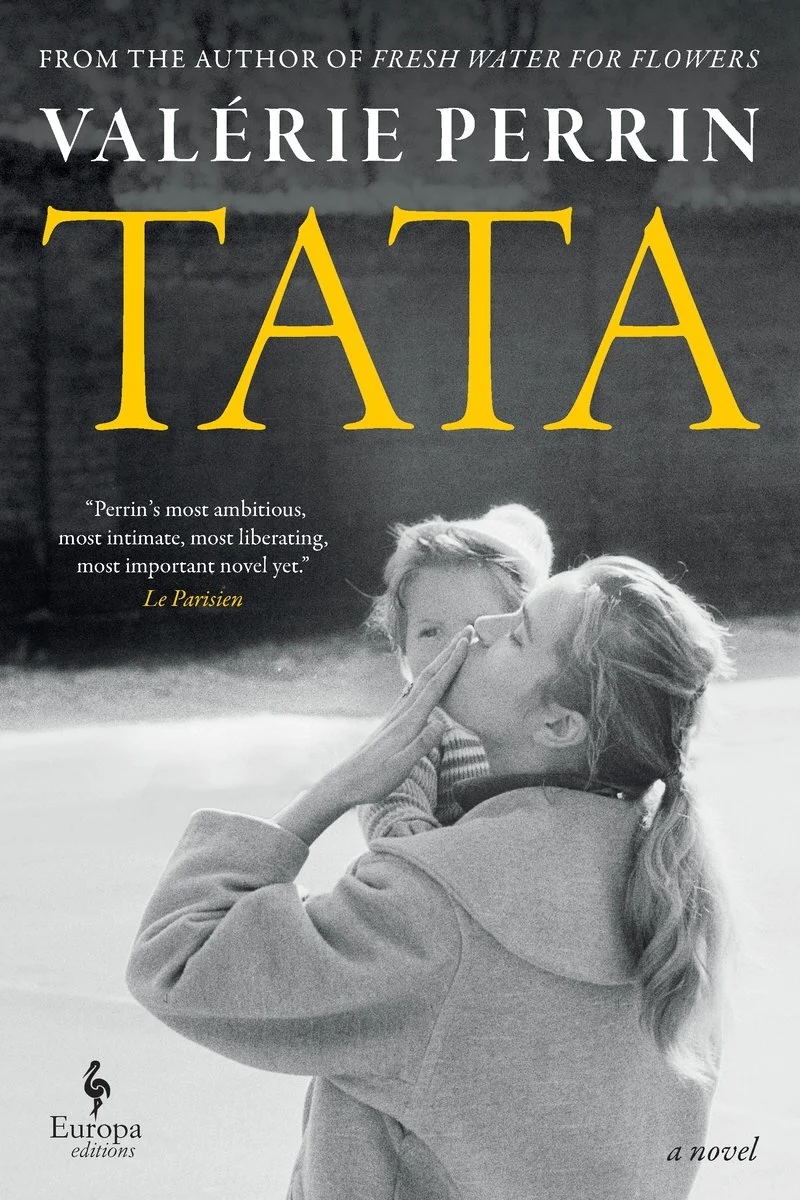
From Tata by Valérie Perrin, translated by Hildegarde Serle. Used with permission of the publisher, Europa Editions. Copyright © 2026.