Scott Anderson on the Iranian Revolution
In Conversation with Whitney Terrell and Jennifer Maritza McCauley on Fiction/Non/Fiction
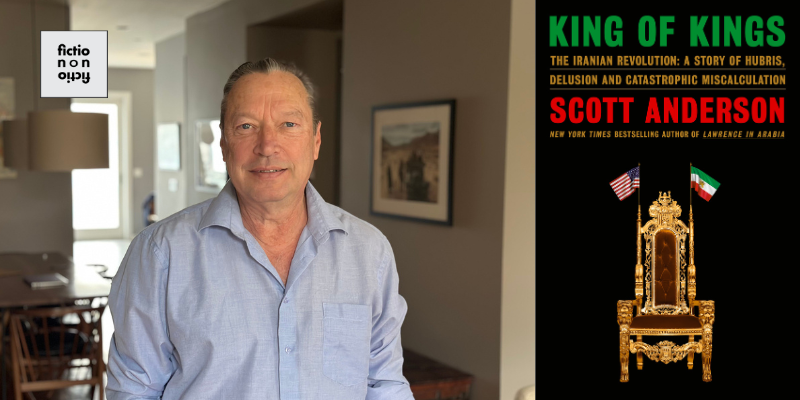
Veteran war correspondent and Kirkus Prize winner Scott Anderson joins co-hosts Whitney Terrell and Jennifer Maritza McCauley to discuss his new nonfiction book King of Kings, a history of the Iranian Revolution. Anderson examines how rapid modernization, inequality, and U.S. influence destabilized Iran, and traces the rise of Ruhollah Khomeini from exiled cleric to revolutionary leader. The conversation explores key mistakes by the Shah, the failures of U.S. intelligence, and how the revolution unfolded in unpredictable ways. Anderson also connects this history to present-day tensions, discussing Iran’s current power structure under Ali Khamenei and the global rise of religious nationalism. Finally, the hosts consider parallels between the Shah’s rule and contemporary political leadership, as well as the limits of American military strategy in the region. Anderson reads from King of Kings.
To hear the full episode, subscribe through iTunes, Google Play, Stitcher, Spotify, or your favorite podcast app (include the forward slashes when searching). You can also listen by streaming from the player below. Check out video versions of our interviews on the Fiction/Non/Fiction Instagram account, the Fiction/Non/Fiction YouTube Channel, and our show website: https://www.fnfpodcast.net/ This podcast is produced by Jennifer Maritza McCauley, V.V. Ganeshananthan and Whitney Terrell.
King of Kings • Lawrence in Arabia
Others
Mohammad Reza Shah Pahlavi • Ruhollah Khomeini • Ali Khamenei • Iran hostage crisis • OPEC • Strait of Hormuz
EXCERPT FROM A CONVERSATION WITH SCOTT ANDERSON
Whitney Terrell: Let’s shift to Khomeini. You give an amazing account of an earlier encounter that an American, George Braswell, had with him. Maybe you could talk about that and just tell us who he was at this time prior to the revolution? Where did he come from? How did he get to his position?
Scott Anderson: So in the early 1960s, the Shah enacted what he called the White Revolution. It was this series of 19 reforms that he wanted to enact, and it was everything from reforestation to industrialization to agrarian reform. Almost all the land was in the hands of oligarchic families or in the hands of mosques, the mosque endowments, and at the emancipation of women, giving women the right to vote. Those two issues, in particular, women’s empowerment and agrarian reform, went over like a lead balloon with the archconservatives of the country, especially religious.
The man in 1963 who became the spokesman of the ultra right in the Iranian clergy was Ruhollah Khomeini. He was a seminary teacher in a provincial city outside of Tehran. What he was saying was so vituperative against the Shah, basically calling the Shah an infidel, that essentially in 1964 the Shah threw him into exile. So, he spent 14 years in exile in Iraq, and from Iraq, he was sending very fiery sermons calling for the Shah’s overthrow, and tape cassettes that were being smuggled back into Iran.
Getting to this guy, George Braswell, he was an amazing figure. He was a Southern Baptist proselytizer who in 1968 gets a job in the theology faculty at the University of Tehran. He’s the only American there, the only Christian there, and all the clergy in the theology department take a liking to him. One of his graduate students says, “Would you like to see a special type of sermon?” And George says, “Yeah, sure.” So this graduate student takes him to this cinder block mosque in the ghetto of southern Tehran, and it’s a bunch of young seminary students and mullahs that are like lower level priests, and they’re gathered around, and he hears this tape recorders playing, and it’s Khomeini, and he’s saying, “I need you to organize people to get ready, because a revolution is coming. We’re going to overthrow the infidel Shah.” This was in 1968 and Braswell said, “Well, I never heard of Khomeini, but I figured, of course, the American Embassy had. The CIA had a huge station. Surely they knew about this whole underground movement.” And as it turned out, wrong. They didn’t know anything about it.
WT: One thing that I also noticed about your book was that the CIA sucked during this time when it came to Iran. They were wrong about everything. Just a bunch of idiots.
SA: No, just unbelievable, and in fact, Khomeini’s name would not appear in either a CIA report or a cable out of the American Embassy for another seven years. 1975 was the first time official America took any note of Khomeini at all. And the CIA had one of its largest stations in the Middle East in Tehran. It did absolutely no domestic intelligence gathering at all. Instead, it got all of its domestic information from the Shah’s secret police, it was just handed to him. So, of course, everything was in support of the Shah.
Jennifer Maritza McCauley: So, one of the things I really connected to with your book is your strength in storytelling. Your book handles real individuals, whether they’re civilians, military figures or political insiders. So I was wondering if you could talk a little bit about the human cost of revolution and what the impact is on the individual.
SA: The strange thing with the Iranian Revolution is that usually with revolutions, there is this gradual building of intensity of violence, this escalation, until you reach a climax, and one side or the other wins out. The Iranian Revolution wasn’t like that at all. Instead, it kind of went in fits and starts over a 13-month period. There were periods when it looked like the Shah was going to be overthrown any moment, followed by really long periods when there was virtually no violence in the country. So, they lulled people into this idea that things weren’t serious. The Americans were horribly ill formed, especially this being such an important ally, but I think the bedrock idea of the Americans was “The Shah has the fifth largest army in the world. If he was in serious trouble, he would put the army out in the streets, kill a bunch of people and restore order. So the fact that he isn’t doing that must mean this is not a crisis.” Really up until a month before the Shah went into exile, President Carter was voicing his full support of him and that he’s going to survive.
The human cost is different, of course, for the Americans and for the Iranian people. This is not just the religious right, but Iranians across the spectrum. Iran was a very westernized, very progressive, well-educated country. I mentioned before, there were 50,000 students studying abroad. This was not North Korea. They knew what was happening in the world. I think for a lot of Iranians, initially, the idea of getting rid of this autocrat— he was no Saddam Hussein, he was not a brutal autocrat, though he was brutal enough— but after thirty-some odd years, they wanted a change. And also this idea that the Americans were in control of their destiny I think really worked on that too.
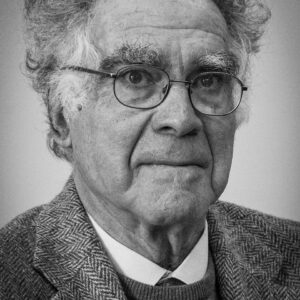
Transcribed by Otter.ai. Condensed and edited by Rebecca Kilroy. Photo of Scott Anderson by Nanette Burnstein.

Fiction Non Fiction
Hosted by Whitney Terrell and V.V. Ganeshananthan, Fiction/Non/Fiction interprets current events through the lens of literature, and features conversations with writers of all stripes, from novelists and poets to journalists and essayists.