Sarah L. Kaufman on Harnessing the Power of Verbs
How to Use Unusual Verbs to Create Fresh Images
This first appeared in Lit Hub’s Craft of Writing newsletter—sign up here.
How do we suggest the ineffable through actions and dynamic verbs? In the following exchange from The Sound and the Fury, William Faulkner wields the power of suggestion with extraordinary ease (and no punctuation). Minimal description, maximum heat. Quentin, the tormented young man who’s narrating the scene, is grilling
his sister, Caddy, about her boyfriend:
do you love him Caddy
do I what
she looked at me then everything emptied out of her eyes and they looked like the eyes
in the statues blank and unseeing and serene put your hand against my throat
she took my hand and held it flat against her throat
now say his name Dalton Ames
I felt the first surge of blood there it surged in strong accelerating beats
say it again…
her blood surged steadily beating and beating against my hand
Note that this intimate scene is all action. Emotions reveal themselves through actions but Faulkner leaves the emotions unnamed. Instead, he writes about what the conversation looks and feels like, how the characters behave, how their bodies respond. Readers’ imaginations supply whatever they want to supply: what their subconscious delivers, what their experience fills in.
In laying out his corporeal stepping stones, Faulkner leads us to our own discovery of Caddy’s and Quentin’s feelings. We perceive them through Quentin’s senses, through verbs that describe what he sees, hears, and feels. From his point of view, Caddy’s reactions are forceful, as in “everything emptied out of her eyes.” Emptied—what a surprising, visceral verb. More violent than spilled. Emptied feels like a sudden gushing whoosh, then nothingness. Her blood surged—also aggressive—“beating and beating against my hand”: more than a little erotic. Yes, Faulkner goes there, or rather, he suggests powerful, possibly incestuous feelings. Quentin’s view of Caddy’s reactions opens up his state of mind.
For another example of the interpretive and suggestive quality of verbs, let’s look at Patricia Highsmith’s The Two Faces of January. Highsmith’s domain is the psychological thriller; she’s best known for the novels Strangers on a Train and The Talented Mr. Ripley, which inspired the well‑known movies. Here, she takes us inside the minds and bodies of a con artist and his wife when a detective confronts them: “Chester’s heart stumbled… He looked at Colette and saw his own fear leap to her face…”
Stumbled: We read that and understand a heart wobbling in shock, an image that’s unexpected yet clear. What Chester sees in Colette suggests her fight‑or‑flight response to sudden danger, and the reader can supply the rest—the blood draining from Colette’s cheeks, perhaps, maybe a slight widening of her eyes. A lesser writer than Highsmith might have described the moment in those terms. But Highsmith hones the drama by putting us in Chester’s head. We see what he sees through the lens of his anxiety, with an intensified awareness, seeing the act of leaping—his perception, and Highsmith’s—in vacant, silent space.
What intense physical responses can you define with unusual but apt verbs, to suggest a fresh image?
You and I are Chester all day, every day, looking at life through our own lenses. Let’s say you and your friend see a person wearing a backpack and boots, approaching a trailhead. If anyone quizzed the two of you, you’d both say she’s a hiker, no question. But whether this person galumphed, ambled, or dragged herself up the trail is a matter of what subtleties her movement suggested to you. The verbs you’d use to describe the hiker’s actions might be different from your friend’s. They’d depend on how you gauged her effort and estimated her speed, what associations and memories her stride sparked in your mind.
Verbs mediate our experience; they link us to the world. In their vast variety, we have endless ways to express ourselves and understand our lives. Dynamic verbs aren’t only for bold moves, but for clues and implications, too.
To pack the Bud—oppose the Worm—
Obtain its right of Dew—
Adjust the Heat—elude the Wind—
Escape the prowling Bee
Great Nature not to disappoint
Awaiting Her that Day—
To be a Flower, is profound
Responsibility—
—Emily Dickinson, from “Bloom—is Result—to meet a Flower”
Dickinson emphasizes verbs throughout this poem (and her work in general). The theme would be quite different if she had written “fight the Worm / Grab its right of Dew.” Instead, her verbs oppose and obtain signal that this flower is practical and conscientious, as it must be to benefit its community. In suggesting a reasonable frame of mind, the poet hints at a model for us as well.
Verbs exist in so many shades of connotation, expressing subtle feelings along with their primary meaning. As a result, they can suggest a great deal.
This makes verbs interesting and a little dangerous.
Imagine this exchange:
“I was not snickering.”
“You were.”
“Giggling, maybe.”
“I distinctly heard you snicker.”
“The verb you want, love, is discerned. No adverb needed.”
“Snicker this.”
Snicker, giggle: There’s a slight difference in how those gurgly little eruptions sound coming out of someone’s mouth, but a big difference in intention—and how we perceive it. Describe that not‑quite‑laughing with the wrong word and risk fireworks, because with such an abundant array of verbs, we’re sensitive to their nuances.
Verbs can deliver the sass of a runway model and a good degree of brushoff. Snicker? Chortle? Smirk? So many options. Choose with care.
_____________________________________________
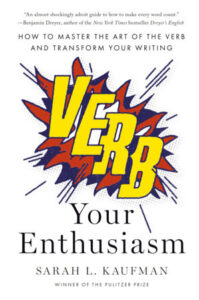
Excerpted from Verb Your Enthusiasm: How to Master the Art of the Verb and Transform Your Writing by Sarah L. Kaufman. Copyright © 2026 by Sarah L. Kaufman. Published with permission from Penguin Press.

Sarah L. Kaufman
Sarah L. Kaufman is a Pulitzer Prize–winning critic, an author, and a writing teacher. As The Washington Post‘s chief dance critic and senior arts reporter, she focused on the union of art and everyday living. Her work has also appeared in The Wall Street Journal, The New York Review of Books, and The Boston Globe. Her debut book, The Art of Grace, won the Barnes & Noble Discover Great New Writers Award. A former McGraw Professor of Writing at Princeton University, Kaufman has also taught at Harvard University, American University, and the National Critics Institute. She lives in Asheville, North Carolina.