Rebecca Lehmann on Anne Boleyn, Trump, and Treason
In Conversation with Whitney Terrell and V.V. Ganeshananthan on Fiction/Non/Fiction
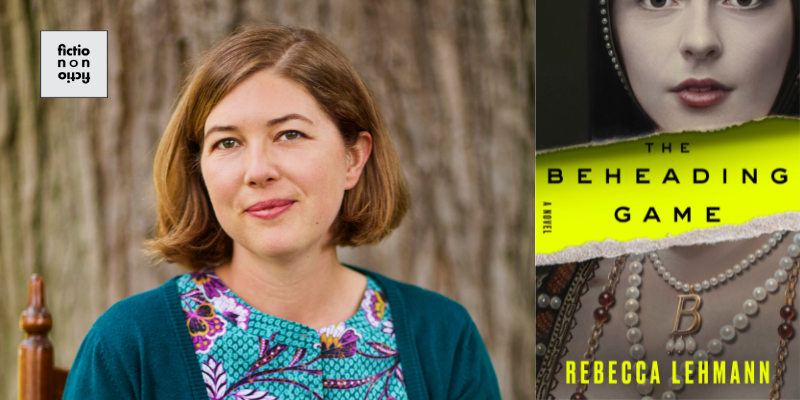
Writer Rebecca Lehmann joins co-hosts Whitney Terrell and V.V. Ganeshananthan to discuss her debut novel, The Beheading Game, a work of speculative historical fiction in which King Henry VIII’s second wife, the beheaded Queen of England Anne Boleyn, comes back to life after her wrongful execution, sews her head back on, and seeks revenge. Lehmann considers the contested history of Anne Boleyn, the outlandish accusations against her, and the ways in which her image has been erased and changed over time. She outlines the reasoning behind her portrayal of Anne, explaining how it was born out of a mix of historical fact and modern perspectives. Lehmann discusses Anne’s often forgotten role as mother to Queen Elizabeth I and how that may have shaped her motives as a queen and a politician. Lehmann also talks about similarities between the chaotic courts and allegedly treasonous advisors of Henry VIII and President Trump and the importance of scapegoats in consolidating political power. She reads from The Beheading Game.
To hear the full episode, subscribe through iTunes, Google Play, Stitcher, Spotify, or your favorite podcast app (include the forward slashes when searching). You can also listen by streaming from the player below. Check out video versions of our interviews on the Fiction/Non/Fiction Instagram account, the Fiction/Non/Fiction YouTube Channel, and our show website: https://www.fnfpodcast.net/ This podcast is produced by Jennifer Maritza McCauley, V.V. Ganeshananthan and Whitney Terrell.
The Beheading Game • The Sweating Sickness • Ringer • Between the Crackups
Others
Sir Gawain and the Green Knight
EXCERPT FROM A CONVERSATION WITH REBECCA LEHMANN
Whitney Terrell: So, it didn’t happen that she sewed her head back on.
Rebecca Lehmann: Sadly, no.
V.V. Ganeshananthan: This is how you guys break it to me.
RL: I really wish I could have written that into being, but, try as I might, it did not actually happen.
WT: But it’s an interesting way of rethinking the story. I wondered if there are other fantastical aspects of the story, and if you could talk about those, and what led you to that original decision? I mean, obviously, the book can’t happen without that.
RL: I knew I wanted to write a novel that dove into Anne Boleyn’s story in more detail, and that tried to give her an ending that I felt was more deserved, a different end than the one she had, which just seemed so blatantly unjust. I thought a lot about different ways to do that: I could have had her escape the tower before she’s executed, or she had a couple different proposals come in while Henry was courting her, she could have married one of those men. I thought about setting the story forward in time, and having her have access to more resources, but ultimately, I decided that I wanted to keep the beheading in the story, because one of the things that really resonates about Anne Boleyn across 500 years of history is she’s an example of this woman who was really intelligent, and had this really meteoric rise in power, and ascended to a certain height, and then was brutally punished by a patriarchal system for that power. The beheading is this crystallization of state-sponsored patriarchy that comes for Anne Boleyn. I didn’t want to take that out and defang the beast, because I think that that’s something that people, and particularly women, recognize, even today in the story of Anne Boleyn. Thankfully, we’re not still seeing women in the UK being beheaded for being too powerful, but we could all think of some modern parallels of women that ascend to a certain level of power, and then have these really steep and precipitous falls.
So, I wanted to keep it in, and I thought about how to do that, and there’s a long tradition of what are called head carrier stories, where characters are beheaded and then continue living afterwards. The one that is referenced by the title of The Beheading Game and in the novel is the story of Gawain and the Green Knight from Arthurian Legend, where this magical green knight shows up, and Gawain, the young upstart knight, beheads him, and then the green knight picks up his head and walks off in an enchanted way. There’s also the legend of Sleepy Hollow in North America. Or there’s a whole line of what are called, cephalophore saint stories where saints are beheaded, mid-sermon, usually, and then they pick up the head, and the head keeps preaching a lot of the time. So, I just thought why can’t Anne Boleyn do that? And I could not stop thinking about the idea once it crossed my mind.
So I sat down and wrote the first chapter, and I thought this could work, but she has her head off. I got it back on her pretty quickly because I was really worried, when I was writing it, it was a lot to try to write a character whose head is held in their hands in front of them, just from a narrative perspective, you have to mention every time they’re looking at something, they have to physically turn the head. Even though I was in total control as the author of this book, I was very worried that she was going to drop her head in the river, as the story was going on. So I was happy when she sewed it back on and kept going. But like I said, it’s never really explained in the novel, and there are some other enchanted magical realism-ish elements that pop up throughout The Beheading Game.Without giving too much away, there are a couple of moments as the book goes on that seem like, “Are they magic? Are they just a great coincidence?” And there’s another kind of fantastical thing that happens to Anne at the conclusion of the book.
VVG: So, as we can hear in your answers, you did a massive amount of research. There’s the bear baiting. I remember you planning your trips to England.
RL: I remember texting you about that to see if you had any tips for places to go when I was not touring Tudor sites.
VVG: I learned a lot about England from your trips there, and your questions where I was like, “I have no idea.” So, even these magical elements that are not realistic are informed by the research. We’re taping, I should say, listeners, on Friday, May 8th, and Sunday is Mother’s Day. One of the threads in this book is Anne wanting to keep Elizabeth safe, as we hear in the passage. Can you talk about how motherhood drives this narrative?
RL: So Anne’s goal of getting to Henry in the novel, is that she wants to get to him before he can marry Jane Seymour, and kill him before he can produce a rival heir. In real life, Henry VII marries Jane Seymour 11 days after Anne Boleyn’s execution, and they announce their engagement the next day. He had been engaged in a months-long chaste affair with Jane Seymour that Anne was aware of and angry about. If you didn’t already think that the charges were false, that’s some pretty damning evidence that this man may have been full of shit. He’s got the next wife lined up in the wings as he’s executing wife number two. But I really wanted to think about Anne as a mother, so her motivation in trying to get to Henry is that she wants to protect Elizabeth’s claim to the throne.
The fact that Anne Boleyn was a mother and was the mother to Queen Elizabeth often drops out of her story and almost becomes a little footnote, because it doesn’t gel with the idea that a lot of people have of Anne Boleyn as this promiscuous person, which is not even a factually-based assumption about her, but nonetheless, people struggle to reconcile those two things. I don’t know where they think babies come from, but she was a mother, and she was a really devoted mother to her daughter, and I wanted to think about that in The Beheading Game.
In the same way, I think that Anne Boleyn drops out of Elizabeth I’s story as well, or becomes this little footnote. Elizabeth I becomes queen after both of her siblings have been crowned monarch and passed away, and she’s entering into this dicey political time where she can’t really be like, “Yeah, my dad was a real jerk who executed my mom, and I think my mom was probably right.” She has to kind of keep her love for her mother secret, but there is a lot of evidence that Elizabeth was really interested in Anne Boleyn. For example, she wore this locket ring throughout her life that had a portrait of herself on one side and a portrait of her mother on the other side, which I found to be a really touching detail. So I knew I wanted to pull in this thread of motherhood.
Like all royalty in England at the time, Elizabeth was separated from her parents when she was a baby. This was a customary thing that would happen in royal families. So she’s taken away, and given her own household when she’s 3 or 4 months old. Anne and Henry got updates on her, but Anne was very concerned with her. One detail that I found really heartbreaking when I was researching for the book is that one of the last things that Anne Boleyn did when she was in the Tower of London awaiting her trial was to order clothing for her daughter for the coming seasons. As a parent myself, I found that to be such a relatable detail. I’m not royalty and it’s 500 years later, but I still worry about whether my kids are going to have the right size shoe, or enough shorts for summer, or if I buy them uniform pants, will they have enough to make it through the school year?
It spoke to how, for Anne Boleyn, probably the last thing that she was thinking about when she stepped up to that scaffold was her daughter, Elizabeth. This is part of the reason, for example, that her execution speech is not a giant rail against Henry VII. It’s a fairly compliant execution speech. She doesn’t admit to any wrongdoing, but she also says something about Henry. She hopes that he lives a long time, and that he’s been a just and kind monarch to her, which, of course is just not true, but she’s really trying to butter him up so that he doesn’t pass Elizabeth over after her death.
Transcribed by Otter.ai. Condensed and edited by Rebecca Kilroy. Photo of Rebecca Lehmann by Andrea D’Agosto.

Fiction Non Fiction
Hosted by Whitney Terrell and V.V. Ganeshananthan, Fiction/Non/Fiction interprets current events through the lens of literature, and features conversations with writers of all stripes, from novelists and poets to journalists and essayists.