Read the Winners of American Short Fiction’s 2026 Insider Prize
Selected by Elizabeth McCracken
Writing is a challenge, at every level. There are constant pressures acting upon a writer: juggling between responsibilities and work; prioritizing health; making and somehow slowing down time; even, perhaps, the arresting, infinite possibilities of the page. Not to mention, all the subconscious terrain, where one wrestles with memory, vulnerability, and presence.
And yet—
These five pieces, selected as the winners by novelist and short story writer Elizabeth McCracken for the 2026 Insider Prize, are awe-inspiring depictions of fortitude, honesty, and the power of narrative—all written under the difficult circumstances found within the carceral system.
Take, for example, Charles Hill’s winning story, “Prisoner’s Home”: where a protagonist returns after serving a lengthy sentence and struggles to adjust to societal conditions. Hill expresses, in earnest, the fears of being seen in public spaces, such as a grocery store, hounded by personal questions—an all-too relatable scenario, regardless of one’s background. (In an interesting turn of events, Charles Hill was discharged sometime after submitting for the prize; his whereabouts are currently unknown. Here’s hoping his personal odyssey leads him to safe harbors.) And Brian Steven’s runner-up story, “A Hairy Tale,” follows a character desperately seeking to rid his cell from his celly’s hair with vivid use of detail and a suspenseful ending.
Deanna Carney’s winning essay, “Sit. Stay.,” recounts heartbreaking events from childhood to parenthood, marked by the various pets that provided comfort in those moments. With prose akin to poetry, she delves into the layers of trauma and finds a way out through healing and support. (A notable event, too: Deanna will be released on parole in late September 2026.) And in a first for the Insider Prize, there are two runners-up in nonfiction, with thought-provoking insights of the system and a portrayal of yearning to reunite with family; Matthew Mendoza’s “Zen and the Art of Civil Commitment” reaches emotional depths through powerful reflections in search of redemption, while Steven Perez’s “Aunt Terry and Josiah King” transports the reader inside his bunker where he makes a call to his dying aunt.
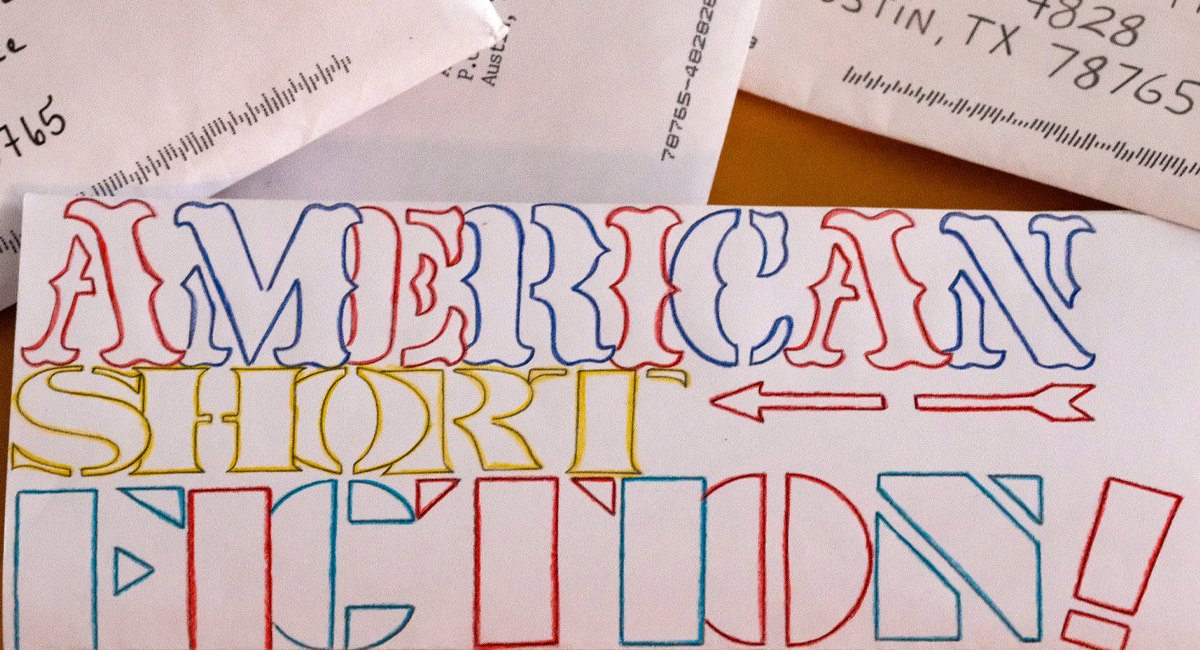
Each submission received for the prize—handwritten or typed out, then mailed in thick, delicate envelopes—examined the human condition through a diverse lens: the lack of justice, oppressive Texas heat in harsh living conditions, violence suffered by transgender women, and the struggle with addiction. Most moving, above all, are the correspondences with the writers themselves who reach out at their own expense—quite literally. A message to touch base and say hello, an eager inquiry on the next open window for the contest, a half-torn, crumbled page from someone asking for writing resources in penciled scribbles. I can only imagine, through slivers of their reality depicted in their pieces, the limited spaces and time allotted; it serves us well to keep in mind the effort and length incarcerated writers undertake for the chance of expression and connection.
With much gratitude from our Insider Prize Assistant Editors, our partners at Lit Hub and Huston-Tillotson University, and everyone at American Short Fiction, I hope these remarkable stories serve as beacons for hope, forgiveness, and redemption. A pause to reflect and a reminder of our privileges, the responsibility to uplift marginalized voices, and the opportunity to meet ourselves on the page—and each other—with the same strength, humility, and grace.
–Sergio Muro, Insider Prize Director
*
First place, Fiction:
Charles Hill, “Prisoner’s Home”
“Prisoner’s Home,” by Charles Hill, follows a young man in the months after his release from prison, as he discovers that the features of his incarceration—the fights he’s been in, the lies he’s told, the way he’s tried to make himself invulnerable—all follow him home. His given name is Chris, but in prison he calls himself “Crazy.” This complicated and heartfelt story is about how the lies you tell yourself about who you are will change you, but never in the way you hope: what you hope will save you might doom you instead.
–Elizabeth McCracken
Prisoner’s Home
by Charles Hill
Chris went to prison at the young age of nineteen—he was in his second year of college. Photos of Chris on social media show him hunting, drinking, and dancing: all the things his parents never had the opportunity to do.
Prison turned Chris into a liar. After prison, even he couldn’t accept the truth: he had learned to hate freedom and lied about loving home.
***
His American Dream was going well, until one night at a party.
“Hey girl, what’s your name?”
Chris stood up and placed a hand between his girl and the kid who approached her. “Buzz off, buddy. She’s not interested,” Chris said.
The kid stepped back, raising both hands in defense. “Woooow bro, I’m just here to party.” He gave a shitty grin, then glanced at his buddies behind him.
Chris lowered his hand.
“So, girl: are you going to stay with the lame Captain Save-a-Ho or come with big daddy?”
Chris dashed the kid with his drink and swung furiously; he caught him in the jaw with a second swing, the kid dropping like a wet noodle. Two bodyguards turned and walked off. But Chris wasn’t done: he dropped to one knee and pounded the kid’s face. Blow after blow, Chris saw red. He didn’t feel the soft hand or long blond hair rest on the back of his neck or hear the sweet voice crying, “Stop, Chris. Please. Stop.”
Smash, smash, smash.
Someone hit Chris over the head, and the next thing he could remember was a bright white LED shining into his eyes.
“Yep, he’s up now. Drag him to the car,” a cop said.
***
The county jail was a new experience for Chris to say the least, a new one that would last for years. He was charged with aggravated assault; that didn’t stop him from telling everyone he was in for murder. The first thing Chris did was invent a tough sobriquet. Crazy was what he went by now.
Three months later, the DA offered him fifteen years. Everyone on the pod said fifteen was good for murder, so he signed for it.
***
The photos of Crazy that his mom collected were only from visitation. In the first few, Crazy was heavy with weight (which he said gave him more power in his punch) and discolored eyes (which he said was from all the fights he won). This one was a broken nose. This one he had his arm in a cast. The rest are full of deep, deep depression (which he said was from homesick fever).
“Why are all the backgrounds so different?” Susan, Chris’s sister, asked.
“Oh, he has been in so many units: Garza West, Garza East, Beto, Connley, Alred, Coffield, Michaels,” Mom said.
“What for?” Susan asked.
“Heaven knows, Chris’s always said he got into fights but couldn’t talk about them.”
Crazy never told the same story twice. He was all you could be at any given day and had the tattoos to prove it: Crazy’s arms and back were covered with hook tattoos that had thick black lines, pepper shading, and tons of skulls—he even had the state of Texas on his neck.
***
The last two weeks before Crazy was released on parole, he gathered all the personal information of fellow inmates he could. With a smile and a hug, he told them he would keep in touch. Crazy even told all his close friends he was going to send them money to buy snacks. But the last two days, his pretentious promises ate at his insides; he hovered over the toilet all night puking the pork noodle casserole. He puked so much, it seemed like he had puked all the casserole trays he had ever eaten in the past decade—which is a lot of pork noodle. The truth was he wasn’t ready to leave. He had never prepared to leave. But Crazy was never going to tell that.
Crazy wore ‘70s throwback Salvation Army clothes and stood at the last gate between him and freedom, the closest he had been in ten years. The air was fresher, the sky was baby blue and deep with no clouds. The trees played music with the wind as it sifted through their branches.
He exhaled. “Okay, okay, okay,” he whispered, squeezing his hand and looking down at the scars over his knuckle.
“Gate!” an officer behind him yelled.
Crazy’s body shrunk hearing the voice. Did I do something wrong? Are they going to let me go?
Click. The door popped open, and the gate swung out with a creak.
“Go on boy. Ain’t gonna shoot you. You’re free,” the office said, giving him a shove.
Crazy’s right leg stepped on the uneven concrete; for a moment, he felt like Armstrong. One small step for man. His mind reeled like a movie: steps, hugs and kisses from Mom and sis. Breathe. Sit in the car. Breathe. Soft seat, gone. Breathe, gone. Out of sight. Breathe.
The piny woods swallowed the red bricks surrounded by spirals of razor wire and fence. He felt like his heart was plucked from his chest.
***
“Oh, Chris, wait until we get you something to eat,” Mom squawked. His dad said nothing. Susan said nothing. Crazy said nothing.
“Chris, quit looking back,” Mom said with a sap smile.
“Huh? Oh, okay.” Breathe, Crazy thought.
The first five years in prison, all Crazy wanted was a homecoming party, but the last five years, he didn’t want anything.
“Well, here we are. We’re home! Come on, Chris. No one’s here. Just you, Susan, me, and Dad,” Mom said.
Crazy sat on the swing under the oak tree: no party, no friends, just family. The only people who reached out to him the entire ten years. Nothing was the same. The house was painted brown. All the bikes were rusted, and everyone’s vehicles were new. But it was just like he liked it, he told himself. He sat on the swing until the sun went down, alone, just like he wanted.
Dinner decked the table: golden buttery mashed potatoes, roast beef with draining juices seeping out the sides, greens with chunks of soggy bacon gasping for air.
“Just like you always liked it, after a big Friday night game,” Mom said.
“Just like I liked it. Thanks, Mom.” Crazy slapped a heap of potatoes on his plate.
Dad forked a bite of roast beef, eyed it, then shoved it in his mouth.
His sister stared at Crazy with amazement. “Chris, now that there’s no one listening to the phone calls, tell us some real stories.” Susan’s eyes beamed.
The potatoes on Crazy’s spoon, once golden butter, turned to prison-styled potatoes: rotten with black spots and brown potato skins. He dropped the spoon, stopped chewing.
The clock on the wall clicked its small, plastic hands. A small, black radio in the living room, just over a whisper, played a George Strait song.
“The real story . . . you see, well I . . .” Crazy stopped to wipe the water in his eyes.
“Oh Chris, it’s okay. Tell us another time, honey,” Mom said.
“Yeah. Susan, you can’t ask big questions like that. That answer’s going to take weeks to tell,” Crazy said.
“Okay, do you have a good fight story?” Susan probed.
“Which one?” Crazy wiped his forehead, then trailed his finger over the scar above his eyebrow.
“You got more than one?” She leaned over her plate.
“What, do you think it’s a walk down a church pew? Everyone’s a criminal.”
Dinner floated by with vapid comments around the meal and eventually died out.
***
After dinner, Crazy laid down in his own bed and was transported to another time: one he no longer recognized—the time every minute was precious. The bed felt soft, softer than it had ever felt. Time ticked up to twelve, then started down. In the dark, Crazy couldn’t tell if his eyes were open or closed. His mind ran the perimeter of the room, visualizing the window, door, walls, and photos. Silence rang in his ears, listening to himself breathe. Blood streamed through his veins, pulsing inside him, like a ticking time bomb. The bed turned stiff and hard; he felt uncomfortable, alienated.
A dream haunted him: Somebody, somewhere, chasing him. Room after room, he slammed the doors behind him for safety, but the doors were never the right size to fit the frame; they were smaller, half the size. Run, run, run. Twisting in blank abandoned rooms like a maze with no end, but no time to stop. No time to rest.
“Chris!”
“Huh? Yeah?” Crazy said.
“Get up. Coffee’s ready,” Dad said.
“Yeah.” Crazy ran his hands over his face, trying to relax. “I’ll be out in a minute.” He rolled out of bed and shuffled to the porch.
“Black?” Dad asked, rocking back on a wooden chair.
“Yeah, that’s all I drink anymore.”
“That’s good,” he said, handing Crazy the other cup on the coffee table. “It’ll put hair on your chest.” Dad smiled and slurped the top of his cup.
“When I worked in the fields, I used to watch the sun come up like this,” Crazy said.
“Fields?”
“Hoe squad. Fields. It’s the worst job. The same job as slaves in America: picking vegetables and cutting grass with a hoe,” Crazy said.
“Sounds like a good job for youngsters trying to knock the edge off.”
“You would think, but that’s where I got into my first fight.”
“Ahh? You win?” Dad leaned in, staring at Crazy.
“Yeah, well almost. But winning’s not always a win because both of you lose—and a loss is a win. So, a fight is a win-win or a loss. Out of the hundred and five fights I’ve had, I’ve never lost one.”
“Son, I don’t think you woke up yet.” Dad glanced down at Crazy’s cup.
Crazy looked out at the sheen of the dew covering the grass. “The grass is what started it,” Crazy said in a daze. “The lead row said I wasn’t cleaning my row.” Crazy trailed off, searching the vast blue sky. “Then, he called me a white boy. That was when Krooked Kracker elbowed me and threw a shoulder up.” Crazy swallowed. “That’s when I knew I had to. So, I yelled back, ‘You’re a boy, boy.’ They all stopped rocking after that. Well, the black ones. They threw down their aggies.” Crazy sat the cup on the table. “I got two swings in. He got me in the eye. I hit the dirt and got pepper sprayed. Then, the lieutenant fired his pistol.” Crazy tapped his fingers on his leg. “I never missed a blade of grass after that or wasn’t called out on it.” Crazy picked up the cold coffee and swallowed a big gulp. “I never missed a blade of grass. Never.”
Dad sat his cup down, stood up to leave, then said, “It was better the last time you told me that story.”
Crazy watched Dad’s car head to work until it faded into the horizon. His phone buzzed. His thumbs fumbled with the touchscreen. “Damn screen, where’s the buttons at?” Twenty minutes later, he texted Nathan back: Yeah, come over, bro. I’m at the house chillin.
***
When Nathan arrived, he walked up the porch and gave Crazy a big homecoming hug. Crazy couldn’t keep his eyes from watering; he wasn’t sure if it was the hug or compassion. They sat on the porch with a round of fresh coffee.
“Yeah, prison is like a fight club: the more time you do, the better you get,” Crazy said.
“So, you ever get your ass whooped?” Nathan asked.
“Hell no. I never lost a fight.” Crazy’s hand shook, sipping the lies down with black gold.
“I remember this one time, I sold a watch and the guy said, ‘Oh, you’re jacked.’ That’s when I stole off on him,” Crazy said.
“Stole off?”
“I hit him in the mouth, took his tooth out with that punch. Took my watch and the black bag he had.”
“Black bag?”
“Instant coffee. It’s trash, really. After that, they shipped me. The law said I was a danger.” Crazy pulled air through his teeth. “How many fights have you been in out here?”
“Uhh,” Nathan blushed. “None. No one fights out here.”
“Oh,” Crazy relaxed. “No one fights?”
“If you fight at work, you’re fired.”
“No fights? What happens if someone disrespects you? You know, calls you out of your name?”
“Uhh, you, well, they don’t.” Nathan cast his eyes down to his phone. “Well, I’ve got to go, Chris. Got to pick the kids up.”
“Oh yeah. Don’t you have a son?”
“I got three. They all popped out a year apart. The oldest is in third grade.”
Crazy looked at Nathan’s young face, wondering if he looked like a father.
***
The next three months, Crazy stayed in his room. He was stuck on TikTok and YouTube, looking up prison stories: gangs, fights, horrors, and testimonies. Prison, prison, prison. He learned more about prison than a prisoner knew. He learned so much, he felt it built up on him, pushing him to a new standard: super penitentiary.
“Super penitentiary, yeah,” Crazy said out loud.
Crazy was confined to his room. He didn’t like the feeling of opening doors; when he did, he closed them quickly. The only time he left the house was on foot to visit the local HEB. He pushed an empty cart. He loved to admire the flashy, plastic logos, different varieties of chips, and junk food. As soon as he passed another shopper, he stiffened and furled his eyebrows. Crazy looked into shoppers’ eyes like he was going to say: What? Say something.
But he was scared—scared of the questions they would ask about his tattoos. He knew they knew. He felt everyone knew he was fresh out.
Crazy hated seeing fellow convicts. He could spot them easily: the way they walked and the black ink on their body. He always quickened his pace and gave a strong nod. His body turned into a robotic character on a mission to some important place—which was never the case for Crazy—but he felt the need to lie with his body. The most terrifying conversation Crazy could think of was the one where he was working, how he was adjusting, because truthfully, he was tired of lying.
***
One day, Crazy sat at the dinner table eating a bowl of Top Ramen noodle soup.
“Chris, you know it’s May?” Mom said.
“May?” Chris slurped noodles.
“The summer is coming. You know how much work goes on in the summer?”
“Yeah, and it’s hot.”
“Chris, it’s been six months. It’s been long enough. Your father told me to tell you to take his truck out.”
“Drive his truck?! The Silverado? That thing is big.”
“Don’t start with me! It’s the same size as your old truck,” Mom said.
“I never had a truck. I’ve never had a job.” Crazy picked the bowl up and chugged down the salty, yellow sludge. “They want to see past work history. I ain’t got any.”
“Chris, honey. You can’t get history if you don’t get a job.”
“The jobs are history. Didn’t you see what the news said about AI?! It’s going to take all our jobs!”
Mom grabbed the rag on the table and wiped the clean corner, dumped the rag in the sink, then turned to Crazy. “The keys are on the hook.”
Crazy grabbed the keys, got in the truck, and headed down the road. The pressure of doing something for the first time compounded. Every lie Crazy told about the job he had in the past rattled in his head, like bouncing marbles. Crazy was so used to doing nothing; the thought of doing anything triggered his fight or flight. Job, car, housing, insurance, bills, wife, kids: all equaled responsibility. Life was too complicated for Crazy. He couldn’t lie himself out of this one, so he did the only thing he knew would bring him home.
***
Main Street was as dead as it had always been, but the courthouse was busy as a beehive swarming with squad cars. Crazy locked eyes on a trooper as he rolled through the four way. The light turned green. Crazy froze. His heart leaped inside his chest.
The cop stared at him and the front license plate. Crazy stomped on the gas, burning the back tires.
Lights flickered, red and blue. The chase only took ten minutes.
Crazy jumped out before parking the truck and laid down on the soft asphalt. He grinned when the cold handcuffs clicked around his wrists. He laughed when the cop screamed at him to answer the questions. Crazy relaxed when he sat on the hard plastic backseat; he felt free looking through the metal bars lining the windows. The plexiglass in front of him had scratches that appeared random until he looked closer. He could make out the words: super penitentiary.
“Well, Superman, you’re headed back to the pen,” the cop said.
***
Crazy sat on a rusted, circular stool in a cold hard cell. He flipped open a copy of The Odyssey. The question dawned on him: Could a warrior ever return home?
*
Runner-up, Fiction:
Brian Stevens, “A Hairy Tale”
“The hair was another animal entirely.” Funny, dark, surreal, and completely surprising: “A Hairy Tale” by Brian Stevens follows the weird life of the narrator’s cellmate’s hair. It is also deeply strange, in the best possible way.
–Elizabeth McCracken
A Hairy Tale
by Brian Stevens
My celly’s hair is a nightmare. The stuff just goes everywhere. Every morning, my first chore is to wipe all his hair off the floor. I clean the cell to no avail.
***
Ants occupied the cell when I first arrived. They crawled in through the cracks and marched along the walls. Any food or flesh that crossed their paths was quickly devoured. Their bites would leave itchy red welts on my hands and feet. I fought them tooth and nail with everything I had: baby powder, soap, shampoo, laundry detergent, bleach. I was able to slow them down; as summer ended, the weather cooled and they eventually went away. Then, only the hair remained.
***
The hair was another animal together, but unlike the ants, it could not be contained. The fans in the cell created tornadoes of tangles that clung to anything they touched. There was hair on my bed; my clothes; in my mouth and nose; my coffee when I took a drink; and the drain when I used the sink. Hair came back around, got stuck in the fans, and when I rinsed my washcloth, hair stuck to my hands. The hair began to take on a life of its own: no matter how much I cleaned, I was never alone.
The hairs were long, black, and curly like the pubes of a buffalo. Bundles of them would roll across the ground like tumbleweeds blowing in the wind of the Wild West. Sometimes, I would mistake a stray strand for a cockroach as it scurried from one side of the cell to the other. Hairs strung along the shelves like broken spiderwebs in abandoned basements. The black hairs were bad, but the white ones were worse: they were invisible to the naked eye and could hide in plain sight. They were ghosts of dead hairs past that would continue to haunt me for eternity. Something drastic had to be done.
***
No ordinary razor would ever be able to chop down that forest of frizz. I searched for some scissors but had to settle for a shank—a dirty guy named Sanchez sold it to me for six soups and seven shots of coffee. He told me it was so sharp, it could slit a pig’s throat with a single slice. I took his word and kept it carefully wrapped in a johnny sack. I certainly did not want to get caught with such a serious piece of contraband, so I had to act soon.
That night, I asked my celly to cut his hair; he refused. He knew it made a mess everyday but didn’t seem very concerned about cleaning it up. He was also deeply religious and claimed his hair gave him strength like Samson.
As he drank himself to sleep, I thought about cutting some of his hair but then decided it all needed to be shaved. Upon further inspection, I realized: even with a shaved head, his hair would still grow back, and that would never do. No, his whole head would have to come off.
*
First place, Nonfiction:
Deanna Carney, “Sit. Stay.”
In a few short pages, Deanna Carney’s wonderfully written “Sit. Stay.” manages to look at a whole life and contemplates death and love and no less than the nature of time, all through the animals that the narrator has known since childhood. It is full of beauty and sadness and the paradox of loving animals when the human world is too much.
–Elizabeth McCracken
Sit. Stay.
by Deanna Carney
Seven cats shared our cramped apartment in Virginia.
Family lore fills in false memories: a pungent cloud of clumped kitty litter, discarded beer bottles, marijuana, my soiled diapers.
Did my biological father’s heroin addiction have a smell?
***
A tomcat, Rocky, was the most beloved; his memory enshrined in poetry I inherited two decades later, after my father’s heroin overdose. In hindsight, the name seems to be a foreshadowing.
I had to be younger than two. Momma hadn’t yet escaped quickly to Texas, her skin a carry-on bag full of storm-hued bruises. She hadn’t been ejected from the seat and flown through the windshield of a car. She hadn’t died, leaving my father with nothing more than memories and cats.
***
In Texas, my Nannie and her new husband fed, clothed, and put me to bed after Momma died. Well, they must have, because I survived. And there was no one else to do it; at least, no one wanted to, as Nannie would later frequently remind me.
Someone gave me a puppy: a pile of ebony fluff we named Blackie. He stayed in the add-on room that housed the water softener. While he bathed me in the perfume of puppy breath, I licked fallen rock salt pellets meant to condition the hard Hill Country water running through pipes beneath our single-wide trailer.
One day, while I dipped my fingers in a bucket of sudsy water Nannie was using to wash our little brown truck, my puppy ran away. I cried all the salt from my body as Nannie and I called out for him, our two-person search party scouting the neighborhood in vain.
I had to be younger than four—I still slept in the room that I used to share with Momma; my toys were still in the closet where her clothes used to be.
***
I wore a dress and socks with lace the day Nannie and her husband became my new mom and dad. The man behind the desk, making it legal, seemed much like the Wizard of Oz. We went to a lot, picked out a double-wide that had a bowl of fake fruit displayed in the kitchen.
Dad brought me a dachshund the color of a dried bloodstain—his name was Mister. Barrel-bodied and surefooted, Mister was not adorably mini-sized: at the end of a leash, he may as well have been a trained sled dog. Any attempt to walk him ended with me dragged across the asphalt behind his drumstick legs.
Unable to bear my tears, Dad rehomed Mister. I begged for a sibling. Instead, Mom and I went to pick out a puppy from an apricot-colored patch of poodles. I named him Danny Boy, undoubtedly under Mom’s influence. Many nights, I carried Danny Boy to bed with me, only to wake up and find him in Mom’s room. From day one, that dog was decidedly hers.
I must have been younger than five. I hadn’t graduated from kindergarten yet. Dad hadn’t been crushed behind the steering wheel of an eighteen-wheeler. Mom hadn’t gone to a hospital in Missouri and returned without him. Loving her hadn’t become painful. Years passed between us alone in that house. Silence, anger, tears.
***
Walking home from the bus stop one fall afternoon, I heard a kitten’s pleading cry beneath a garbage can. I took him home; bathed his long tabby fur; begged to keep him; and named him Tigea. Eventually, I taught him to walk on a leash.
I was younger than fifteen. I hadn’t found out I was pregnant. I hadn’t run away with my much older boyfriend. I hadn’t felt fear and bravery swirl inside me. I wasn’t yet married. I wasn’t yet an adult.
***
We found a German shepherd mix with floppy ears and named him Bogie: where our first daughter was born. In the next five years, we had a second daughter; then, a son. I had never known love as deep as what my heart held for them. Life was giggles and tiny toes.
I was younger than twenty-one. I was still able to kiss my children before bed, every night. My heart still knew happiness. I wasn’t yet divorced. My children weren’t kept from me. I hadn’t begun drinking.
***
At a gas station, I was offered a tiny red pup: the last of a litter, the runt no one wanted. I named her Lexi.
I taught her to sit, shake, and lay down. We went to parks and swam in rivers. I curled on the floor next to her, crying tears onto her copper coat when she died in the living room.
I was younger than thirty-nine. I hadn’t learned the full consequence of surrendering my heart to someone who would help me destroy it. Or how my attempt to drown the world hurt anyone, other than myself. I hadn’t noticed how far I had traveled from God or begun my eight-year sentence for DUI.
***
I am years away from the broken heart and mind that brought me here; months away from the freedom of open skies and second chances. I have had time to be still with my past and make peace with its voice. I’ve found support. I know love.
One day, when my foundation is fully formed on the other side of this fence, I will get another dog, confident that no matter what comes, I have: the strength to sit, and the peace to stay through it, even when it rains—
like cats and dogs
*
Runner-up, Nonfiction:
Matthew Mendoza, “Zen and the Art of Civil Commitment”
“Zen and the Art of Civil Commitment” is a clear-eyed essay describing, with precision, elegance, and even dark humor, taking a questionnaire that begins the process of civil commitment, the Kafka-esque practice of keeping sex offenders incarcerated after their sentences are served. It is also, without sentiment, falsity, or self-importance, about looking for redemption inside of prison through both words and deeds, art, and other people.
–Elizabeth McCracken
Zen and the Art of Civil Commitment
by Matthew Mendoza
Yesterday, I was called to the Unit Education Building for a psychological exam. There, the proxy informed me the State of Texas selected me for the Civil Commitment Process. I floated outside my body. The proxy gave me a blue pencil, a test booklet, and a scantron for my answers.
***
Generally speaking, The Civil Commitment Process is designed to catch “Predators with Behavioral Abnormalities”—the psychological exam is the beginning of that process. Failing the exam or refusing to take it is proof of the need for civil commitment.
Of course, I took it. I answered questions like: Do you ever feel like a soulless husk? Does your eyesight come and go? Is high jumping your favorite sport?
***
Texas inmates are excluded from many things involving the legal system: child support, civil proceedings, divorces, and property seizures can all be commenced without the inmate present. But that’s not all: an inmate may not even be notified until after the judgement. (An interesting side note: a Texas inmate can’t interact with the parole board, unless they hire an attorney.)
Civil commitment is a little different but not much: it circumvents the Constitution, claiming to be a public safety or civil proceeding instead of a criminal one—even though the result is the same. The difference is: the state must provide evidence an inmate is an immediate, continual threat upon release. The psychological exam is part of the state’s case.
***
A lot of the questions, including those three, repeated in some form or another. About a dozen times. As I answered and re-answered the questions, I wondered if consistency was the metric. I wondered if there was an overlay, a graph that could show change. I wondered if there is something metaphysical about certain sports; if so, I would add breakdancing and fishing to the list.
I just don’t know how you calculate points for contemplation or joy, if winning is the only metric.
***
I committed a horrible crime. It was inexcusable. I hurt my victim. I destroyed the respect and trust of the people I love forever.
As bad as that is, it isn’t all. During my first years of prison, I was on both sides of every single, fucked up thing one person can do to another. Part of it was survival; part of it was anger. Regardless, all of it was wrong—and none of it I can ever make right.
I have no desire to do crime nor break even the most mundane laws. I don’t care if I ever leave prison. A free-world sex offender has little value. (You don’t want a sex offender as a co-worker or a neighbor, so save the pep talk. Besides, that’s not what this is.) Life after prison is punitive; in prison, no one pretends otherwise.
I don’t care about dope prison politics or “The Price is Right.” In the eyes of the administration and most inmates, that makes me a mystery—and a mystery means: I’m not a very good inmate.
There is nothing mysterious about the things I care about: reading and writing, collecting all the playwrights in the Library of America book series, the awards and honors I’ve received despite being in prison. I care about finding a way to redeem myself.
***
I am the Assistant Program Coordinator for the assisted living dorm in my unit. Part of what I do is help inmates with disabilities and mobility issues. Sometimes, I help these men get and stay sober. I celebrate their recoveries—from medical events or their addictions—with cakes, coffee, and movies. Sometimes, if someone proves they can stay sober, I help pay off their drug debts. I do all of this out of my own locker. Most of the money comes from awards and stipends I’ve earned as a writer.
I think redemption, like faith, is personal.
In prison, I have value: as a writer and a teacher, even if it is an incredibly flawed system. My eyesight and my ideas about sports aside, I am content with the world I’ve created for myself in this community.
I feel fulfilled: a step on a journey towards peace.
*
Runner-up, Nonfiction:
Steven Perez, “Aunt Terry and Josiah King”
In “Aunt Terry and Josiah King,” Steven Perez writes beautifully and wrenchingly about the deep pain and separation from those he loves—his dying aunt, his pregnant daughter—and about looking for impossible consolation in what he’s left with. The people in this essay are so well drawn they will break your heart.
–Elizabeth McCracken
Aunt Terry and Josiah King
by Steven Perez
My mother’s sister was on her deathbed. A surgeon had cut her open, gutted her. He was supposed to cut out scar tissue from two surgeries she had thirty years earlier; parts of her intestines were not properly digesting food. But he didn’t cut out enough of the bad intestines, and she didn’t wanna go through another surgery.
I called my mother at five-thirty in the morning. “She’s already passing,” she said. “It might be her last day.”
***
My daughter was six months pregnant. She was living with her baby’s father in a garage apartment with one bedroom, a kitchenette, and a restroom with a stand-up shower. The baby’s paternal grandfather had given them an old three-bedroom house. But the house was too rundown to live in.
My daughter applied for Section 8 housing aid. While she waited for assistance, her baby’s father worked on the house, but he didn’t have any money for the materials—he had been recently diagnosed with schizophrenia. The doctor said he couldn’t work until he got better.
My daughter worked nights at Wienerschnitzel. She had spent the last four years hooked on meth, in and outta jail, and then had been completely off the meth for five months—since the day she found out she was pregnant. She was twenty-five. My only child.
The child in her womb was a boy. My first grandchild.
***
My daughter, my mother, and her sister lived on the Gulf Coast in Corpus Christi, Texas: eighty-five miles southeast from where I lived in prison. I was locked up at the Connally Unit, a maximum-security prison in South Texas. It was January 9th, 2026. I had been locked up for the last nineteen years, eleven more to go before I was eligible for parole.
I lived in a warehouse dorm, where ten-by-five-foot, one-man cubicles were racked together by the dozens. Inmates in white—most of us Black or brown—were scattered throughout the dorm in and out of our cubicles. Some of us sat on benches in the center of the dorm, watching ESPN highlights of Houston Texan games; others watched ABC News on another TV, where an ICE agent gunned down a white woman in her SUV.
I stood up from my cubicle: two charcoal-colored, synthetic wool blankets folded together, making four. A linen sheet. Plastic mattress on an iron bunk. A stack of books on the floor: Scoot McCloud’s Understanding Comics, Volume IV of Peter Kreeft’s Socrates’ Children, The Georgia Review, Susan Wise Bauer’s The Well Educated Mind, and Alec Karakatsanis’s Copaganda. On the desk: a breviary, a black plastic rosary, a tablet, and ear buds.
***
On my way to the schoolhouse, guys from 4 Building—a three-story-high square concrete building—hollered at me from behind the metal grating of their cell windows. Razor wire fences separated me from them.
“Tell ’em to get us outta here!” They said. “Theres no officers in the building. No rover to open our doors. No laws in the control picket. We’re trying to go to school.”
“All right,” I said. “I gotchu.”
Daylight had barely broken. The air was foggy and thick. I saw a wooden windmill covered in blue and yellow morning glories. I said to myself: They give glory to God through their beauty.
I sat alone in the middle of a classroom, surrounded by wooden tables and white, plastic chairs. In front of me, a chalkboard on a turquoise wall with four questions:
What are some ways to analyze a story?
What makes a good story?
Why should books be banned?
What stories should be allowed in the classroom?
The wall to my right wasn’t a wall at all; it was shatterproof glass. The sun revealed himself. I saw, outside the glass, two more concrete buildings; one was 8 Building, with cell numbers on the side underneath the windows: 72, 64, 56, 69, 61, 53. The other building a gym—no windows.
My worktable was full of papers, envelopes, and folders; drafts of handwritten prison memoirs; carbon copies of typewritten drafts already submitted for publication; packets of lit mag info; submission guidelines; a Poets & Writers magazine; an update from Malcom, a writer at PEN America; my tablet; and my earbuds.
I needed to write. I needed a shot of coffee. I needed to call my mother and check on my aunt.
I called my mother.
“I’m at the nursing home,” she said. “I stepped outside of the room, so I can talk to you. Her feet are red. The blood’s not circulating to her feet. I googled it. Means she has only about forty-eight hours left. The nurse bathed her. When she turned her on her side, she reached for the handrail on the side of the bed, but it wasn’t there. She was moved to another room with a different bed. She can still hear, though. The hearing is the last thing to go. I put music on for her. You wanna talk to her?”
“Yes. I do.”
She put the phone next to her ear.
“Hi, Tía,” I said. “I just called to say I love you with all my heart. I’m praying for you. We’ll be together one day.”
***
A few days earlier, she asked me: “Son, are they ever gonna let you outta there?”
“Yes, Tía. They’re gonna send me to school. And when I finish, they’re gonna let me outta here.”
“Steven, I had a dream. You were standing in front of me with your hands handcuffed behind your back. Then, they took the handcuffs off.” She sang me a song from Stevie Wonder: I just called . . . to say . . . I love you . . . And I mean it, from the bottom of my heart.
***
After we hung up, I opened up my tablet gallery app to a recent picture of her and my mother. My aunt was sitting at a round, wooden table with her left hand wrapped around a styrofoam Wienerschitzel cup on the table; her right hand rested above her stomach. She was wearing a pink short-sleeved blouse with white and black polka dots, a closed-lipped smile. The short distance between her nose and her chin revealed she wasn’t wearing her dentures. Her nose was pointy, her cheeks chubby, and she had black and gray hair with a receding hairline. On the table sat a paper boat with what looked like a piece of deep-fried apple pie with smashed up gum bites. My mother was standing beside my aunt, her left arm resting around the back of my aunt’s neck and shoulders. Leaning on her and wrapping her body around her, almost smothering. My mother was wearing a lavender blouse with a black skirt. Her hair was brown, her eyebrows thins. Her broken nose that never healed right. She was looking down at the dessert tray. Her left cheek resting on the right side of my aunt’s head.
A painting of the Last Supper hung on the wall behind them.
I hadn’t been able to hold my aunt for almost two decades. Would she even recognize me with a taper fade, a face full of black and white reaching for my chest? She was too sick to visit. My life was tied up in electric razor-wire fences and smothered in concrete.
***
During our creative writing workshop, a discussion ensued: the difference between creating literary art for its own sake and creating literary art for publication and a paycheck.
Our facilitator, Mr. Hayes—a white guy with a red mustache and a six-day beard, who stooped his head to walk through the doorway, wearing a blue plaid cowboy shirt with pearl buttons—said publication was something he never really cared about. “I’m more interested in producing good art,” he said. “It’s not about the money or publication.” I thought about Kafka.
In Mr. Haye’s mind, we could spend the next ten years on a five-thousand-word essay and still not finish. In my mind, I was like, yes, we need to stay focused, determined in producing literary art for its own sake.
At the same time, most of our families are living in poverty. Our children and grandchildren need a home they call their own. They need a college education. We need to pay lawyers to get us outta here. And we need to build our own portfolios: so the free world can see we’re not the monsters the state’s lawyers said we were.
It’s easy to say it’s not about the money or publication when you and your families’ lives don’t depend on your writing.
***
By eight o’clock, that night, I was lying in my bunk, praying a rosary for my aunt. My mother was at home, getting ready to go back to the nursing home.
I woke up at six in the morning and lay in my bunk, fingering rosary beads while reciting Our Fathers, Hail Marys, and Glory Be’s. For breakfast I had a pouch of Vienna sausages and a generic chocolate protein shake poured over a bowl of generic Cinnamon Toast Crunch. An awful smell of mildew lingered in the air.
I remembered my Aunt Terry in the kitchen cooking scrambled eggs mixed with potatoes, pork chops in salsa, and refried beans. The smell of homemade flour tortillas on the comal.
I sat at my desk in the bunk, staring at a pencil draft of thoughts on sheets of college-ruled paper. At ten o’clock in the morning, I called my mother.
“She’s gone, son. She passed away last night, at nine-fifteen. She was glowing, in bed. The Lord took her.”
My mother’s only sister. Her last remaining sibling.
I sat and listened to my mother weep. “She’s not suffering anymore, Mom. She’s with the Lord. And God is now giving you a grandson.”
“You’re right, son. They say that for every person who dies, another is born. She wants to name him Josiah King.”
*
Biographies
Elizabeth McCracken is the author of nine books of fiction and nonfiction, including her most recent book, A Long Game. She was the winner of the 2014 Story Prize for Thunderstruck and Other Stories and has been a finalist for the National Book Award. Her stories have won three Pushcart Prizes, two National Magazine Awards, and have appeared in five editions of The Best American Short Stories. She taught fiction at The University of Texas at Austin where she held the title of the James A. Michener Chair in Fiction. She retired in May 2026 after 35 years of teaching and moved to England with her family.
Charles Hill is a writer in Texas.
Brian Stevens is a writer in his third year of the Pen City Writers class and is located in the Connally Unit Texas State Prison.
Deanna Carney is a writer and a recipient of the 2025 American Short Fiction Insider Prize in fiction for “Breach.” Hailing from San Antonio, Texas, Deanna is a proud mother of three and an excitable introvert. For her, writing is a shared connection to parents she lost too soon: a way to share, speak out, and love.
Matthew Mendoza is a playwright and poet who dabbles in fiction and nonfiction. His first book of poems, DIY Prison Project, was published in 2025 by Evening Street Press. Since 2018, his plays have been produced as podcasts and performed at festivals throughout the country. What’s Prison Like? was a 27th Annual Webby Award honoree in the Crime & Justice category.
Steven Perez is a fellow of the University of Texas at Austin English Department. He’s been studying creative writing under the author and professor Deb Olin Unferth for nine years. He’s a member of the Pen City Writers. He’s assigned to the Connally Unit maximum security prison in Kenedy, Texas. He’s currently awaiting transfer to earn a BA degree and an MA degree in humanities at the University of Houston Clear Lake. He was the 2025 American Short Fiction Insider Prize Runner-up in Nonfiction for “The Life and Mind of the Prisoner.”
Sergio Muro is a writer from Laredo, Texas. He is a Senior Editor and the Insider Prize Director at American Short Fiction and an editor for El Alboroto at The Rumpus. Sergio is at work on a short story collection centered around the Mexican diaspora.
Our sincerest gratitude to the Insider Prize volunteers for their time and dedication to this project: Robin Chotzinoff, Eric Dexheimer, Chanda Grubbs, Alice Kim Hawari, Seth MacLowery, Abhijith Ravinutala, Sol Wooten, Tommy Mouton of Huston-Tillotson University, and American Short Fiction Senior Editor Adam Soto.
*
About HT’s Institute for Justice and Equity
Huston-Tillotson University’s Institute for Justice and Equity (IJE) is dedicated to advancing and applying justice and equity knowledge. IJE aims to infuse equity principles and practices into what we do at HT—teaching, learning, research, administration, service, and community engagement.
About Huston-Tillotson University
Huston-Tillotson University is a private historically black university in Austin, Texas. Established in 1875, Huston-Tillotson University was the first institution of higher learning in Austin.