What Peatlands Can Teach Us About Time
Jennifer de Mooy on the Carbon Under Our Feet
I am sitting in a frost pocket in West Virginia, looking at a Canada warbler.
It is World Migratory Bird Day in spring, the second Saturday of May, and I have spent the past week in search of warblers. The Appalachian Mountains roll out a green carpet for songbirds making their annual migration between the winter warmth of Central and South America and the northern habitats they need to breed and nest. Some birds will pass through and continue on to the boreal forests of Canada; this warbler might be one of them. Some birds find their sweet spot along the 2,000 miles of mountain ridges that flow southwest to northeast. Their route traces the compressed, parallel spines of ancient rock, a corrugated topography of knobs and hollers. As the land dips and rises, these small travelers find their comfort zone in the microclimate and plant communities that suit them best.
I have a moment of spatial and temporal dislocation: I could be much farther north, or I could be watching a landscape emerging from the last ice age.
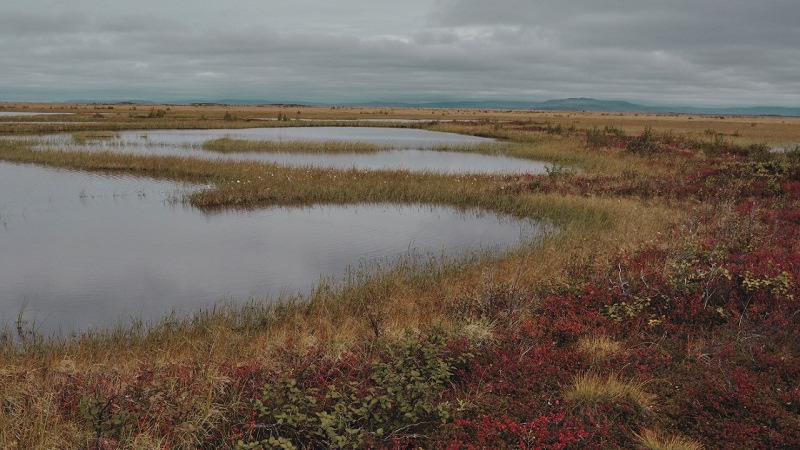
To follow the birds, I follow the geography, which led me to the Cranberry Glades Botanical Area, a peatland nestled in the Monongahela National Forest. The protected area encompasses an assemblage of peat bogs that resemble the muskegs of northern Canada. At 3,400 feet in the Allegheny Mountains, the Glades exist in a place where cold air sinks from the surrounding mountain slopes into low hollows—aptly called frost pockets. These pockets create the climate conditions that sustain plant species more commonly found in the boreal north, survivors from colder times long past. This dense, wet habitat is where the Canada warblers feel at home.
The Glades are warming up to spring, still swathed in dried sedges from last fall. The word “glade” comes from Middle English, or Old English “gloed,” meaning a bright, sunny place, a clearing in a forest. I enter a boardwalk that makes a looping path along the edge of Round Glade, through a dense patch of alders and giant rhododendron, and past a corner of Flag Glade. The wooden walkway is weathered and warped; unlike elevated boardwalks in other peatlands I’ve visited, this one sits nestled directly on the uneven terrain of the bog. The Glades are lush with Sphagnum mosses, black chokeberry, skunk cabbage, and a creeping mat of teaberry. Cinnamon ferns form hummocks, with tightly wound fiddleheads stretching upwards toward the sun, just beginning to unfurl into emerald fronds. The deep-red, leathery leaves of northern pitcher plant emerge from the moss, rising below the dried flower heads from last summer.
I watch the Canada warbler flit from branch to branch in a red spruce (Picea rubens), another species of colder climes. Red spruce forests once covered a million acres of the central Appalachians, before being reduced by logging, fire, acid rain, and wind damage from the loss of sheltering trees. An estimated 10 to 20 percent of red spruce forests remain in these mountains, though they are slowly increasing through extensive tree-planting and restoration efforts.
The warbler flies to an eastern hemlock. It sees me too, with its bright eye encircled by a bold white ring. This male bird’s lemon-yellow underside is adorned with fine black streaks that form a necklace across its breast. I sit still and listen to bird song in a dozen languages and the soft breath of wind through the fresh green leaves of alders. I have a moment of spatial and temporal dislocation: I could be much farther north, or I could be watching a landscape emerging from the last ice age.
The Cranberry Glades is a relict from another time, formed more than 10,000 years ago. Like many peatlands in the northern latitudes, the Glades developed as the last glacial period waned and the earth became warmer and wetter. There have been many ice ages in the planet’s history, but it is the Pleistocene that captures our interest because it coincides with the story of human expansion across the globe. People were part of Pleistocene history, adapting to the colder climates in the north and traversing the unglaciated regions to the south of the glacial margins. My distant ancestors may have stood on a hill looking across a half-frozen landscape.
Healthy peatlands represent massive carbon sinks.
To understand peatlands requires thinking on a much longer timescale than the life of a human. Peatlands are ancient habitats whose histories are measured in millennia rather than decades or centuries. The process of building a peatland is slow, almost incomparable to our own experience: in the time it takes for a person to be born, grow up, and grow old, a peatland might have deepened by just a few inches.
Peatlands are wetlands that are proficient in accumulating organic matter, preserving the bounty of life and death in layers of watery peat. Peat becomes a kind of time capsule; core samples taken from deep peats reveal the story of the peatland’s past lives. As the process of decay in the saturated and acidic peat slows to a glacial pace (no pun intended), leaves, seeds, and pollen are captured whole or in fragments. Scientists examining these core samples can identify the kinds of plants that filled the peatland and reveal changes in environmental conditions that occurred over time. The organic matter in peat is more than historic evidence: it is a carbon treasure chest.
Plants, like all life forms in our world, are carbon-based. The carbon dioxide they absorb through photosynthesis is transformed into plant tissue, and when plants die, much of that stored carbon is recycled back into the soil and the air. The carbon cycle never stops, but in peatlands, it slows down considerably. This capacity to hold carbon in the ground is what gives peatlands significant influence in the earth’s climate system.
Healthy peatlands represent massive carbon sinks. An often-quoted fact about peatlands is that they cover only about 3 or 4 percent of the land surface, yet they store twice as much carbon as all the world’s forests combined. But peatlands that are damaged—by drainage, fire, or a warming climate—can release that stored carbon back into the atmosphere, contributing to the concentration of greenhouse gases that is driving climate change.
What happens to carbon under our feet is part of an even longer story, one that dives deeper into the earth and further back in time. Some 350 million years ago, the Carboniferous Period was a fecund era in the planet’s history; plant life was abundant and the earth was warm and wet. Lush forests of giant club mosses and ferns produced bountiful quantities of organic matter. As plants died and were buried in the mud, they formed deep layers of peat. With the right ingredients—time, heat, pressure—the process of carbonization transformed organic material (peat) into a solid form of carbon, and thus, coal was born.
The full story is, of course, more complicated: rising and falling of sea levels, cycles of flooding and burial of peat, and pressure from tectonic shifts in the ancient Pangea supercontinent. The combination of these forces ultimately produced massive coal seams that fueled the Industrial Revolution. Some of these coal beds run through the mountains of West Virginia—not far, in fact, from where I am standing. West Virginia is the largest producer of bituminous coal in the US, with active coal mines in almost half of its 55 counties. In 2025, the state produced 86 million short tons of coal, an increase of 8 percent from the previous year.
While coal production in the US has been in decline for almost two decades, there is still plenty of coal left to be mined. A map of West Virginia’s remaining coal reserves shows a swath running diagonally through the state containing an estimated 1.6 trillion tons.
Here is where the threads of time and human history come together in a tangled knot. Peatlands absorb carbon from the atmosphere and store it, effectively, for millennia. Coal, the product of millions of years of carbon buried under pressure and heat, has an even longer history. When this buried carbon is unearthed and released back to the atmosphere, the climate system responds: carbon dioxide and methane are powerful greenhouse gases that warm the planet. The carbon cycle is spinning wildly, as the carbon accumulated over vast stretches of time is recycled in a flash. Peatlands and coal beds have one thing in common: left undisturbed, they can keep carbon locked in the ground.
If I count time looking backwards, I see myself as a recent arrival, a member of Homo sapiens that appeared perhaps 300,000 years ago. The Canada warbler, singing from its hidden perch, hails from a species that evolved one or two million years ago. The Sphagnum mosses that surround me arose some 14 million years ago, the descendants of mosses that evolved 400 million years ago, making their lineage older than the coal seams that runs through the deep mountains. What if I were to count time looking forward, imagining this scene in a thousand or ten thousand years? Will the deep hollows be moist with mosses, shaded by red spruce and hemlock? Will the air hum with birds and insects?
The rhythm of a bird’s life is measured in seasons. Mine is in years, which seem to be accumulating all too quickly. The peatland around me records its time over millennia. Walking along the boardwalk through the Glades, I feel the lure of falling back into the past. How far would I want to go? Before the invention of the internal combustion engine, perhaps. Not as far back as the last ice age. I savor the peace and quiet in this pocket of peatland, and feel grateful I am here, in the present.
__________________________________
Water, Carbon, Time by Jennifer de Mooy is available from the University of Minnesota Press.

Jennifer de Mooy
Jennifer de Mooy has worked in conservation, environmental protection, and climate policy for forty years. For two decades she designed and implemented projects with The Nature Conservancy to protect and restore natural habitats, and for ten years she worked with the Delaware state environmental agency, promoting climate mitigation policies that enhance the capacity of plant communities to absorb and store carbon.