“Get Out.” Advice on Teaching High School From the Late, Great Frank McCourt
Tom Allon on His Enduring Friendship with the Beloved Irish Memoirist
On my second day as a rookie English teacher at my alma mater, Stuyvesant High School, I walked down the fourth floor hallway on my way to class.
Behind a thick column, lurking in the shadows, a kind looking man with an Irish brogue quietly summoned me. “Psst…hey, come over here.”
When I strolled over, he blurted out: “Get out while you can!”
He saw my quizzical expression, not quite comprehending his warning.
“It’s five shows a day, in front of the toughest audience you’ll ever face,” he said with a twinkle in his eye.
The man was Frank McCourt, Stuyvesant’s venerated creative writing teacher. I was immediately smitten.
Thus began the most rewarding mentorship and friendship that I’ve ever had. Two years later, I heeded his advice and “got out” to pursue my dream of a journalism career. Even after I left teaching, we stayed close, and our lives continued to intersect.
A few days after his first essay appeared in print, an excited Frank called me from a phone booth on East Ninth Street, near the pub. His voice sounded electric.
Frank clearly was a highly adored teacher but that wasn’t his ultimate dream—he really wanted to make it as a writer. But no path had yet opened for him, and he was in his late fifties. I recall one day the famous Jerzy Kosinski, author of Being There and The Painted Bird, came to speak at Stuyvesant, and after his remarks, Frank went up to him and plaintively asked: “How can I be a writer like you?”
He told me a few times when we were teaching together that on nights and weekends he was trying to write a book about his impoverished childhood, but he “couldn’t get the sounds of the classroom” out of his ears.
I left Stuyvesant because I was offered a job as Editor of a new weekly newspaper covering the West Side of Manhattan. It was a great first journalism job, and I was only 24. Frank told me he was proud that I was chasing my dream.
About a year after I left teaching, Frank and I had one of our occasional dinners at the Lion’s Head restaurant on Christopher Street in Manhattan. It was a well-known journalist and author hang out. That night, we eyed revered columnist Pete Hamill across the bar. Frank told me he was jealous of Hamill and Jimmy Breslin, two of the more literary columnists who became famous in New York in the 1980s.
Frank took his eyes off Hamill and turned to me, a pint in his hands, and said: “You know, I’ve always wanted to be a columnist.”
“Interesting. What would you want to write about?” I asked, playing along.
“Well, one week I’d go to a pub, and I’d observe whether the bartender mixed good drinks and if there was a lively conversation at the bar. The next week, I’d go to a church or synagogue, and I’d review the rabbi or preacher’s sermon. And the next week, I’d go to a school and sit in on a few classes and write about whether the teachers in that school were really engaging the kids.”
I nodded my head and said: “Hmm… that could be interesting.”
“They’re the three most important institutions in society—pubs, houses of worship and schools—and nobody writes about them unless there’s a scandal,” Frank elaborated.
Two weeks later, a new monthly column by Frank McCourt, called “Forays,” appeared in The West Side Spirit.
The debut piece was a witty, literary look at the history and enduring appeal of McSorley’s, a pub on East Seventh Street in Manhattan. The city’s oldest drinking establishment, it opened its doors in 1854, and it continues to serve up ales and stouts even today, 172 years later. It was Frank’s favorite watering hole.
But halfway through our journey, we hit an unexpected roadblock: You can’t name a school after a living person.
A few days after his first essay appeared in print, an excited Frank called me from a phone booth on East Ninth Street, near the pub. His voice sounded electric.
“Tom, you won’t believe what I just saw. Hanging above the men’s urinal is a framed copy of my McSorley’s column. Do you know how many people will see that?!!!”
Years later, after Angela’s Ashes became a worldwide phenomenon and sold more than 10 million copies, I’d introduce Frank at an annual event he emceed for my media company, called “The Blackboard Awards.” We honored 25 Teachers of the Year in New York City, and the assembled crowd was always enthralled by Frank’s entertaining storytelling and commentary.
In my introduction of him those evenings, I’d tell the McSorley’s bathroom urinal story. “Until he wrote Angela’s Ashes, that was Frank’s best-read piece of writing,” I’d deadpan, as the whole audience broke into laughter.
I was so proud that Frank and I ultimately chased our individual dreams. For him it meant overnight worldwide fame, albeit after years of trying to write. He was always a bit shocked by all the attention. He once said of the hoopla: “Tom, I’m the mick of the moment.” And he’d flash his impish grin.
I knew while I was editing his essays that he was a singular talent—literary, profane, wise, cutting, and unique all at once. His prose would crackle off the page as if to say: “LISTEN! This is important!”
I was excited to showcase his talents and allow him to see that he belonged in New York’s journalism ecosystem. He was painstaking in writing those pieces and it showed in his final drafts. They required very little editing. Why mess with a future Pulitzer Prize winner?
Watching Frank teach, as I did as often as I could, was like watching a master on stage. He knew how to lob provocative questions at his students, elicit more detail from monosyllabic answers all while making learning joyful. His assignments were genius: “Go home and write a restaurant review of your mother (or father’s) home cooked dinner tonight. Lots of detail. I want to SMELL the pasta when I’m done reading it.”
Or: “Go home and write the most creative excuse note you can for why you didn’t do last night’s homework. Most creative one doesn’t have to do homework for two weeks.”
After Frank passed away in 2008, The New York Times posted his lengthy obituary online. I noticed a few thousand comments posted in the first week, most of them former students singing his praises and reminiscing about how his class turned them on to writing.
He had students, like Susan Gilman, who went on to become successful memoirists and novelists. Gilman once told me that Frank saved her life: as a brooding 16-year-old she found purpose in his creative writing class. His attention gave her the hunger to become a great writer to make him proud—and he was.
After Frank’s searing memoir captured the minds of millions around the planet and he won numerous awards, I would gleefully watch his well-earned fame. And between book tours and lectures and television interviews, we would periodically catch up. One day he called for advice: “We’re buying this co-op on West 77th Street. What is this thing, a co-op board interview?”
This was Frank’s first foray into New York’s cutthroat real estate market. “Just be yourself at the interview and they’ll fall for you like I did more than a decade ago,” I said.
In 2008, as a publisher and education activist, I was given the opportunity to help create a new public high school on West 83rd Street with local Council member Gale Brewer, a West Side legend.
At the teacher awards ceremony that Frank emceed for my company, he’d always lament that schools are never named after teachers—just politicians or astronauts or other undeserving people.
Remembering Frank’s words, I suggested to Brewer that we name the new school after Frank McCourt, an immigrant success story that would inspire kids of all backgrounds. Coming to New York penniless, he worked odd jobs to survive before embarking on a high school teaching career of two decades before he wrote one of the most beloved books of the late 20th century, Angela’s Ashes.
Gale liked my idea, and we embarked on getting community buy-in to create a school focused on creative writing. But halfway through our journey, we hit an unexpected roadblock: You can’t name a school after a living person.
I had to call Frank about the problem. “Don’t worry, Frank, we will figure out a way around this,” I said, trying to convince myself and him that all would be ok.
I realized that Frank and I had a great friendship—seeing each other through good times and bad, coaching each other on professional aspirations and ultimately becoming inextricably linked by our shared pasts.
I’ll never forget his response, which even as I type this, sends a chill down my spine. “Well, I guess I better hurry up then.”
A week later, I found out that Frank had passed out on a cruise and that led to a revelation that he was very ill. I couldn’t believe it. It made my passion for creating this school accelerate.
Frank passed away in July 2009. That summer I worked day and night campaigning for Frank McCourt High School. At his memorial service in early September, I got on stage with Frank’s wife, Ellen, and NY City’s Schools Chancellor, Joel Klein, and we announced that Frank McCourt high school would open that Fall. I stood on stage with a bittersweet feeling: I already missed Frank, but I was glad I was able to help make his dream come true. In his final weeks, I gave him updates on the school’s progress, and he seemed very pleased.
I realized that Frank and I had a great friendship—seeing each other through good times and bad, coaching each other on professional aspirations and ultimately becoming inextricably linked by our shared pasts.
__________________________________
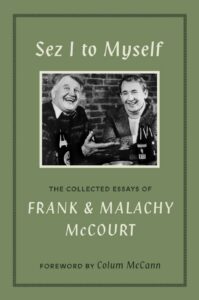
Sez I to Myself: The Collected Essays of Frank & Malachy McCourt edited by Tom and Jonah Allon is available from Abrams.

Tom Allon
Tom Allon is an award-winning journalist, columnist, media executive and publisher. He has written for The New York Times, the Daily News, New York Post, Huffington Post, Dan’s Papers, City & State, The West Side Spirit, Our Town, and many other publications. Allon is a graduate of Columbia University’s Graduate School of Journalism, Cornell University, and Stuyvesant High School. He has taught opinion writing at Hunter College, and journalism and American literature at Stuyvesant High School. He has four adult children, three cats, and is married to Rebecca Cohen. They live in Dumbo, Brooklyn, and East Moriches, Long Island.