When Dad and I went to Dallas for Mom’s funeral, Dad gave me my own disposable camera with twenty four pictures on it. I used up two taking pictures out the window of the plane. I remember thinking it looked like there were animals made of diamonds swimming around in the water and crashing into each other and breaking.
I used the rest of the camera to take pictures of Mom in her casket. She was wearing a tight white dress and pink-orange lipstick. There was a wreath of lilies on her stomach. In the envelope under my bed with pictures of Mom in it, I have five pictures of her when she was alive and twenty-two pictures from that disposable camera of her when she was dead.
I don’t remember the church part of the funeral very well, but I remember the part where everyone looked at Mom’s body. There was a big air-conditioned room with green-and purple carpet and a long line of people in black, picking at their fingernails as they walked past Mom lying there, dead, while they got to be alive.
One of the women said she was my aunt. She gave me a box of cheap crayons that broke if you pressed too hard. She took me into a corner of the room where there were sandwiches and mini bottles of water and she made me a word search on the back of the program for the funeral. They were all words I didn’t know, like “solace” and “angel.” The only one I knew was “paradise” because of the pawnshop.
The aunt held my hand and showed me a display with pictures of Mom when she was a little girl, biting into a big chocolate rabbit, doing a cartwheel, holding a parrot on her shoulder and laughing. I kept waiting for the aunt to say that Mom looked like me, but she never did, even though Mom did look exactly like me in some of the photos. Then the aunt had to help put out more trays of sandwiches for everybody, and then she had to stand in a line by Mom’s casket while people hugged her and cried. I wanted to be hugged by all the people there too, but when I went to stand by the aunt, she made me another word search and told me to go sit in a folding chair far away from the people giving hugs.
Then someone said it was time to take a picture of the family. Dad went in the other room with the sandwiches. He knew nobody wanted him in the picture. The women went to the bathroom to mop the bottoms of their eyes, where their makeup was smeared from crying. I went with them, even though I wasn’t wearing any makeup. A photographer set up a big light and arranged everyone against the wall—tall people in the back, short people in the front. I went to stand in the front. The aunt put her hands on my shoulders for a few flashes of the camera. Then she whispered to me, “Could you go over there for a second, sweetheart?”
I sat on the floor by the photographer watching everyone else grin like they weren’t in the same room as a dead person and like they hadn’t just kicked me, their literal family, out of their family photo.
Up until then, I hadn’t cried once that whole day. When people made speeches about Mom and it seemed like every one was supposed to cry, I poked myself in the eyes with my finger to try to make them water, but it didn’t work. As I sat on the carpet all alone under the photographer’s flashing light, I finally felt tears in my throat. It was a bad time to cry. Every one was lined up, looking right at me. I breathed in through my nose and out through my mouth, just like Kayla taught me to do when I needed to stop myself from crying at school. I kept breathing like that and I went to find Dad.
“Can we leave?” I said.
“You didn’t want to be in the family picture?” he said.
“No, they didn’t want me to be,” I said, and then I cried, finally. Dad didn’t say a word. He picked me up. It was back when I was small enough that he picked me up a lot. He carried me to the car and we drove to a Denny’s with no other people in it.
While we waited for our food, Dad built me a card house out of the sugar packets. When I tried to help, I kept knocking it down, but he never got mad. He just kept rebuilding it and he kept letting me help. Eventually it was so big that it took up half the table. We got more sugar packets from the table next to us and built little houses around the main house. Dad made up a story about how he and I lived in the big house, which was a castle, and we were the bosses of every body in the little houses. There was a pink wing of the castle for me and Kayla, a blue wing for Dad, and a brown wing for Aubrey and Giselle. When the waitress came with our food, she got mad at us.
She said it was unhygienic for us to put our fingers all over the sugar packets.
“We’ll buy them then,” Dad said. I remember thinking he sounded like a really rich person. We looked like rich people too, because Dad was still wearing his black suit and I was wearing a black dress and tights and a ribbon in my hair and anew bracelet from Paradise Pawn. I didn’t understand money back then. I knew we had spent a lot of money on the plane tickets and I got a little worried about how we would afford all the sugar packets, but it made me happy looking at the waitress’s face. She was so shocked. I thought she must have thought two millionaires were at her Denny’s.
After Dad ate shiny eggs and sausage and I ate French toast sticks, the waitress gave us a little to-go box for all our sugar packets. We took apart the castle and the houses carefully, putting pink sugar packets in one corner of the box, blue ones in another, yellow ones in another, and brown ones in another. Then we got in the car and we drove to a hotel parking lot.
“Get out,” Dad said, “and bring your sugar packets.” He looked at his watch and counted down from ten. A spray of pink fireworks shot into the sky, then gold, twinkling, dripping ones, then ones in the shape of smiley faces. It was the most fireworks I had ever seen in my life. They were the Six Flags fireworks, but I thought they were just for me. Dad ripped open a pink sugar packet and handed it to me. I poured it into my mouth and it felt like my teeth were full of sweet sand. When I’d crunched it all down, Dad opened another packet for me, and another one.
“Are you happy?” Dad yelled to me over the booms.
“Yeah!” I screamed. Then, when the sound died down and the sugar melted in my throat, I remembered that my mom was dead and I wasn’t supposed to be happy. I was still wearing my black clothes. I was sweating through my tights and I’d spilled sugar into the velvet of my dress.
“Why did you do that to me?” I asked Dad when we were back in the car.
“Do what?” he said.
“Trick me into being happy. I’m supposed to be sad.”
“Babe, no you’re not. You’re eight,” he said. “No one who’s eight is supposed to be sad.”
__________________________________
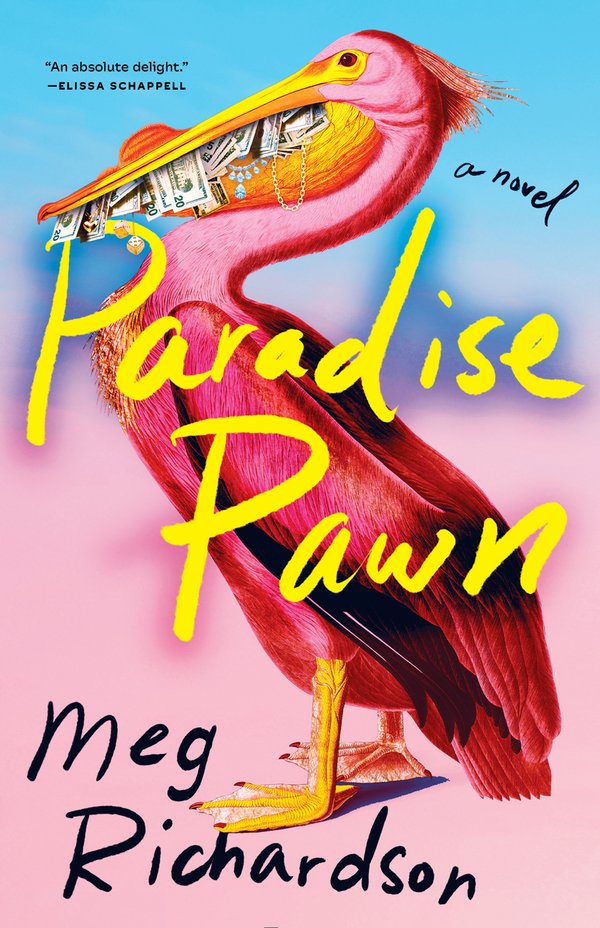
From Paradise Pawn by Meg Richardson. Copyright © 2026 Meg Richardson. Reprinted with permission from Tin House an imprint of Zando, LLC