On the Propaganda of Early Nazism, and How We See it in America Today
Omer Aziz Encounters the Spectacle of Fascism
The train blitzed through the Bavarian countryside, through another foggy day. I was headed toward Vienna, the city known as the crown jewel of Europe, the home of art and culture and music. Vienna was the city of Mozart, the creative hub of Beethoven, the home of Freud and Klimt. The small Bavarian towns passed by, draped in clouds. One thing was certain: The Germans had gotten train travel right.
Next to me sat a banker from Vienna, living in Berlin, who wanted to move back to Vienna. He recommended the Muzikverein and the home of Mozart, as well as—“very rare you can make it, but the Vienna Opera House.” He advised against going to Berlin under the gloom of December. “Berlin looks, so, bleh these days,” he said in German-accented English.
Some hours into the ride, I went to get a coffee and was suddenly stopped by two women and a man. They were wearing jeans and hoodies, and they appeared to be looking through one of the compartments where suitcases are stored between train cars. “ID!” one of the women shouted. “Now!”
I stopped, looked around, and suddenly realized she was talking to me. “Why do you want my ID?” I asked. I’d heard of scammers who pose as plainclothes officers, take your passport details, and then send them to their criminal friends for identity theft or extortion or fraud.
So who are you? I thought. The Gestapo? I was careful not to ask the question out loud.
Apparently, I was mistaken. The woman showed me something vaguely resembling a driver’s license. The other woman and man did the same. These were actually undercover police officers. My mind immediately went to the fact that the far right was surging in Germany.
“Show us your ID!” she said in harsh, broken English.
I asked the woman for her name, badge number, and police station. “We don’t need to tell you that,” she said.
So who are you? I thought. The Gestapo? I was careful not to ask the question out loud. I handed her my passport and tried to make my face unreadable.
When you are arrested in a totalitarian regime, you do not even get a chance at asking why. Formalities might still be followed, but they’re for appearances only. As calmly as I could, I waited and watched as she put my passport through a scanner. She handed it back and didn’t look me in the eye. She was ready to move on to the next suspicious person.
Her colleague, a blonde woman, seemed more apologetic. She explained that they were plainclothes Bavarian police officers. She showed me her gun under her hoodie. She offered to give me the number of the local station if I wanted it. Their job was to board the trains going from Germany to Austria at random to interdict drugs, illicit money, and criminals. Tensions were high in Germany, she explained. Just a few days before, a man had driven his car into a Christmas market, killing dozens.
We had a little chat about how to stop criminals, and then I walked back to my seat for the rest of the trip. The word Kafkaesque is overused, but I couldn’t help but think it was apt. Kafka—who was from Prague, just over a hundred miles from here—stuck humans into impossible situations in his novels. Dropping them into states of nightmarish absurdity, he created worlds where rational thought and question led only into walls and mirrors.
I still think something was off about those state police officers and about our interactions. People with guns who do not have to reveal their names or badge numbers to people they question wield nearly limitless power. Nations cross the line between democracy and dictatorship in multiple ways, and I wondered if putting agents of the state on trains with no discernable limits on their power was one of them.
Fascist nations are police states by definition, ruled by agents of the state who are ruthless and arbitrary. Multiply what happened to me on the train several million times and go back to the last century, and you’ll find the story of fascism. In both Germany and Italy, the judicial system had to bend and go along with the police state, where real power resided. Agents of a fascist state can question or incarcerate or deport or impose the death penalty at will without a “law” to protect the innocent.
But in a democracy, the people’s institutions control the police forces at all levels. Likewise, in a democracy, the military is always under civilian control. Before General Dwight Eisenhower ran for president in 1952, he retired from active service and resigned his commission as a general. The democratic tradition in America of the president being a civilian remains a bedrock principle.
Fascism creates a world of artifice and sophistry. It drapes officers with guns on trains behind the logic of fun house mirrors. It hides the erosion of freedom and augments what it sees as beautiful and patriotic. Things are not as they seem. There is always something missing, a truth hidden in the lies, contradictions that need to be mentally processed. Words refer not to their actual meaning but to an alternative reality, a world where newspapers are “the lying press,” where “removal” means to kill someone, where the heroic opponents of Nazism are “scum.”
Fascist propaganda works by distraction and deception. It puts on a spectacle and invites the public to participate, distracting them from the state agents on the streets with guns. The name of the game is to disorient the individual and make them dissolve their humanity into the delusions of the crowd. The private encounter with the secret police, the offhand critical remark about the regime that is overheard by the wrong person, the sensation of being watched: All are the realities of fascism. “Propaganda is more important than violence in securing popular acquiescence,” noted one writer in 1934. Fascist propaganda exists to cover up reality and present a glorious, entertaining show. It creates a circus that the public can lose themselves in, forgetting the truths before their eyes.
Everything he learned in Vienna—from leaving an audience awe-inspired and soaring into dreamlands of fantasy, to the architectural glories of the opera house that could make heads turn—Hitler would apply to Nazi Germany’s theatrics.
I made it to Vienna, and the city was like poetry. Every building resembles a grand palace or theater. It is a Renaissance city, where art and culture are revered. It is also a city where antisemitism and racial theories were once in vogue and where Hitler was radicalized. Moreover, Vienna was the city where Hitler learned to put on a good performance.
As a young man, Hitler somehow managed to score tickets to the glorious Vienna State Opera. He would attend night after night of opulent performances, waiting in line outside in the cold for a standing-room ticket to the sold-out shows. He loved Richard Wagner’s operas and attended them regularly. How he afforded it, no one knows. He painted the Vienna Opera House in one of his works that survive today. What did Hitler learn from all those hours spent at the grand opera house? The artistry of stage presentation, the portrayal of narrative, and how to make a rally come alive. Hitler spent his time in Vienna learning stage designs, trapdoor mechanisms, and lighting techniques; according to his childhood friend August Kubizek, with whom he shared a room for a time in Vienna, young Hitler even wrote plays inspired by Germanic myths, composing not just the text and stage directions but even trying to write the music.
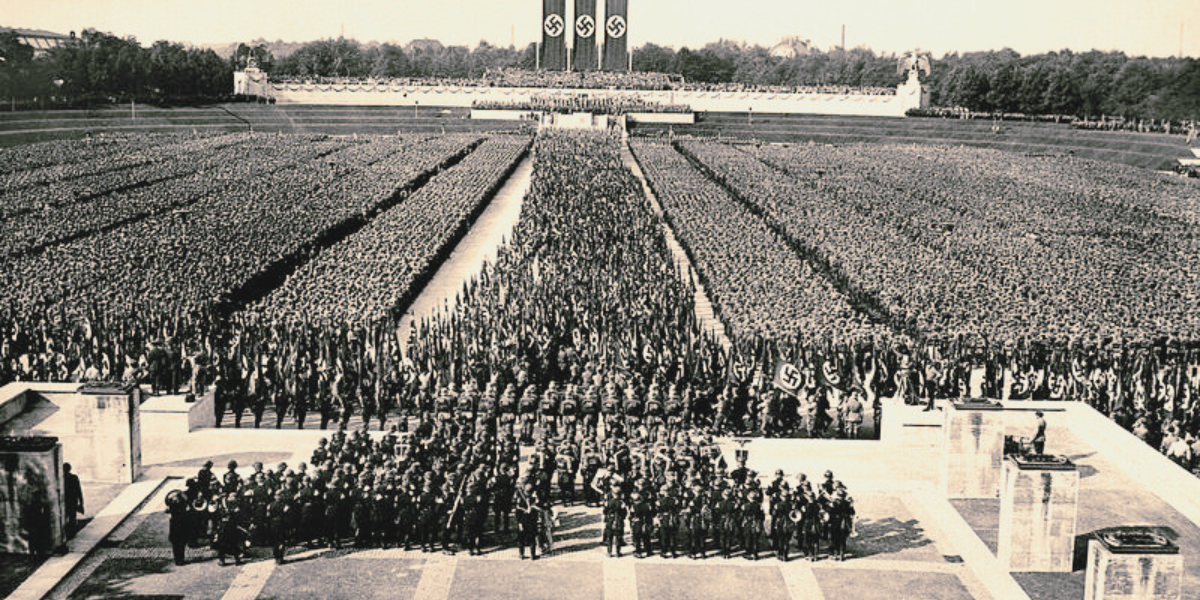
Many years later, when Hitler was Reich chancellor, his chief architect would observe that despite being head of state of Germany, the Führer was still drawing stage designs and scene sketches, spending weeks at a time on these creations and showing them to professionals. Everything he learned in Vienna—from leaving an audience awe-inspired and soaring into dreamlands of fantasy, to the architectural glories of the opera house that could make heads turn—Hitler would apply to Nazi Germany’s theatrics. The frustrated creative demon was part of fascism from the beginning. The Nuremberg rallies were simply political stage plays, with music from Wagner, drums, symmetrical marching formations, red flags, and gatherings often held in darkness to heighten the mood. Vienna was the artistic—and intellectual—inspiration for national socialism.
The Vienna Opera House itself today remains majestic. Its performances are planned years in advance, and its red seats and Renaissance decor seem part of a world long since passed. Then and now, people escape themselves and their surroundings through theater. Betrayal, martyrdom, love, murder, glory: Theater is human drama brought alive. Meanwhile, serious young art students mill about the Vienna Academy of Fine Arts, another classical-looking building. Hitler was rejected from this academy, and he carried that embittered frustration forward into politics, turning Germany into a spectacle of death.
The key element of fascist and Nazi politics that distinguished it from other radical right-wing (and left-wing) movements, and that allowed it to garner mass support, was not its racial ideology, or its economic ideas, or its parliamentary tactics. The key element by which fascism elicited widespread devotion was its deep understanding of human psychology. Fascism knows our desire for heroes and villains, and Mussolini and Hitler grasped something that all the teachers, journalists, artists, novelists, and scientists of Italy and Germany did not: how to effectively wield propaganda to convert and convince the masses to their cause. They gave them a narrative they could believe in and a glorious future to which they could aspire.
“The art of propaganda consists precisely in being able to awaken the imagination of the public through an appeal to their feelings,” wrote Hitler in Mein Kampf. “All propaganda must be popular and its intellectual level must be adjusted to the most limited intelligence among those it is addressed to.”
The fascists knew what people would love before they knew it themselves.
Propaganda, in the 1920s and 1930s, was not seen as a nefarious concept. The word simply meant propagating or spreading one’s message. Edward Bernays, also from Vienna and a nephew of Sigmund Freud, published a 1920s book called Propaganda. Known as the godfather of public relations, Bernays explained how the unconscious element of people in democratic societies could be manipulated. “Those who manipulate the unseen mechanism of society,” Bernays noted, “constitute an invisible government which is the true ruling power of our country.” Bernays believed that only an “intelligent minority” could articulate the will of the masses. For any demand in society, propaganda was required to effectuate change.
But there were deeper, baser motives the public might not even know they had, and the successful propagandist had to tap into those innermost fears and desires. If one thing about fascists was true, it was that for all their evils, their undermining of democracy, and their creation of dictatorships, they knew how to put on a good show.
Fascism, then and now, is masterful at propagating and reinforcing its ideas through an aesthetic that captivates a large number of people. The fascists knew what people would love before they knew it themselves.
In Nazi Germany and Fascist Italy, the marches, parades, banners, colors, speeches, festivals, and celebrations were all intended to spread the regime’s message. Propaganda was the means through which the public would assimilate and receive the fascist message; it is how they would be manipulated and become part of one organism devoted to the fascist cause.
The Nuremberg rallies, which were Nazi mass gatherings that took place every year—with all their choreography and symbolism, pageantry and force—were turned into a propaganda film called Triumph of the Will by German director, producer, and actress Leni Riefenstahl. Hitler commissioned her personally, though she was not a Nazi Party member, and gave her maximal resources and full creative license. She had thirty cameras and a crew of 120 people at her disposal to film and piece together Triumph of the Will. The film was actually an advertisement, disguised as a documentary, for the Nazi regime.
Riefenstahl was an expert at using lighting and shadows, of creating a sense of patriotism and glory and even divine mandate. In the early scenes, the film portrays Nuremberg from the sky, the streets and steeples emerging from the clouds. It shows a small plane flying over the city, descend-ing toward the people awaiting Hitler, evidence of the vast camera and production crew Riefenstahl had at her disposal. We see masses of people marching toward the rally; the first faces shown are of women enthusiastically giving the Nazi salute. The plane lands, surrounded by throngs of people, and out steps Hitler, followed by his posse, including Joseph Goebbels. Trumpets blare, and thousands upon thousands of Nazis cheer.
The scenes are sharp and innovative for the time, and the message clear: Hitler is descending from the heavens to rule over his people. The documentary was partly fictional—some of its scenes and its staging were rehearsed, and Riefenstahl had full discretion in how to shoot and portray the Nazi rally, even to intervene so it worked best for the camera. But to the modern eye, it still appears ominous.
Triumph of the Will would become an iconic film, one that immediately received international success. The documentary was considered advanced for its time; independent of its propagandistic qualities, its cinematic contributions were significant enough that much of what the film did for the first time is common now in filmmaking. (As I later learned, scenes ranging from The Lion King, with Mufasa on Pride Rock, to Nuremberg, and Star Wars II, with the three characters walking, to the opening of Citizen Kane were in part inspired by Triumph of the Will.)
Riefenstahl’s film made an indelible cinematic impact, influencing the direction and editing of films to this day. She rejected any responsibility for creating the public image of the Third Reich and elevating it through the medium of film. To the end, Riefenstahl maintained that she was only an artist making her art and had no political motivations—a claim difficult to take seriously given she helped spread the message of Nazism to millions.
Like cheap political cocaine thrown to the hungry masses, propaganda gave them a story they could believe in.
The film captures the Nazi aesthetic, with Hitler standing alone before the masses giving a speech, the shadows cast across the Nazi Party rally grounds, and the euphoria on the faces of rallygoers. This film demonstrates just how dangerous aesthetics are when weaponized, how beauty can mask brutality. There is the Lichtdom, or Cathedral of Light—more than a hundred searchlights beaming columns of light into the sky—creating an elevated sense of ceremony and import. The creative work of Albert Speer, Hitler’s architect, the Cathedral of Light became an aesthetic hallmark of Nazism.
Unlike other political systems, fascism was not meant to be intellectualized or discussed; it was meant to be experienced. It was about stagecraft and about illusions captivating the emotions. It put on spectacles full of pomp and pageantry to showcase the newfound strength of the nation. All the orchestration and glamour of the rally, the glory of the Leader, was meant to tell a story—of a nation wounded from within, of a fifth column, of tyrannical foreign countries, of an economic crisis, and of a grandiose account of renewal and coming greatness. Like cheap political cocaine thrown to the hungry masses, propaganda gave them a story they could believe in.
Both Hitler and Mussolini were writers in their own way, and Hitler’s failure to pass the entrance exam to the Vienna Academy of Fine Arts burned in him throughout his career. Hitler always felt slighted by that rejection and, in later political life, preferred to spend most of his time discussing architecture and art. In Vienna, he drew buildings; after his failed coup attempt, he wrote a book. When he was in power, this penchant for the arts continued. According to the memoirs of Hitler’s valet, Heinz Linge, Hitler’s home resembled “the household of a busy architect and building tycoon rather than the Führer and Reich Chancellor.” Fascism wielded visual art, language, and spectacle, and it applied an aesthetic lens to politics.
The Nazi red flag, the Fascist salute, the scenes of millions standing in obedience and hysteria: All were meant to evoke belonging, order, pride, a facsimile of goodness. The political aim of such propaganda was the self-perpetuation of lies; naturally, it would sooner or later collapse in on itself, the way systems of lies always do. (Hitler’s invasion of Russia during World War II, for example, was said to have sealed his fate. Had he not made that decision, his regime may have lasted. It was an irrational, impulsive, drug-fueled decision. All that is true: But that was the point. Irrationality and delusion were central to fascism.)
Fascism understands human beings’ deep desire for entertainment, our need for theater. It knows our longing for the intrigues and knife-plunging dramas of heroes and victims. Fascism knows we need our new myths to be connected to old myths, too, and that we hunger to live in fantasy worlds—to escape ourselves and our meager private lives and be part of a grand story.
Fascism spins the greatest fictions of all time—about race, about origins, about past and future glories—and people eat them up.
A couple of months after Hitler seized power, Joseph Goebbels, an academic and failed journalist, established the Ministry of Public Enlightenment and Propaganda. Goebbels’s department was charged with converting the masses to Nazism through media in all its forms at the time—books, newspapers, films, radio. He kept a copious diary during his years as propaganda minister, and he died with Hitler in the bunker. On March 25, 1933, Goebbels defined the objective of his Propaganda Ministry as the “spiritual mobilization” of the people.
The Associated Press had quoted Goebbels as saying, “Our propaganda is primitive because the people think primitively. We speak the language people understand.” Goebbels himself walked with a limp because of his club foot, a fact that other Nazis had to overlook, given they were publicly railing against the physically disabled. At the 1934 Nuremberg Rally, Goebbels reminded the masses how the Nazis came to power: Propaganda, he declared, “was our sharpest weapon in conquering the state.”
For Goebbels and the Nazis, propaganda was most effective when it was turned into an art—attempting to express what was already latent in the human soul.
Propaganda was the art that conveyed—through emotions and even spirituality, not intellect—the all-encompassing ideology that ruled one’s life. “Propaganda,” Goebbels said, “works best when those who are being manipulated are confident they are acting on their own free will.” It’s not that the receivers of propaganda have no agency; in fact, they are co-creators of the delusion. The public would participate in Nazism’s grand theater and mutually created mania. Millions of Germans joined the audience for the Nazi play, in which Hitler played the glorious Leader and the regime ruled ruthlessly while spinning stories about its own rectitude.
Nazi spectacle was built upon layers of not just performance but of lies. There was the “Noble Lie” of Plato, which said that lying for noble causes was permissible. This became the “Big Lie” of Goebbels—which said that if you told a bigger lie, it was more believable. But there was a third kind of fascistic untruth: the Pointless Lie. This was the superfluous lie, the gratuitous lie—the lie that did not need to be told but was told only as a demonstration of power. This was the lie in which the masses were told not to believe what they saw and heard.
Fascism captivated people by absorbing them in fantasy worlds, combining a nostalgic past with a glorious future, and giving them theater every day of their lives.
The fascists had already told many lies. Regimes of other totalizing varieties tell lies too. But it was the Pointless Lie—such as denying the obvious or exaggerating its leaders’ accomplishments—that made fascism different. What was true yesterday is false today, and what was false yesterday becomes true today. Goebbels wanted to use modern forms of technology to tell alternative stories about people’s reality. He wanted to bend people’s reality such that they could no longer tell the difference between what was true and false. He needed them to lose their judgment and discretion so that they would come to rely on something being true just because the regime said so.
Though fascism was serious to the point of being livid—anger was fascism’s driving force—there was still room for laughter in the Third Reich. Goebbels wanted entertainment to flow, and he wanted films where the propagandistic element was artfully concealed. Over half the films shown in Germany in 1934—some 55 percent—were comedies. The next-closest categories were political films (24 percent) and dramas (21 percent).
By the end of the decade, the number of political films had gone down substantially, while dramas made up nearly half of all films and comedies saw only a slight decline (49 percent). So even as the Nazi regime was radicalizing through the 1930s and committing horrific violence, the German population was still laughing and being entertained. Mickey Mouse was hugely popular in Germany (including personally with Hitler), but Germany imposed hefty duties on the import of foreign films after the Nazis came to power, bringing Mickey Mouse’s broad viewership to a halt.
Instead, Germans relied on domestic sources of entertainment. Flooding the market with comedies and dramas in which the populace could be absorbed was a way to keep the masses distracted. Fascist propaganda, whether in films, posters, or mass rallies, was the creation of a fantasyland in which the masses could get lost.
While denouncing global elites and Jewish conspiracies and cabals of men in back rooms, the Fascists and Nazis were themselves cabals: inner circles of a few men around Mussolini and a few around Hitler. A clique ran each party and thus each country. “All that goes on behind the backcloth,” Goebbels said, extending the theater metaphor, “belongs to stage management.” Fascism captivated people by absorbing them in fantasy worlds, combining a nostalgic past with a glorious future, and giving them theater every day of their lives.
For Goebbels, it was important that propaganda be creative. He needed his staff to create propaganda that was not obviously propaganda. He chastised the German film association in 1934 for making too many extremely pro-Nazi films. The project was about permeating the masses, gradually lulling them with propaganda. It required enough subtlety and nuance that people could feel like they were coming to their own conclusions. And the messaging of Goebbels’s Propaganda Ministry, with its domination of radio, was, according to a German writer, like a medieval sermon, with tales of redemption through service and transcendence through loyalty to a cause.
Imagery was multiplied to tell a story—the stentorian Mussolini, with his upraised chin and bald head, delivering a speech, or Hitler, with his toothbrush mustache, gesticulating. It’s said that when Hitler was thirty-four years old, a friend told him to shave the mustache and grow one that was actually in fashion. Hitler stubbornly refused, telling his friend not to worry about the mustache. “If it is not the fashion now,” Hitler said, “it will be later because I wear it.”
Naturally, Hitler had a personal photographer follow him everywhere. An early supporter of the Nazi Party was none other than the tailor Hugo Boss, whose company produced the uniforms of the SS, the storm troopers, and the Hitler Youth. Fascism became fashionable for a time, even if it was rooted in self-grandiosity, narcissistic grievance, and sadistic vengeance.
One of the opponents of Nazism was the writer and translator Viktor Klemperer. A convert to Protestantism, Klemperer was considered a Jew by Nazi racial law. He was thrown out of his professorship and banned from using the public library, and he began documenting the subtle changes in words he began to notice—in government speak, in books, in news broadcasts, in products at the supermarket, and in common parlance. Less than two months into the Nazi regime, Klemperer observed that even the toothpaste he bought from his local pharmacy now had a swastika on it.
A student of language, Klemperer documented how the Nazis bastardized certain words or subtly modified connotations of words to change their meaning. They were the masters of euphemism. The word fanatical started to mean a good thing. The word evacuation described deportation. Someone forced into the concentration camp or jail had gone away or was put in protective custody. Someone who received special treatment was marked to be murdered. Phrases like alien to the species were repeated to describe Jews. Truth was inverted: Work Makes You Free was written at the entrance to a concentration camp.
Strength Through Joy was the Nazi leisure organization. Hitler was not a dictator but the People’s Chancellor. New words like Nordify were invented to denote implantation of Nazi racial doctrine. The point was to conform language to lies, to narrow the range of thought, to obscure the truth, and, over time, to get people to believe in illusions. If you told enough lies enough times, eventually you—and the people to whom you lie—will believe them. Resistance will be quashed before it is even thought of.
One sees this same disfiguration and manipulation of the English language today.
Klemperer also noticed how often Nazi propaganda used sports analogies and superlatives to make its point. Nazi and fascist language was filled with hyperbole—something was the best and the greatest of all time. This was borrowed directly from American sports reporters, with their propensity to exaggerate to make a point, often by citing absurd numbers. After one of the Nuremberg rallies, the Nazis said the event was so great that a stack of all the German newspapers published that day would reach twenty kilometers into the sky. Nazi language was especially similar to the language of boxing and other physical sports: Everything was a fight to win, a fight for survival, a fight to dominate and crush.
One key tactic the Germans learned from Americans was that American sports reporting and sensationalizing was meant to show bravado, while the Nazi variant was deliberately used to numb and mislead. Of course, if everything is the most glorious and biggest of all time, the claim starts to lose meaning. Language became another area of culture to defile. Language is a mechanism to structure our thoughts and give expression to our ideas, so the objective was to eliminate any possibility of critical thought. For Klemperer, it all came down to “a bad conscience; its triad: defending oneself, praising oneself, accusing—never a moment of calm testimony.” And what could be more defensive and self-aggrandizing than choosing a weaker person to pick on, to transfer all of one’s anxieties to, and then to harm for daring to comply?
One sees this same disfiguration and manipulation of the English language today. Alternative facts depict a different worldview, rather than lies. Immigrants have launched an invasion against the United States, despite the word invasion typically being used to refer to a nation-state. News that the regime does not like is fake news, which takes a real concept of fake news and applies it to the entirety of reporting by the mainstream press. The biggest crowds come to watch the leader, a deportation is remigration, and woke means not to stand up to injustice but to be consumed by leftist ideology. The lexicon is changing before us.
After seizing power of the city and invading Austria, Hitler ordered that Vienna be treated as a second city of the Third Reich and also that it not receive any building funds because its beauty made gloomy Berlin look bad by comparison. Nazi buildings in Berlin today still look off-putting. Hitler spent most of his time not working or planning or leading but fantasizing about architecture. The Nazis did not introduce a new architectural style; instead, they took the neoclassical buildings of a Rome and a Washington, DC, and made them gargantuan. Everything had to be big, gigantic, the greatest ever: It was architecture as megalomania. Hitler’s architect, Albert Speer, designed the massive new Reich Chancellery, which extended over multiple city blocks in Berlin and had a hallway twice as long as the Hall of Mirrors in Versailles. Visiting dignitaries had to take in the splendor and power of the regime while going to meet Hitler.
From the arts to architecture to language to radio, Nazi propaganda permeated the mass imagination. Fascist propaganda in Italy did the same, with the regime’s ideas spreading through newspapers, pamphlets, and broadcast-ing. Mussolini’s ideas had the benefit of seeming more “moderate” and less racially focused, so they received a welcome hearing abroad, including in the United States.
When we look at fascists’ propaganda from that era, their attention to narrative and spectacle, one thing is clear: While liberals understood thoughts and arguments, fascists understood emotions. What the theorists and practitioners of fascism understood was that for propaganda to work at a large scale in technologically advanced societies, it had to become so good as to become invisible, just part of the general milieu of daily life. It had to be believed by millions, who were to be reminded at every moment of the regime’s greatness.
Goebbels with social media and artificial intelligence and multiple algorithms at his fingertips—and censorship power—would be unstoppable today.
“A mixture of gullibility and cynicism had been an outstanding characteristic of mob mentality before it became an everyday phenomenon of the masses,” noted the German philosopher and political theorist Hannah Arendt. “In an ever-changing and incomprehensible world, the masses had reached the point where they would, at the same time, believe everything and nothing, think that everything was possible and nothing was true.” This was the aim of fascist propaganda: to prey on people’s vulnerabilities and to stoke cynicism.
Cynical people were quick to believe that everything was corrupted anyway; the more cynical the populace became, the likelier they were to give power to fascists promising a glorious future once they fixed things. By making people feel deeply insecure and afraid, the fascists could pose as their saviors.
How did societies like Italy and Germany—and others, for there were fascist movements in every European country in the 1930s—go for fascism? The answer was simple: The fascists invited the masses into a collective hysteria, in which they could transcend themselves and their individual realities. They spread cynicism and paranoia and allowed the masses to participate in creating a glorious illusion. In other words, the fascists told a more riveting story.
Imagine for a moment if Joseph Goebbels lived in an age of social media. Goebbels had the largest megaphone in Germany after Hitler—and it was intended to bombard people with so much Nazified language and propaganda that they could only succumb to its lies. Goebbels today would be a digital czar, running several tech and social media companies and holding a state monopoly over free speech rights. Perhaps he’d be a tech bro, one who had the brilliance and potential to change the world for the better but ended up pursuing evil. One can imagine him sitting in a palatial office with dozens of computers and phones, with hundreds of employees scurrying around, publishing posts every second.
Goebbels with social media and artificial intelligence and multiple algorithms at his fingertips—and censorship power—would be unstoppable today. As in: If he and his boss did not provoke world war, they could at the very least totally control any society. He would have the capability, with AI tools and advanced analytics, to spread propaganda around the world, all the time, without much effort.
Goebbels today wouldn’t need to raid your house to read your diary and learn your secrets; he’d know them by looking into your Notes app. He could read your emails. He would know the entire web of friendships, relation-ships, and associations you possess, going back to your birth. He would know who you’re talking to and what you’re saying. And with predictive analytics, he would essentially know what you were thinking. He’d have all the tools of modern advertising and public relations to shape your thoughts and emotions before you even became aware you were having them. He would possess advanced artificial intelligence tools to spew out propaganda and manipulate the masses, with greater computing power than the original fascists could have ever dreamt of—though they, too, were futurists.
__________________________________
Excerpt from the book Shadows of the Republic: The Rebirth of Fascism in America and How to Defeat it for Good by Omer Aziz copyright © 2026 Broadleaf Books. Reproduced by permission.

Omer Aziz
Omer Aziz is the author of Brown Boy: A Memoir and a Radcliffe Fellow at Harvard University.