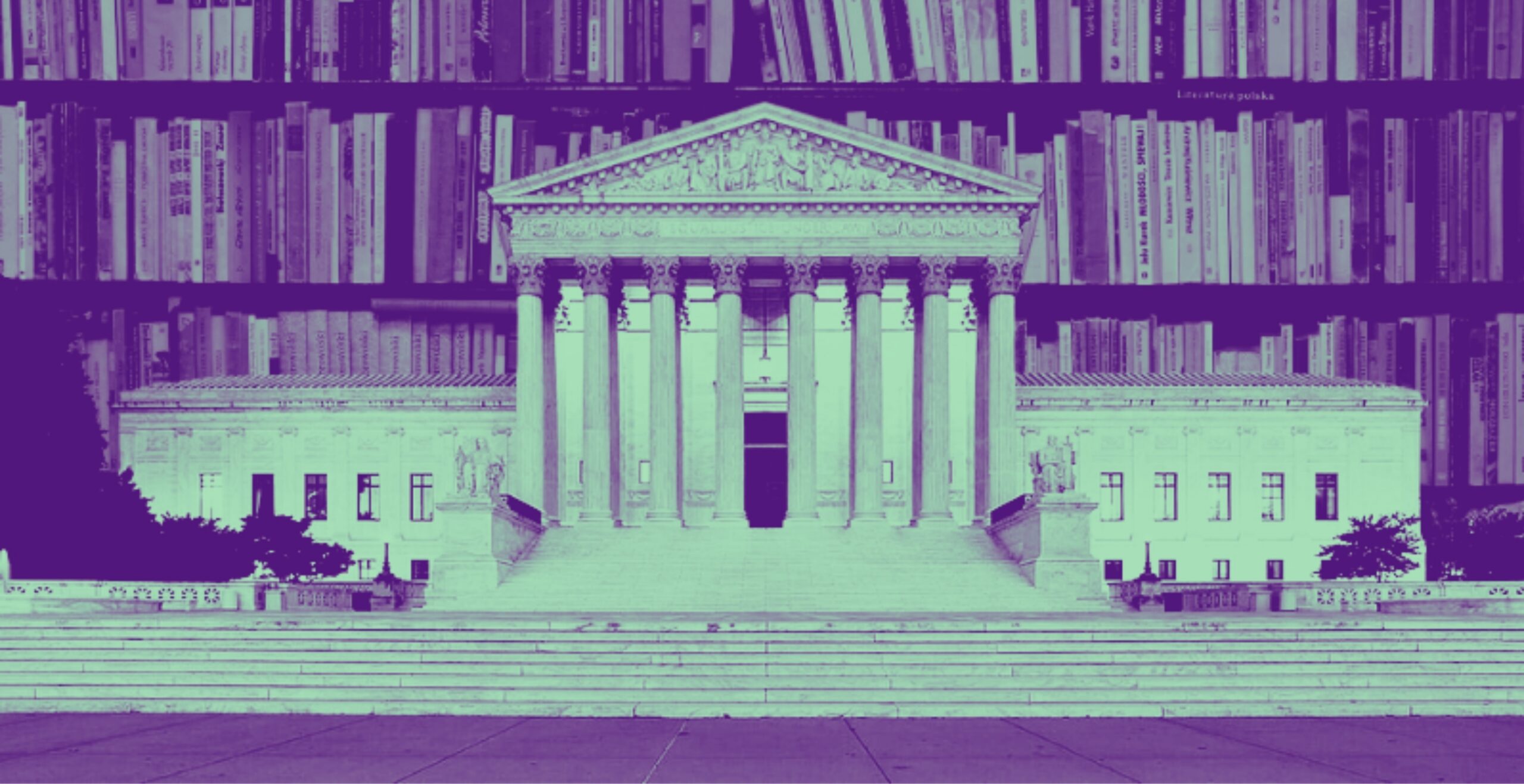
On the First—and, So Far, Only—Book Ban Case Ever Heard by the Supreme Court
Anthony Aycock Looks Back at Island Trees v. Pico,
There had always been efforts to ban books, of course. And in the 1970s, those efforts exploded. In the early part of the decade, the American Library Association’s Office for Intellectual Freedom averaged 100 or so book challenges a year. By decade’s end, there were ten times more. Would-be censors condemned all sorts of literary portraits: unorthodox families, radical politics, race, unflattering portraits of American authority, any mention of Christ, any mention of sex.
Some of the attacks were sobering, as when, on an overcast day in December 1977, the Warsaw, Indiana Senior Citizens Club built a bonfire and chucked in forty copies of the self-help treatise Values Clarification: A Handbook for Practical Strategies for Teachers and Students. Others offered a bit of high camp, like the campaign of Tom Williams, a Baptist minister in Abingdon, Virginia. Characterizing his local library as a “dispenser of hard-core pornography at public expense” for circulating such titles as Philip Roth’s Goodbye, Columbus, Harold Robbins’s The Lonely Lady, and Sidney Sheldon’s Bloodline, Williams accused the head librarian of “feloniously corrupting the minds of children.” The librarian, in turn, accused the preacher of book theft. When Williams tried to get excerpts from these raunchfests published in the local newspaper, the editor-in-chief refused, calling Williams a “nipplehead.”
As for the banned authors, they didn’t take it lying down….Lunks. Emotional meagreness. Hatchet-faced. You take a towering risk when you piss off wordsmiths.
Another controversy occurred in Ridgefield, Connecticut, a town of about 25,000 situated in the foothills of the Berkshire Mountains. In April 1970, a group called Concerned Parents of Ridgefield denounced the Ridgefield Board of Education’s plans for a federally funded junior program called Project TELL. The program would provide health instruction, including sex education, at the town’s junior high school. Norman Little, the head of Concerned Parents, said, “We consider any such activity as part of the school’s curriculum or programs an unacceptable and unjustifiable incursion on the right of privacy of both children and their parents.” Five months later, Little latched onto Playing It Cool, a 1964 anthology that included such oft-censored writers as Langston Hughes, Martin Luther King, Jr., and Claude Brown, author of Manchild in the Promised Land.
Perhaps cowed by Concerned Parents’ aggression, the board voted in 1972 to remove from classrooms Mike Royko’s book Boss, an exposé of Chicago Mayor Richard Daley. Defending the decision, board member Leo Carroll, a former police officer, said, “The first time I opened the book, I came across a section that said the police had burglarized some establishments belonging to peace groups. Now tell me, do you think a policeman would do something like that?”
The banning made national news, with stories appearing from The New York Times to the Los Angeles Times. One political cartoon compared the board to Nazi book burners. The Authors League of America, now the Authors Guild, called the board’s action an “example of fear of the printed word, intolerance and a shocking disregard for the Constitutional principles of free speech.” But Carroll was just getting started. After Boss, he pivoted to Eldridge Cleaver’s Soul on Ice and Police, Courts and the Ghetto, a sociological study by Marjorie Kilbane and Patricia Claire, saying there was “nothing of redeeming social or educational value in the books.” Teachers threatened to strike, but the board dug in.
Tensions might have risen higher if not for a poodle. A poodle hanging from a tree.
The dangling dog belonged to Elfrieda Travostino, president of the Ridgefield Teachers Association, who also told police that an anonymous caller told her she or her children might be next. Fido was fine, if a little bewildered, and in February 1973, the board lifted its book bans. It also, as recompense, eliminated the social studies classes in which the books had been assigned. No lawsuits were filed; no arrests were made. Eventually, the imbroglio faded away.
*
Book banning’s Trial of the Century began in 1975 in the Island Trees Union Free School District in Long Island, New York. Created in 1902 as a common school district (this meant it could operate only a K-8 school; it became a union free district in 1951 so that a junior high, and later a high school, could be added), Island Trees encompassed parts of four towns: Seaford, Plainedge, Bethpage, and Levittown. Most of the area was farmland until World War II, when people began arriving from the city in search of a quieter setting. Over time, it became a remarkably homogeneous area. The New York Times reported in the mid-1970s that there was not one Black student among 4,300 children in the district. Russell Rieger, who had been one of the Island Trees plaintiffs, told me that many of his friends and neighbors “were as Archie Bunker as you can imagine.”
Just after the start of the 1975 school year, three members of the Island Trees Board of Education—Richard Ahrens, Frank Martin, and Patrick Hughes—attended a conference in Watkins Glen. The conference was sponsored by Parents of New York United, or PONY-U, a conservative group headed by right-wing activist Janet Mellon, who formed the group twenty years earlier when she was “appalled” that her oldest daughter was taking a course that “taught boys how to sew and girls how to shave.” Mellon was an enemy of many types of books.
At the conference, she circulated “crudely typed and reproduced” lists of thirty-two titles “considered objectionable by some persons together with excerpts from them containing the more objectionable material.” The lists included, for example, Soul on Ice, which bore the all-caps comments “SEDITIOUS AND DISLOYAL” and “FULL OF ANTI-AMERICAN MATERIAL AND HATE FOR WHITE WOMEN. WHY WOULD TEACHERS WANT HIGH SCHOOL STUDENTS TO READ THIS????” About Go Ask Alice, the list maker warned, “Parents, do not be fooled by the movie version of this book. It reads a lot different. If teachers cannot find a better book than this to illustrate drugs are bad then what are we paying them for.” A third book, Helen Colton’s Our Sexual Evolution, was decried because it “has chapters on Group Marriage, Communes, Abortion, Contraceptives etc. It also promotes women’s lib.” Worst of all, it “costs $5.95 of our tax dollars.”
Ahrens and Martin brought copies of these lists home but didn’t act on them until November 7, 1975–Winter School Night at the high school. Under cover of awkward teen dancing, the pair slipped into the library, riffled through the card catalog, and discovered, in addition to Soul on Ice, eight other volumes in PONY-U perdition. A tenth book, A Reader for Writers, turned up at the junior high school. Finally, book eleven, Bernard Malmud’s The Fixer, was found lurking on a twelfth-grade syllabus.
The matter simmered until February 24, 1976, when the board, after one of its regular meetings, asked Irving Carroll and Ernest Valenze, the principals of Island Trees’ two high schools, to remove the books from the library shelves. Three days later, Superintendent Richard Morrow sent Ahrens a memo questioning this action. “We don’t know,” he wrote, “who developed the list, nor the criteria they used.” He reminded Ahrens of the existing policy for book challenges, which called for Morrow to appoint a committee to study the issue and make recommendations. Morrow was sympathetic to the board’s feelings, pointing out they weren’t that different from the parents’ and predicting that any study committee would agree to the books’ unsuitability. A unilateral ban, on the other hand, “would surely create a furious uproar—not only in the staff, but across the community, Long Island and the state. I don’t believe you want such an uproar, and I certainly don’t.”
Ahrens agreed to the study committee. Yet he thought the board should read the books first, so instead of buying additional copies for that purpose, he took the libraries’ copies. As Morrow predicted, all hell broke loose. Ahrens responded with a March 19 press release, explaining that the board members “in no way are BOOK BANNERS or BOOK BURNERS.” Rather, they were merely trying to protect students from books that were “anti-American, anti-Christian, anti-Semitic, and just plain filthy.”
There was no question the board had made some missteps. It had removed the books without considering the views of the community, evaluated the books by reading only excerpts, and bypassed the district’s official review procedures. At a March 30 public meeting of the school board, Morrow acknowledged these mistakes, insisting that the books would be returned to the shelves while a review committee, which the board would appoint, considered their fate. Ahrens declined to return the books, but he did agree to the review committee, which was appointed on April 6. It met several times over the next two months, eventually voting to restore all the books except The Naked Ape and Down These Mean Streets.
He certainly didn’t expect seven years later to be standing before nine black-robed jurists, struggling to explain why he felt threatened by some F-bombs, a little raciness, and Kurt Vonnegut’s screwball plots.
Didn’t matter. At its June 28 meeting, the board decided to keep all but Laughing Boy and Black Boy in exile.
In response, letters to the editor of Newsday, the Nassau County newspaper, poured in. Many writers reacted with outrage, disgust, or sarcasm. One wag recommended further bannings: The Scarlet Letter, because a minister seduces a young woman; Romeo and Juliet, for the nurse’s “filthy tongue”; and the Book of Genesis, because Lot is a horny old drunk. In contrast, Frank Martin defended the ban, claiming that “letters are coming into the school district at the rate of four to one in our favor.” He invoked Communism, saying that it “undermines the moral fiber of a nation” before asking rhetorically, “[w]hat better way to corrupt our youngsters than by subjecting them to decadent and deviant literature in the schools?” Finally, he encouraged Newsday to “keep the pot boiling…You are inadvertently waking up hundreds of sleeping parents who thought all was well with their schools. And when the giant awakens, his roar of anger will be deafening, and the counter-reformation in education will have begun.”
As for the banned authors, they didn’t take it lying down. In an August 11 speech at Hofstra University, Kurt Vonnegut said that the Island Trees board members “are in the wrong society. If these people find this society uncongenial, then let ‘em go to another country, one where the government worries about people putting ideas into their children’s heads.” Later, he wrote in the New York Times: “Such lunks [the board members] are often the backbone of volunteer fire departments and the United States Infantry and cake sales and so on, and they have been thanked often enough for that. But they have no business supervising the educations of children in a free society. They are just too bloody stupid.” Bernard Malamud also chided the “self-appointed censors” who “reveal their intellectual and emotional meagreness,” but this was a billet-doux compared to Desmond Morris, who decried the Island Trees board as “hatchet-faced ladies with hard eyes and cowrie-shelled lips hovering with ill-concealed rage just around the corner.”
Lunks. Emotional meagreness. Hatchet-faced. You take a towering risk when you piss off wordsmiths.
To Ahrens, none of this was the board’s problem. “This is all politics,” he complained. “If you want to tell your child about this wonderful book, you can take her to the public library. I would not dream of trying to take that book out of the public library. That would be censorship—and we are not censors.” Perhaps he thought that would settle the matter. Maybe he thought most people wouldn’t care. No doubt he counted on all those Archie Bunkers in the community to stick together and support this random act of blindness. He certainly didn’t expect seven years later to be standing before nine black-robed jurists, struggling to explain why he felt threatened by some F-bombs, a little raciness, and Kurt Vonnegut’s screwball plots.
Richard Ahrens had not reckoned on Steven Pico.
_______________________________
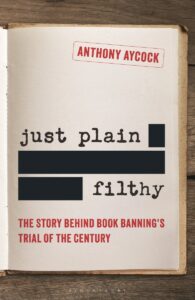
Adapted from Just Plain Filthy: The Story Behind Book Banning’s Trial of the Century by Anthony Aycock. Copyright © 2026. Available from Bloomsbury Publishing.

Anthony Aycock
Anthony Aycock is the legislative library director at the North Carolina General Assembly. He is a writer, teacher, and librarian. He is a regular reviewer for Booklist and Blue Ink Review, and a frequent contributor to Medium and Information Today. Aycock has also written for Slate, the Washington Post, Literary Hub, Reactor (formerly Tor.com), the Missouri Review, the Gettysburg Review, Ploughshares, Creative Nonfiction, and other venues. His first book, The Accidental Law Librarian, was released in 2013. In addition, he has spent 20+ years working in government, academic, and private law libraries, as well as teaching academic and creative writing.