On Humanity’s Earliest Attempts
to Make a Home
Stefan Al Considers the Architectural Prowess of Our Prehistoric Ancestors
In 1753, the Jesuit priest Marc-Antoine Laugier described the origin of dwelling by imagining a lone “savage” troubled by nature’s extremes. This “primitive man,” seeking refuge from scorching heat and torrential rain, initially fled to a cave but found it too dark and filled with “foul air.” Upon leaving the cave, he embarks on a mission. “Resolved to make good by his ingenuity the careless neglect of nature,” Laugier writes, “he wants to make himself a dwelling.”
As Laugier’s story continues, the man wanders through a forest, stumbles upon fallen branches, and has an epiphany. “He chooses four of the strongest, raises them upright and arranges them in a square.” With surprising engineering intuition, he lays four more branches across their tops to create a frame. He then crowns it with a pitched triangle, making a roof truss, and covers it “with leaves so closely packed that neither sun nor rain can penetrate. Thus man is housed.”
This tale of instant architecture became the foundation of Laugier’s influential theory, championing the simplicity of a “primitive hut,” a pitched roof supported by columns, over the theatrical flourishes of High Baroque architecture. While the story shaped architectural thinking for generations, it is far from the historical reality. Rather than a single stroke of genius, the story of human habitation is one of gradual evolution, unfolding over millions of years through the collaborative acts of countless generations. And this story begins not with Homo sapiens but with our distant ancestors.
This history begins in the trees, roughly 14 to 18 million years ago, according to evolutionary biologists, when our great ape ancestors likely developed sleeping platforms. They would bend and weave together branches, twigs, and leaves, creating what we might call the first beds. Building these rudimentary and temporary platforms—something modern gorillas, orangutans, and chimpanzees still do—would have offered protection from predators and blood-sucking insects. Perhaps they offered escape from ground-level humidity as well.
Rather than a single stroke of genius, the story of human habitation is one of gradual evolution, unfolding over millions of years through the collaborative acts of countless generations.
But the real transformation came when our hominin predecessors, the forebears of Neanderthals and Homo sapiens, broke from this pattern. While apes continued to build fresh nests each night, abandoning them in the morning, our hominin ancestors began experimenting with something surprisingly revolutionary: permanence.
One of the earliest traces of this practice was found in Olduvai Gorge, Tanzania, dating back to around two million years ago. Archaeologists discovered stone artifacts associated with early hominin species. Most importantly, these were clustered in specific locations. This suggests our ancestors were creating the first “places,” sites they would return to again and again.
Why bother establishing a favored place at all? Unlike most primates, who consume what they find on the spot, early hominins began carrying food back to a central place to share. Such behavior would have improved the odds of reproduction. “The extraordinarily long period of juvenile dependency necessitates high levels of cooperation and resource sharing by both parents, by other children, and sometimes by other members of the society,” evolutionary anthropologists Steven Kuhn and Mary Stiner observe. “It takes a village to raise a child, but it also takes a long time.”
Regardless of intent, this seemingly simple change—the creation of places to return to—marked one of the most significant transformations in human evolution. Unlike the solitary nests of apes, these early campsites became the first community spaces in human history.
Here, our ancestors did more than rest—they slept, shared food, crafted tools, and passed down knowledge. As several anthropologists have noted, these sites became “arenas for social learning that had not existed previously.” This new social environment may have even helped shape our brains, particularly the neocortex—the region responsible for advanced cognitive functions such as emotional control and planning. This new lifestyle not only set human habitation apart from that of apes, it may have redefined who we were.
This would also have accelerated one of our signature strengths: our ability to make tools, positioning us, as several archaeologists describe, as “ultrasocial engineers.” The earliest known trace of this engineering impulse surfaces at Kalambo Falls, Zambia. There, excavators discovered two interlocking timbers dated to roughly 476,000 years ago—evidence that, as the researchers describe it, offers “a glimpse of a capacity to create a built environment” long before Homo sapiens.
The next major revolution came with the habitual use of fire, beginning around 400,000 years ago. Fire changed human habitation in ways our ancestors could hardly have imagined. It kept predators at bay, illuminated the darkness, provided warmth, and unlocked new food sources, making previously inedible items like grains digestible. This transformed our relationship with time, cutting the time spent chewing raw foods and extending our days beyond sunset.
Around the same period, our ancestors began to more frequently occupy rock shelters and caves. Fire made the inhospitable conditions of caves more bearable, as caverns were often cold, dark, damp, and home to other residents like lions, bears, and hyenas, which had to be displaced. With fire, these places stayed occupied longer. But fire did more than make campsites and caves more comfortable.
“Home is where the hearth is” goes the saying, and in prehistoric times, the hearth was truly the center of the home. Our ancestors gathered around fires to share food, tell stories, and strengthen social ties. As archaeologists Desmond Clark and Jack Harris observed, fire “helped to weld early hominid groups into the coherent family units that are characteristic of human society.”
These more permanent places likely changed our trajectory. They provided safe havens, helping to protect the young and vulnerable and extending the lifespan of the physically compromised. Previously, a bone fracture would have meant certain death. Now, there was hope for recovery.
In some ways, a permanent place made survival easier. But it also required more advanced social skills. This could have affected our evolution. Natural selection could have increasingly favored those better at cooperation, communication, and conflict resolution. The use of fire for cooking reduced the size of our teeth, leaving them smaller than those of other animals. Some archaeologists have proposed that dwelling may have changed our brains. It established a feedback loop: Humans were creating homes, and homes were shaping humans. This process may have influenced the development of future generations in a nonlinear way. As Kuhn and Stiner observed, “More and more, hominins were coevolving with the world that they modified.”
These early settlements proved attractive to other hominins, drawing them in with the promise of food, resources, and companionship. Yet this closeness came at a cost. Exposure to smoke from open fires harmed lungs. Meanwhile, the close proximity of people hastened the transmission of mycobacterial diseases through coughing. Tuberculosis, for instance, is estimated to have caused about a billion deaths across history, more than all famines and wars combined.
Managing fire brought other challenges as well. Early humans had to master the delicate balance between warmth and smoke inhalation. Recent studies of sites like Lazaret Cave, occupied approximately 170,000 years ago, reveal advanced spatial thinking. Hearths were strategically placed in “sweet spots” that maximized heat and light while allowing smoke to escape. Too deep in the cave meant safety from predators but poor ventilation. Too near the entrance meant better air but exposure to cold and danger. This spatial problem-solving reflects not only an awareness of these practical challenges but also an ability to overcome them.
Meanwhile, the control of fire enabled our ancestors to venture into regions like northern Europe during periods when nearly 30 percent of the continent lay under ice, dramatically expanding our territory. It also marked humanity’s first major impact on the Earth. Long before industrial emissions, our ancestors wielded flames as environmental engineering tools. They managed burn zones that promoted fruit- and nut-bearing plants in the postfire regrowth vegetation. Fire became a powerful hunting aid, exposing the nests of small game and driving larger prey into traps. It effectively shrank the “radius of a meal”—the distance humans needed to travel to find enough food. Our ancient use of fire has influenced many ecosystems and spurred the rise of fire-adapted plant species (pyrophytes).
As our ancestors’ mastery of fire grew, so did their ingenuity in creating comfort. More than 200,000 years ago, evidence of the first intentionally created bedding appeared in southern African rock shelters. Early Homo sapiens carefully constructed beds of broad-leaved grasses to enhance their comfort. They placed them close to the hearth—and, judging from the scorched ends of the grasses, sometimes too close. This arrangement mirrors modern hunter-gatherer camps, where people still gather to sleep around the fire.
Neanderthals displayed architectural capabilities of their own. Around 176,000 years ago, deep within Bruniquel Cave in France, they ventured more than a thousand feet from the entrance. Working by torchlight, they deliberately stacked hundreds of stalagmite pieces into two broad rings, some bearing traces of fire. This wasn’t shelter but one of humanity’s earliest monuments. The sheer effort required speaks to sophisticated planning and cooperation.
By 100,000 years ago, hominin settlements show evidence of complex spatial organization. The popular image of Neanderthals living deep in caves turns out to be wrong. Archaeologists found they preferred more accessible spaces near cave entrances and under rock shelters. There, they created distinct zones for different activities, including hearths for cooking and areas dedicated to toolmaking and butchering. They even buried their dead beneath the cave floors and engaged in symbol making, adorning stalagmites with abstract designs using red ochre pigments.
What began as simple returns to favored spots evolved into increasingly sophisticated and enduring manipulations of space that would ultimately distinguish us from every other species on Earth.
When Neanderthals tracked game, they constructed temporary windbreaks from wood and mammoth bones. One striking example comes from La Folie, a 60,000-year-old site in west-central France. In this harsh, cold environment of Ice Age Europe, Neanderthals created what archaeologists believe was a base camp. Preserved post holes suggest a circular wooden structure, likely supporting brush or hides, serving as a windbreak. Within this 30-foot diameter space, they carried out several activities. They rested, shaped stone tools, and prepared meals. They may have even laid mats to soften the floor.
As the Neanderthals gradually disappeared around 40,000 years ago—partly due to competition with our own species—Homo sapiens began taking shelter-building in new directions. In the Dordogne region of France, they occupied rock shelters and decorated them. They made engravings and stained them with red, yellow, and brown ochre, sometimes starting with a preparatory charcoal sketch. Among these earliest artistic expressions were hand stencils, geometric patterns, and animal figures. One of the oldest symbols was probably a representation of the vulva. These endeavors revealed not only the unique symbolic capacity of our species but also an emerging desire to make living spaces distinctly our own.
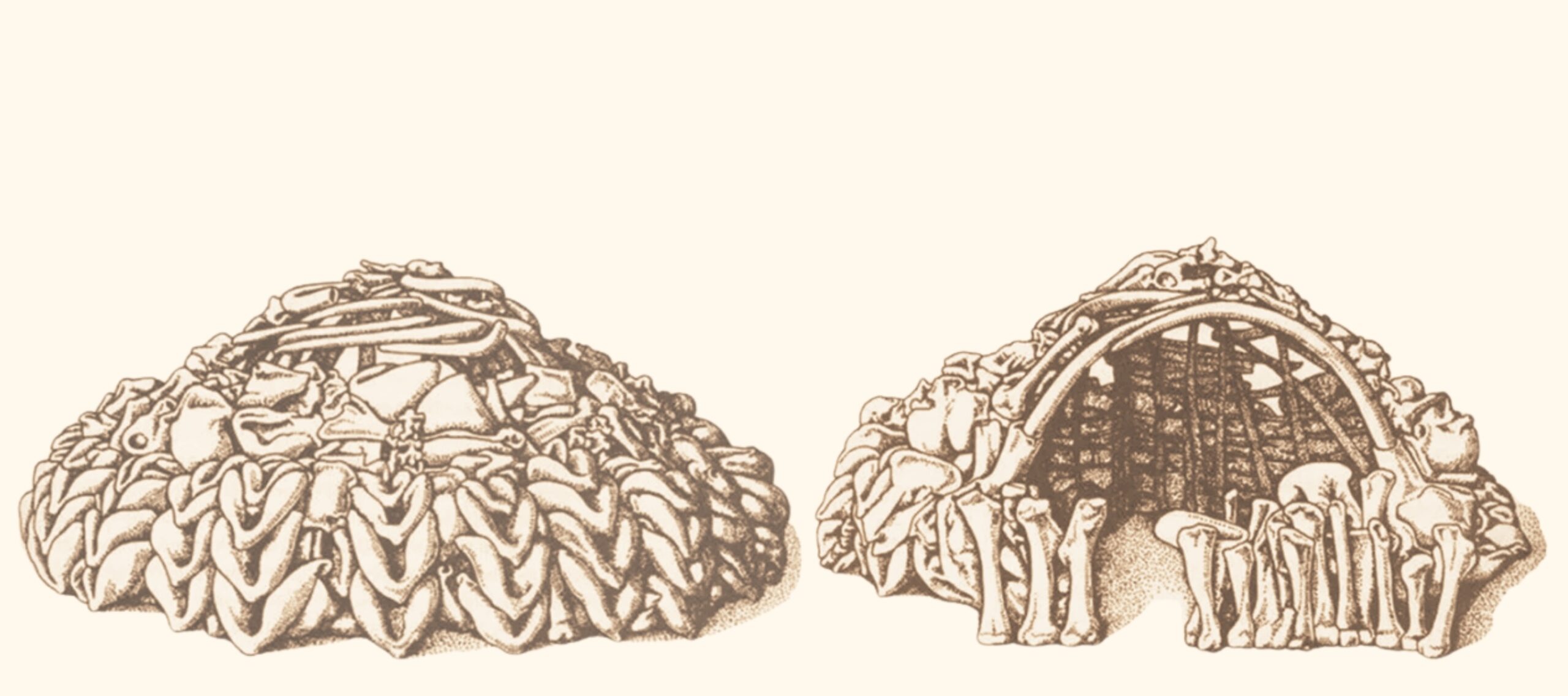
The limitation of caves, of course, is that they have a predetermined location. However, modern humans also built more impressive temporary shelters in open locations. One example comes from Mezhirich, Ukraine, dating back around 15,000 years ago. Here, a group of Ice Age hunter-gatherers constructed oval and circular huts from 120 to 240 square feet in size. They were built mostly from mammoth bones and are among the earliest examples of architecture. The largest of these structures, weighing approximately 50,000 pounds, would have required ten people over five days to erect. Given the extraordinary effort required to build them, these structures may have held ceremonial or symbolic meaning beyond simple shelter.
The mammoth-bone huts represent a level of architectural skill that sets them apart from the instinctive nest building of our ape ancestors. The builders demonstrated a rudimentary understanding of engineering, deliberately placing each bone to exploit its natural geometry. They created a precise oval or circular foundation and arranged leg bones and jaw bones at regular intervals. They positioned the jaws chin down. The leg bones probably upheld a roof, although it is likely that wooden elements would have helped support it as well. The entrance was marked by large upright mammoth tusks. The wall displayed a careful repetition and symmetry using pieces of the vertebral column. Remnants of hearths inside the dwellings indicate the use of bones as fuel. The final effect must have been striking—like igloos made of bone rather than blocks of ice.
Several of these mammoth-bone dwellings have been found across Eastern Europe and Russia. They helped the builders cope with the frigid temperatures near the end of the last Ice Age when ice sheets stretched far into Europe. Archaeologist Steven Mithen describes what these homes might have been like inside: “The floor is soft, carpeted with hides and furs that surround a central ash-filled hearth. Mammoth skulls and leg bones provide furniture; an assortment of leather bags, bone and wooden bowls, antler and stone tools are scattered by the walls and hung from the rafters—a scene of Stone Age domestic clutter.”
In a twist of prehistoric irony, our ancestors’ hunting skills proved too effective, leading to the extinction of mammoths around 10,000 years ago—and mammoth-bone dwellings with them. However, humans also used other building materials, particularly wood. Yet these more perishable materials present a challenge for modern archaeologists. Wooden structures rarely survive. Even when promising sites are discovered, researchers struggle to interpret them, due to their decay. As archaeologist John Yellen noted, “Paleolithic Pompeiis are unknown.” Most of these ancient homes have long since returned to the soil, leaving archaeologists to piece together their stories from fragmentary evidence.
However, on rare occasions nature preserves a snapshot of prehistoric domestic life. One such example was a fisher-hunter-gatherer base camp of six huts on the shore of Israel’s Sea of Galilee dating back 23,000 years. These Paleolithic homes survived thanks to a curiously helpful sequence of events: a fire followed by submergence under lake water, which protected them from decay. They might have remained hidden forever, until a recent drought when water was pumped from the lake. Archaeologists found that the site’s foragers had crafted small huts from brushwood, weaving them into dome-like structures enclosing a central hearth. Near the perimeter, they covered the floor with thick bunches of grass laid out in a tile-like pattern on top of a solid layer of clay.
Yet even these well-crafted dwellings were not meant to last forever. This pattern of temporary settlement continues among modern hunter-gatherers today, like the !Kung people in the Kalahari Desert. They rarely stay in one place for more than a few months due to the intrusion of insects that inevitably follows human habitation. Nevertheless, in these fleeting shelters we find humanity’s first steps toward permanent places in the landscape. What began as simple returns to favored spots evolved into increasingly sophisticated and enduring manipulations of space that would ultimately distinguish us from every other species on Earth.
__________________________________

Excerpted from Dwelling on Earth: The Past and Future of the Places We Call Home by Stefan Al. Copyright © 2026 by Stefan Al. Used with permission of the publisher, W. W. Norton & Company, Inc. All rights reserved.

Stefan Al
Stefan Al, a New York-licensed architect who holds a PhD in urban planning from the University of California, Berkeley, is the author of Supertall and The Strip, among other works. Originally from the Netherlands, he has lived and worked on four continents and now lives with his family in a 100–year–old house in New Jersey.