“No One Talked.” On Growing Up Under Brazil’s Military Dictatorship
Juliet Faithfull Remembers a Childhood Without the Right to Speak Freely
Growing up in Brazil in the 1960s and 70s, I had no frame of reference for free speech. My Spanish mother had grown up with Franco, so all we knew were dictatorships. We were careful with what we said as a habit. When I was eight years old, the reality of censorship entered my life in a direct way. It was 1968, and I was obsessed (like all the other children in our village) with the International Song Festival. At the time, forty percent of the country (including my mother, my sisters and me) was illiterate, and music was our speech, our religion. Everyone watched the song festivals, and people placed bets on who would win.
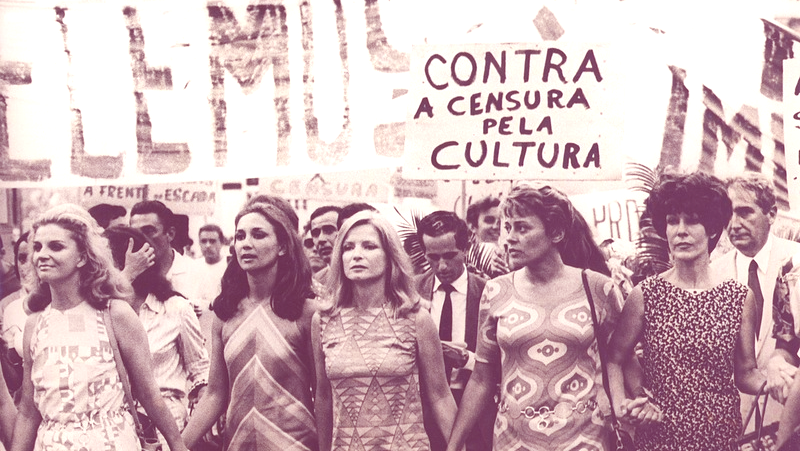
1968 was a time of political turmoil in Brazil. A high school student had been killed, and thousands took to the streets of Rio in what came to be called “The March of the Hundred Thousand.” We lived in a small rural village, so we were sheltered from the demonstrations and the violence happening in universities and cities across the country.
Until the International Song Festival, when the tensions in the country played out on national TV for all to watch.
I’d taken censorship for granted, imagining it was part of what governments did everywhere. I’d assumed that part of the cost of being an artist was the risk of being exiled. Or worse.
The unruly Tropicalia movement, influenced by “western” rock and psychedelic music, competed with more traditional songs. Gilberto Gil’s “Questão de Ordem” (A Question of Order) was disqualified for openly criticizing the government. Caetano Veloso’s “É Proibido Proibir.” (It is Forbidden to Forbid) was booed off stage, but surprisingly, made it to the finals. Each of these developments were discussed by children and adults with fervor. My father disliked Tropicalia but did not believe in censorship. He preferred the more subtle and beautiful Sabiá, by Chico Buarque and Jobim.
On the final night, I watched with my family as Geraldo Vandré walked on stage with only his guitar and sang “Pra Não Dizer Que Não Falei de Flores,” (more commonly known as “Caminhando.”) The fact that the lyrics openly criticized the military and called for action was probably lost on my eight-year-old self, but the beauty of the melody was not. It was simple and moving, everyone’s favorite. Not only in my family, but across the nation. When the jury announced the winners, the atmosphere was charged. “Caminhando” was awarded second place, and the more poetic “Sabiá” came in first. Jeers and boos filled the stadium. People accused the jury of being rigged. Buarque and Jobim’s Sabiá was indirectly political, speaking of exile, a bird singing in a foreign land—but the public wanted a more direct confrontation.
The next day, “Caminhando” was banned.
A few months later the repressive A-5 law was passed, suspending the Constitution and institutionalizing censorship and torture. Vandré was forced into exile, and the song became a symbol of resistance.
We weren’t a particularly political family, but my father knew what was going on, and sometimes he’d make comment about a body being found under a bridge, the government going too far. My mother would shush him and change the subject. She didn’t trust the silence of our walls.
This atmosphere of secrecy extended into personal matters too. I had a disabled twin sister, and one day when I was nine years old, I woke up and she was gone. My parents had sent her away, to live in an institution. There were other secrets too. After we moved from rural Brazil to Rio, our life changed dramatically. My father had a fancy new job, and with it came parties and British expats and tennis clubs. My mother’s illiteracy was kept secret, as was my father’s lack of education (he didn’t finish high school).
There was a tone, a quietness and a particular register of voice that I learned to listen for as a child. It meant they were talking about something forbidden: often, my twin sister’s illness, or later, her institutionalization. It was the same tone when they talked about the government. A journalist my father knew had been killed. The newspaper said it was suicide, by my father knew better. I would strain to hear these snippets, afraid that some other unannounced calamity might ensue.
I was in high school during the worse years of the dictatorship, the “Years of Lead,” as they were called, and my youth sheltered me. If I had been five years older (in university), I might have been arrested and perhaps tortured. Later, I would learn that this had happened to a friend’s older sister, but she never told us at the time. Everyone knew someone who knew someone who was picked up by the military police, but no one talked.
I grew up scared of policemen. I’d cross the road to avoid them. It was preferable to be robbed. When they did stop us, under some pretext or another, we knew they wanted a bribe and it was best just to give it, rather than argue.
A few people here and there, less willing to voice their opinions. This hesitancy and worry about speaking up is the way free speech dies.
When I was fifteen or sixteen, on a trip to London with my family, I went to a Frank Zappa concert. It was rowdy, exciting. Joints were being passed around. I took a hit. Between songs, Zappa launched into funny irreverent monologue about British food, the French, and censorship. l kept looking behind me. My date noticed my anxiety. “Don’t worry,” he said. “Getting stoned in London is no big deal.” “It isn’t the pot,” I answered. “He’s criticizing the government.” I’d never seen it done so openly. I was terrified. I expected the police to storm the place. I couldn’t imagine that it was allowed.
I returned to Brazil with a new sense of what was possible. I’d taken censorship for granted, imagining it was part of what governments did everywhere. I’d assumed that part of the cost of being an artist was the risk of being exiled. Or worse.
I never imagined freedom.
I came to the US as a student, and it took me a long time to understand the idea of free speech. Or the fact that all cops may not be crooks. Freshman year, I did not sign petitions I believed in, for fear of having my name on some list. I never lost my fear of cops.
In 2018 I became a US citizen. I voted and signed petitions. It felt safe to speak up. I went to demonstrations. Unafraid.
But recent events have made me wary. A South African friend and I, both of us now US citizens, discuss the cost of going to an anti-ICE demonstration. Afraid that if we get arrested, we won’t be seen as true Americans. And we are white. What if we weren’t? It feels very much as if my citizenship and sense of belonging could be taken away.
A few people here and there, less willing to voice their opinions. This hesitancy and worry about speaking up is the way free speech dies.
__________________________________
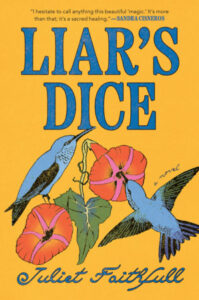
Liar’s Dice by Juliet Faithfull is available from Random House/Thousand Voices, a division of Penguin Random House, LLC.
Juliet Faithfull
Juliet Faithfull is a Spanish-British-American writer who grew up in Brazil. Liar’s Dice, her first novel, was a winner of the 2024 Irish Writers Centre’s Novel Fair and a semifinalist for the James Jones First Novel Fellowship. She was awarded a Pauline Scheer Fellowship by GrubStreet’s Novel Incubator program and her short stories have been published in the Bellevue Literary Review and Urbanus Magazine. A graduate of Harvard University and Smith College School for Social Work, Juliet works as a trilingual psychotherapist and currently lives in Cambridge, Massachusetts, with her two sons.