







No One Really Drives Away from Anything in Horror Films
Tyler Malone on the Open Road and Auto-Eroticism, from "Lost Highway" to "The Hitcher"
I. Taking to the Open Road
Afoot and light-hearted I take to the open road,
Healthy, free, the world before me,
The long brown path before me leading wherever I choose.
These words of Walt Whitman’s—from his poem “Song of the Open Road”—were originally published in 1856 in the second edition of Leaves of Grass, three decades before Karl Benz invented the first modern, gasoline-powered automobile, yet his descriptions of the road in that poem anticipate the iconography, the allure, and the promise of the coming car culture.
In the 170 years since Whitman first wrote these words, not only did car culture emerge and evolve, but it did so on a parallel course—like two lanes on a highway separated only by a broken white line—with a new artistic medium: cinema. Perhaps it’s no surprise, then, that the open road has become one of film’s most iconic images.
You can picture it: The car speeding down the highway, radio up, windows down. The winding road snaking toward a fixed point on the horizon beneath a still blue sky. This tableau appears encased by the windshield, as if under a glass bell. In relation to a pair of snow-capped mountains in the distance, the car barely seems to move, locked in some sort of suspended animation. Though motion parallax makes us feel like we’re not getting any closer to those massive objects in the distant landscape, the blur of the roadside objects that line the highway—an indistinct parade of buildings, restaurants, gas stations, overpasses, trees, telephone poles, tourist traps, muffler men, rock formations, billboards, street signs, roadkill—reminds us that we’re moving at great speed. And in the rearview mirror, what we’ve passed—and made past—recedes. We’re headed off into the unknown, the long black highway before us leading wherever we choose. It’s an image of escape, of movement, of adventure, of self-discovery, of individualism, and—most of all—of freedom.
But these heavenly highways that populate our collective imagination are shown to be something altogether different when they appear in the horror genre: there they expose themselves as highways to hell. As I’ve argued previously, if houses promise safety, then the house in horror reveals that safety as nothing more than an elaborate illusion, an attractive façade. Likewise, if roads promise freedom, then the road in horror proves this freedom to be a mirage.
No matter how far you drive you can never escape yourself.
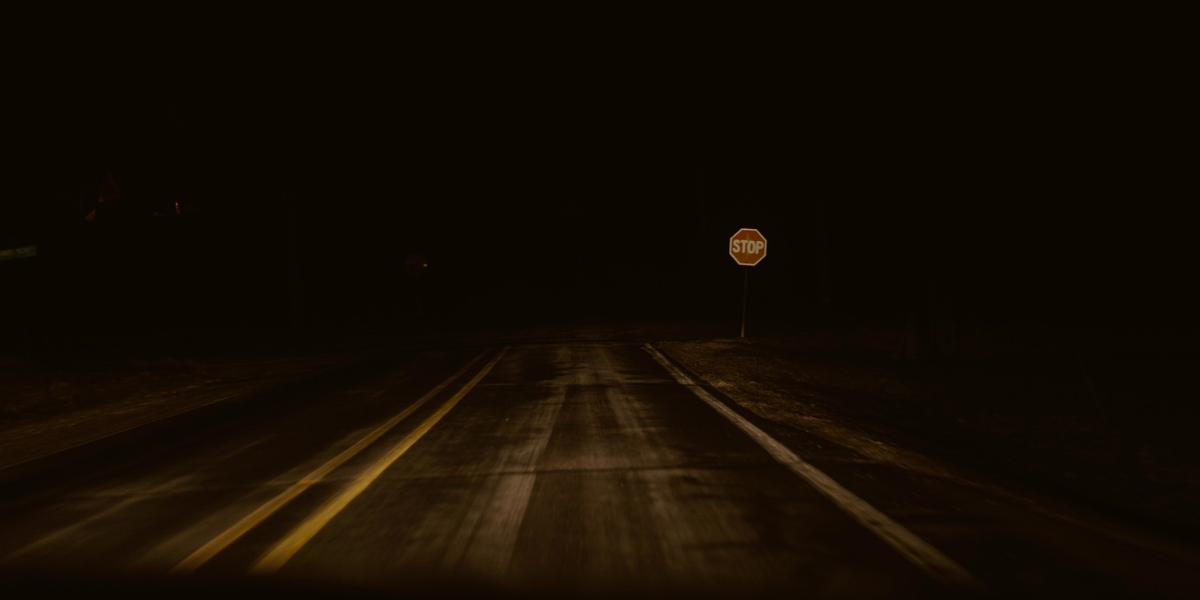
In the horror genre, the automobile shines its brights on the always-already-terror, that occulted world living in the shadows of our own, that is—and always will be—fundamentally un-understandable, though all we ever see are the few illuminated lane lines that stretch out before us on the road ahead and the looming darkness that swallows up everything beyond the tapering light of our headlamps, as in the title sequence of David Lynch’s Lost Highway.
II. No One Really Drives Away from Anything
When we peep in on a hotel room at the beginning of Alfred Hitchcock’s Psycho, two of the first things we see are Janet Leigh’s breasts in a white bra, like those two towering snow-capped mountains on the horizon. We’re catching the tail-end of a lunchtime rendezvous between Marion Crane and her beau, Sam Loomis. Marion tells Sam that she hates having to be with him “in a place like this.” He counters, playfully: “I’ve heard of married couples who deliberately spend a night in a cheap hotel.” Her reply tells us everything we need to know: “When you’re married you can do a lot of things deliberately.”
Being an unmarried woman in 1959, there is much in which Marion is not allowed to partake if she wants to retain the“respectability” she so values. Therefore, her view of marriage as an avenue for freedom should come as no surprise: by hitching herself to a husband, a woman in mid-century America likely gained more liberties than she lost.
Sam, having already been married once—and saddled with not only his father’s debts but, more to the point, his ex-wife’s alimony—has a different view. To him, marriage is confinement. It’s not that he is uninterested in Marion, but that he can’t allow himself to get married again until he is more financially stable, for he too is trapped, albeit in different ways, by the same patriarchal systems that restrain Marion.
In the very next scene, when Marion gets an opportunity to steal $40,000, she doesn’t have to tell us that she sees this money as her ticket to marriage and to all the liberties that institution would provide her; we connect the dots easily enough. As she heads out of town to bring her boyfriend the much-needed money, the motorway may feel to Marion like her road to freedom, but it becomes her hellish highway.
As soon as she’s on the road, she starts playing out in her head the reactions people will have to her crime. We hear these in voiceover while watching her drive, in medium close-ups, close-ups, and extreme close-ups, which are interspersed with her point-of-view shots, looking through the windshield at what lies ahead and into the rearview mirror at what lies behind. Her consciousness seems to split: she’s simultaneously paying attention to the conditions of the road and letting her mind wander. But even as it wanders, her thoughts are tethered to the past, to her crime, to her guilt. No matter how far you drive you can never escape yourself.
Hitchcock gives the road an uncanny presence. Marion is not in any imminent danger—not yet—but her paranoia and the claustrophobic camerawork imbue these driving scenes with an anticipatory terror. She is already in her private trap, even if no one has given her the language to call it that yet. There is an overwhelming dread. We feel something is about to happen because Marion knows something already has.
At the end of her second day on the road, as darkness and rain obscure her vision, she ends up unknowingly getting off the highway onto an old road that the highway has long since bypassed. She sees a neon sign in the distance amid the blur of her wet windshield. The sign reads, “BATES MOTEL,” and just beneath that, “VACANCY.”
This is where her roadtrip ends, in a motel shower just fifteen miles from her destination. Before that fateful wash, she has a conversation with Norman Bates, the motel’s proprietor, that focuses on “private traps” and “private islands.” At one point Norman says to her that “no one really runs away from anything.” He sees no possibility of escape for himself or anyone else: “We’re all in our private traps, clamped in them, and none of us can ever get out. We scratch and claw, but only at the air, only at each other, and for all of it, we never budge an inch.” Freedom is not elusive; it’s illusive.
Marion has not driven off into the sunset with the man who might have been her future husband; she has driven straight into danger. Ironically, though, the danger is not a direct response to her crime. Norman has no knowledge of or interest in her money. The danger is a vacancy in our comprehension, even if a psychiatrist at the film’s close attempts an explanation. In horror, all roads lead to the un-understandable.
Psycho is the ur-text of road horror, even though the driving scenes account for less than a sixth of its runtime and all take place in the first third of the film. It is in this film that cinema’s perception of the road takes a u-turn. This is the directional movement of all highway horror that follows: a reversal of the Whitmanian allure of the open road, replaced by an admission of what has forever been there, the road’s always-already-terror.
The car is a private trap in the guise of a private island. No one really drives away from anything. Think you’re escaping and run into yourself, for our old delicious burdens hitch a ride with us always.
The car is, first and foremost, a sex object.
III. Driving Is a Spectacular Form of Schizophrenia
David Lynch described his film Lost Highway as a “psychogenic fugue,” which is a psychological state of dissociative amnesia in which a person forgets their true identity, wanders confusedly, and often adopts a new persona. This dovetails with what philosopher Jean Baudrillard writes in America: “Driving is a spectacular form of amnesia. Everything is to be discovered, everything to be obliterated.”
Yet Psycho acts as counterpoint to Baudrillard’s famous claim. While it is true that what is outside the car takes on a spectral quality when traveling at high speed, driving does not evacuate the mind of the driver. Movement is not a mental blank slate.
Driving, instead, might be thought of as a spectacular form of schizophrenia. The driver develops a dual self: sure, he becomes the detached amnesiac of Baudrillard’s formulation, but he also becomes a paranoiac, whose mental faculties are, in the words of Whitman, “loos’d of limits and imaginary lines,” a consciousness flooded with memories, hallucinations, plans, facts, thought experiments, emotions, questions, stories, arguments, images, fragments of text and song. It is not so much that Baudrillard is wrong, but that he is only half-right. The emptiness that the road elicits must be filled—so we fill it. The mind creates its own traffic.
The road demands our attention: we must stay in our lane, mind the changing speed limits, react to our fellow drivers, look out for our exit, etc. One self attends to these demands, but this liberates a second self to imagine or to interrogate, to dream or to remember, to plan or to play. Yet it’s not just that the first self’s concentration and responsibility allow the second self to be liberated from the immediacy of the present, but that the second self is actually birthed by the boredom of the body’s occupation. The repetitive nature of the drive and the simple mechanical actions that maintain it force the unstimulated mind to meander and consciousness to proliferate.
IV. The Royal Road to the Un-Understandable
This schizophrenic self that emerges in a vehicle is what links road horror to dream states. As in Lost Highway, it is not just that the driver has a fractured consciousness, but that reality itself fractures around such consciousnesses.
Lynch’s film is ouroboric. It begins and ends with the same image: a rush of road beset by darkness with only the broken lane lines on the asphalt ahead given any illumination by the headlamps.
One of the road’s great appeals is its linearity. It is Whitman’s long path leading wherever we choose. Even if a road curves, it is directional and takes us away from our current position. It has a beginning and an end, an origin and a destination. It leads elsewhere. The nightmare of Lynch’s film is that the road’s linearity—and, by extension, our own linearity—is as illusory as its—and our—freedom. Movement is not always progressive. The road becomes a Möbius strip, a never-ending loop of surface. It spirals in on itself as we spiral in on ourselves.
Distance is often flattened in horror through spatial-temporal confusion. Michael Myers can walk slowly in pursuit of his prey, yet he always manages to catch up to them. But this flattening of distance is exaggerated on the road, because the reach of a car extends far beyond that which can be done on foot.
In Robert Harmon’s The Hitcher, hitchhiker John Ryder seems at odds with the physical reality of the road and its landscape. Whether or not he is a projection of Jim Halsey’s consciousness, he never occupies a stable reality: he appears, disappears, and reappears as an oneiric presence. That is not unique to this film; the same is true of other hitchhiking entities in horror, the Dust Devil in Dust Devil, the Passenger in Passenger, etc. as well as of equally anomalous terrorizing vehicles, like the tanker truck with its faceless driver in Steven Spielberg’s Duel, which seems to be around every bend in the road, ready to attack.
Yet the oneiric qualities of road horror still do not make the driving-event amnestic, as Baudrillard claims. Even if they allow for temporary flight from our past and our identity, dreams are deeply rooted in the self. This is why Sigmund Freud saw the interpretation of dreams as the royal road to the unconscious, because dreams are not meaningless or random; they are expressions of repressed desires and subsurface struggles dressed up in elaborate disguises playing make-believe in the theater of our repose.
Though dreams are tangled up in our desires, Freud’s royal road to the unconscious is not unlike the road in Lost Highway, and other similar Möbius strip horrors, such as the purgatorial Dead End. The unconscious is not a destination to be mapped or even reached. If Freud’s royal road leads anywhere, then it leads only to the impossibility of arrival. It is the royal road to the un-understandable.
V. Auto-Eroticism
The road to horror is paved with sex and death drives. Since the beginning, the car has always been a locus for Freud’s competing instincts: Eros and Thanatos (those old delicious burdens).
The car is, first and foremost, a sex object. Its embodiment of masculine power makes it a perfect symbol of virility. The need for speed is erotic, and the car both represents and fulfills this desire. The car’s engine vibrates with the promise of bodily pleasure.
In fact, even before the popularization of the automobile, movement itself was sexualized. In an early essay, “Infantile Sexuality,” Freud explains, “A compulsive link of this kind between railway-travel and sexuality is clearly derived from the pleasurable character of the sensations of movement.”
The un-understandable which has dominion over our meat likewise has dominion over our machines.
In previous centuries, horse-drawn carriages sometimes hosted romantic trysts, but with the mass production of Henry Ford’s Model T in the early 20th century, the now widely accessible car allowed more people this amatory freedom, especially teenagers and young adults. Cars offered a private space where young people could spend time with one another away from parental supervision. The car became a place of sexual experimentation, contributing to the changing sexual mores of the century and helping usher in the sexual revolution.
The car completes the centaurian myth of fusion of man and animal, the intelligence of the former and the power of the latter; we see this in the way we talk about engines by using the bestial (and sexually suggestive) term “horse power.” Even though the car is the thing that rid us of our dependence on animals for speed and distance, it ironically better completed this centaurian myth than horseback riding did. When man rides a horse or drives a horse-drawn carriage, he enters into a relationship with another creature. They may work as a team, but they are still two distinct beings, not one. The horse has its own consciousness and desires.
Baudrillard discusses the difference between horse and car in his book The System of Objects: “In the love relationship the tendency to break the object down into discrete details in accordance with a perverse autoerotic system is slowed by the living unity of the other person. When it comes to material objects, however, and especially to manufactured objects complex enough to lend themselves to mental dismantling, this tendency has free rein. With the automobile, for instance, it is possible to speak of ‘my brakes,’ ‘my tail fins,’ ‘my steering wheel’; or to say ‘I am braking,’ ‘I am turning’ or ‘I am starting.”
He determines that the horse does not allow for this confusion. While we can say “my horse,” we would not dare to take ownership over the horse’s “parts.” We would not, for example, say “my hooves” like we would say “my tires.” This is because the automobile is a machine which “we are concerned not with having but with being.” This is the modernized centaurian myth; call it the cyborgian myth, where the machine becomes an extension of the man, the car his prosthesis.
In John Carpenter’s Christine, the titular car becomes an object of sexual desire and, ultimately, obsessive fixation. In some ways, Christine functions as a sexual partner—as in the “show me” seduction and striptease where Christine does her own bodywork—but Christine also functions as an extension of Arnie Cunningham. She is his repressed desire metastasized into an external object. But even if we take the film at face value and grant the premise that Christine is possessed, this is not merely a relationship between two sexual beings, but rather a narcissistic projection, through which Arnie comes to desire in Christine an idealized version of himself.
In this way, the auto-erotic is always autoerotic. It’s not that there’s no potential for encounter with the other. As we will see, the driving-event is always a road-encounter, but the car is an extension of the self and the mechanophilic desires we have bound up in it are inherently onanistic.
In Christine, a film about a serial killer car, the vehicle’s capacity for violence is clear, but this extreme example is but a grandiose image of what we know is always true: the car constantly careens toward death and destruction. Drive one long enough and an accident is basically inevitable. In fact, it’s ironic that we call an accident “an accident” since the crash is the car’s most certain destiny rather than some unlikely mishap.
But if accidents are inevitable, then why would we continually risk getting back behind the wheel? The truth is the car gives us pleasure and power as well as danger and violence—and we desire both poles of that binary.
In Crash, David Cronenberg’s adaptation of J. G. Ballard’s novel, our sex and death drives collide where desire is auto-erotic accidental recreation. Robert Vaughan, the cult leader of a group of car-crash survivors who recreate the collisions of famous figures and find sexual gratification in vehicular destruction, explains that “the car crash is a fertilizing rather than a destructive event,” but the film understands that these possibilities are not mutually exclusive. Vehicular collision remains an act of destruction, but its destruction is generative: it ruptures the body’s relationship to pleasure, opening it up to new forms of desire.
Here, Eros and Thanatos, the double helix of desire, become indiscernible from one another. The car crash functions not only as the impetus for a sexual awakening, but as an accidental catalyst for the need of compulsive repetition of the initiating event, forever chasing the dragon of that orgasmic smash. The accident must be repeated to truly live (though it is now no longer an “accident”). The violence must be revisited, and the danger heightened, for the closer the proximity to death, the more pleasurable the living experience.
Julia Ducournau’s Titane similarly presents sexuality—and bodily fluidity—as emerging from a traumatic accident. Both films emphasize the compulsion of auto-erotic autoeroticism, but Titane pushes Vaughan’s description of his project in Crash—“the reshaping of the human body by modern technology”—ever further. Desire becomes auto-erotic trans-mission-fluid, in which machine re-engenders man.
If the cyborgian myth of car culture promises human mastery over technology, it also reminds us that we have little mastery over our meat: the desires that dictate our actions remain mysterious to us. As the distinction between man and machine disappears, our lack of bodily autonomy, which is already so great, may only become greater. The un-understandable which has dominion over our meat likewise has dominion over our machines.
VI. Rearview Mirror and Windshield Diplomacy
If sallying forth upon the open road is meant to be an escape from the other, where the self proliferates and the auto-erotic becomes autoerotic, we will be sorely disappointed by any driving-event, for every driving-event is a road-encounter not only with the self, but with the other. There is always interaction with our own passengers, with other drivers, with passengers in other cars, with pedestrians, with hitchhikers, with people in the places we stop at along the way.
Diplomacy is always a two-way street. It is built on reciprocity. We must make concessions and compromises.
The frames offered by the car’s windshield, windows, and rearview mirror, when catalyzed by the oneiric ennui and schizophrenic paranoia of the drive, create a crucible for a unique brand of voyeurism.
Hitchcock’s Rear Window, though not a road horror film, is about the moral dilemmas associated with encounters with the other, particularly with regards to voyeurism. L. B. Jeffries and his girlfriend, Lisa Fremont, discuss “rear window ethics.” Jeff is confined to his apartment due to an accident. His immobility becomes the condition of his scopophilic tendencies, but he wonders “if it is ethical to watch a man with binoculars and a long-focus lens.” Stella, his nurse, laments that “we’ve become a race of Peeping Toms.”
Richard Franklin’s Road Games, a loose remake of Rear Window set on the Nullarbor Plain Highway in Australia, takes these quandaries into the realm of the road. In Road Games, Patrick Quid is a truck driver delivering meat crosscountry. Unlike Jeff in Rear Window, he is mobile, but his mobility is also constraining. He drives the highway, but he is confined to the cab of his truck during the drive. This is his mobile home, because according to Baudrillard, “The car achieves an extraordinary compromise, for it makes it possible to be simultaneously at home and further and further away from home.”
The automobile, therefore, remains a private space, but on the road, it becomes a private space within a larger public one. Its windows allow those within the car to peer out, but they also allow those outside the car to peer in. We are unwitting exhibitionists as much as we are conscious voyeurs.
Whereas Jeff’s neighborhood is organized by architecture, Patrick’s is organized—or disorganized—by movement. The road’s “neighborhood” is precarious, unstable, in flux. The travelers he sees on his journey (and who see him on theirs) constantly fall behind him or overtake him. Their proximity is temporary and provisional.
In Rear Window, Jeff can sit back and passively watch his neighbors, but no such allowance is made for a driver because a driver is inherently active: he drives. Patrick must participate in a way that Jeff need not. He chases and is chased. He causes collisions. He picks up hitchhikers, one of whom is the runaway daughter of a diplomatic advisor. “Life was incredibly diplomatic in Canberra,” she jokes. Now she’s looking for excitement, and the road can offer that, but the road is also a space that necessitates diplomacy. Driving, therefore, is not merely about rear window ethics, but about rearview mirror and windshield diplomacy. We must determine how best to interact with others on the road.
Diplomacy is always a two-way street. It is built on reciprocity. We must make concessions and compromises. Without mutual respect, the already dangerous highway becomes a minefield of menace. This is why Spielberg’s Duel is so unnerving: the tanker truck driver terrorizing David Mann is undiplomatic (to put it mildly). His lack of road diplomacy—his road rage—is heightened to psychopathic degrees and puts everyone in his path at risk. We do not see the truck driver’s face, so he essentially becomes machine—not unlike the car in The Car, which doesn’t even have a driver at all—but as machine is equally un-understandable.
VII. Here Is a Man Tallied
If the road is a Möbius strip that leads us nowhere, that does not mean it offers us nothing. On the road we are confronted with the self, with the other, with meat, with machine, with sex, with death, with dreams, with desires, with drives.
Though the horror genre undermines much of Whitman’s romanticized road, there remains some common ground with what Whitman assumes is to be found out there on the open highway:
Here is realization,
Here is a man tallied—he realizes here what he has in him,
The past, the future, majesty, love—if they are vacant of you, you are vacant of them.
But if the road offers a realization, it is the realization of the always-already-terror, that ever-present occultation. Think you’re escaping and run into this vacancy. It is the vacancy in you; you are the vacancy in it. The long black highway before us sees us always crashing in the same car. Accidental recreation.

Tyler Malone
Tyler Malone is a writer based in Southern California. He is the founder and Editor-in-Chief of The Scofield as well as a Contributing Editor at Literary Hub. His writing has appeared in the Los Angeles Times, Lapham’s Quarterly, the LA Review of Books, and elsewhere.