New York Pastoral: Sitting Outside and Inside With Eileen Myles
Rosa Campbell Considers the Decades-Long Development of an Iconic Poetic Voice
Sitting outside in America is an Eileen Myles pursuit. Every time I do it I think of an Eileen Myles poem—from throwing open “all the doors in my home” because “There’s a pulse outside I want to hear” in “Immanence” (Maxfield Parrish, 1995) to the “fat little Buddha” in the yard in “Sweet Heart” (evolution, 2018), ice cracking as the poet pours coke—decidedly not Fresca—into a glass (I, a Brit, once had to get them to explain Fresca to me).
In one of my favorites, a quiet poem called “our happiness,” a late afternoon stoop is illuminated by a last bit of money spent on “a strong cappuccino / which we shared / sitting there & / suddenly the / city was lit.” It is a relief, therefore, to discover afresh that Myles has been sitting outside in America since the beginning of their career.
Their new book, lovingly published by Fonograf, comprises sorely needed reprints of their first three books—The Irony of the Leash, A Fresh Young Voice from the Plains, and Sappho’s Boat—along with Bird Watching, written in 1978 but emerging wet behind the ears in print for the first time. The book begins in a “green lesbian summer”—you know the ones—that is also a “rock ’n roll summer / pregnancy summer / slick uptown summer,” in which sitting outside is perhaps the only thing to do. With Myles we sit on stoops, on the street corner, on curbs, on fire escapes (or in fact, delightfully, “firescapes”—the portmanteau evoking both the cityscape of the New York skyline and perhaps something grander, stranger).
Bird Watching, the never-before-published long poem that is, as Myles puts it, “the main heave of this volume,” is an astonishing epic of restlessness, but one that returns and returns to “kick the door in” and sit down at a typewriter. In “The Lesbian Poet,” a talk Myles gave at the Poetry Project at St. Mark’s Church-in-the-Bowery in 1994, their meditations on poetry as a “menu” are seemingly interrupted by a call from their girlfriend, eating on the corner of First Avenue and 10th Street, asking “do I want to come by.” They do not go—instead, they say, “I go shooting forward sitting right here.” This is the experience of reading their early work; sitting alongside Myles, we are propelled forth, out into the streets of New York, back into the past, and yet also—inevitably, inexorably—forward to the effulgent future that awaits their young writer. We sit, and yet are transported out into the porous world.
Sitting alongside Myles, we are propelled forth, out into the streets of New York, back into the past, and yet also—inevitably, inexorably—forward to the effulgent future that awaits their young writer.
I sit on a porch at my friend’s place in Portland and help a cat called Ceridwen birdwatch. She is an Eileen Myles creature: a cosmological being, strung to the nerve-pathways of the universe—always turning her knife-like attention on new things, always the center of gravity in the room, and always, always talking: “just sitting on my branch / going chirp.” Like Myles, she is also an animal of simultaneity; an indoor cat with outdoor interests. Because, despite the endless green that is the key motif of Bird Watching (leaves, money), its “I” is to some extent also an indoor cat: naked and tapping away in front of an open window, somehow both inside and outside at once.
Like their great influence Jimmy Schuyler, in their early poems Myles is perennially looking out through the glass, but unlike in Schuyler’s work, where an aperture is often a frame around a slice of almost-inaccessible world, in these poems the window is something to be climbed out of, something white cats “hop” through, or from which strange men “dash[ed] / out”—a permeability echoed in the way the poems shift impatiently between interior and exterior. New York, so indivisible from our sense of Myles, is one vast stoop, “the biggest home / you could possibly have.”
Myles has lived in their rent-stabilized apartment on East 3rd Street since 1977, and it has become part of their iconography, its whitewashed brick and unmade bed forming the backdrop to archetypal photos of them, appearing in numerous Instagram posts as well as venues like The Paris Review, and becoming the cover of their 2018 collection evolution. Although they have now lived for many years between this apartment and a place in Marfa, Texas, it remains tied inextricably to their work, a spatial symbol of both their longevity and status in the downtown scene, and their commitment to a surprisingly domestic poetics. Yet the poems gathered in the new Fonograf volume are, unlike everything they’ve written since, not all 3rd Street works.
Much of The Irony of the Leash and A Fresh Young Voice from the Plains were written in an apartment in Thompson Street in Soho, before Myles moved to “the poet neighbourhood” in the East Village. They recall writing “Greece” during a “hot miserable New York summer” in the old apartment, desperation for an impossible “blue Aegean” threaded through every line. The 3rd St. apartment is a kind of watershed in Myles’ story, marking the transition from a state of “temporary / permanence” as a New England blow-in who “shouldn’t / talk like a lifer” (“New York”) to the certainty of being “a 28 yr. old poet living / in New York City in 1978” (Bird Watching). 1977 was the end of a period of somewhat anarchic training in the Poetry Project’s famed workshops, and the year that John Ashbery published their poem “An Attitude About Poetry” in The Partisan Review.
The same year, Myles also began publishing their own little magazine, dodgems, as well as Ladies Museum, a one-shot mimeo of downtown women poets co-edited with Susie Timmons, Rochelle Kraut and Ann Rower. If in the first years of being in New York Myles was, in their words, “an early dyke to the extent I’d still go fuck a man,” by the time of Sappho’s Boat they are clearly laying a deliberately unsubtle claim to a lesbian tradition. The new book straddles all these shifts: from a love of juxtaposition in The Irony of the Leash (printed in 1978, one of four books published by Jim Brodey, including one by Brodey himself), to the self-reflexive “cheap talk” of A Fresh Young Voice from the Plains (published in 1981 by Joel Chassler and Barbara Barg at Power Mad Press), to the love poems and self-assured declamations of Sappho’s Boat (published in 1982 by Dennis Cooper’s Little Caesar Press in Los Angeles).
It is in Bird Watching, though, that the 3rd Street apartment perhaps finds its hitherto sequestered monument. Written about six months before Bernadette Mayer’s masterpiece, Midwinter Day, Myles’ requisite ‘long poem’ is a similar testament to the powers of accumulation and attention, gathering in everything under the literal banner of the title:
sign over my desk
“BIRD-WATCHING”
holds summer
or my life together
The re-publication of Myles’ first three collections is thrilling and long overdue, but the premiere of Bird Watching is momentous. It is an epic in what Timothy Gray would term the New York School’s “urban pastoral” mode: sat at their typewriter overlooking the New York Marble Cemetery (also the graveyard of “Continuity”), the poet holds a months-long dialogue with the world, via a set of birds they cannot see and “don’t understand.” Yet despite its deep commitment to typewriter, window, birds, tree, Bird Watching is utterly various, by turns funny and harrowing and stupid and philosophical, moving ceaselessly between the chaotic, article-less staccato of a downtown party, the sober litany of Cambridge’s “Leverett House, Dunster House, Adams, kirkland, Fogg Library” with “daddy sleeping / it off” (the tenderness of “daddy”!), and back home to take phone calls or write “CHANGE SOMETHING” on the mirror in soap.
More than any other work by Myles it is a poem of becoming; a chronicle not just of daily life but of poetic endeavor, its vagaries and failures; the delight in airy “small bird” notations and the frustrations of “heavy fucking columns / goddamn statements descriptions.” Within the first few pages “musical berries” self-consciously become “melodious berries,” but of course simultaneously remain “musical”—revised but unexpunged. Bird Watching is a record of such adaptation, a palimpsest of rewrites and reviews that refuses finalization (it is perhaps no surprise, then, that Myles namechecks fellow Bostonian poet, “my secret pal, Bunny Lang,” with her sense that “Not to finish becomes the challenge”). In particular, Bird Watching pays attention to the strange and almost embarrassing externalization of self that poetry can be, as Myles considers what it is “[t]o be a real idiot / to perform my day.” As I read it, though, I was struck over and over again by the simultaneous bravado and vulnerability of such a position, by the open window as fundamentally reciprocal.
A peculiar thing about encountering a poet we already know in their most nascent state is that we can’t help but read teleologically, hunting for those moments in which Eileen Myles sounds most like ‘Eileen Myles.’
This creates, of course, an incredible porosity in their writing, the sense that we can enter it entirely, invited into the bedroom, the bathroom, the kitchen. In “Homebody,” the first poem in the first book of poems they ever published, Myles quite literally opens the door to the reader with their inaugural line: “Oh, Hello. C’mon in.” The intimacy is immediate: the poem is not just put “squarely between the poet and the person, Lucky Pierre style,” as Frank O’Hara would have it, but in fact seems to have physical heft behind it, plonking the reader into a chair, practically force-feeding them fishcakes. The “you” of “Homebody” is not some universal second person, but a beloved friend, a lover, familiar to the point of carelessness—why put on matching socks when “Nothing’s / as fetching as the raw”? This is a libidinal poetics, in which the body of the poet is always present: clothed, naked, masturbating, drunk, eating. Indeed, lovers of the “low-glowing / hunger” that permeates some of Myles’ best-known work (the pizza in “Triangles of Power,” the “red plate of pasta” in “Holes”—yes, the one that is “like your cunt / on a plate”—the peanut butter of, well, “Peanut Butter”) will find in these republished and newly published poems a glut of things to fill them up: cheeseburgers, soup, bread, “onions and tomatoes soaked / in vinegar oil and pepper and garlic powder,” “frosty vodka / cheese & animalistic bread.” “Fuck brunch,” they write with characteristic omnivorousness, “I want dinner.”
This kind of attention to life’s materiality is omnipresent in Myles’ work, but its economic reality is felt nowhere more acutely than in their early work. As compared to the romanticism of the oft-reiterated tale of coming to New York “to be a poet,” or even the mythologizing nostalgia of “Holes,” here we have the immanent, unadorned reality of dental bills, the job hunt, the unemployment line (albeit a reality somewhat tempered by the vision of Angela Davis in the same queue). The Irony of the Leash, in particular, is a collection remarkably obsessed with money, right down to the anti-ars poetica “An Attitude About Poetry,” in which the attitude in question “is somewhat / this, I should be doing something / that pays more money.”
Such anxieties percolate through all the early poems, the very existence of which are the result of an embattled negotiation with the concept of labor: “poetry as opposed to a job” in Irony becomes “got this job / but fuck it / this is the real job” in Bird Watching. Myles has always, to me at least, embodied a kind of effortlessness when it comes to their work—think, for example, of the shrugging, easy miracle of “I can / connect // any two / things // that’s / god” in “Writing”—yet a poem like “Dear Muse” from Irony complicates such a relation. This poem feels early not because of a significant stylistic difference, but because this is a poet seemingly still working out if they even want to be one, so much does poetry impinge upon their world; a “yellowing force that drips / across August,” “a fucking distraction.” This is the “weekend writer” of Bird Watching, the one for whom making rent, they claim, is more necessary than making art. Yet there is hard graft here too; far from the divine control the poet wields in “Writing,” in “Dear Muse” the tail is wagging the dog—or rather, poetry is the dog, wilful and disobedient, always in the way but seemingly lacking recall: “Here, Musie Musie Musie!”
Myles is, of course, a dog poet—even before Rosie (of Afterglow fame) or Honey or, most recently, little Charley. In Bird Watching dogs are part of the cacophonous city symphony playing outside the 3rd Street window, the “unowned pets” that become “my birds and dogs” by virtue of Myles’ seemingly inalienable right to own all they witness. The irony of The Irony of the Leash is that dogs barely feature until the title—and final—poem (particularly if one glosses over the dog-eating in “Onward Upwards & Always,” as I would distinctly prefer we do), but once there, they are the central conceit: as Bob Rosenthal put it in his review of the book in 1978, it is “a selfless comparison between the ‘I’ and a dog, how Every ‘I’ yearns for some sort of leash.” The most important dog in these pages is Skuppy the Sailor Dog, his “ownership of his / own small tug” a canine echo of Myles in their poetically mobile apartment. Skuppy also looms large because he appears on the verso of about forty pages of the original typescript of Bird Watching, the remaining pages made up of copies of the final stanzas of “The Irony of the Leash,” the copyright and title pages for Jim Brodey’s mimeographed print run of Irony, and its dedication page, featuring Myles’ mother’s Polish name. Dogs endlessly chasing the birds. (In the new version of Bird Watching, it has been excised of its doggy flipsides.)
Dogs are not the only continuity we can trace across Myles’ prolific career, and a peculiar thing about encountering a poet we already know in their most nascent state is that we can’t help but read teleologically, hunting for those moments in which Eileen Myles sounds most like ‘Eileen Myles.’ We can’t transport ourselves to a place of unknowing, and the fact is that Eileen Myles is about as famous as a living poet can become.
Still, they weren’t always. On the 16th of June, 1977 (a Thursday, and a new moon), Myles joined Alice Notley in an appearance on the cable TV show Public Access Poetry, “coming to you from ETC studios at the heart of East 23rd Street.” The show was a ragtag, DIY affair that ran for a couple of years, featuring downtown poets connected to the Poetry Project, and Myles—much less established than Notley, though only five years her junior—is introduced ironically via a t-shirt printing enterprise and their editorship of the newly published dodgems. They don’t have a book yet, but they are writing the poems you can now buy and hold once again. In a white raw-hemmed shirt, they open by reading “Misogyny,” endlessly pushing long hair back from a smirking, unlined face. They look impossibly young as they declaim “I am prepared // to be a saint,” the stanza break leaving them suspended in an almost-sanctified hinterland, prepared for anything. Nearly forty years later (though I experience both simultaneously in an Edinburgh kitchen in 2025), the veteran broadcaster Michael Silverblatt says to Myles, “Now you’ve always known that you would be famous.”
It is not a question, and Myles does not treat it as one, simply clarifying, “I mean, in that way that part of growing up Catholic is do you or don’t you want to be a saint.” This slippage between canonizations runs throughout their ouevre—in Chelsea Girls they declare “I am a significant person, maybe a saint, or larger than life.” Silverblatt is right, they’ve always known; this same certainty radiates from the 27 year old that wrote “Misogyny,” the one smirking as they lean over the podium to deliver a flood of names from Rudyard Kipling to Bernadette Mayer to Jackie Gleason, using “Walter de la Barbara” to get from Barbara Walters to Walter de la Mare, and clearly enjoying the ripples of speculative tittering as they repeat, eyebrow twitching, “Trixie. Lily Tomlin. Trixie. Lily Tomlin. / Trixie. Lily Tomlin. / Trixie. Trixie. Trixie.” Recently Myles told me that “it’s not that younger people are easy, just braver.” The poet we find in their early work is just that: incredibly young, not particularly easy, and extraordinarily, laughably brave. Chirp chirp.
____________________________
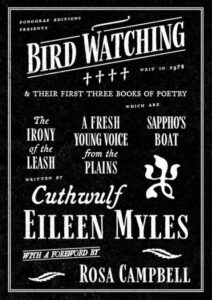
From Bird Watching and Their First Three Books of Poetry by Eileen Myles. Copyright © 2026. Introduction copyright © 2026 by Rosa Campbell. Available from Fonograf Editions.

Rosa Campbell
Rosa Campbell lives in Edinburgh, Scotland, and is a British Academy Postdoctoral Fellow at the University of St Andrews, where she teaches poetry, poetics, and queer and feminist studies. Her first book, Pothos, a lyric essay/memoir about grief and houseplants, was published in 2021 by Broken Sleep Books, and she is the editor of The Miraculous Season: The Selected Poems of V.R. ‘Bunny’ Lang (Carcanet, 2024; forthcoming in North America with NYRB in July 2026). She is currently working on a critical biography of Lang and a book on the poetics of failure.