Never-Ending Brightness: How Excessive Exposure to Artificial Light Is Hurting Us All
Rowan Jacobsen on the Impact of Insomnia on Human Health
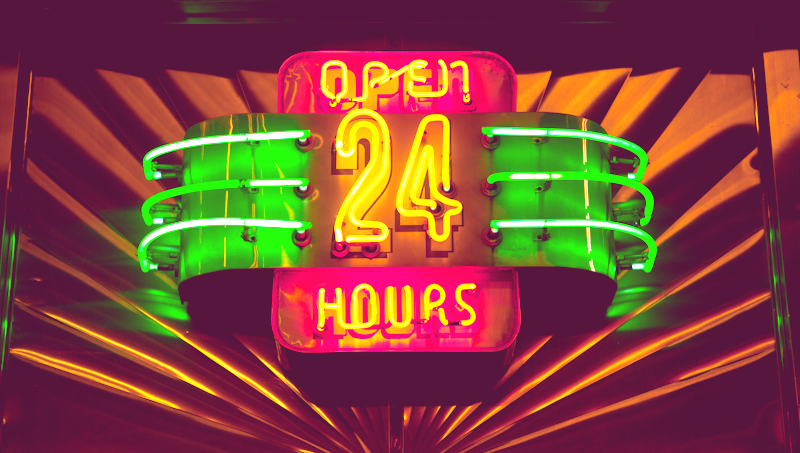
If you want a perch from which to observe the circadian train wreck of modern industrial society, you could do worse than a corner booth in the Tick Tock Diner. A 24-7 neon beacon holding down the corner of Thirty-Fourth Street and Eighth Avenue, the Tick Tock serves up Manhattan on a plate. Breakfast all day. Corned beef on rye. An actual Manhattan if you’d like. The rainbow columns of Madison Square Garden glow across the street. The train to everywhere is directly below. Down Thirty-Fourth, the Empire State Building fills the sky, its sixty-eight thousand LED lights pumping power into the cosmos. That pale smudge to the left? That’s the moon.
When a Knicks game lets out at the Garden or concertgoers from the Meadowlands pour out of Penn Station, crowds pack the Tick Tock’s orange-and-green banquettes and the line snakes out the door. But even in the thin hours, people find it. The cop warming her hands around a coffee. The Times Square revelers not ready to call it quits.
And me. I found myself at the Tick Tock in January of 2025, down from Vermont on business, nursing a cup of decaf and a bad case of insomnia and deciding I needed to make some changes in my life. The insomnia hit in middle age, eyes snapping awake at 1:00 AM, maybe 2:00, with a grim clarity that there would be no sleep before 3:00, maybe 4:00. “The brother of death exacteth a third part of our lives,” Sir Thomas Browne lamented in 1663. If only. Brother of death, come get it anytime.
Clocks confront you everywhere in the Tick Tock. Gleaming neon ones near the doors. An O turned into one on the cover of the menu. Stencils on the walls. But they are all sacrificial victims. The real promise of the Tick Tock is that the day’s rhythms have been banished from its bright cocoon. You can get the waffles at 5:00 AM or 5:00 PM. The lighting will be the same. When someone in your party wants the steak-house burger, someone wants the cheesecake pancakes, and someone just needs a martini, everyone’s good.
You don’t even need to be a night owl or to work the late shift to suffer the debilitating effects of ALAN. You practically can’t avoid it.
Except we’re not. My insomnia put me right in line with 50 million other American adults who suffer occasional or chronic sleep problems. There’s no shortage of reasons. Stress, poor health, overstimulation, all the usual candidates. But for years, sleep experts have been shouting at the top of their lungs that part of the problem lies in our lightscape.
As I stirred my decaf and watched the lights of an ambulance go by, feeling the neon-lit loneliness of something that just crawled out of a Hopper painting, I was ready to listen. I’d spent a lot of time thinking about all the light we can’t see—the infrareds and ultraviolets of the solar spectrum. But I’d spent almost no time considering the photons that have the most glaring impact on mind and body—the visible ones pouring into our eyes.
My server, smelling of onion rings, dropped off the check and told me to take my time. I didn’t mention to her that shift workers suffer alarmingly high rates of diabetes, obesity, heart disease, digestive disorders, autoimmune disease, dementia, depression, and cancer. Or that night owls suffer more cognitive decline than early risers. Or that the WHO now classifies shift work as a probable carcinogen.
The biggest factor in this grim situation, say the experts, is artificial light at night, or ALAN as they call it. We did not evolve in Times Square. But you don’t even need to be a night owl or to work the late shift to suffer the debilitating effects of ALAN. You practically can’t avoid it.
For context, picture the world pre-Edison. The standard measurement for light is lux. A candle at arm’s length produces 1 lux. Until the advent of artificial lighting, that was about as bright as night got for most people. The full moon produces a mere 0.1 lux. Even a raging campfire might throw only 30 or 40 lux.
By comparison, the light in the Tick Tock was around 200 lux. I knew because I had a light meter sitting on my table. It was shaped like a cheap plastic GPS device with a yellow body and a round light-sensing eye on top connected by a little neck. It felt intentionally anthropomorphic, C-3PO without the legs.
To be fair, 200 lux is not insanely bright. It’s about twice that of a cozy living room and half that of a brightly lit office space. But it’s about 199 lux more than the experts say you should have in your eyes while trying to sleep.
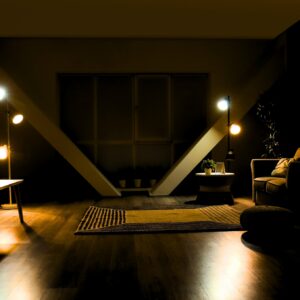
Rare is the bedroom that qualifies. More often, the technosphere seeps into your room, your eyes, your mind, with deadly results. In one recent study, volunteers who spent a night of sleep in 100 lux of ambient light felt that they had slept normally, and technically they had, but EEGs showed that they barely made it to the deep, restorative stages of sleep. Their heart rates stayed elevated through the night in a kind of superficial pseudo-sleep, and their insulin function was that of a prediabetic. Even scarier data was reported in 2025 by a team of Harvard cardiologists, who found a direct link between ALAN, brain stress, inflamed arteries, and heart disease. “When the brain perceives stress, it activates signals that can trigger an immune response and inflame the blood vessels,” explained the lead scientist on the study at Massachusetts General Hospital. “Over time, this process can contribute to hardening of the arteries and increase the risk of heart attack and stroke.” The effect was clear as day: “We found a nearly linear relationship between nighttime light and heart disease: the more night-light exposure, the higher the risk. Even modest increases in night-time light were linked with higher brain and artery stress.”
The scariest data of all come from that big UK Biobank study that tracked the light exposure of eighty-nine thousand volunteers. Yes, lack of daylight was deadly, but ALAN was just as bad. It didn’t matter if people were out and about in the evening or just trying to ignore the streetlight pouring into their bedroom, the ones burdened with the brightest nights were 21 percent more likely to die compared to those who experienced relatively dark nights.
The researchers estimated that those who got neither bright days nor dark nights were shaving five years off their lives. Again, cardiovascular disease was the top culprit, but ALAN also triggers inflammation and is associated with higher rates of cancer, Parkinson’s, and cognitive impairment, including Alzheimer’s. The bad news is that artificial light at night pervades the planet, polluting the dark hours of 80 percent of the world’s population, and it grows worse every year.
As a card-carrying light evangelist, you’d think I of all people would have had my circadian act together by 2025. But it turns out to be surprisingly hard to do in the modern world. We are all Tick Tockers, tethered to laptops and light bulbs. Summer or winter, my evenings were spent beneath a cascade of artificial photons. And those extraordinarily efficient LEDs bathed my mammalian brain in an uncanny radiance unlike anything seen in the planet’s previous 1.6 trillion nights. Times Square was everywhere.
And it had begun to catch up with me. Insomnia, a general malaise that arrived a little earlier each winter, blood pressure creeping upward, gluey cognition, chi clogged as ketchup.
In the modern world, we’ve come to think that this is just part and parcel of aging. Metabolism slows. Energy sags. Sleep sputters. But the burgeoning field of sleep studies suggests it doesn’t have to be this way. If our circadian funk is a product of the flickering hellscape of the modern night, well, that’s fixable, though you have to really want it.
Which I did. By the time I found myself tapping my mug for a refill in the neon glow of the Tick Tock, I was ready to admit that I was just another washed-up insomniac with a light problem. And it was time for an intervention.
*
Circadian, from the Latin circa (around) and dies (day), refers to the twenty-four-hour cycle of the spinning Earth and how we relate to it. There is a natural rise and fall to our hormone levels, alertness, and associated activity through the day, all governed by our built-in body clock, and we are best when it’s in sync with the rising and falling of the light. Broadly, stuff gets done during the day, stuff gets fixed at night. That goes down to the cellular level. Like tiny factories, cells spend their days burning energy and using it to do the thousands of different tasks they need to accomplish. All that work is physical, even if it’s cognition. Molecules are made, broken, and remade. Electrons and protons are stripped apart to produce electrical current.
For their size, the voltages produced inside cells can rival that of a lightning bolt, and every day of activity results in a lot of molecular damage and waste products. Muscle proteins break. Neurons, firing hundreds of times per second, get clogged with their own gunk—and the accumulation of that gunk is what triggers the need to sleep.
Every evening, all this day work shuts down so the night repair crew can fix the damage, take out the trash, and top up the fuel supplies. As in a power plant, you can’t really accomplish that kind of maintenance while the reactors are running. So it happens during sleep. Our cells go quiet. During a phase of sleep called slow-wave, the brain’s vascular system pulses rhythmically, literally pumping cerebrospinal fluid through its innards and washing them clean. We can defer that maintenance for a while, but the more we do, the more junk and damage accumulates, and eventually things stop working so well.
It isn’t just the night owls in the Tick Tock. We are all living an experiment to see what happens when you crush a society’s melatonin.
Sleep is regulated by a hormone called melatonin, which is produced in the pineal gland and is triggered by special light receptors in our eyes. When light disappears in the evening, the pineal gland starts producing melatonin, the molecular messenger of darkness. Melatonin floods the brain and body, telling each cell that night has come. By daybreak melatonin levels are already declining in most of us, as the body clock anticipates the day to come, but the first splash of light in the eyes helps hasten the process and keep us in sync with the sun. The receptors in the eye that regulate melatonin are particularly sensitive to light in the blue part of the spectrum. That’s an ancient evolutionary adaptation to the color of the sky during the blue hour, that eggshell interval prized by artists. Blue is the first color we see at daybreak and the last to fade from the sky at night. In prehistoric times, that blue sensitivity would have meant that melatonin production fired up a couple of hours after sunset and shut down just before sunrise. It still does in hunter-gatherer groups such as the Hadza of Africa’s Rift Valley. By their own accounts, they sleep like a dream. These groups have no word for insomnia in their language, and when asked about it by anthropologists, they struggle to understand the concept. Anthropologists chalk this up to their “circadian hygiene.” They know day from night.
We don’t, as sleep researchers have been warning with increasing stridency, and we haven’t since the arrival of electric lights in the late 1800s. Campfires and candles were warm and golden, with lots of red and orange and virtually no blue component, and even the gas lamps of the 1800s were essentially potted fire. But the “cold” light of electricity was something else and was not greeted with universal awe.
In his 1878 essay “A Plea for Gas Lamps,” Robert Louis Stevenson makes it clear how weird the strange electrical illumination seemed. “A new sort of urban star now shines nightly,” he lamented. “Horrible, unearthly, obnoxious to the human eye; a lamp for a nightmare! Such a light as this should shine only on murders and public crime, or along the corridors of lunatic asylums. To look at it only once is to fall in love with gas, which gives a warm domestic radiance fit to eat by.”
Electric lighting might be fine for the harsher parts of town, Stevenson argued, but “where soft joys prevail, where people are convoked to pleasure and the philosopher looks on smiling and silent, where love and laughter and deifying wine abound, there, at least, let the old mild lustre shine upon the ways of man.”
But it was not to be. The “old mild lustre” was soon relegated to séances and the occasional romantic dinner. Since then, our evenings have been brighter and our melatonin diminished. The problem was bad enough with the old incandescent bulbs, which produced only a little bit of blue light mixed with warmer tones, but it has become severe with the advent of modern LEDs, which are blue lightsabers, dicing melatonin to bits.
One classic study by Harvard’s Charles Czeisler, a pioneer in the circadian field, compared an evening of reading a printed book versus reading on an iPad, which, like all modern devices, has a screen of tiny LEDs skewed heavily toward the blue spectrum. The subjects read from 6:00 to 10:00 PM in a dimly lit room of 3 lux, which is just enough light to read by. Light exposure at the participants’ eyes measured 1 lux for the print group and 32 for the iPad. Over the course of the session, melatonin levels rose 19 percent in the print readers, as you’d expect as the evening wore on, but plunged 55 percent in the iPad group.
Media coverage of studies such as Czeisler’s triggered a wave of panic about devices and their impact on sleep, and soon everyone was fitting their tablets with blue filters or donning blue-blocker glasses to prevent all those blue photons from reaching their eyeballs at night.
But it soon became apparent that screens were the tip of the blue iceberg. If you are reading a dimmed tablet in a dark room, few lux are reaching your eyes. LED bulbs, on the other hand, are now ubiquitous in most homes, adding hundreds of lux of mostly blue light to our evenings. One recent study found that the average amount of ambient light it took to suppress melatonin levels by 50 percent was just 25 lux, the equivalent of a dim bedside lamp.
So it isn’t just the night owls in the Tick Tock. We are all living an experiment to see what happens when you crush a society’s melatonin.
*
I paid my Tick Tock tab and ran the gauntlet of Times Square (78 lux in the dark recesses; 500 lux staring straight at a billboard) back toward my hotel. Had I come unstuck from the planet’s rhythms? All winter, I’d been feeling it, kicking myself as I spent another dark day gazing into the abyss of the internet doing research, kicking myself some more as I lay awake at night, worrying that another evening’s dose of photons was sabotaging sleep and feeding a festering mass of inflammaging.
There was one way to find out. I needed an LEDetox. A month of primeval darkness. Some place where the days were days and the nights fell with thudding certainty. Bonus points for weather nice enough to stay outside after dark.
The Rift Valley? Awesome, but impractical.
Rollier’s Institute for Heliotherapy in Switzerland? Closed since the 1950s.
California, Sanatorium to the World? Times have changed.
Camping was also not an option as I had deadlines and needed enough infrastructure to keep my writing career on life support. Laptops and tents don’t mix.
After much scouting, I found an off-the-grid 1962 Airstream for rent in the Sonoran Desert, plunked down on seventy-three hundred acres of nothingness an hour from the Mexican border. Remote, sunny, some of the darkest skies in the country. A solid stand-in for the Serengeti in the dry season. I booked it for all of March and vowed to never touch a light switch. The first step toward getting right with light, I decided, would be making friends with the dark.
_______________________________
Rowan Jacobsen
Rowan Jacobsen writes about science and nature and the less-explored corners of the world for Harper’s, Outside, The Atlantic, Scientific American, Smithsonian, The New York Times, The Washington Post, MIT Technology Review, Businessweek, and others, and his work has been anthologized in The Best American Science & Nature Writing and other collections. He has received awards from the James Beard Foundation, the Society of American Travel Writers, and the Overseas Press Club. He is the author of nine books, including A Geography of Oysters, Fruitless Fall, and Truffle Hound, several of which have been named to Best Book of the Year lists by The Washington Post, The Wall Street Journal, The Boston Globe, NPR, and Publishers Weekly. He has performed with Pop-Up Magazine, lectured at Harvard and Yale, and appeared on CBS, NBC, and NPR. He has been an Alicia Patterson Foundation Fellow, writing about endangered diversity on the borderlands between India, Myanmar, and China; a Knight Science Journalism Fellow at MIT, focusing on the environmental and evolutionary impact of synthetic biology; and a Nova Media Fellow, researching the science of sun exposure.