On Women and The Water Cure: Nine Memoirs About Wild Swimming
Catherine Jagoe Recommends Amy Liptrot, Sophie Pierce, Megan Hayes, and More
“Wild swimming” is a term coined by British nature writer Roger Deakin in his cult classic Waterlog: A Swimmer’s Journey Through Britain (1999), about his year swimming outdoors all over the UK. A paean to the joys of daily, year-round immersion in rivers, seas, ponds, and lakes, it sparked a nationwide cultural phenomenon with a catchy name, a society, a swim trip company, and an entire line of gear for changing onshore. As practiced in Britain and Ireland, wild swimming might more properly be termed “cold-water bathing,” since it can involve merely a few minutes of head-raised breaststroke in water temperatures ranging from heart-stopping to extremity-numbing (35-60ºF), clad in nothing but a swimsuit and a wooly hat. Most wild swimmers are not athletes training for an open-water event or even necessarily very proficient at swimming. They do it for wellbeing and connection, as a way of being in touch with the natural world and the seasons.
In my UK childhood, I felt an ease in the water that I rarely did on land, though I never swam competitively. Early moves from England to Ireland to Nigeria and then back to England had left me feeling an irremediable outsider. In water’s reassuring embrace, however, I felt confident and at home. Swimming (both indoors and out) is a practice I’ve carried with me as I’ve triangulated my life between the US, Spain, and the UK. As I wrote my memoir Unbelonging: A Life in Search of Home, I was surprised to find how often I drew on memories of swimming. Water has been the translucent thread that runs through my transnational life, connecting me more deeply with place while reminding me of the fluid borders of the self.
The UK’s Outdoor Swimming Society, founded in 2006, initially boasted 300 members, but now numbers over 200,000. Intriguingly, the Society found in a 2023 survey that roughly three-quarters of its members are women. Over the last ten years, there have been a spate of memoirs about wild swimming penned by women around the UK and Ireland, many of which appeared in 2017, meaning they must have all been written concurrently. These narratives portray open-water swimming not as heroism but as healing and empowerment. Their authors swim for the interior journey, to commune with a place and the elements, with other women, and their own bodies.
*
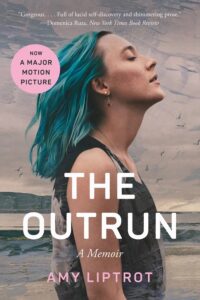
Amy Liptrot, The Outrun: A Memoir
Amy Liptrot’s raw, luminous memoir about moving back to the Orkney Islands and striving to heal from drug abuse and alcoholism became a surprise bestseller after its publication in 2016. The bleakness of those far northern isles, the punishing, incessant wind, the wild beauty of the land and rugged coastline are unforgettably conjured alongside her inner struggle to stay sober. Late in the book, she joins the mostly-female Orkney Polar Bears for their convivial Saturday dips in the gelid seas off the islands. Along with walking, farm chores, and birding, her wild swims become an essential component of her recovery, each dip leaving her exhilarated, “reborn and very alive”. In the water, she experiences a sense of elemental, existential connection, a sort of spiritual dissolving. Sea swims don’t magically cure the narrator, but they provide the container for healing to occur over time, gentling the existential ache of not-belonging that underlay her addictions.
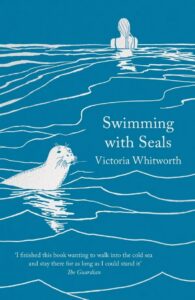
Victoria Whitworth, Swimming With Seals
Novelist and academic Victoria Whitworth lived on Orkney at the same time as Liptrot and swam alone daily as well as with the Orkney Polar Bears. She interweaves lyrical snapshots of her wild swims with discussions of local history, myth, folklore and archeology, braiding in memories of growing up in Kenya, her struggle with crippling pain due to plantar fasciitis, and glancing references to “the slow-motion misery of a failing marriage.” The narrative is punctuated by prose-poems about the water conditions during her swims, which varied enormously from day to day and month to month, sometimes exquisite, sometimes terrifying. She prefers to swim at dawn or dusk, with no wetsuit separating her from the water. By the end of the book, she writes, “[s]wimming in the sea has helped me rediscover myself … made me understand the strengths of my body, as well as its limits. It has been fundamental in healing my feet, but, more than that, it has allowed me to fall in love with being embodied all over again. With being alive.”
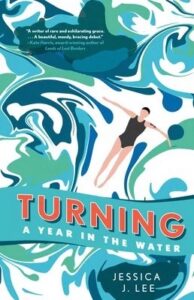
Jessica J. Lee, Turning: A Year in the Water
Jessica J. Lee’s first book Turning gained her international recognition as a writer who explores themes of multinational identity, migration, language, and environmental history. Seamlessly blending lyrical memoir, science writing and travelogue, Turning covers her first year in Berlin. In the grip of depression, repeated displacement (she is British-Canadian-Taiwanese), and a broken heart, she decides to swim in a different lake every week for a year. The book is notable for its intellectual depth and evocative descriptions of finding and entering the many lakes, as well as the vivid sensory impressions of swimming in each different location. In January, she carries a hammer as all the lakes are frozen, and risks hypothermia by submerging in them alone. As well as the agony of cold, she documents its after-effect of intense elation, a high many wild swimmers come to crave.
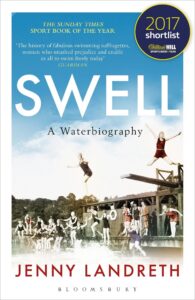
Jenny Landreth, Swell: A Waterbiography
Jenny Landreth invented a fantastic punning term for the emerging genre in her subtitle, “a waterbiography.” She provides a wealth of social and historical context, braiding her own evolving experience of swimming with the history of women’s two-hundred-year struggle for parity of access to public waters and mixed bathing. She deflates the male Swimmer as Hero trope by stressing her distinctly unheroic learning process: “I could maybe manage two or three widths, but I still swum in a U-shape and I still didn’t get my hair wet.” Even though her memoir begins by stressing her incompetence, it ends by affirming the pleasure and confidence open-water swimming bestows on her in middle age.
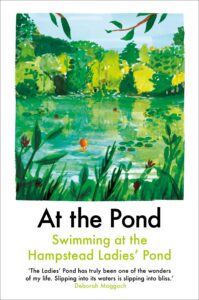
At the Pond: Swimming at the Hampstead Ladies’ Pond edited by Deborah Moggach
Opened in 1926, the women-only pond on Hampstead Heath is a beloved London institution. All the essays collected here are by writers who happen to swim, rather than swimmers who happen to write, including luminaries like Margaret Drabble, Esther Freud, and Leanne Shapton. Organized by season, the pieces vividly evoke the women’s experiences of the water at different times of year. “The water is silky,” Lou Stoppard writes about winter. “It’s thicker than other water. It sticks to the skin, laps your body and holds you, suspended. You cut through it, as if stirring cream.” Some offer heartwarming stories of how swimming there helped them through difficult periods, provided community and continuity, and reconnected them to their bodies and the more-than-human world. Others explore the history and geography of the ponds and the Heath, and the social worlds of the swimmers and their circles.
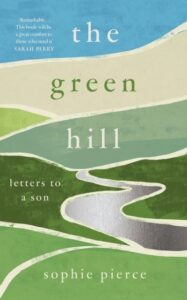
Sophie Pierce, The Green Hill: Letters to a Son
Pierce, who has since co-authored five regional wild swimming guides about Devon and Cornwall, lost her twenty-year-old son suddenly and unexpectedly in 2017. In the agonizing years after his death, she composed letters to him during walks and swims, a practice of active mourning in places they had enjoyed together. These form the spine of the book, interwoven with descriptions of swims of varying lengths in a very wide range of locales—rivers, waterfalls, ponds, different coves and beaches, each different and beautifully captured for the reader. Over a five-year period, we witness her emerge from utter devastation to a more-bearable form of grief.
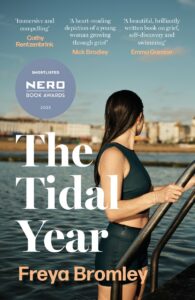
Freya Bromley, The Tidal Year: A Memoir on Grief, Swimming, and Sisterhood
Grieving and adrift in the aftermath of her teenage brother’s death from bone cancer, Bromley embarks on a year-long quest to swim every tidal pool in mainland Britain in a year with her friend Miri. Tidal pools are deep hollows in the rock that fill with seawater on an ebb tide, offering “the ability of enjoy the salt of the sea in a safe watery cradle,” ideal for swimmers who don’t want to brave the dangers of the open ocean. Descriptions of the dozens of beautiful (and occasionally disappointing) locations they visit are inspiring, and the swimming-induced self-discovery and the solace of female friendship create a redemptive arc.
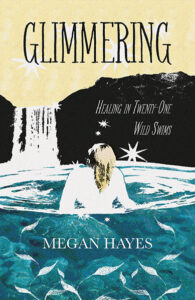
Megan Hayes, Glimmering: Healing in Twenty-One Wild Swims
Hayes suffered unspecified childhood trauma and is, at the outset of the book, in a damaging relationship with a manipulative, sex-addicted boyfriend. Her wild swims at beautiful spots in Wales and around the world offer well-being and safety in “glimmers,” the term coined by trauma specialist Deb Dana for “moments of regulation and connection.” Hayes’ memoir stresses the redemptive power of nature as an antidote to suffering and a way to build emotional resilience.
__________________________________
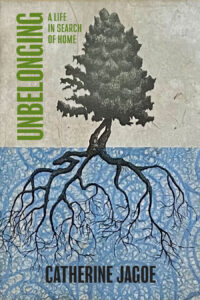
Unbelonging by Catherine Jagoe is available from University of Wisconsin Press.

Catherine Jagoe
Catherine Jagoe is a poet, essayist, and translator based in Madison, Wisconsin. Her collection Bloodroot won the Settlement House American Poetry Prize and the Council for Wisconsin Writers’ Edna Meudt Award, and Praying to the God of Small Things was named an Outstanding Work of Poetry by the Wisconsin Library Association. A recipient of a Pushcart Prize, among several other honors, she has published nine full-length books and four chapbooks across genres. Her personal essays have aired numerous times on Wisconsin Public Radio’s Wisconsin Life series.