Never Again? On the Death of Universalism After Gaza
Franco "Bifo" Berardi Considers the Political and Philosophical Ramifications of Israel’s Genocide
Whether humankind can survive the combined onslaught of climate change, rampant aggressive dementia, and destructive artificial intelligence technologies is currently uncertain.
It is certain, however, that civilization—the progressive “humanization” of the human, the predominance of language over the natural ferocity of instinct—is disintegrating.
We have long perceived the signs of this disintegration; we have long seen that liberal deregulation has been paving the way for the prevalence of force in relationships between human animals.
Now the collapse is underway, after the atrocious aggression unleashed by Hamas on October 7, 2023—an aggression that must be defined as a pogrom, similar to those that the Jewish people have suffered over the centuries in many European countries, and similar to those that the Palestinians of the West Bank have suffered for years at the hands of armed gangs of Israeli settlers.
After Gaza, it is time to recognize that this attempt to humanize history has failed, and that there will not be a second try.
In the year of uninterrupted atrocity that followed, the failure of the project called “civilization” became evident, and ferocity regained the upper hand: the return of the beast in human history, the return of homicidal violence as a primordial reflex of self-defense and survival.
The name Gaza appears for the first time in the military documents of Pharaoh Thutmose III in the fifteenth century BC.
In Semitic languages, the city’s name means “fierce.” Throughout history, men have often given themselves high-sounding titles, exhibited aggressive postures, and threatened disasters; similarly, the Gazawi called themselves “ferocious.”
The unhappiness of the world depends to some extent on this self-identification with greatness and ferocity, with a power that we do not have but that we like to flaunt and that we are sometimes forced to flaunt in the hope of frightening others who are, in reality, more ferocious than us.
That sandy strip of land overlooking the eastern Mediterranean is mentioned many times in the Bible, and in ancient Egyptian documents and inscriptions of Ramesses II, Thutmose III, and Seti I.
When the Israelites arrived in the Promised Land, Gaza was a Philistine city, and among its inhabitants were the Anakim, a population that was dwelling in the mountainous regions of Canaan and some coastal areas. It was in Gaza that Samson, blinded and in chains, caused the temple dedicated to the worship of Dagon, where over three thousand people could gather, to collapse. He himself died, taking to hell thousands of Philistines.
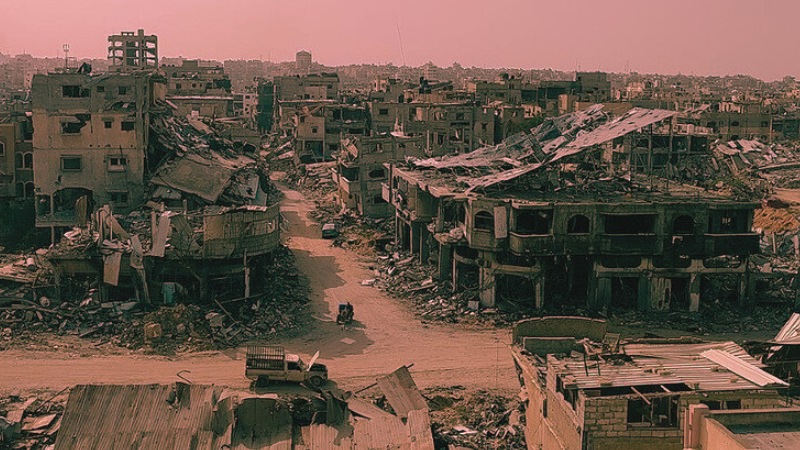
After October 7, 2023, the Israelis reacted with cruelty and ferocity.
If cruelty is a perverse desire of humans, ferocity is an animal reflex inscribed in the instinct of self-preservation.
The beginning of the extinction of so-called civilization is marked by this return of ferocity as the sole regulator of exchanges between humans.
At least in recent centuries, civilization has been essentially the attempt to submit ferocity to politics and instinct to will, which can together be summarized as the submission of chaos to language.
After Gaza, it is time to recognize that this attempt to humanize history has failed, and that there will not be a second try.
It is time to recognize that the experiment called “civilization” has failed. What is left of civilization is the destructive power of technology—particularly, military technology. When ferocity prevails, technology becomes a function of war.
We are left now with our ability to kill in a much more sophisticated and systematic way than any other ferocious animal.
“Thinking Gaza” means first of all recognizing the irremediable failure of the universalism of reason and democracy—that is, the dissolution of the very core of civilization.
But it also means looking for escape routes from the future that awaits us, and that awaits those who have been born in this century that promises to be the last.
To those who were conceived in the dark light of this final century, we owe this last act of thought, so that they can desert history, along paths that we cannot yet imagine.
“Thinking Gaza” implies the acknowledgment that words mean the opposite of what they are supposed to mean according to history, psychology, and semiotics.
In the age of ferocity, language is only useful to lie, to cheat, to subjugate, and to exploit.
In current discourse, in hyperaccelerated media, there is no time for critical analysis, there is no time for ethical discrimination. There is no time to listen and to understand.
Techno-media temporality is contracted to such an extreme that understanding and critical elaboration are impossible. This implies that human history is over, because the human (beyond any speciesist privilege) is the sphere where words have meaning, and can be interpreted, so that language can mediate the relations between bodies. Ever since language became another battlefield where the most powerful imposes his own interpretation, ever since the paths of criticism and independent thought were cut off in the name of speed, we have entered the realm of ferocity.
In the realm of ferocity, every form of language becomes a tool for extermination.
The law was intended as universal frame for regulating the relationships between the actors of the social game, who were considered subjects of language.
In recent centuries, the law has established itself as a universal discourse, alternative to the ferocity of tribal belonging.
The modern assertion of the universality of reason was made possible by the Jewish intellectual tradition: by the contributions of those who were allowed to think in a nomadic place, in a place that was not a place of belonging.
Even the internationalist idea, supported by communist workers, has been made thinkable thanks to the contribution of Jewish culture, which was free from ethnic or territorial belonging.
This is why the tragedy of Gaza seems definitive and irremediable: because a state and an army that pretend to be the expression of that culture, as the heirs of that history, have betrayed the Jewish intellectual contribution to modern civilization.
“Thinking Gaza” means acknowledging the betrayal of Jewish culture by the Zionist leadership and by the vast majority of the Israeli people.
The failure of universal reason and the betrayal of modern Jewish culture are two sides of the same coin. From its start, the State of Israel has betrayed and denied the Jewish intellectual tradition; but today, after Gaza, this disdainful negation of the very illusion of the universality of human reason has become Israel’s political program and common sense.
The military action of the Israel Defense Forces and the complicity of the Israeli people with the genocide unleashed by Netanyahu’s government irreversibly mark a regression toward particularism and the cancel-lation of any hope of a “human” future.
“Never again” was temporary, because the foundations of a society capable of expelling ferocity from the sphere of human civilization had not been laid.
This is the lesson that Israel has given us: in the sphere of history, the victims do not know how to and cannot ask for peace or reparations but can only seek revenge. This means that today’s victims will never be anything other than victims, unless they manage to transform themselves into exterminators.
After the Israeli genocide, law, universalism, and democracy appear as illusions that predators have used to maintain their power over their prey. But now these illusions have dissolved, and what is revealed is the ferocious face of colonialism, of which Israel is the latest manifestation.
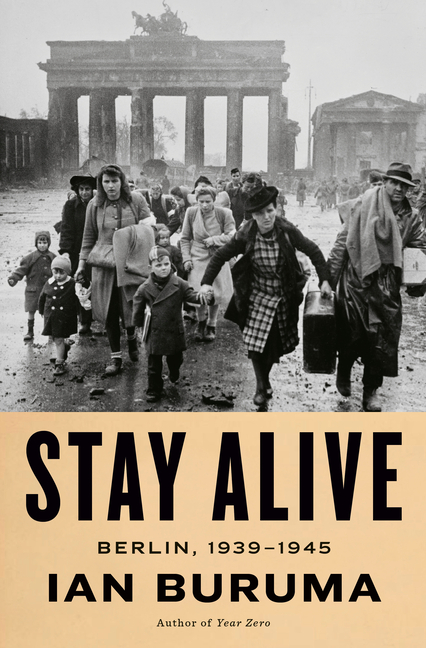
The fight against Nazism and the victory against Hitler’s Germany appeared as a reassertion of the principles of modern universalism.
The Nazis’ ferocity was defeated by the symmetrical ferocity of the antifascist powers, but beyond the ferocity of the Second World War, a time of peace, of law, of democracy seemed poised to emerge and to last forever. This was the meaning of Nie wieder: “Never again.” Those words were at the foundation of the cultural and political education of the generation that grew up after the end of the Second World War—my generation.
Looking back today, I feel that this belief was an illusion.
“Never again” was temporary, because the foundations of a society capable of expelling ferocity from the sphere of human civilization had not been laid.
Those foundations are fraternity and social equality. It was only the organized force of the working class that had made such a condition possible, but the source of ferocity (exploitation, transformation of life time into exchange value) was never eliminated. The genocide that Israel has committed in revenge against Hamas makes clear that Nie wieder was a lie. The heirs of the victims of the Nazi genocide were preparing to become strong enough to perpetrate their own genocide.
__________________________________

“Ferocity” will appear in Thinking Gaza: An Essay on Ferocity which will be published on March 24 by Semiotext(e).

Franco “Bifo” Berardi
Franco Berardi, aka “Bifo,” founder of the famous Radio Alice in Bologna and an important figure of the Italian Autonomia movement, is a writer, philosopher, and media activist. He teaches at the Accademia di Brera, Milan.