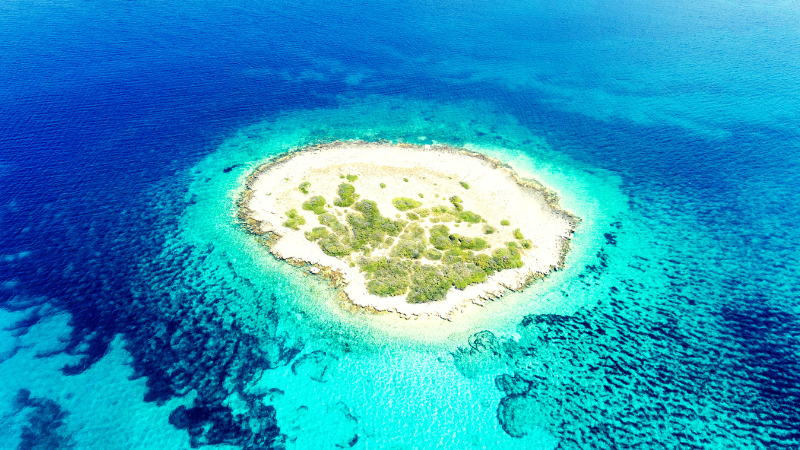
Mysterious, Isolated and Seductive: The Map of Literary Islands That Inspired My Novel
Christiana Spens: “Even when you have left an island, it lingers on in your imagination as a half-real and half-made-up place.”
Islands emerge in novels and poems as mythical, seductive places; they are separate from the mainland in a way that could be a punishment or an escape, or sometimes both. They are places of nostalgia and longing, where we may be stuck, whether by shipwreck or bad weather or imprisonment—or sometimes some strange desire. They may be almost fantastical destinations that we long for and romanticize, by virtue of seeing them on the horizon as some distant shore; we think of them as separate from life, and yet their reality may often be a microcosm of all we seek to escape.
In my novel The Colony, the narrator Lena travels to an island retreat off the coast of Scotland in an attempt to disappear from her life, and also, she hopes, to recover from it. What she finds seems at first to be the home and sense of belonging she has always longed for. And yet as her new community there, and the island itself, begin to show signs of toxicity, she realizes that she has not so much escaped her past as transferred it to a new setting, where her sickness and theirs is impossible to escape.
I was partly inspired by a trip to a real Scottish island, near where I had grown up, which was only just recovering from the Avian Flu pandemic; as I walked past fallen birds, I couldn’t stop thinking about what it meant to be contagious, to risk catching things from one another with every attempt at connection, or even just a desire to experience beauty. At what point do we all surrender to some sense of toxicity, in order to live a full life? At what point do we actively chase it? Humans, isolated together on an island, or in any close community, will start catching feelings as well as diseases; this idea began to interest me, and it spread into the novel as well.
Writing my own island novel compelled me, despite myself, to appreciate the mainland in a new way; as something I had never really committed to before, had never explored.
Several island-set stories were on my mind during this time, from J. M. Barrie’s Peter Pan to Kafka’s The Penal Colony. As I look back now, I have a fresh sense of the nostalgia that once gripped me, that at times felt like a kind of disease, and the books that compelled me there too. Even when you have left an island, it lingers on in your imagination as a half-real and half-made-up place. As I re-read some of these books for this reading list, I realized that I go to novels for the same reason I might go to an island; to revisit the past, to escape into a private world of longing or homecoming or shipwreck; to find a strange melancholic peace there, before leaving again, and putting the book aside, and returning to the mainland.
*
Probably the first island-set book that I really loved was Peter Pan; or, the Boy Who Wouldn’t Grow Up by J. M. Barrie, which has held court in my imagination ever since. As a child it was comforting to imagine escaping from everyday life into a secret, tropical world of adventure; I would have liked to be a Lost Boy or a fairy. I think I was probably scared of growing up, as children often are, and yet as I’ve got older, I’ve realized that Peter Pans and Lost Boys walk amongst us; perhaps many of us do not leave Neverland entirely. Only when I started writing this reading list did I realize that my own novel is really a Peter Pan story, too; and yet as we do grow up, the desire to escape to some fantastical island takes on darker qualities.
Not dissimilar to Peter Pan is the story of the Lotus Eaters in Homer’s Odyssey, which was made the subject of the famous Romantic epic poem, Tennyson’s The Lotus Eaters, Here, a group of sailors find themselves stranded on an island, where they are quickly taken in by the narcotic effects of the lotus fruits they find there. Losing any desire to return to their homes and their loved ones there, the island is a kind of melancholic paradise they can never quite leave. Odysseus manages to fight the seductive properties of the lotus plants, dragging his man back to their ship so that they can return home; though in Tennyson’s poem, the sailors remain in their blissful fog; “O, rest ye, brother mariners, we will not wander more.”
Though in some sense this is a cautionary tale, the way that first Homer describes their attachment, and then Tennyson elaborates on their doomed, blissful apathy, is seductive in its own right. I sometimes think of writing as a kind of lotus-eating, where we can escape so much of life in favor of a reality that has been tampered with and softened (depending, of course, on the author). These lines, in particular, resonated so much that I made them my epigraph:
Let us swear an oath, and keep it with an equal mind,
in the hollow Lotos-land to live and lie reclined
On the hills like Gods together, careless of mankind.
Maybe there are all these island-dwelling books because a novel is a kind of island in itself, where we can immerse ourselves in something new and yet familiar, meet characters who remind us of people we once knew, and experience a separation from reality that is both soothing and melancholic. It is this liminal, dreamlike place, disorienting but all the more compelling for inducing that state.
And yet islands in novels are so often about the desire not just to escape reality, or regular life, but to go back to some kind of home, or something that resembles it. In Virginia Woolf’s To the Lighthouse, the Ramsay family stays in a summer house on the Isle of Skye on the West Coast of Scotland; across generations we see their attachment to one another and then the loss or transformation of those bonds play out. People come and go and yet this desire to visit the lighthouse on the island persists; this idea of the trip survives some of the characters, and in a world in which so much is in flux, and there is so much devastation, the lighthouse remains constant. For James, especially, it is a mostly unattainable desire, a journey he dreams of taking but is often denied due to circumstance; over the course of his life, it is a way for him to process and reconcile with his family and their transient time on the island.
When I re-read Moominpappa at Sea by Tove Jansson recently, I began to wonder if it had also based it on Virginia Woolf’s To The Lighthouse, not only for the reason that both are so concerned with family trips to lighthouses, but because of the melancholic tone they share too, and the changing intergenerational relationships that these journeys and conversations expose. For Moomin-Papa, like James, the trip to the lighthouse symbolizes some almost-unattainable desire; this time, it seems that the journey to relocate his family is to make up for other projects that have not been successful. The hostile environment of the sea, the island and its lighthouse present a challenge so tough that he can hope to regain a sense of superiority; and yet with the family’s unease with their new home, he spirals further into crisis. Rather than abandon their journey for home, however, they persist, and Moominpapa does find a sense of solidity through this midlife-crisis expedition that he had brought his whole family on.
In The Summer Book, Tove Janson elaborates further on these themes, this time in a book more specifically for grown-ups (though the Moomin books, particularly the one I just detailed, seems to cater for a wide audience). In her novel, made up of 22 vignettes, Janson describes another family holiday, this one on a Finnish island, where a grandmother and her six-year-old granddaughter Sophia stay together, in the wake of the death of Sophia’s mother. As in the Moomin stories, this summer unfolds with small adventures, companionship, and time in nature; here, the island is a chance to retreat into family time even at a time of strain and bereavement. The island is not just an escape from home or family; it is an important part of it, which transforms with each summer and provides a place where the characters can surrender to its seasons and natural wisdom and so find security in that familiarity, even when the mother has gone.
*
I have written about islands as places of pleasure and homecoming, and yet both of these elements often overlap with systems of pain and punishment too; one thing reveals the other through absence sometimes, or a complex coexistence. Whether by intention or circumstance, the isolation of islands mean that they are prime locations for darker plots, too. In Lord of the Flies by William Golding, young boys gradually become feral and sadistic when trapped on an island together, and in Shakespeare’s The Tempest, Prospero magically shipwrecks his brother and his allies so that they will all be exiled together under his watch. In this vein, Sophie Macintosh’s The Water Cure presents three sisters who live in their parents’ control, so isolated from other people that they take their punishing routines to be not only normal, but beneficial to their wellbeing.
Islands seem mystical until you spend any time there, and then they are claustrophobic and small. But then you can look back and see all you left as a new horizon.
When I wrote The Colony, where humans interact oddly with their natural habitat, I often though of novels like Franz Kafka’s The Penal Colony or Yōko Ogawa’s The Memory Police, where inhabitants of islands exist in submission to those who control the territories. In the former, the penal colony is the location of a brutal execution machine; as those involved in condemning prisoners to painful deaths reminisce, it becomes clear that these executions have a ritualistic function; the machine carves each prisoner’s sentence onto their skin over 12 hours until they die. It is a simple fable that lays bare the pointless brutality of a highly bureaucratic, retributivist justice system; the island setting mostly escalates the sense of isolation and a creeping claustrophobia of being stuck in such a system.
In The Memory Police, too, a totalitarian system has used the isolation of an island to ensure their surveillance and control of those living there; this time they control memory and all that relies on memory; echoing The Lotus Eaters’, these inhabitants do not choose to forget their families and identities, but it happens through their subjection to a fanatical power instead. What interested me was this pull between subservience and sense of self; the more these people’s minds were edited and controlled by those above them, the less they even knew to want their freedom.
This idea of being brainwashed by a more powerful source seemed to play out through these island novels—from the Lotus Eaters’ narcotic apathy, to the casual compliance of the executioner in Kafka’s novel, and from the naivety of the daughters in The Water Cure to the children so excited by a flying Peter Pan that they don’t question a night time adventure to another world. This separation from the mainland, or regular life, seems so often to be contingent on some kind of submission to a magical or cruel power; the characters’ journey is not so much to appreciate what they left behind, but to throw off these delusions, and the terrors they so desire to have respite from.
When I wrote The Colony, I was not always sure why I was doing so, or why the island I visited with my son had such a magical impact, but now that it is finished it seems clearer that it represented my complicated relationship with my own childhood home, even though I grew up just a few miles away from the island itself, on the mainland. I used to see the island out there on the horizon every single day on my way to school, and I had gone there on a school trip when I was ten, and I had thought it was beautiful then. For me, it was also a visual anchor, the one thing I could gaze at and drift away to in my mind, whatever was happening at home. And now I had come back, and brought my son there, and yet everything had changed. My anchor had transformed into a very strange place. A lot had happened between visits.
I think over the years away from home, perhaps writing and reading had taken over the role of the island, and so when I did finally return there, only to find so many dead birds, it felt like an intense version of every other trip home, as well as a confrontation of what writing had become for me too. My anchor was made of cliff faces and wild things; its beauty was terrifying. My novel became a similar revisiting of strange past lives, as well as a crystallization of the desire to be free of forces that had once consumed me—whether that was home, or people who reminded me of home, things that could deliver pain and pleasure at once.
Writing my own island novel compelled me, despite myself, to appreciate the mainland in a new way; as something I had never really committed to before, had never explored. Islands seem mystical until you spend any time there, and then they are claustrophobic and small. But then you can look back and see all you left as a new horizon, as something just as compelling, if not more so, with a slight change in direction.
____________________________
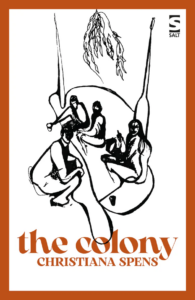
The Colony by Christiana Spens is available from Salt Publishing.

Christiana Spens
Christiana Spens is the author of The Fear (2023), The Portrayal and Punishment of Terrorists in Western Media: Playing the Villain (Palgrave Macmillan, 2019) and Shooting Hipsters (Repeater, 2016). She holds a PhD in International Relations from the University of St. Andrews, and before that read Philosophy at Cambridge. Her writing and artwork has appeared in various publications including The Irish Times, Prospect, Glamour, Stylist, Dazed, the Quietus, The London Magazine, NYRB, and Studio International. She lives in London.