Meet Hildegard of Bingen, the German Mystic Who Destigmatized Women’s Health
Elinor Cleghorn on Pregnancy, Childbirth and Motherhood in Medieval Europe
In the Middle Ages, birthing women and hopeful mothers were not honoring their saints purely out of religious duty. Like the appeals made by women during the antiquity to midwife goddesses, prayer and supplication were ways to affirm intentions for healthy pregnancies, calm labors, and living children. Where ancient midwives had summoned divine assistance by uttering incantations, medieval maternity caregivers called upon saintly mothers by reciting rhythmical charms. A popular charm known as the peperit—Latin for “gave birth to”—invoked the Virgin Mary, her mother Anne, and her cousin Elizabeth, while imploring the baby to “leave your mother’s womb without you or she dying.”
If a priest was called to bless the birth, he chanted the peperit from a piece of parchment “three times over the woman who is laboring.” Her attendant then bound the parchment gently around her belly. An Anglo‑Saxon version stated that the charm should be inscribed on to a piece of wax and tied to the birthing woman’s right foot. As she breathed through her pains and summoned her strength, she felt those hopeful words right upon her skin.
For Hildegard…women’s maternal bodies were not corrupting and degrading, but strong, nurturing, and creative.
Not all birth rituals depended on the intercession of a saint or the authority of a churchman. Around the eleventh century, in Anglo‑Saxon England, instructions for an elaborate childbearing and mothering ritual were recorded by monks in the Lacnunga, a collection of medical texts and curative prayers. “For a Delayed Birth,” as this ritual is known, comprised five sequences of incantations, movements, and gestures for women to perform to protect themselves and their pregnancies. Unlike rituals that summoned divine entities, “Delayed Birth” recognized that a woman’s capacity to create and sustain life resided not in the heavens, but within her own body.
The first part of “Delayed Birth,” for a woman hoping to become pregnant after a distressing birth experience, began with a walk to the grave of a dead man. As she stepped over the grave three times, she declared: “This is my remedy for hateful slow birth. / This is my remedy for heavy difficult birth. / This is my remedy for hateful imperfect birth.” When she felt she had conceived, she repeated the stepping sequence in bed, over her sleeping husband, while whispering, “Up I go, step over you / with a living child, not a dead one.”
If, later, she found breastfeeding difficult, she was to find a one‑colored cow, drink its milk from her cupped hand, and hold it in her mouth as she made her way to a stream. After spitting out the milk, she gathered water from the stream with the same hand and drank it down. “Everywhere I carried with me this famous strong son / with this famous strong meat,” she announced, once the ritual was complete; “then I want to possess myself and go home.”
“Delayed Birth” is the only charm in the Lacnunga that was reserved for women. Known collectively as the “metrical charms,” the others were poetic prescriptions for curing diseases, saving livestock, preventing bee swarms, and summoning protection on long journeys. Anglo‑Saxon England converted to Christianity over the seventh century, so some of the charms included appeals to Jesus, Mary, and the apostles. But they also drew upon Old English mythological references and pagan symbolism, evoking ancient practices of ritual healing.
The origins of “Delayed Birth” are a mystery, but it probably derived from magico-medical knowledge initiated and transmitted by women, for women. Like the midwives’ spells Pliny the Elder described, this ritual harnessed the belief that women’s bodies and voices were powerful and transformative. In “Delayed Birth,” a woman’s affinity with nature wasn’t “monstrous and awful,” but replenishing and productive. As she moved from graveyard to stream, she was taking control of her fertility, her pregnancy, and her mothering life. She possessed her body and spoke for herself.
“For a Delayed Birth” didn’t assume women became mothers only by birthing and raising living children. It honored the motherhood of lost pregnancies, stillborn babies, and infants whose lives had been cut too short. In the Middle Ages, female infertility was seen as a curse, and pregnancy loss could be blamed on a woman daring to have sex on a holy Sunday. But none of these events, which many women faced in Anglo‑Saxon England, were failures or punishments in the ritual. The fourth part of “Delayed Birth” was intended for a woman whose child had died. To begin, she gathered a handful of soil from her child’s grave and wrapped it in black wool. She sold this wool to a traveling merchant, to symbolize her grief and the threat of another loss being taken far away. “I sell it / you buy it,” she recited; “this dark wool / and seed of this sorrow.”
In the High Middle Ages, medical understandings of women’s reproductive and maternal bodies were mostly Christian interpretations of classical medical discourse and natural science. Birth and peripartum care remained in the hands of women maternity caregivers, but much of their knowledge, accrued by word of mouth and hands‑on experience, hasn’t survived in written form. The female body was cast as a passive vessel for growing male “seed,” and the unruly womb as the locus of women’s weakness and inferiority. But no matter how loudly authoritative men preached the “frail sex” gospel, this didn’t mean women internalized such diminishing beliefs.
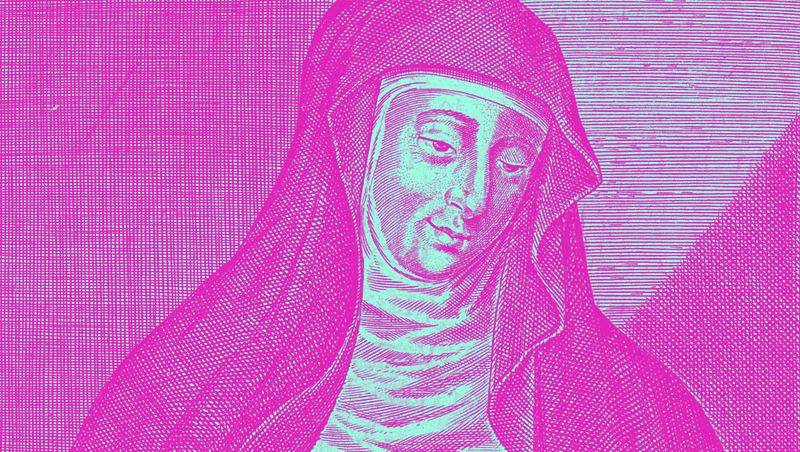
For Hildegard of Bingen, the German mystic, scientist, composer, and philosopher, women’s maternal bodies were not corrupting and degrading, but strong, nurturing, and creative. Hildegard, who was born at the end of the eleventh century, is the first known female medical writer in Europe during the High Middle Ages. Most of the era’s discourse about human generation came from monks and theologians who vowed never to have any contact with women’s bodies. But Hildegard introduced into the Christian medical tradition compassionate and celebratory theories about physical maternity that were inspired by her own bodily experiences and those of the women she cared for.
Hildegard was a Catholic abbess of the Benedictine Order. The tenth child of a noble family, Hildegard was tithed to the Disibodenberg, a monastery nestled between two rivers in Germany’s Rhineland‑Palatinate region, when she was born. After being cloistered when she was eight, she took her vows at fourteen and became a nun. Hildegard prized virginity as the highest state of womanhood, and she never experienced biological motherhood. But her commitment to spiritual motherhood did not stop her from thinking seriously about conceiving, bearing, and birthing.
In 1150, Hildegard founded the Rupertsberg, a women’s monastery on top of a hill near the Rhineland town of Bingen. It was there, while presiding as magistra—Mother Superior—over her family of noblewomen nuns, that she wrote her two medical treatises. Causes and Cures, which explored the creation of the world and the human body’s place within it, included insights into almost every aspect of biology and physiology. Physica described the healing properties of plants, animal substances, and earthly elements. Like all her works, Hildegard’s medical treatises were inspired by the visions she claimed to have received from God since early childhood.
Fearing she would be denounced as a heretic, she kept her visions secret for decades, which tormented her body and mind. When she was forty‑two and very unwell, Hildegard heard a “voice from heaven” instructing her to speak and write about what she had seen and heard. Her understanding of the pleasures and pains of the female body was grounded in her devout beliefs and mysticism. But her struggles with her health and the physical sensations she experienced during her visions made her acutely attentive to her own body—and the bodies of other women.
Unlike men who exploited humoral theory and biblical myths to denigrate women’s bodies and minds, Hildegard valorized the contribution of female difference to nature’s grand scheme.
Many monasteries in medieval Europe provided charitable health care to people who needed it most, and the Disibodenberg, where Hildegard lived for thirty‑nine years, was no exception. As she tended the healing plants in the gardens and assisted in the infirmary, Hildegard, who was appointed magistra in 1136, became an expert herbalist and physician. In the library at Disibodenberg, she pored over Latin translations of Greek, Roman, and Arabic treatises, as well as De Materia Medica, a five‑volume compendium by the Greek physician and botanist Dioscorides.
The depth of medical competence and literacy Hildegard gained was rare even for educated women within the monastic sphere. She treated her nuns and local and visiting women who came to the monastery seeking care for gynecological ailments, fertility issues, and pregnancy complaints. Nuns often served as birth attendants to women in their communities. Hildegard didn’t mention whether she delivered babies or assisted at births, but she knew how to care for women’s bodies as they journeyed toward motherhood.
Hildegard’s regimens comprised time‑honored techniques of women’s healing lore. She recommended placing warmed sweet herbs around a birthing woman’s back and thighs to relieve her pains and help her womb open. Making a woman look at her reflection in a vessel containing dried crane’s blood mixed in water—some of which had been rubbed on her vulva—was thought to be an effective aid for an obstructed delivery. Tie the right foot of said crane over her naval, and her loins were sure to open. A gemstone called sard rubbed over the thighs of a heavily pregnant women who was “oppressed by pain” could bring on labor. Hildegard noted that the rubbing ritual should be performed while a prayer was being recited that urged the child to come forth “a shining person.” And if a mother kept a piece of jasper on hand throughout her child’s infancy, they would both be protected from malign spirits of the air and from the tongue of the ancient serpent that was hell‑bent on ensnaring newborns.
In the twelfth century, understandings of bodies and illnesses were grounded in humoral theory, and Hildegard followed these principles in her writings about conception, birth, and physical maternity. She didn’t depart from the prevailing belief that the paltry constitution of female humors—the bodily fluids, described in ancient and medieval medical theory, which were believed to determine a person’s temperament and physiological nature—made women the frailer sex. Neither did she disagree that women, made not from the earth but from a spare bit of male flesh, were softer, lighter, and weaker than their strong, virile male counterparts. But unlike men who exploited humoral theory and biblical myths to denigrate women’s bodies and minds, Hildegard valorized the contribution of female difference to nature’s grand scheme. In Causes and Cures, she showed that women were complex human beings, not a monolith of walking wombs—and she also flipped the misogynistic script on female sexual desire.
__________________________________
From A Woman’s Work: Reclaiming the Radical History of Mothering by Elinor Cleghorn. Copyright © 2026. Available from Dutton, an imprint of Penguin Publishing Group, a division of Penguin Random House, LLC.

Elinor Cleghorn
Elinor Cleghorn is a feminist cultural historian, writer, and researcher living in Sussex. After receiving her PhD in humanities and cultural studies in 2012, she worked for three years as a postdoctoral researcher at the Ruskin School of Art at the University of Oxford on an interdisciplinary arts and medical humanities project. Her writing on women’s health and its histories has been published in The Wall Street Journal, BBC History, BBC Science Focus, New Scientist, and Vogue, and she has discussed her research on BBC’s Woman’s Hour, NPR, and numerous podcasts. Elinor is the author of Unwell Women, which has been translated across the world.