Manil Suri on Visualizing Your Book’s Narrative Structure
The Art of the Book X-Ray
This first appeared in Lit Hub’s Craft of Writing newsletter—sign up here.
Here’s a nifty tool I’ve devised which authors might want to try out for themselves. It’s free, easy to use, and reveals the underlying narrative structure of a book, much like a medical diagnostic. I call it a book x-ray.
I realized the need for it at a particularly fraught juncture in the editing process of my new memoir, “A Room in Bombay.” After a year of rewrites, my editor Jill Bialosky (of W.W. Norton) still felt that the first part of the book didn’t connect well enough with the rest. She also thought that the main thrust of the story, the relation between my mother and me, was in danger of getting lost for readers amidst competing strands.
I could see her point, which jibed well with general advice about focusing on a single narrative for memoirs. Moreover, I knew from working with Jill on all four of my previous books (even, bless her heart, the one on popularizing math she bravely took on) that she has an uncanny sense of what will work with readers. And yet I had a gut feeling that my alternate vision of the book was just as viable. But how to prove this to Jill? Or, for that matter, even myself?
This is where my experience teaching mathematics kicked in. I’ve often seen the power of images—how some of the most abstract math concepts can be made assimilable by pictorially representing them. Might something similar hold for literature? Was there a pictorial representation of my book that would allow a deep dive view of how its different strands interacted to form a single narrative arc?
I found some websites that offered book visualizations, even a research dissertation on the topic. But they were all too onerous and confusing—I needed something simpler.
Enter my book x-ray. First, I identified and color-coded each of the distinct narrative strands in the book. There was the room in which I grew up, which was part of a large minefield of an apartment my parents shared with three warring families—I colored its storyline red. My mother’s story—her attachment to both me and the room, her efforts to find fulfillment—got assigned black. There was also my father’s story—his loveless marriage and closeness to me – which I colored yellow. For myself, I added two strands: a green one which kept track of all the parts of the story in which I was physically present and a pink one for the thread of me realizing I was gay, escaping the room, finding a life partner.
The book had 129 sections (grouped into 32 chapters), so I created five parallel longitudinal tracks, each with 129 squares on virtual graph paper. For the topmost track, I colored a square red if the story of the room was active in the section that square represented, and left it blank otherwise. For the next track, I colored a square black or left it blank depending on whether my mother’s story was active in that section. I repeated this similarly for each track, to get the following book x-ray:

From this, I was able to do two things. First, I identified an area where more connectivity was needed (see the vertical blue line, where the bulk of the pink strand—about my sexuality—ends).
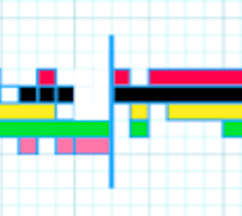
This pinpointed what Jill had been warning me of—that readers might not have enough of a hook to continue. So I rewrote the two sections before this break, to add more of the other strands to them and pose questions that would ensure interest in the rest of the book. (I had taken care of myself, fine—but what about my parents, stuck in the room?) Indeed, with the rewrite, the new x-ray looked much more connected in that vicinity.

I also composed another figure to analyze Jill’s second concern. This time, for each story strand, I filled in intermediate blank squares and ignored outlier filled squares.

This gives a picture of where the bulk of each strand is operational. What it shows—with a little reordering—is that first the pink strand (finding myself) gets resolved, followed by the yellow strand (my father’s story), then the red strand (the fight with nefarious neighbors over the room). Only my mother and I are left beyond that, showing that after all the other threads have fallen away (like the stages of a rocket), it’s the mother-son thread that endures, that forms the driving thrust of the book.
Seen this way, things started to make much more sense to both Jill and me. The book was never going to have a single narrative thread, but in the rarefied atmosphere left after all the other threads were resolved, only my mother and I remained. With a little more editing, we were able to arrive at a final version we were both happy with.
Go ahead and try this yourself on a book. The strands will generally be the storylines of the main characters. You’ll be able to see how these interact, whether there’s enough continuity, whether a character’s been ignored for too long a stretch. And who knows? If you analyze an author’s entire oeuvre this way (something I’d like to do for my own books), a “biometric” type underlying pattern, common to all their books, might emerge.
_____________________________________

A Room in Bombay by Manil Suri is available via W.W. Norton & Company.

Manil Suri
Manil Suri is a distinguished mathematics professor at the University of Maryland, Baltimore County. He is the author of three internationally acclaimed novels, including The Death of Vishnu, which have been cumulatively translated into twenty-seven languages. He is a former contributing opinion writer at the New York Times, for which he has written several widely read pieces on mathematics. His work has also appeared in the New Yorker, the Wall Street Journal, the Washington Post, Granta, and other publications. He lives with his husband in Silver Spring, Maryland. https://www.manilsuri.com/