Who Were the Mayflower Puritans? (And Did You Know They Came From a Town Called “Scrooby”?)
David S. Reynolds on the Political and Religious Motivations For the Pilgrims’ Journey to America
The Mayflower Pilgrims believed that they were freedom seekers, escaping centuries of bondage. William Bradford, a Mayflower passenger who served as Plymouth’s longtime governor, began his History of Plymouth Plantation by describing the oppression that religious intolerance had caused over the centuries. The “Heathen Emperours” of ancient Rome, Bradford wrote, initiated the kind of “bloody & barbarous persecutions” that were later inflicted on alleged heretics during the Inquisition and under English monarchs. King Henry VIII’s persecution of Catholics had been followed by the ruthless anti‑Protestant campaign of his Catholic daughter, Mary I. Under Mary’s rule, around 280 Protestants were executed—most of them by being burned at the stake. Mary’s crusade against Protestants was vividly captured in John Foxe’s Book of Martyrs, an influential work among the Pilgrims. Bradford wrote of “Mr. Foxe [who] recordeth…those worthy martires & confessors which were burned in queene Marys days & otherwise tormented.”
It was the practices of Mary’s Anglican successors Elizabeth and James I that most directly affected Bradford and his fellow Puritans. Elizabeth and James imposed strict Anglican conformity, penalizing Catholics as traitors and Puritan Separatists as religious dissenters. Elizabeth oversaw the execution of nearly two hundred Catholics, including her cousin Mary, Queen of Scots, whose beheading was gruesomely botched when the errant executioner sliced parts of her neck twice with his axe before finishing her off with the third blow.
Elizabeth was also harsh on Puritans (Protestants devoted to “purifying” the English church of all remnants of Catholicism, such as vestments, rituals, and church hierarchy). Prominent dissenters—Elias Thacker, Henry Barrowe, John Penry, John Copping, and others—were hanged for speaking or writing against the Anglican Church. Many others were imprisoned.
James I continued the crackdown on religious nonconformists. For James, the king not only controlled the church but also had a direct link to God. James verbalized the doctrine of the divine right of kings that would inspire later Stuart monarchs. James declared, “Kings are not only God’s lieutenants upon earth, and sit upon God’s throne, but even by God himself they are called gods.” As for the Puritans, he vowed, “I will make them conform themselves or I will harry them out of this land or worse.”
A well‑known conflict over these doctrines revealed that beneath Holland’s appearance of tolerance, there lay narrow‑mindedness and exclusivity.
He put his threat into action. Bradford wrote that the Puritans became “slaves” of the monarchy; they “were hunted & persecuted on every side….Some were taken & clapt up in prison, others had their houses besett & watcht night and day, & hardly escaped their hands; and the most were faine to flie & leave their howses & habitations, and the mean of their livelehood.”
In the face of the ongoing monarchical onslaughts, some gave up the idea of purifying the church and decided to separate themselves from it. Separatism had arisen as early as the 1570s under the radical Robert Browne, whose followers were popularly known as Brownists. Separatist groups sprouted in London as well as Nottinghamshire and Lincolnshire in northeastern England.
The group that would become the Pilgrims emerged in the rural Nottinghamshire hamlet of Scrooby, about 150 miles north of London. The Separatist William Brewster, a government official, served as postmaster in the region. He lived in a large manor leased by Samuel Sandys, whose brother Edwin Sandys would prove to be important both for the Pilgrims and for the settlers of Virginia. The Scrooby manor became the clandestine site of religious services held by the Cambridge-educated clergyman John Robinson, who had broken with the Anglican Church. Attendees at the Scrooby services included, besides Brewster, many local supporters, including the young William Bradford, who lived in nearby Austerfield.
By the fall of 1607, the Nottinghamshire Separatists had grown so restive under James that they decided to leave England. The Dutch Republic was an attractive destination. An alliance of seven provinces, led by Holland, whose long war with Spain (1568-1648) was at a temporary standstill, the Dutch Republic offered religious tolerance. Robinson’s group made two attempts to go there secretly by ship. The first one, in 1607, failed, resulting in the temporary imprisonment of some of the Separatists. The second, the following year, was successful. Robinson described the group’s escape as a “flight in persecution,” comparable to the exodus of Moses.
Arriving in Holland in August 1608, the refugees lived for a year in Amsterdam, a city of one hundred thousand where several other groups of English Separatists had already moved. Dissension among the groups broke out, impelling Robinson to take his flock twenty‑five miles southwest to Leiden, a manufacturing town of forty‑four thousand that had a famous university.
The Puritan conflict with Catholic Spain shaped the Separatists’ long stay in Leiden. The centuries‑long Spanish Inquisition had led to the execution of thousands of alleged heretics, including Protestants. Mercilessly oppressed under Spanish Habsburg rule, the Calvinistic Dutch Republic had been fighting since 1568 to gain independence. In April 1609, both sides, exhausted, agreed to the Twelve Years’ Truce—just as John Robinson’s Separatist congregation was settling in Leiden. The Separatists found themselves in a peaceful Protestant environment. Peaceful but very challenging. As Bradford wrote, the refugees confronted “the grim & grisly face of poverty” in a country with “differente maners & custumes” and a “strange & uncouth language.”
Coming from different social classes and educational backgrounds in England, most of the Separatists were reduced to taking mundane jobs, about half of them in the textile industry, the mainstay of Leiden’s economy.
Occupations for the Separatists included wool comber, glover, twine maker, leatherworker, hatmaker, serge weaver, tailor, and silk maker. William Bradford, who arrived in Leiden when he was twenty, wove fustian, a heavy cloth. Other jobs were cabinetmaker, brewer’s employee, mason, watchmaker, carpenter, mirror maker, tobacco seller, and tobacco‑pipe maker. William Brewster became a tutor of English and a printer of books.
If the Separatists’ jobs had an equalizing effect, so did their religious practices. The congregation made key decisions, such as admitting members or electing the pastor and the elder (the lay leader). Robinson described his church as “popular and democratical” in that it allowed “the people freely to vote in elections and judgments of the church.” The only monarch, Robinson wrote, was Christ. The pastor and elder had special positions in the church, but not a unique connection to God. The church’s humblest member was on the same level, spiritually, as its leaders. In the fellowship of faith, Robinson wrote, “every one is made a king, priest, and prophet, not only to himself but to every other, yea to the whole.”
Robinson put great emphasis on “prophesying”—that is, speaking spontaneously under divine inspiration. The pastor and the elder read Bible passages in parts of the service, but they did not deliver the sermon from a written text. Instead, they prophesied. So did others who were present. In Robinson’s words, everyone in the congregation was “a prophet to teach, exhort, reprove, and comfort himself and the rest.” Women did not participate in church decision‑making but were permitted to prophesy, which was highly unusual for that time.
After three years of meeting at the homes of members of the congregation, in 1612 the group bought a sizable property near Leiden’s Pieterskerk (St. Peter’s Church) on which Robinson lived in a two-story house and others occupied smaller dwellings on the land. The group gathered on Sundays for Sabbath worship either on the first floor of Robinson’s house or in nearby spaces. A service lasting two to three hours, led by Pastor Robinson and Elder William Brewster, was followed by a meal and an afternoon service during which members of the congregation prophesied. The Separatists learned about toleration in Leiden, but they also got vivid reminders of intolerance. Bradford’s comment that the group went to Holland because they had heard there was “freedome of Religion for all men” reflected the Dutch Republic’s founding document, the 1579 Union of Utrecht treaty, which said that “every particular person shall remain free in his religion, and that no one will be pursued or investigated because of his religion.” This proved true up to a point. People outside of the Dutch Reformed Church were not persecuted, but they were required to worship in private and could not hold community events. The Dutch Reformed Church claimed status as the “public” church of the Netherlands—that is, the only one with government sanction and the freedom to practice openly. The English Separatists had to meet privately, despite their Calvinistic doctrines being similar to those held by the Dutch Reformed Church.
A well‑known conflict over these doctrines revealed that beneath Holland’s appearance of tolerance, there lay narrow‑mindedness and exclusivity. In 1618, a group of ministers led by Jacobus Arminius issued a remonstrance (a public petition) requesting permission to teach that moral behavior contributed to one’s salvation—an idea that departed from the Calvinist principle that humans, depraved since the fall of Adam, were entirely in the hands of an omnipotent God, who had predestined a select few to go to heaven and the rest to hell. The request for a more hopeful doctrine by Arminius and his followers, who were called the Remonstrants, met with stiff opposition from Leiden’s Calvinist leaders, known as the Counter‑Remonstrants.
The two groups engaged in an open debate. John Robinson, the author of many books on religion, participated in the contest on the Counter‑Remonstrant side. But he could not foresee the extreme actions that the controversy would lead to. The Calvinism of the Counter-Remonstrants was officially endorsed by an international synod in the South Holland town of Dordrecht (Dort in English). The Synod of Dort not only reinforced Calvinist orthodoxy but brought to power Counter‑Remonstrant politicians who persecuted Arminians, most notably Johan van Oldenbarnevelt. Long revered as the heroic leader of the Dutch Republic’s war against Spain, the seventy‑one‑year‑old Oldenbarnevelt was tried by a special court, convicted of treason, and executed. Other leading Arminians, including the philosopher and jurist Hugo Grotius, were imprisoned, while many more were deposed from office or forced into exile. Robinson, though staunchly opposed to Arminian doctrine, rejected calls to suppress the Remonstrants, insisting that magistrates could not compel faith. In Leiden he encountered the Mennonite historian Pieter Twisck, whose expansive book Religion’s Freedom assembled more than a thousand historical examples defending liberty of conscience from early Christianity onward. Often described as the earliest systematic history of arguments for toleration, Twisck’s work helped shape the intellectual atmosphere in which Robinson’s thinking evolved. Even without proof of a direct meeting, Robinson and his congregation moved in circles where dissenting views on liberty circulated widely, and these ongoing exchanges encouraged his gradual shift toward broader principles of toleration in the years ahead.
Robinson’s toleration anticipated that of Roger Williams, who would introduce the separation of church and state to America. The Leiden years had changed Robinson. A member of his group noted that he “was more rigid in his course and way at first than towards his latter end,” when “there was nothing more hateful to him” than “schism and division”; by then “his study was peace and union, so far as might agree with faith and a good conscience.”
To be sure, Robinson maintained a Puritan distaste for practices of the Anglican Church that had no apparent biblical basis, such as reading the Book of Common Prayer, kneeling before a crucifix, or having priests wear a cap or surplice. But he thought it was wrong to impose one’s views on people of different faiths. His outlook became so open that he and his group were denounced by strict Separatists in Amsterdam, who called his church “[as much] a harlot as either her mother the Church of England or her grandmother Rome.” Robinson responded to such criticism by declaring that “I have one and the same faith, hope, spirit, baptism and Lord which I had in the Church of England.” His goal was “to preserve the unity of the spirit with all that fear God to have peace with all men.” Although his theology was Calvinist, he thought that Calvin, Luther, and other Protestants had gone only so far in understanding Christianity, the meaning of which was always unfolding. God, for Robinson, was eternally unknowable. The best that humans could do was to seek God constantly. In this sense, all thoughtful people of faith were Pilgrims—they were on an unending journey toward a knowledge of God’s message.
*
By 1617, some of Robinson’s followers wanted to leave Holland. The Dutch environment was pulling the group away from its English roots. It also fostered laxness about the Sabbath and drew the younger generation toward what William Bradford called “the great licentiousness of youth in that countrie.” Thoughts turned toward the Americas. The Dutch Republic’s truce with Habsburg Spain would end in 1621. Although moving to America posed dangers, the Leiden group reasoned that “as great miseries might possibly befale them in this place [Holland], for the 12 years of truce were now out,” and “the Spaniard might prove as cruell as the salvages of America.”
But where would they go? Guyana in South America was a popular choice. Warm and favorable to agriculture, it was one of the few tropical places in the West that Spain had not yet colonized. On the other hand, Spain would surely become envious if England established a successful colony there. As Bradford wrote, “the jealous Spaniard would never suffer them long; but would displante or overthrow them,” just as “he did the French in Florida.” The Separatist group would be “too smale to resiste so potent an enemie, & so neare a neighbor.”
If not Guyana, where? Northern Virginia was agreed on. At the time, Virginia extended from the current‑day Cape Fear, North Carolina, all the way north to the Long Island Sound. The Separatists decided on an area near the mouth of the Hudson River.
First, they needed to get approval from King James. That came through the well‑connected Sir Edwin Sandys. In the late fall of 1617, two members of Robinson’s group went to London. They met with Sandys, requesting his help in securing King James’s permission for the Leiden group to establish an English colony in North America. Although Sandys did not support religious separatism, he wanted to boost the population of Virginia, and he had long respected William Brewster and others in the Leiden congregation. Calling himself “your very loving friend,” he wrote to Brewster and Robinson, promising that he would inquire with people he knew in the royal circle. This “loving friend” had to be cautious, because he had alienated James by criticizing the doctrine of the divine right of kings in Parliament.
Edwin Sandys’s backing of democracy in Virginia also infuriated the king. Sandys, who said he aimed “to make a free popular state there in which the people should have noe government putt upon them except by their owne consents,” created Virginia’s General Assembly, America’s first body of elected representatives (which met initially in July 1619, a month before the arrival of enslaved Black people on the White Lion). Because he defied James’s autocratic rule, Sandys was reported to be “the king’s greatest enemye.”
Whoever made that leap, Plymouth Rock would become a potent cultural symbol.
To communicate the Pilgrims’ request to the king, Sandys used his friend Robert Naunton, James’s secretary of state, as an intermediary. Naunton carried a statement from the Pilgrims, declaring that they recognized the supreme authority of the king and the Church of England. They didn’t mention that they had separated from that church. Naunton informed James of the Pilgrims’ plan to establish a colony in America where they hoped to “live under his government and protection” and “enjoy freedom of conscience.” James did not give open support but said he would “not molest them, provided they carried themselves peaceably.”
He asked what occupation the Pilgrims would pursue in the New World. When Naunton said “fishing,” the king chuckled, “So God have my soul, ’tis an honest trade; ’twas the apostle’s own calling.” In June 1619, a patent was issued authorizing the Pilgrims to migrate to the Virginia colony.
Financial backing came from London merchants John Peirce and Thomas Weston, who regarded colonization as a promising enterprise. They assembled a syndicate of about seventy English investors, later known as the Adventurers, to support the Separatists’ plans. In February 1620, the group arranged a patent through the Virginia Company that envisioned the colony in northern Virginia as a joint‑stock undertaking. Under its terms, profits would be shared between settlers and investors, and after seven years the colonists could purchase the investors’ shares and assume full ownership of the settlement. With the way clear for migrating, the Leiden congregation in the spring of 1620 discussed who would go on the first voyage. About a third of the congregation wanted to be among the early emigrants. Because the majority did not want to leave, it was agreed that Reverend Robinson would remain in Leiden and move to America later with others. The voyage was initially scheduled for June, but delays necessitated rescheduling for July. The plan was to travel by ship to Southampton, England, where a second ship and additional passengers would join the journey.
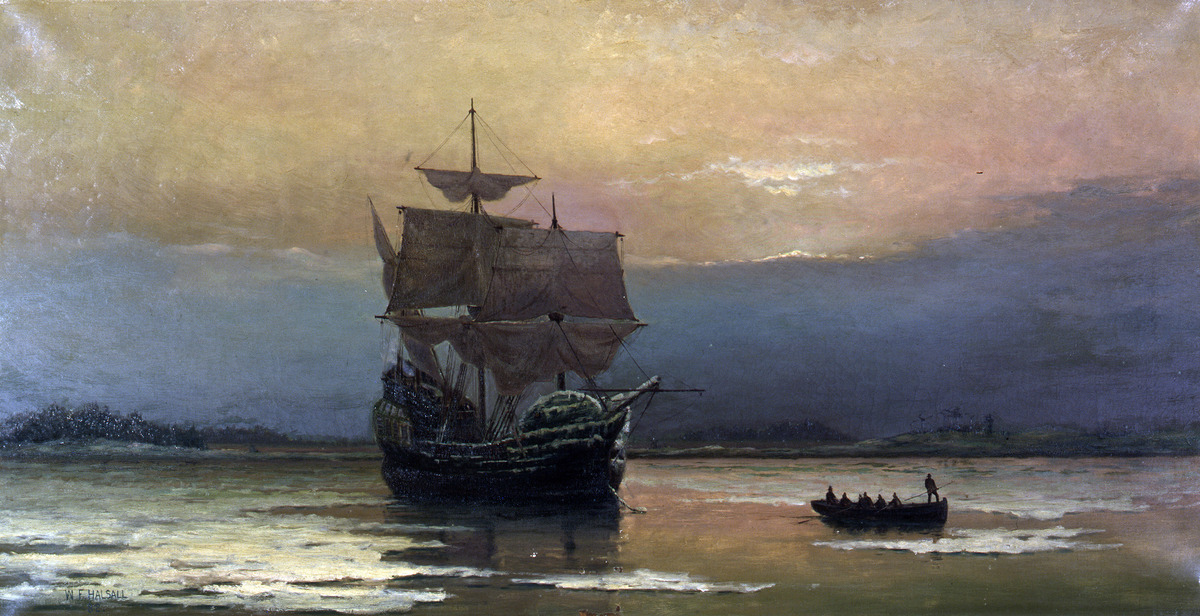
In late July, Robinson held a feast in his home in celebration of the Pilgrims’ mission to settle in America and create a godly community there. Hymns were sung, and Robinson delivered an inspiring sermon. The next day, many in the group went to Delfshaven, a port town twenty miles south of Leiden. There, the emigrants boarded a small ship, the Speedwell. On July 22, as it departed, those on shore shed tears and prayed aloud. At Southampton, the Mayflower, which the Adventurers had funded, awaited with additional travelers, mainly people intent on moving abroad for commercial reasons. The Mayflower and the Speedwell set sail for America but had not gone far before the Speedwell sprang leaks. The two vessels returned to England, making port in the town of Dartmouth about August 12. Eleven days later, after the Speedwell was repaired, the ships left again for North America. But three hundred miles into the trip the Speedwell again proved unseaworthy, and the ships returned to Plymouth, England. Several would‑be emigrants lost resolve and opted out of the voyage. On September 6, the Mayflower headed off alone across the Atlantic. According to recent estimates and historical records, the Mayflower carried about 135 people—102 passengers and over 30 crew members. Among the passengers were about 37 Leiden Separatists, later known as the Pilgrims, and approximately 65 others, the so‑called strangers—merchants, craftsmen, laborers, and a few orphans recruited to round out the new colony. The company included 44 men and 18 women, all of them married, with 3 of the women pregnant at the start of the voyage. There were also about 40 children and youths, the youngest being one‑year‑old Humility Cooper. During the crossing, a son was born to Stephen and Elizabeth Hopkins, whom they fittingly named Oceanus. Even two dogs—a large English mastiff and a small spaniel—shared the cramped quarters of the ship on its storm‑tossed passage across the Atlantic. The Pilgrims saw everything that happened, favorable or unfavorable, as providential and biblical—God’s will at work. One man, a servant named William Butten, died at sea. His death was viewed as a sign of God’s just punishment of evildoers. Bradford described Butten as “a proud & very profane” man who cursed the passengers and said he looked forward to seeing half of them die so that he could throw them into the ocean and take their belongings. Midway in the journey, he contracted “a greeveous disease, of which he dyed in a desperate maner, and so was him selfe the first that was throwne overbord.”
The Mayflower had fair sailing until it reached the mid‑Atlantic, where it met with turbulent weather. The ship’s center beam broke and caused leaks until it was pushed back into place by a huge jackscrew that passengers had brought from Holland. The storms grew so fierce that the crew sometimes took down the sails and let the ship float freely in the mountainous waves.
The people on board lived in a dark space below the main deck that was around five feet high, twenty‑four feet wide, and fifty‑eight feet long. Additional space was taken up by the pole of the mainmast in the middle and the mizzenmast at the front. The windlass and the capstan, bulky machines used for hauling items from the cargo hold below, also occupied room, as did a thirty‑foot shallop (a single‑sail boat) that would be used for trips ashore. Seawater seeped in through the ship’s crudely caulked seams. Food consisted of hard biscuits, dried fish or meat, pickled foods, cereal grains, and beer (then a common drink, even for children, because keeping water pure for an extended period was difficult). Most passengers slept on straw mattresses on the planking of their deck; some improvised hammocks or wooden pallets. Besides the two months of the voyage, many of the passengers, mainly women, would live on the ship for an additional four to six months while a settlement was being built.
On November 9, after a sixty‑six‑day voyage, land was sighted. Driven off course, the Mayflower had arrived at Cape Cod. The decision was made to sail south to the Hudson River area, the ship’s original destination. That proved impossible because of rough seas. Within a day, the ship returned to Cape Cod. It dropped anchor in what is now Provincetown Harbor on November 11. Over the following weeks, parties went ashore, explored, and found firewood and corn that the Nauset tribe had buried. The corn was a godsend for the famished passengers, but Nausets attacked the English, who scattered their assailants by musket fire. Although no one was killed in this so‑called First Encounter, the settlers felt that they were confronted with what Bradford called “a hidious & desolate wildernes, full of wild beasts and willd men.” But they rejoiced over reaching America—a truly remarkable providence.
On December 18, 1620, the Mayflower anchored near a place that had already been named New Plymouth by explorer John Smith in 1614. After a small group went ashore to survey the site, the main body of passengers first came ashore on December 21 to begin building their settlement. Did they alight on what came to be known as Plymouth Rock? Contemporary records from the period don’t say. But that was the recollection of the ninety‑four‑year‑old Elder Thomas Faunce when in 1741—more than a century after the landing—he identified a boulder that he said was where the shallop from the Mayflower had landed. There were questions regarding the rock and the identity of the first person to step onto it. Was it John Alden, the Mayflower’s cooper, or Mary Chilton, the teenage daughter of James Chilton (who at sixty-four was the ship’s oldest passenger)? Whoever made that leap, Plymouth Rock would become a potent cultural symbol.
Equally potent was the Mayflower Compact. Signed on November 21 by forty‑one male passengers on the ship, the document established a “civil Body Politick” with the power to pass laws and select officers “most meet and convenient for the general Good of the Colony.”
Tremendous importance was later assigned to this hastily prepared manuscript. For Civil War-era progressives, the Mayflower Compact embodied the spirit of freedom that lay behind the goal of emancipation. In the 1830s, the historian George Bancroft wrote, “In the cabin of the Mayflower, humanity recovered its rights,” representing “the birth of popular constitutional liberty.” Recently, the legal scholar Julia L. Ernst has described the Mayflower Compact as “the historical precedent for future seminal documents in the formation of the American governmental system, including the Fundamental Orders of Connecticut, the U.S. Articles of Confederation, the Virginia Declaration of Rights, the Northwest Ordinance, and particularly the U.S. Constitution.”
How accurate were these assessments? Only somewhat, if applied to the Mayflower Compact alone. John Quincy Adams took a broader view. As an antislavery congressman, he declared in 1843, “The Plymouth Colony is remarkable for having furnished the first example in modern times of a social compact or system of government instituted by voluntary agreement, conformably to the laws of nature, by men of equal rights, about to establish their permanent habitation as a community in a new country.” Adams asserted, “The change was a total one, a democratic revolution.”
__________________________________
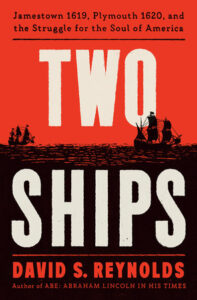
From Two Ships: Jamestown 1619, Plymouth 1620, and the Struggle for the Soul of America by David S. Reynolds, to be published on June 9, 2026 by Penguin Press, an imprint of Penguin Publishing Group, a division of Penguin Random House, LLC. Copyright © 2026 by David S. Reynolds.

David S. Reynolds
David S. Reynolds is a Distinguished Professor at the Graduate Center of the City University of New York. He is the author of Walt Whitman’s America: A Cultural Biography, winner of the Bancroft Prize and the Ambassador Book Award. His other books include Beneath the American Renaissance, winner of the Christian Gauss Award; John Brown, Abolitionist; Waking Giant: America in the Age of Jackson; Mightier than the Sword: Uncle Tom’s Cabin and the Battle for America; and Lincoln’s Selected Writings. His most recent book is Abe: Abraham Lincoln in His Times, the basis of the documentary Lincoln’s Dilemma and winner of the Gilder Lehrman Abraham Lincoln Prize.