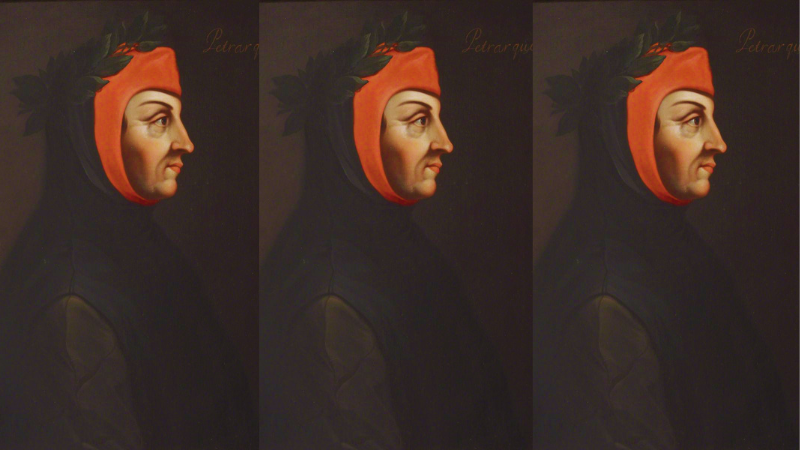
Learning to Live With Invidia: What Petrarch Has To Teach Us About Envy
Peter Jones on the Ways We Can Apply Medieval Philosophy to Our Modern Lives
Although Francesco Petrarch grew up near Giotto’s city of Florence, he spent the last years of his life in Arqua’Parcheggio, a village just outside Padua. Along with Giovanni Boccaccio and Dante Alighieri he was one of the three crowns of Italian literature, writers considered the successors of Virgil, Horace and Cicero. Petrarch wrote poems, letters and treatises, but he was also a famous conversationalist. He’s credited with coining the term ‘Middle Ages,’ a label he invented to dismiss the thousand years of ‘darkness’ that separated his own enlightened era (the mid-1300s) from Ancient Rome. Ironically, most critics today think of him as part of the Middle Ages himself.
Petrarch was especially interested in how envy affects a friendship. It’s a “virus,” he said, that produces a “kind of evil” unlike any other. He first came to experience it for himself, as he told his friend Donato in a letter, one day when he was ambushed in Venice. Four of his well-connected friends—he didn’t repeat their names, since Donato would “know them all” already—had met up to discuss Petrarch’s work. After private deliberation, they decided to condemn his mistakes in a series of public attacks. Holding “a tribunal of envious friendship,” they called out all the places Petrarch had made philosophical “errors,” and the points where he had supposedly contradicted “the law of Aristotle.” His education had been somehow soft, they said, his reading rather light. He was a ‘good man’ but he lacked knowledge, and was too much of a performer. “Much eloquence,” they decided, but “little wisdom.”
Petrarch’s solution was to never try to ‘extinguish’ his invidia. This was naive, and would only lead to greater misery. Instead, his answer was to learn to live with it.
To Petrarch, this was slander. He had no doubt, on reflection, that their condemnation was driven more by envy than any concern for philosophy. Maybe they began their criticisms with “good intentions,” but soon—as often happens with Invidia—”an unfortunate grudge” crept through the “cracks” into their hearts. What was it, precisely, that they envied? It couldn’t be his body, Petrarch was sure of that. And it couldn’t be his wealth, as all four were richer than him. He wanted to believe they envied him his “virtue.” But really, what these friends envied most was Petrarch’s fame. This was a poet who’d been invited to instruct three successive popes. He was somebody that the emperor up in Germany regularly wrote letters to, and that King Robert of Sicily considered a close friend. Petrarch had become, in other words, a literary celebrity. And these four friends—who all considered themselves serious scholars—wanted to find a way of invalidating his success.
Invidia is a sin that thrives in the shadows. The most upsetting thing for Petrarch was not so much these four friends’ condemnations, as the secretive and sniping way they went about them. Instead of bringing their problems with his work to him straight away, they chose to meet in secret. As they never considered any evidence in Petrarch’s favor, these private meetings soon lapsed into full-scale character assassinations. To make things worse, even as they were conducting their private meetings, these four friends carried on visiting Petrarch, pretending nothing was going on. They made “agreeable conversation” with “astonishingly good manners” and “bright faces.” They practiced the envious art, as another medieval writer once put it, of hiding “anguish beneath a paralyzed smile,” covering “hidden animosities with flattery.”
If anything, Petrarch stayed upbeat through all this rough treatment. The best defense against invidia, he felt, was to stay focused on doing what’s good, instead of what’s popular. And his diagnosis of jealous hatred—where enjoying other people’s mistakes becomes your lifeblood, and knocking down your rivals becomes a reason to exist—still feels fresh and alive. Isn’t this the same experience many people go through today, in a life lived half online? But there’s a good reason why a medieval writer like Petrarch was able, instinctively, to summon a culture that resonates with our own. And that’s because his social system, that of the very first universities, was a lot like ours. One defined by backstabbing, shaming and reveling in the Raws of other people.
Medieval universities were powered by individual reputation and popularity. Or, to put it another way, they were powered by invidia. During higher education’s “start-up” era, the early 1100s, being a professor was less a professional vocation than a journey. First, just like today, you needed to get credentials. Usually—because centers of learning were scattered sparsely around the continent, and because all education took place in the international language of Latin—this involved a lot of travel. To begin, you could go to either one of the major cathedral schools (like Chartres, Metz, Reims or Würzburg), or maybe a nearby monastery. There you would learn the basic essentials of the seven liberal arts: grammar, rhetoric and dialectic, as well as music, geometry, mathematics and astronomy. This was costly, but worth the effort. By mastering these essentials you were making an investment in yourself
To really get ahead in this ecosystem, you would have to travel to one of the new universities and study one of the three “advanced” subjects (theology, medicine, or law). Europe’s three major institutions, Bologna, Paris and Oxford, welcomed between 1,000 and 2,500 students each in these early decades, and conditions were sprawling, anarchic and provisional. Professors (or masters as they were called) hired rooms and formed their own schools. Students then had to choose between them, paying fees relative to their reputation. If a master had good reviews, he could charge more. If he had bad reviews, he would quickly find himself with no students and no livelihood. Consequently, the most famous masters of this era, like Peter Abelard, made their careers, in part, by cutting down competitors. When Abelard made a fool of his rival William of Champeaux, outperforming him in a public battle of logic, William was left “seething with such envy” that he ‘boiled’ inside, feeling such a pain that “words cannot do it justice.”
Petrarch, in his youth, had followed this same educational pathway. He studied law in Bologna, at a time when that school’s population was growing. Still, he was never inclined to become a university master. Academic life always felt claustrophobic, and he claimed to regret those years as “a waste of time.” Really, Petrarch’s heart was with his poetry, and he was burning to carve a life away from education, to find a way to become “good rather than learned.”
And it was this drive that led Petrarch to travel widely. Visiting villages and towns across Italy, throughout southern France and up the Rhine valley, he earned the nickname of “Europe’s first tourist.” His real passion, in all this, was for the Alps. He once climbed Mont Ventoux, and looked across at the same mountains I saw while I walked between the Arena Chapel and the Basilica di Sant’Antonio in Padua. When Petrarch climbed them, he felt “an inexpressible longing.” There was only so far this beauty could take him, though. Descending the mountains, he decided to “turn” his “inward eye” on himself. Thinking about the ten years that had passed since he had finished his own studies, he reflected that he still wasn’t free of his “perverse and wicked passions.” “I am not yet in a safe harbour,” he wrote, “where I can calmly recall past storms.”
What, exactly, were these “perverse and wicked passions”? What were the storms? Although Petrarch’s life was complex, it seems that one of the things that tortured him was his envy. He once wrote a letter to another great Italian writer, Boccaccio, confirming that he wasn’t jealous of Dante. Here, he was defending himself from an accusation that had often been thrown at him. Why had he never owned a copy of Dante’s Commedia, people asked, even though it was the greatest work of Italian literature? Dante had once lived with Petrarch’s own father, so shouldn’t it be a prized work on his shelf? “I didn’t want to risk imitating it,” Petrarch said, unconvincingly. In another revealing letter to Boccaccio he outlined in painful detail where the three poets (himself, Boccaccio and Dante) ranked in terms of prestige. “I have heard that our Old Man of Ravenna [a mutual acquaintance]…is accustomed to assign you the third place,” he said, before protesting just a little too much. “If you think that I prevent your attaining to the first rank—though I am really no obstacle—I willingly…leave you the second place.”
Even as he tried to run from the accusation, Petrarch recognized the universality of envy. Just like the writers who sympathized with Judas or Cain, he believed invidia was really an unavoidable ingredient of every human relationship. “I have envied my friends” one of the characters in his dialogue, De remediis utriusque fortunae, told his master. “But, who hasn’t?” As the master said, there was only one way to live without jealousy. And that was to run away from society. To “leave public honours and offices” and “sequester yourself as much as you can.” Petrarch’s solution was to never try to “extinguish” his invidia. This was naive, and would only lead to greater misery. Instead, his answer was to learn to live with it. To soften his envy and then shape it, and to find something else to do with all that nervous energy.
The cure for envy is to try to see what’s in front of us. To really see it, and to accept it for the beautiful and fragile thing it is.
How to do this, exactly? How do we turn an envious grudge into something more inspiring? As Petrarch said, the first rush of invidia—Cain’s sense of injustice, Judas’s burning ambition, or even the jealousy we all often feel—shouldn’t be discarded or discounted. Instead, it should be redirected and repurposed to help us achieve something great or useful. Rivalry can “accomplish wonders,” Petrarch said, so long as we follow only its strengths: its burning curiosity; its obsessive interest in other people; and its restless desire for self-improvement.
So, if attention is the main tool of envy, it can also be its cure. The challenge, according to a thirteenth-century preaching guidebook from Cambridge’s Corpus Christi College, is to make all this curiosity, interest and ambition into the ingredients of a more open and ethical social life. When we’re envious—like Petrarch’s four friends, meeting in secret to churn over and enjoy somebody else’s every last flaw—the plus side is that we are at least paying an intense amount of attention to another person. All we need to do, then, is modify our attention. To bring it out in the open and, instead of sniping, try to “feel every wound,” to “rejoice in every triumph” of our rival. Practice this long and hard enough and we’ll find that our envy can wash into compassion. Then, if we’ve done it right, we’ll discover that we understand both ourselves and the person we’ve been watching all the better. We’ll love both them and ourselves in ways we could never have dreamed of before.
How do we stop the flow of resentment? How can we stop looking with hatred and hunger at the lives of other people? Is there a cure for that feeling—disgusting to admit—that makes us sometimes want to see another person fail? Judas and Cain experienced envy as a toxic combination of two drives. A sense of injustice combines with an irrational fear that others are taking away things we want to enjoy ourselves, forming an explosive loathing. One answer to this, for medieval thinkers, is to train the eye to see differently. John Climacus, a theologian who died in the seventh century, believed the cure for envy was to see other people the way a winemaker sees a grapevine. Coming to pick the grapes, you should reach only for the good ones. The bad grapes—the ones that are rotten, or broken, or unripe—you should pass over without a glance. Can we do the same with all the difficult features we encounter in another person? Ignore those, and reach out for the inspiring things instead?
And yet even medieval theologians admitted that it was impossible to live without a little resentment in your heart. As Anthony of Padua described it, invidia was like a strain of bacteria. We all need an amount of it in our microbiome to function; a little bitterness to help us fight injustices, a little competitive rivalry to get the best out of our talents. But when it’s unchecked, invidia can multiply and overflow, especially when we don’t deal properly with a wound. Under vulnerable conditions it can send a toxin through the bloodstream, making even relations with our friends—and maybe especially our friends—into something poisonous. So, as with any injury, it’s better to seal off the wound that sparked the envy and try to build up our immunity, rather than keep the wound open, out of morbid fascination, and allow invidia’s infection to take hold.
And so the other answer to envy is not to fight it, but to follow it. It’s to take all the elements in the Arena Chapel code and turn them towards something worthwhile. We shouldn’t feed that snake that wants to grow inside us. But if it’s there, we can remember that the harshest poisons, in the right doses, can be medicinal. Although we need to reduce the size of our ears, so that they don’t act like satellite dishes waiting to pick up news of other people’s successes or failures, we can comfort ourselves that we are at least listening. And we can embrace this as the seed of an attention that, used well, can make us good friends, better partners, good citizens. We can keep our claws, so long as they reach out in hope. We can use our horns to pierce through brambles, and make sure that ambition for money becomes philanthropical. And that flame, licking at our feet, can warm us as much as it can burn.
Most of all, though, the cure for envy is to try to see what’s in front of us. To really see it, and to accept it for the beautiful and fragile thing it is.
__________________________________
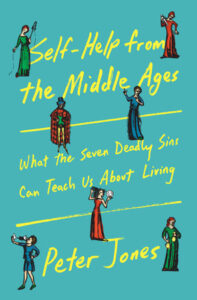
From Self-Help from the Middle Ages: What the Seven Deadly Sins Can Teach Us About Living by Peter Jones. Copyright © 2026. Available from Doubleday, an imprint of Knopf Doubleday Publishing Group, a division of Penguin Random House, LLC.

Peter Jones
Peter Jones received his Ph.D. in medieval history from New York University. He taught at the School of Advanced Studies at the University of Tyumen in Siberia, where he was Chair of History. Today, he is a Marie Curie fellow at Complutense University of Madrid.