Lauren Acampora Recommends 7 Books About Deep Human-Animal Connections
With Work by Geraldine Brooks, Takashi Hiraide, Lydia Millet, and More
From birth, we’re surrounded by animals. We cling to stuffed animal friends, wear clothing adorned with bunnies and bears, and listen to stories of anthropomorphized creatures. The first books we encounter, too, are often tributes to animals. As a child, I devoured all the Black Stallion books, Jim Kjelgaard’s Big Red and the rest of his novels about Irish Setters, Jack London’s Call of the Wild and White Fang, and every other animal book I could find.
I’m still and forever drawn to animal stories: arrested by my neighborhood’s social media posts of bobcats caught on Ring cameras, bears raiding birdfeeders, fox mothers carrying their kits. I save newspaper articles about red-tailed hawks nesting on ledges of urban buildings, wild boars prowling the streets of Rome, coyotes crossing the frozen ponds of Central Park, and police dogs leading their handlers to fugitives.
And for me, our relationships with animals—all the ways in which we admire, fear, cherish, and exploit them—is a bottomless source for fiction. The stories in my linked collection The Animal Room delve into human-animal dynamics in all their colorful iterations, including deer hunting, private zoos, therapy animals, laboratory mice, dogs of the rescue and working variety, and maligned pests like the spotted lanternfly. Together, the stories aim to show how our attitude toward animals is largely dependent on context and species. They also try to shine a light on the part of the human mind that is bound to its own animal nature: the “animal room” hidden within each of us, a primal locus of deep-seated instincts, fears, and desires.
When it comes to writing animal stories, I’m happy to be in excellent company. Here are seven standout works of fiction that illuminate the inextricable links we share with our animal compatriots. In all these books, animals serve as mirrors, reflecting our personal and societal shortcomings and shame, our hubris, anxiety, and moral failings. But they also show the compassion and courage that mark us as uniquely human. They remind us that, as detached as we may sometimes feel from the natural world, we remain firmly embedded within it as members of the animal kingdom. And they each evoke some truth about what our relationships with animals say about the nature of humanity itself, and of our unknowable, untamable hearts.
*
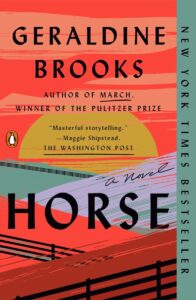
Geraldine Brooks, Horse
The famous real-life 19th-century racehorse Lexington is at the center of this expansive novel that travels fluidly between antebellum South and modern-day Washington, DC. A devoted horserace watcher as a child, I found this novel deeply moving and eye-opening. The story follows the life of a young, enslaved horse groom and trainer named Jarret, whose deep connection with the legendary horse begins at the moment of its foaling. The reader feels the impact of economic and historic tides on the lives of both boy and horse, as they grow together and are transferred from owner to owner, and as fortunes are made and lost on a single animal’s performance. Jarret’s loyalty to Lexington is unshakeable, even when staying at the horse’s side threatens his own chances at freedom, and we come to care for Lexington as he does. The novel painfully exposes the ruthless mistreatment and exploitation of both racehorses and humans in this era and tracks the ripples of that trauma through time. The story is interwoven with the fictional lives of contemporary researchers of art history and osteology investigating racehorse paintings of the Civil War era and the provenance of a mysterious skeleton labeled simply “Horse.” There is much at play here regarding power, race, and the conditional value of life, both human and animal, and ultimately, the true “humanity” of the horse, and the true worth of the human, come to light by the attention of those who care to learn their stories.
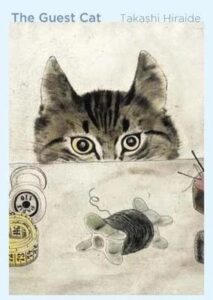
Takashi Hiraide, The Guest Cat (translated from Japanese by Eric Selland)
This trim, understated jewel of a novel takes place during the economic turbulence of late 1980s Japan, during which an introverted childless couple rents a small house in Tokyo where they begin to be visited by a neighbor’s cat. The narrator and his wife find that their attachment to the charismatic and cryptic Chibi grows with the cat’s increasing visits, in a way that bewilders them but somehow bonds them closer together. Through this deceptively simple framework, Hiraide delivers a poetic and poignant meditation on the passage of time, the meaning of work and love, and the surprise of finding joy in life’s ephemeral details. I found a philosophical undercurrent here, hinting at what we might learn from the quiet self-possession of animals, their unassuming natures, and their indifference to notions of fame or immortality. Referencing a dying poet friend, the narrator muses, “The noble-minded do not thrust others aside in order to make their way in the world. But then they themselves are ultimately thrust aside by the advancing tide.”
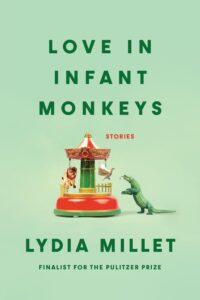
Lydia Millet, Love in Infant Monkeys
Madonna hunts pheasant in the English countryside, Thomas Edison electrocutes an elephant, Harry Harlow conducts callous experiments on monkeys, and Jimmy Carter fends off a swamp rabbit attack. Millet’s collection of tight and unsettling short stories operates through the conceit of fictionalized true tales about famous people and the animals associated with them. At times comical, each of these stories swerves and plunges deep into dark truths of human nature. Here, animals serve as vessels for our worst impulses, suffering at the point where curiosity turns to sadism, domination to cruelty, and self-interest to neglect. In the brilliant story “Sir Henry,” a dedicated dogwalker to the stars remarks, “Dogs were the martyrs of the human race.” And yet, while the animals in these stories are sacrificed to selfish purpose and whim, the human characters are astonished and haunted by them. Like Thomas Edison’s electrocuted elephant, they glow like saints, symbols of innocence and divinity, embodying the impossibility of human perfection and the original sin of our nature. As the guilt-ridden Edison imagines of his executed elephant: “I hear you. You say: I do not forgive. You say: this is my gift to you. I will never forgive.”
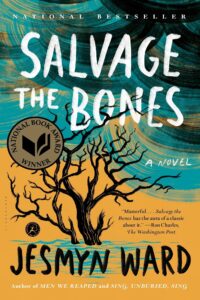
Jesmyn Ward, Salvage the Bones
Heat radiates from the pages of this extraordinary novel about a poor family in rural Mississippi in the days leading up to Hurricane Katrina. The story is narrated by Eshe, a motherless pregnant teenager whose love for her brother Skeetah is at the heart of the novel, along with Skeetah’s love for his prize pitbull, China. With the myth of Medea as a burning thematic wire, and through the metaphor of bloody dog fights, the novel burns with the rage and despair of those who remain unseen. Like a blazing sun, it exposes the truth of poverty and of motherhood, the frustration, exhaustion, and steely strength inherent to both. When China, still nursing a litter of newborn puppies, returns to the fighting ring in an unforgettably visceral scene, Skeetah whispers words to her that have deeper meaning beyond the fight: “Make them know.” When the hurricane hits, and the family clings to survival through the raging storm, we are confronted with the shared condition of humans and animals, who are by turns perpetrators and victims of violence, purveyors of both negligence and power, but ultimately and inexorably at the mercy of nature.
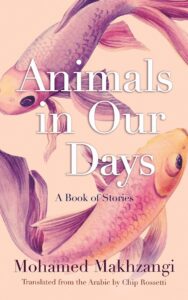
Mohamed Makhzangi, Animals in Our Days (translated from Arabic by Chip Rossetti)
The dreamlike, disturbing stories in this collection by Egyptian writer Makhzangi take place in settings ranging from Egypt toa India to Vietnam to Iraq, often at moments of violent conflict. Animals serve as allies, guides, objects of cruelty and aggression, and as striking metaphors for power, imperialism, and insurrection. In the haunting “Enchanted Rabbits,” a student demonstration in an unnamed city erupts and leads to a storming of the governor’s mansion, which is discovered to have been evacuated—but for dozens of white rabbits freed from the governor’s cages. The protesters take the rabbits but later release them onto the streets when they become liabilities in the subsequent government crackdown. The rabbits mysteriously vanish thereafter, but many years later reappear spectrally at night, in an eerie reminder of the quashed uprising: “The puddles on the wet square didn’t shine, because the darkness seemed total and all-encompassing…Along with many other people, I was waiting for the rabbits. And stealthily, stealthily, with no sudden movements, I saw—or thought I saw—white bits of shadow slip silently into the black ring of the city square… Even though my heart weighed heavily in my chest with weariness and exhaustion, I asked myself, hardly believing it, whether what I was seeing was real.”
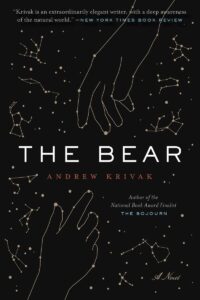
Andrew Krivak, The Bear
This spare and unusual novel is the story of a father and daughter, seemingly the last humans on Earth, as they forage for food and fish and hunt game animals, while unearthing ruins of an extinct civilization and clinging to a few treasured artifacts of the past. The titular bear, who communicates with the girl through language—seemingly telepathic—plays a crucial role in her survival. “Not all animals had the range of voice that could be heard, he said, but all living things spoke, and perhaps the real question was how she could understand him.” It’s not a small achievement for Krivak to earn the reader’s suspension of disbelief, transforming what could have been a far-fetched premise into an affecting and elegant work of fiction. This is finally an allegory of humanity’s needs beyond food, water, and shelter. Our survival is contingent also on connection, companionship, and story, and on our mutual interdependence with the natural world. As we follow the father and daughter’s efforts to live off the land, we come to feel the fleeting spark of life, the transience of individual and species, and the final endurance of Nature.
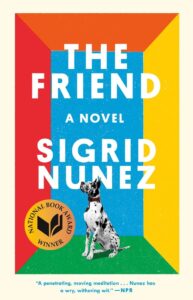
Sigrid Nunez, The Friend
Although this novel is already widely celebrated with its own movie adaptation, I can’t offer a list of books about humans and animals without it. Nunez offers a beautifully insightful and moving account of a solitary writer in Manhattan who inherits a massive Great Dane from her friend who has died by suicide. After she reluctantly agrees to steward him in her tiny studio apartment that does not allow pets, woman and dog find a bond in their shared mourning for their lost friend. Echoing the disorientation of grief, the novel doesn’t take the form of a straightforward story, but rather a mosaic of flashbacks, anecdotes, and reflections. The narrator’s thoughts about literature and the purpose of art are interlaced with historical vignettes and moments of absurdity familiar to any writer or teacher, while she simultaneously navigates the unlikely and sometimes comical situation of sharing a tiny space and public life with a giant animal. An unforgettable, silent friendship arises between woman and dog as they lean on each other, literally and figuratively. The novel includes what is, in my opinion, one of the best lines ever written about human-animal companionship, and one of my favorite literary quotes ever: “What are we…if not two solitudes that protect and border and greet each other?”
__________________________________
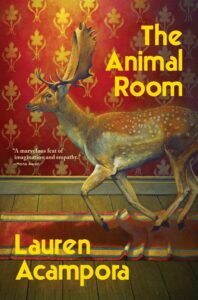
The Animal Room by Lauren Acampora is available from Grove Atlantic.

Lauren Acampora
Lauren Acampora is the author of The Wonder Garden, The Paper Wasp, The Hundred Waters and most recently The Animal Room. Her work has won or been nominated for the GLCA New Writers Award, the Center for Fiction’s First Novel Prize, the Story Prize, and the New England Book Award, and she’s been named an Artist Fellow in Fiction by The New York Foundation for the Arts. Her fiction has appeared or is forthcoming in The Paris Review, One Story, New England Review, Missouri Review, Guernica, Story, and The Common. The story “Dominion,” from The Animal Room, has been anthologized in The Best American Short Stories 2025.