He cooked and we ate our entire dinner including dessert out of one cast-iron frying pan, scooping up the last of the chocolate ice cream embedded with bits of grilled onion and potato. Our spoons, the only dishes I needed to wash because, he explained, “You never wash a cast-iron frying pan, just wipe it down, the residue of every meal you ever ate adds seasoning to the next.”
A slimy onion worm stuck in his beard, wiggling up and down as he talked.
“Samantha, are you even listening to me?”
When Dwight said my name, he paused after each syllable, like he needed to sound it out, like he was learning to read, like he’d never heard my name before.
“Sam. My name is Sam.” “Yeah. Whatever.”
He left the table.
I didn’t wash the spoons, just licked ’em clean and put them right back in the drawer. My mom would have been horrified, but impressed too, by my efficiency.
I was fourteen when my dad started leaving me in the care of random people, my mother dead less than six months. Most of the time he asked one of the female nurses he worked with at the hospital to stay with me. He was never gone for very long. But this time it was a guy from the pathology lab, Dwight—red haired, bearded, and so skinny I could see the hollowed-out joint where his leg hooked up with his torso. His jeans hung low on his hips, he kept his hands in his pockets, but that just made it worse, I mean really, get a belt.
After dinner we drove around, first downtown, then out to the industrial area by the river. Eventually we doubled back, heading away from the city and out along the lakefront on the freeway.
Lake Erie froze solid that year, but Dwight said the toxic sludge at the bottom of the river and the sheen of oil across the top would keep the Cuyahoga from freezing. He took the exit ramp fast, fishtailing on black ice, just missing the guardrail before regaining control of the car. Turning left and then right, we plowed across a flat white field that must have been a parking lot, our tires razoring straight lines in the fresh snow. He pulled the car right up to a cement barrier.
“What is this place?”
He jumped out. Ignoring my question. “Come on Samantha, live a little.”
“Sam,” I mumbled and followed him, around the wall, over a snow-covered dirt mound, and out onto the jetty— a giant finger of icy black rocks pointing straight north. He jumped from the jetty and I slid on my ass down a rock onto the lake.
It was dark and light the way the night sky is when it’s holding the snow in—waiting before letting even one flake fall. We moved fast across the surface of the lake. I’d forgotten my mittens and kept shoving my hands in and out of my pockets until the thin damp fabric of my jeans froze stiff around their warmth.
No horizon line divided lake from sky.
He said we could walk forever. He said we could walk all the way to Canada and out onto the arctic tundra. When he stretched, I saw the hair on his belly creeping down into his jeans. I thought he’d be fine on such a long expedition with all that red hair covering his body. He’d stay warm. I wasn’t so sure about myself. Still, I liked the idea of an endless trek, the two of us walking Great Lake to Great Lake, from Erie to Huron to Superior, and across to Isle Royale. He said there were moose and wolves on that island. He said they lived in “perfect stasis.” I wasn’t sure exactly what he meant but I liked the sound of the word, stasis. We could live there in perfect stasis too. It would be so quiet. Dwight wasn’t much of a talker, and I couldn’t think of anything I wanted to say out loud anymore.
We heard the roar of the engines before we saw the swarm of headlights in the pale darkness. Five cars heading straight for us, skidding and swerving in crazy figure eights. Dwight grabbed my arm, wrenching my hand out of my pocket, flaying it like a fish, pulling me along.
Under drunken shouts and honking horns, a deep lake moan rose up, and a cracking sound, except that this didn’t sound like any cracking I’d ever heard.
We ran.
My sneakers caked tall with snow. I fell. Dwight yanked me up. After that, I stomped down hard with each step, packing the snow flat, till I was steady again. We made it to the shore and Dwight scrambled up the bank ahead of me. I kept slipping backwards, trying to pull myself up, grabbing at thorny stalks poking up and out of the snow. Right behind me, one of the cars slammed into the bank, reversed, and sped off.
On top, I leaned down and wiped my bloody palms on the snow. The air was still and muffled as if the cars’ revving engines and the slurred shouts weren’t just gone but had never even existed at all. Dwight reached out and squeezed my upper arm, pulling me into a bear hug, smashing my face against the rough canvas of his jacket, his gloved hand on my ass pulling me closer. We didn’t talk on the drive back home. And once there, I thought I smelled the fishy odor of the lake thawing. I thought I heard my mother puttering around upstairs. Both impossible.
I thought I’d tell my dad about the lake. I never did. But Dwight never came back.
I returned to the lake whenever I could, watching it thaw and turn to brown sludge. I rode my bike for miles to get to the shoreline park, and by summer the waves were sluggish with heat and algae. I rode alone, straight from the job my dad had snagged for me washing dishes in the basement cafeteria of the hospital.
One day the kitchen staff lent me out to a lab for the afternoon to hand-wash delicate glass beakers and pipettes. On my way to the research wing, I got lost, unable to follow the color-coded stripes on the basement’s black rubber floors, dodging robotic carts filled with patient files. My bike and the lake seemed impossibly out of reach. A metallic, familiar, animal stench filled the maze of hallways. Twice I passed the double metal doors of the morgue. I finally found the lab and rushed to the work, impaling my hand with a cracked pipette, blood everywhere. Dwight materialized out of nowhere, a supernatural mad scientist, beardless and almost unrecognizable in a white lab coat. He cleaned me up and sent me back to the kitchen with a look of disgust on his bare, pale face.
That afternoon I made it to the beach as most of the families were packing up and the summer school kids were arriving. I waded in past the last of the toddlers, their disposable diapers dragging heavy with water and shit. Ducking under the buoyed ropes, I ignored the lifeguard’s shouts, and came up for air, way beyond the pool-sized pen. The lifeguard pursued me in a gray metal dinghy with a bullhorn, ordering me out of the water and yanking me up over the side of his boat. The aluminum gunnels left deep stinging welts, and the flesh turned purple beneath my scraped skin.
For the rest of the summer, I ventured farther up the shore to the beaches that ran close to the highway and were unmonitored, only a few older kids, some black and some white, kicking around in the shallows. No one was watching. I could swim out as far as I wanted.
I kept biking to the lake because I wanted to swim across it, shore to shore. I knew it was stupid, impossible. I just thought I should keep trying. Only later would I realize that I’d have to get much farther away from those oversized lakes if I was ever going to make it across anything.
We’d moved to Cleveland before my mom got sick, but I had only ever been to the lake beaches once or twice before that summer. My mom, Enid, grew up out West and never reconciled herself to lakes as big as oceans, making their own weather like mountain ranges do. Enid was crystal clear about pretty much everything: the appropriate size for a lake, how to make a bed, what books I should read, and how not to go about dying.
But she didn’t tell me. You will drag your mother to the bathroom, place her on the toilet, and wait outside the door as she tries to shit and can’t, morphine making it impossible. You will call through the door to ask if she is okay, and she will hiss back, “Go away Sam. Leave me be,” with the voice of someone you don’t know and never will. You will ignore her words and stand mute, pressed against the door, thinking that this is what she will remember, when she dies, seven days later. She will remember that you had to help her wipe her ass. And this mother of yours who only ever saw you as you were—will hate you for having been there and done that.
Before she started dying, before Dad started leaving, I wasn’t one of those kids that bad things happened to. I was no afterschool special, no YA paperback filled with family drama, childhood cancer, and teenage pregnancy. But that summer, I began to see stuff that had always been there, stuff that happened to other people would happen to me.
I woke up early. I never went to sleep. I couldn’t stay inside for one more second.
Most nights I just sat on the front steps. I watched the woman in the beater car drive down the street and park near the corner under the broken streetlight. She slept in the back seat. I watched the neighbor’s cat stalk a rat. The city was full of rats. Dad had a big map in his office in the public health wing of the hospital with colored pins, which showed where all the biggest rat colonies were in each neighborhood. He called them “equal opportunity vermin.” They liked the rich neighborhoods just as much as the poor ones.
We kept our shoes outside on the porch because Dad knew all about the filth and diseases we needed to keep out of the house. One night I slipped on my boots and walked right off that porch. The neighborhood we lived in was between the big houses on the divided boulevards and streets filled with duplexes and apartment buildings stretching west toward the edge of downtown. I headed down the boulevard, careful not to walk too close to some rich guy’s Porsche and set it shrieking.
I know I should have been scared. I wasn’t clueless. But I needed to feel something more than what wasn’t there anymore. The damp night air was something. The pavement under my feet was something. The smell coming from the bread factory was something.
The homeless guys just nodded like it was perfectly normal for some teenage girl to be out on the street at 3:00 a.m. It’s the clean ones with nice cars you need to worry about—the white ones in suits, same age as my dad. They were easy to shame, to call out, “You sick fuck, pedophile, do you know how old I am? You got a daughter my age? Get away from me.”
I’m my mom’s daughter, I know how to sound tough. They kept driving. I kept walking.
A guy in a Subaru trailed me down Coventry Road, real slow. At the stoplight he pulled to the curb, leaned out his window, and tried to grab my arm. I spat in his face and he jumped out of the car, catching my wrist in his meaty hand. He wouldn’t let go, yanking me hard and pulling me against the car door, his free hand worming its way down the back of my leggings, his thumb searching for a hole. I pushed out a little shit, and wow, that did the trick. Grossed out, he let go, slugging and pushing me away at the same time.
I didn’t leave the house for a few nights after that. I was twitchy and scraped a groove in the plaster wall next to my bed with my fingernail. For safety’s sake, I convinced my friend Melonie to sneak out and hang with me. Most nights we stayed on the porch. With Melonie, it didn’t seem boring. We didn’t see much of anyone. Melonie talked about boys and what she wanted to do with them. She looked like a girl that boys would like—long hair, tight black pants—nothing like me. No matter what I did, I always looked like I’d just climbed out of an unmade, crumb-filled bed.
That first summer of no mom, Melonie’s mother and my dad made a plan for all of us to rent a cabin at the state park north of Sandusky. At night we walked up and down in front of the row of cabins. At the end of the row, the door of the cabin farthest from ours was propped open, and a bunch of guys from Canada sat in camp chairs drinking beer and vodka and Mountain Dew out of insulated travel mugs. One guy offered Melonie a taste. I could tell it was nasty and shook my head when she tried to pass me the cup. The boy who’d given Melonie the drink stood by the door and another guy stood right behind her pressing his crotch against her back. The two guys in chairs were smiling and chanting, “Pay up, pay up, pay up.” But we didn’t have any money.
The big guy in the doorway stretched out his arms, his hands gripping both sides of the knotty pine planks on either side of the door frame, his body filling the space, blocking our way out. He said we could pay with a kiss, but he only wanted to kiss Melonie, which was just fucking fine with me. But it sort of wasn’t either, not because I wanted to kiss that Neanderthal. I just wanted to be kissable. I just wanted to leave.
When we got free of those boys, Melonie rubbed at her mouth with the back of her hand.
“That guy tasted like ass.”
I gave her a cherry Life Saver. She popped it in her mouth and sucked hard while we walked down the beach. It wasn’t a sandy beach, only a narrow band of rocks and poison ivy between the gravel road and the baby-sized waves. Melonie said Canada boy didn’t know “dick” about kissing and was sure I would be a better kisser. Behind a green dumpster we checked to see if she was right, passing the half-sucked cherry Life Saver back and forth until it was a sliver on our tongues.
Back at home, we kept sneaking out at night, but Melonie stopped looking for guys, instead she found all sorts of reasons to share candy and warm our hands under each other’s sweatshirts. One night it was so cold that Melonie stuck her whole head up into my sweatshirt and out the top so we were kissing in a straitjacket, chest to chest. When she wiggled back out, she stopped long enough to leave a ring of sweet sticky redness around my left nipple.
We never went very far on the nights we met up. My need to roam was quenched by her. She was always the first one to try anything. She told me to wear one of her miniskirts, and I figured maybe she was ready to leave all this girl kissing behind and go find some real boys. I was wrong. We made it as far as the neighbor’s garage when she pushed me up against the wall, bracing both of us so her fingers could work their way under the elastic of my underpants and achieve the angle she needed to enter me. We never sat down. We wedged ourselves upright against whatever we found. She was shorter than me so she could move her hand up and into me easily.
Sticky candy cunt fingers.
I had the same dream three nights running. I am having sex with my own mother.
I tell no one about this dream. I can’t even think about it.
Years later, I’ll marvel at the transgressive nature of my own subconscious, such a far cry from reality.
Back then, I don’t know what I thought. But the dream is always there when I think about the night we killed her. We were eating takeout in the bedroom, Mom lying not two feet away. Mom was clear about this too: “Never eat in the bedroom.” She hadn’t been awake for two days, but would sort of rear up, stiff like a zombie, and make a deep moaning sound, like the lake, the signal to both of us to put on gloves and replace the fentanyl patch below her left shoulder blade. She was way past swallowing even the tiniest pill of morphine or Ativan. My parents had a plastic bin filled with drugs they had been stockpiling. We had enough Xanax, oxy, you name it, to kill most of my high school or keep them all high for months. Mom’s breathing was wet, and the new patch wasn’t doing shit. It didn’t quiet the strange leg and arm spasms. But still we waited half the night—knowing she must have thought we’d chickened out—until Dad dropped the cardboard box of fried rice he wasn’t eating on the floor and told me to put on some surgical gloves, peeling back the clear coating on the back of each postage stamp-sized patch and handing the open patch to me as I stuck one after the other across my mom’s back and chest in a toxic checkerboard.
*
Enid died in the bedroom while we were washing up.
Dad didn’t call anyone that night. Told me to go to bed and I did. My room shared a wall with theirs, and I pressed the side of my face to the cool plaster and listened to the scratchy sound of WCLV playing classical music—on and on with no commercial breaks.
I think about the two of them there together with all the windows open to the January night, the smell of snow in the air, lying side by side, him alive and her dead.
In the morning, he called the funeral home and told me to peel off all the drug patches and flush them. I scrubbed away the sticky telltale edges with a warm soapy washcloth and wrestled my mom’s body into a clean nightgown. Her arms and legs were so heavy and her nipples were small, perfect, and pink like in the dream. We waited a long time for the mortuary men to come, and after they left, I walked to school. I took the long way, past the golf course and the reservoir. It didn’t matter, I was already late.
__________________________________
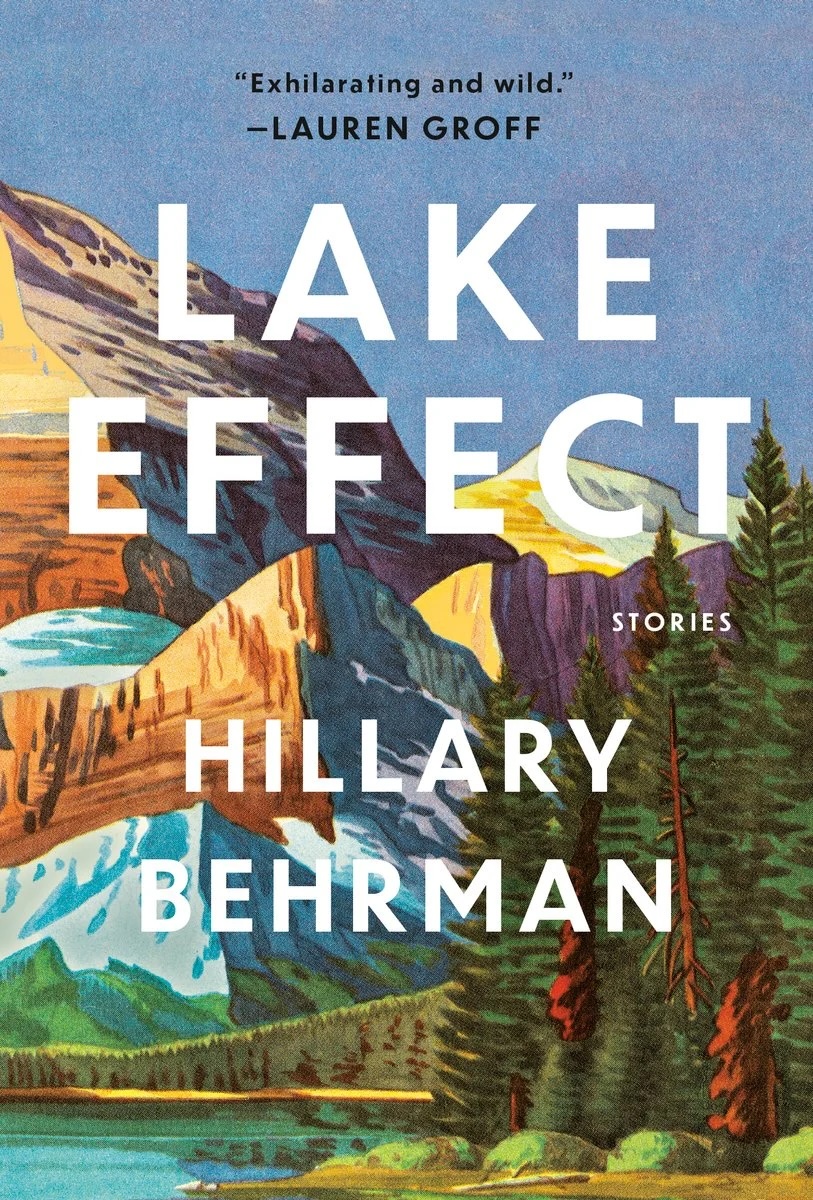
From Lake Effect by Hillary Behrman. Used with permission of the publisher, Sarabande Books. Copyright © 2026 by Hillary Behrman.