Kim Kelly on the Difference Between a General Strike and a National Shutdown (And Why It Matters)
“It is a time for action, and what matters most is that that action, whatever we call it, is effective.”
On January 23, thousands of people across the state of Minnesota took part in a massive day of action to protest ICE’s violent occupation of their home. Despite subzero temperatures, the day saw between 50,000 and 100,000 people hit the streets to demand justice for Renee Good, a 37-year-old woman murdered by an ICE agent on January 7th, and to call on Congress to stop writing blank checks to fund ICE. Officially dubbed “ICE Out of Minnesota: Day of Truth and Freedom,” the protest was organized by a coalition of faith leaders, community groups, and unions, who styled it as an economic blackout; far more just called it a general strike.
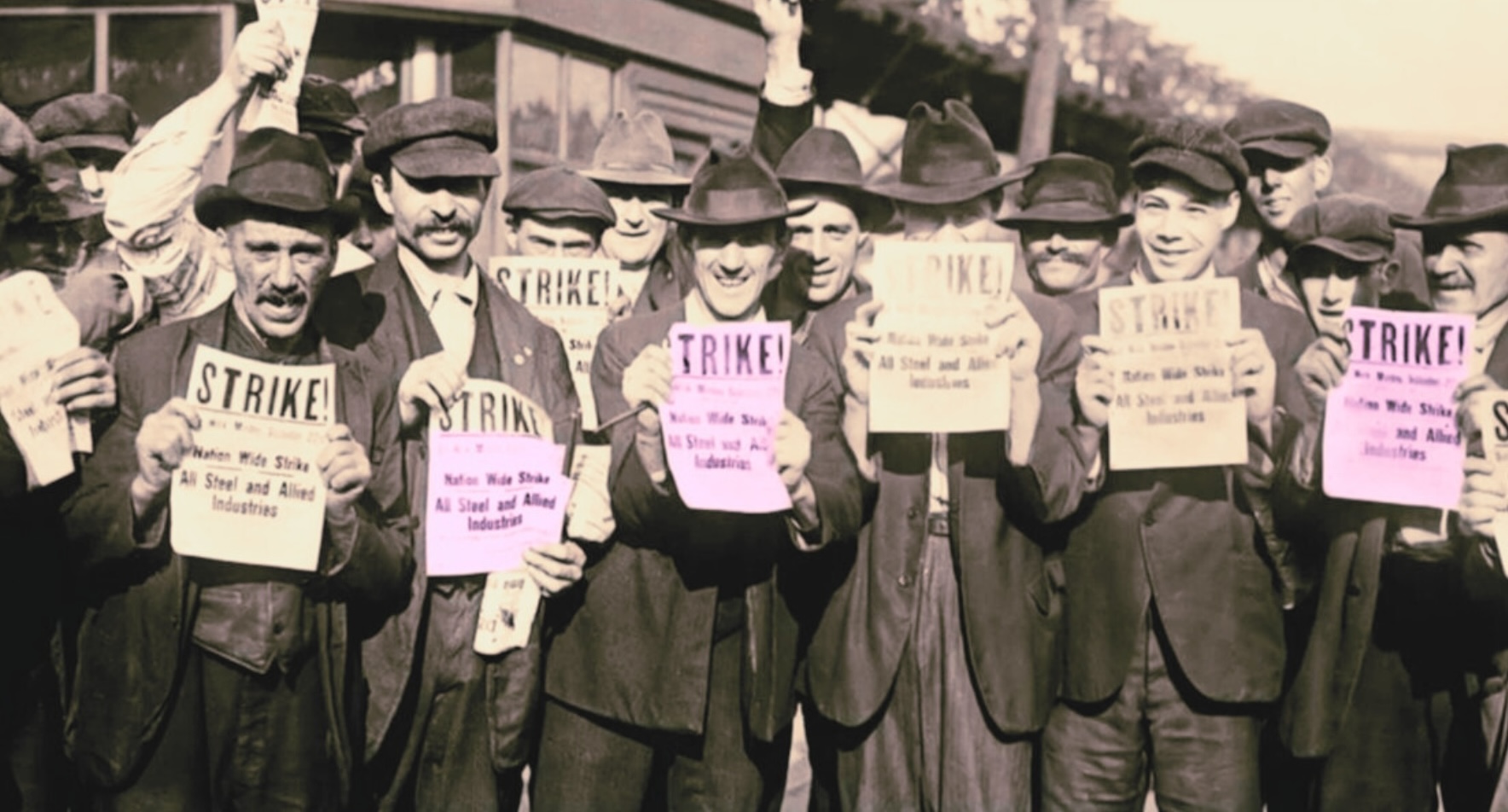
Some labor nerds (myself, admittedly, among them) bristled at this description, though, and for the sake of accuracy, I’ll explain why. For a labor conflict to escalate to the level of a general strike, a large number of workers across multiple sectors in a city, region, or country must come together in a planned work stoppage with the explicit goal of shutting down economic activity in pursuit of their goal. It’s not a boycott, a sanctioned day off, or a protest; it’s a massive, coordinated effort by workers in various industries to shut shit down. The tactic has a long and storied history among the global working class, and the capitalist class and their paid-for politicians really, really hate it. Remember how the nominally pro-labor Biden administration reacted to the threat of a railroad workers’ strike? Now multiply that by a million.
The general strike is organized labor’s nuclear option, a tactic so feared that, following the Oakland general strike of 1946, Congress hurriedly passed legislation to outlaw it outright. Since then, it’s been difficult to launch the kind of large-scale work stoppage that once helped make organized labor so powerfully effective; of course, that is intentional. It’s crucial to note that all the other historic American general strikes in cities like Philadelphia, St. Louis, Chicago, New Orleans, Seattle, and, yes, Minneapolis all took place before the passage of the 1946 Taft-Hartley Act.
Among other indignities, this nasty piece of labor legislation bans workers from participating in secondary boycotts, aka “sympathy strikes” (i.e. the exact tactic workers used to launch those general strikes across multiple industries), rendering it illegal for workers who have no official dispute with their own employer to join a strike or encourage a boycott of a different workplace in support of another group of workers.
Understanding the power of a general strike means recognizing that it’s not a catch-all term for a protest or a boycott, and is not something that can be planned in mere days or weeks.
What would this look like in practice? Say the baristas at your local unionized coffee shop go on strike for better working conditions (ahem). If the bakers at the bagel shop down the block decide to shut down their own workplace and join them on the picket line, any reasonable person would see that as an act of solidarity—but under Taft-Hartley, it’s a problem. When people criticize today’s unions for shying away from organizing—or even talking much about—general strikes, that legal roadblock is a major reason why.
It’s not the only reason, to be sure, or even a great excuse given the current crisis we’re in, but it’s certainly a big factor in organized labor’s reticence to invite that kind of legal smoke from the already virulently anti-labor Trump administration. It was huge that the Minnesota AFL-CIO, a state labor federation representing over 1,000 union locals across the state, endorsed the January 23rd protest in Minneapolis, but if you look closely, you’ll notice that they were careful not to call the action a “strike” in their communications.
Okay, so what does this mean? A janky old labor law passed by a bunch of racists means we can never organize a general strike again? Of course not, but it does mean that the tactic will continue to evolve out of necessity. We’re probably not going to get another version of Seattle in 1919, when 101 of the area’s AFL-affiliated unions called out 60,000 union members and shut down the city for five days. But there’s nothing stopping us from organizing more versions of Oakland 2011, when tens of thousands—including labor leaders and union members—drew on their own history to join in a day of action that shut down the city’s downtown business district and its busy port. Ultimately, a general strike is meant to disrupt business as usual, and Oakland showed that achieving such a thing is possible even in a post-Taft-Hartley world.
If looking at our own past doesn’t provide the kind of inspiration folks are craving right now, workers in many other countries have pulled off militant, majorly disruptive labor actions far more recently. One need only look back to 2025, when in Italy, thousands joined a general strike to protest their government’s complicity in genocide in Gaza; Portugal, where workers launched the nation’s first general strike in 12 years to protest unpopular labor law reforms; or Panama, where construction workers and teachers’ unions led a 50-day mass strike that disrupted the entire country.
India got in on the action in 2025, too, but that strike was built on years of struggle. In 2020, a coalition of ten trade unions, farmers’ organizations, and students’ groups in India organized the largest general strike in human history to protest a new set of anti-labor, anti-farmer laws. Beginning November 26th, 250 million industrial and agricultural workers and farmers took to the streets, bringing many of the country’s major industries to a standstill; from there, tens of thousands of agricultural workers continued their protest beyond the 24-hour strike, marching (and driving, and riding tractors) to the capital city of Delhi. Government officials tried to stop the march, to no avail; though they were met with police violence along the way, the farmers stood firm, and in November 2021, Prime Minister Modi officially repealed the laws they’d been protesting.
January 30th showed that a new generation of activists are ready and willing to throw themselves into organizing the next wave of resistance.
The US is not India, or Panama, or Italy (for one thing, all three have some version of universal healthcare). The specific conditions and political terrain may be different, but the big-picture issues, like creeping authoritarianism in government, anti-worker laws, brutal economic inequality, repression of political dissidents and targeting of oppressed populations, are similar enough that we have much to learn from one another.
Understanding the power of a general strike means recognizing that it’s not a catch-all term for a protest or a boycott, and is not something that can be planned in mere days or weeks. It’s a specific tactic that can yield enormous power when all the necessary ingredients are in place, which include the kind of resources, infrastructure, and legal support that organized labor has built up over decades of struggle. It demands that participants use the strike as a launchpad for more organizing, more planning, and more militancy.
Minneapolis has shown us how to light the spark, and as January 23rd drew to a close, a number of Somali and Black-led student groups at the University of Minnesota (including its Graduate Labor Union) immediately called for another, more widespread day of action. “We want to bring it to the national stage and see it happen all over the country,” Austin Muia, the vice president of the Black Student Union, told Mother Jones. “We want everyone to feel that solidarity that we felt last week.” Their call of “no work, no school, no shopping” spread like wildfire on social media, drew extensive media coverage, and was endorsed by a wide array of organizations, businesses, and celebrities.
More importantly, the people listened, and protests, anti-ICE demonstrations, and school walkouts bloomed around the country. While January 30th was much quieter than its predecessor, it showed that a new generation of activists are ready and willing to throw themselves into organizing the next wave of resistance.
As difficult as it can be for some of us (again, myself included) now is not the time to nitpick. A government-sanctioned death squad is murdering people in the streets and kidnapping children on the daily; the day after January 23rd, ICE agents killed ICU nurse Alex Pretti in cold blood. We have to harness the defiant energy that’s erupted among the many thousands of people who refuse to accept these horrors, and direct it at the forces of evil who want nothing more than to make us suffer for it. It is a time for action, and what matters most is that that action, whatever we call it, is effective. As the US has seen before, a one-day action can change the world. Imagine what a sustained, indefinite, real-deal general strike could do.
We may not have to content ourselves with imagining it for too long. After all, 2028 is right around the corner…

Kim Kelly
Kim Kelly is an independent journalist, author, and organizer. She has been a regular labor columnist for Teen Vogue since 2018, and her writing on labor, class, politics, and culture has appeared in The New Republic, The Washington Post, The New York Times, The Baffler, The Nation, the Columbia Journalism Review, and Esquire, among many others. Kelly has also worked as a video correspondent for More Perfect Union, The Real News Network, and Means TV. Previously, she was the heavy metal editor at “Noisey,” VICE’s music vertical, and was an original member of the VICE Union. A third-generation union member, she is a member of the Industrial Workers of the World’s Freelance Journalists Union as well as a member and elected councilperson for the Writers Guild of America, East (WGAE). She was born in the heart of the South Jersey Pine Barrens, and currently lives in Philadelphia with a hard-workin’ man, a couple of taxidermied bears, and way too many books.