Interrogating the Heaviness: On Resilience in Fiction and Real Life
Rachel León and Grace Spulak Discuss The Ways Their Creative Process Is Informed By Professional and Personal Experience
What role does fiction play in understanding systemic abuses of power and oppression?
That’s a question Grace Spulak and I have wrestled with for years. We’re both fiction writers with a background working in child welfare. Working in child welfare means we’ve spent our work days confronting horrific and horrendous things people have done and gone through. It changes how you see the world, so it’s inevitable to change how you approach the page as a writer.
Grace’s luminous forthcoming story collection Magdalena Is Brighter Than You Think (out with Autumn House Press on April 21), explores characters living in the margins and how they might survive there. It’s beautiful and nuanced, pushing the boundaries of traditional narratives, as it examines gender, queerness, trauma, and resilience. My debut novel, How We See the Gray (out with Curbstone Books on May 15), also challenges traditional narratives, through a story about trying to do better in a system that seems doomed to fail.
I haven’t met many other writers with a background in child welfare, despite seeing its connection with storytelling. Grace and I were eager to chat about how the heaviness of the present moment echoes the heaviness of our jobs. We both believe stories can help us understand horror and heaviness and think it’s important to write about these things. How has our work taught us resilience, on and off the page?
*
Grace Spulak: Many of the stories in my book are asking what happens when people find themselves unable to look to various systems for help and must create their own systems and narratives. I’m trying to understand what possibilities stories really have for us in these situations. I wonder how your work in child welfare intersects with storytelling. What possibilities do you think stories offer?
Rachel León: I think stories are pretty much everything. Stories shape how we think about systems and can help us reimagine them. Stories can act as cautionary tales, but also as inspiration. And they can empower us to take control of our own lives, rewriting old narratives. But that’s my work in child welfare talking: the role of a caseworker is to collect stories and then work to change them. Of course change isn’t easy. It takes time, but also resources. The ability to envision something different. I suppose my role was to sell my clients on that vision—to push the potential of better. And I mostly did that through stories. You know, I once had a client who was able to… Did I ever make up stories to inspire clients who thought change was impossible, to convince them that despite how dire things felt, things could be different if they put in the work? Well, yeah, I am a fiction writer. Making up stories is what I do. But there are worse things to lie about than visions of things getting better—my snake oil was hope.
I think it’s important not to shy away from showing the hard stuff, reckoning with how things are. Stories reveal strength and hidden power.
My day job and writing don’t just intersect, they seem inextricable. Your role with child welfare was different in that you’re an attorney. It’s a different angle. Is it fair to say you’d often argue for a certain ending to the story? I wonder how much being in the courtroom feeds pessimism because it’s one person [the judge] who has the final say. Like watching any system, it can make a person very jaded. How has the heaviness of your work affected how you approach your writing?
GS: I feel that the heaviness is one of the reasons I turn to fiction. Fiction offers so many possibilities that I often could not offer to my clients and that I feel our current judicial system also cannot offer. And fiction offers a way to interrogate some of the heaviness and how it might be caused by our systems.
My thinking about storytelling is also inextricable from my work. As an attorney, I often felt like my role was to expand the kind of stories that were allowed in the court, for example, creating the conditions where a pregnant sixteen-year-old could go to court and ask a judge to allow her to become legally emancipated after running away from abusive parents. Many young people came to me after the other systems that were supposed to help them—child welfare, the police—had largely failed to take action. And as an attorney, I had the power to make the court pay attention to my clients when they themselves did not have this power.
This felt like an uneasy position to be in, one where I was leveraging the power I had to give credibility to my clients, when what I wanted was for them to be taken seriously without needing a lawyer to “sanitize” them or use the right words or documents to get their case in front of a judge. Because of this, I am always thinking about how language is not only a source of possibility, but also a tool of exclusion. Some of the formal and linguistic experimentation I do in my story collection is looking at how language creates barriers and what it might take to break those barriers.
RL: I agree about fiction. I also love poetry and nonfiction, but fiction offers something that those other genres can’t (for me) and that’s indeed possibility—it allows us, both as readers and writers of fiction, to explore different angles and outcomes. And looking at things from different angles and imagining different outcomes is a social worker skill that helps me as a fiction writer.
I like what you said about looking at how language creates barriers as one of the (many) things I admire about your collection is the way you do experiment in form and linguistically.
GS: Speaking of formal experimentation, I’m curious about the structure of your novel and the multiple perspectives. I felt that this was such an effective way to tell the novel’s story! Why did you decide on this structure?
RL: The multiple perspectives in my novel was important because I wanted to offer the reader different angles into the story. I wanted to show how things look different depending on where we’re standing. I gravitate to short story collections for that same reason. (And can I add that yours is so brilliant?)
The structure came through experimentation. I’m a kinesthetic learner and the way that translates to my writing is I have to try things on the page to find my way into and through a project. It’s not a very efficient method, but it’s the only way I know how to write. I don’t really worry about failing. I see failure as inevitable! It’s part of the process, and I see my role as to just try. Maybe why one of the central themes of my work is mistakes and trying to do better? A life obsession—both in my day job and as an artist.
Do you find overlapping themes in your writing and your work as an attorney?
GS: Absolutely! I think who gets taken seriously in our society and why is definitely one of these themes. (Spoiler: it often involves money and power.) I’ve talked a lot about how language can create possibilities as well as exclude. And I’m always questioning how I might be adding to that exclusion both in my work and writing and trying to change that. And another overlapping theme goes back to the heaviness you mentioned earlier—how is it that people are able to go on in the face of horrible things and what does that look like? This is something that feels existential to me, not only because of my work, but also because of my experiences of trauma. What does resilience look like and what are some of the surprising ways it can manifest?
And I’m curious about how you see the connection between storytelling and resilience. Do you find that storytelling seems to inform resilience in some way?
RL: I do think the two are connected. Horrible things are happening, people doing truly horrendous things…That’s going on all the time, every day, whether we want to face it or not. But right alongside that you’ll find incredible things, beautiful ways people are showing up for one another. For themselves. Beauty and pain together. But it’s often easier to see the horrid, especially for those of us who’ve experienced trauma, as we become programmed to look for threats in the environment. It’s easy to look at how bad things are and feel hopeless. Change can seem impossible, our problems insurmountable. Self-doubt is real. We underestimate ourselves. That’s why a few times I spun tales of someone rising up and doing what a client felt was impossible—because I really believed they could do it, even if they didn’t. I was trying to show them the possibilities in their life.
Resilience is refusing to fit into the narrative the world says you should. It’s finding ways to simply go on when the world says you can’t or shouldn’t.
Stories help us understand resilience. I think it’s important not to shy away from showing the hard stuff, reckoning with how things are. Stories reveal strength and hidden power. What do you think? Am I being too optimistic here?
GS: I love this idea of “I really believed they could do it, even if they didn’t.” I think this is one of the most powerful promises of storytelling. To show potential even if that potential never comes to fruition. It’s a way to say, look, there are these other options, and they do exist, even if we haven’t seen them yet.
RL: Exactly. We need to see change as possible, a glimmer of hope, to try for better. So what about resilience? Where does that fit into all this? How do you show resilience on the page?
GS: For me, resilience is refusing to fit into the narrative the world says you should. It’s finding ways to simply go on when the world says you can’t or shouldn’t. It’s creating your own ideas about self-determination and what your life can look like and refusing to let go of those ideas. And in my writing, I try to show this in characters who continue on even when it seems that all the doors have shut against them. And I also try to show resilience through my use of language. To use words in ways that are unexpected or surprising, to repurpose some of the legalese that has been weaponized against my characters.
RL: It’s like you said earlier about how language can be a source of possibility. Fiction, language, fighting for justice—it all goes back to possibility, doesn’t it?
GS: Absolutely! And that’s one of the things I love so much about your book—it shows us so many of the possibilities that can arise, even in the face of really terrible realities. There is hope and stories can offer us that hope.
__________________________________
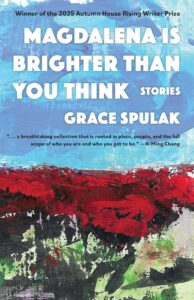
Magdalena Is Brighter Than You Think by Grace Spulak is available from Autumn House Press.
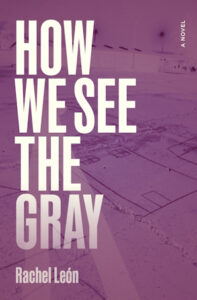
How We See the Gray by Rachel León is available from Northwestern University Press.
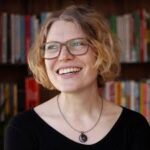
Rachel León
Rachel León has worked in the foster care system for nearly two decades. She serves as managing director for the Chicago Review of Books and fiction director for Arcturus. Her work has appeared in Catapult, The Rumpus, Electric Literature, Foglifter, Publishers Weekly, and elsewhere. She hails from Rockford, Illinois, and is the editor of The Rockford Anthology.