International, Global, Universal Poetry Month: Seven Poetry Books to Read This April
Christopher Spaide Recommends New Work From Alex Averbuch, Joshua Bennett, Milo De Angelis and More
Another year, another April, another National Poetry Month—a phrase that many poetry fans, myself included, can utter only with forced cheer. A whole month dedicated to poetry is a nice idea, I’ll admit. But doesn’t poetry deserve more than that? Why limit ourselves to the National—why not think bigger, with an International Poetry Month, a Global Poetry Month, a Universal Poetry Month? Or why not concentrate on poetry that too often escapes notice, with a Local Poetry Month, an Independent-Press Poetry Month, a Poetry in Translation Month, an Uncollected Poetry Month? (If we brainstorm only a few more months, we could have a whole Poetry Year going.)
As I noted in this column last year, April is as good a time as any to resist T. S. Eliot’s 1943 claim that “No art is more stubbornly national than poetry.” This year, my resistance was aided by unbetterable presses dedicated to literature in translation, like the Harvard Ukrainian Research Institute, whose books include prose as well as poetry, and Archipelago Books, a publisher of square-shaped, deliciously pastry-sized publications. I read poets reducible to no one nation or region: the England-born, North Dakota-raised, afterlife-haunted Soham Patel; the Bay-Area-by-way-of-New Orleans (and vice versa) Sunnylyn Thibodeaux; Christian Wessels, a mythical Merlin based in Rochester, New York.
Even the month’s most notionally national poets questioned established boundaries. Consider Jake Skeets, a professor at the University of Oklahoma and the third poet laureate of the Navajo Nation. Or Joshua Bennett, whose Constitution-sampling collection We (the People of the United States) includes a poem for every state, some stopping mid-sentence only to pick back up in another state’s poem, others standing free. Let Bennett’s multitude-containing collection set the bar: if he can write a poem for every state (and then some), why can’t our Poetry Month aim just as high?
*
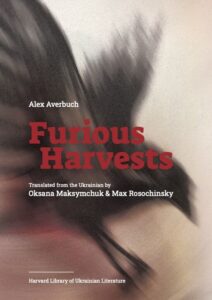
Alex Averbuch, Furious Harvests, translated from the Ukrainian by Oksana Maksymchuk and Max Rosochinsky (Harvard Ukrainian Research Institute)
“Alex (Oleksandr) Averbuch was born in 1985 in Novoaidar, a small settlement of under ten thousand in Luhansk Oblast in the east of Ukraine. The town fell under Russian occupation in March 2022, soon after the start of Russia’s full-scale invasion.” These sentences, written by Averbuch’s translators Oksana Maksymchuk and Max Rosochinsky, appear on the first page of Averbuch’s facing-page bilingual collection Furious Harvests—the only page in the book where chronology can be told quite so simply. Take the opening sequence, “How to Survive What Has Already Happened.” On a page beginning with those words, the past paradoxically beckons (“come closer / touch”), death is imagined as a forcible birth (“something pulls on / the umbilical cord / dragging you into this tinted yellow flow”), and the difference between what the living and what the dead want is practically a technical distinction: “only a muted line / separates the two pleas // yours—for not-being-born / theirs—for not-dying.”
Reading the English-language righthand pages of Furious Harvests, I could only speculate about what Ukrainian readers might make of the increasingly audacious play with chronology in the sequences to follow: “I Thank Them for Not Forgetting About Me,” comprising letters and postcards dated 1943; “The Last Supper of My Body,” in which Averbuch rattles off the largely unpunctuated “book of the generation of Oleksandr,” tracing his family of Ukrainian Jews all the way back to Abraham. With the book’s closing sequence “Kaddish,” readers of American poetry might recall Allen Ginsberg’s 1961 elegy by the same name. Averbuch’s “Kaddish” can be just as maximalist, with full pages of prose enumerating the World War II dead, known and unknown—then heartbreakingly minimal, with curt stanzas, in the mode of official notices, offering the dead no memorial: “your relatives are no more / the house of your relatives is occupied / by local residents.”
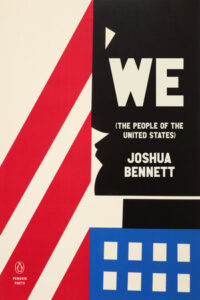
Joshua Bennett, We (the People of the United States) (Penguin Books)
I can see it now: it’s July 2026, the United States is celebrating its 250th birthday, and a poetry-curious reader wandering through their local bookstore finds a collection with the title We (the People of the United States)—the seven words that open the Preamble to the U.S. Constitution. What, that reader might wonder, could be more perfect? (Or, depending on their politics: What could be more perverse? What’s more preposterous?) Upon opening Joshua Bennett’s fourth collection, that reader would find not patriotic unity but one division and distinction after another. It’s not one book, one project, after all: first comes the chapbook-sized section We, followed by The People of the United States, a sequence in fifty parts (each named after a town and state). We contains two poems titled “We,” as though Bennett were calibrating that plural pronoun, testing its capacities: one poem looks horizontally at Bennett’s generation of “latchkey kids, troubadours,” and “substitute parents at fourteen,” while the other peers up the family tree at his father, then down at his heavenly son, “Who refashions the cosmos with his laughter.”
In my day job as an academic, I’ve written and spoken plenty about what the pronoun “we” has meant to American poets. Reading We (the People of the United States), I’ve never been more delighted to have my job done for me. As much as it’s a triple-album-sized poetic performance of the word, Bennett’s book is also a history and theory of the American “we,” across its myriad inflections—familial, romantic, local, congregational, coalitional, racial, transhistorical, even universal. Even when he’s not playing changes on the pronoun, Bennett is often thinking plurally, as in his many poems dedicated to authors, musicians, and thinkers the country over, many of them Black. Bennett’s poem “Minneapolis, Minnesota,” subtitled “for Prince,” ends with lines that fit his own polymathic art: “the sound that brings / the feeling home, to live with you, and transform what you once / held true into something more lovely, and strange.”
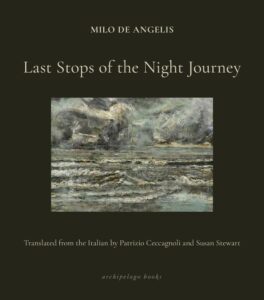
Milo De Angelis, Last Stops of the Night Journey, translated from the Italian by Patrizio Ceccagnoli and Susan Stewart (Archipelago Books)
Last Stops of the Night Journey publishes, on facing pages, the entirety of two books by the contemporary Italian poet Milo De Angelis opposite English translations by Patrizio Ceccagnoli and Susan Stewart. It’s the most extensive English-language introduction to date of a poet who would rather be introduced otherwise. “Since 1996, I have been teaching Italian Literature at Opera, a maximum-security prison in the suburbs of Milan….I believe that this is my vocation and destiny,” he explains in the 2016 interview that opens the book. Once you start looking for it, you can find the weight of prison all over the first book collected here, 2015’s Incontri e agguati (Encounters and Ambushes)—not only in the closing sequence “High Security,” which addresses De Angelis’s students and Opera itself (“Opera, you are everywhere but I do not know where”), but also in the literal and social death considered in the claustrophobic monologues of “Trench Warfare” and the title sequence’s posthumous testimonies: “…I found myself in the afterlife…/…you cannot imagine my surprise…”
In the second book here, 2021’s Linea intera, linea spezzata (Solid Line, Broken Line), the ghostliest figure of all is De Angelis himself, represented as often by a self-directed “you” as by a grounded “I,” as he revisits places and scenes from his past seven decades. “Of all the infinite places of the evening, you come back here,” begins “Bowling Dei Fiori,” named after the oldest bowling alley in Milan. Returning there, De Angelis finds himself becoming a Dantean ghost fit for our media-saturated times: “you pace down the polished track, you pace and someone calls you / Lebowski, the Big Lebowski, someone whispers / now you have to stay.”
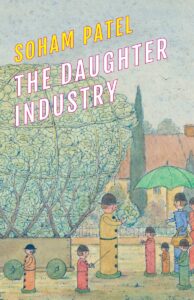
Soham Patel, The Daughter Industry (Nightboat Books)
Soham Patel’s fourth book The Daughter Industry had me hooked with its extravagant subtitle: A Hauntological Confession, Alternative History, Speculative Autopoetics in Three Acts with Seven Players. Within pages, I realized Patel’s subtitle was underselling things: The Daughter Industry is also a yoga instructional, a sitcom for ghosts, a closet drama, an uncloseted queer burlesque, a swirling and shattered gallery of word art, and a point-by-point riposte to cisheteropatriarchy as it manifests in the global North and South alike. (If that’s too much for you, Patel’s acknowledgements provide a simple one-word alternative: “The Daughter Industry also can be a yogachoroeopoemverseplay.”)
Patel amasses this many-sourced, Bollywood-scored excess in opposition to political orders that would prefer that girls, femmes, and nonbinary people had never come into being—as Patel puts it, in a sarcastic toast scripted for the comic player Sasmita, “Here’s to the machines made to say enough now: / Cheers! What are you having? A boy or an abortion?” Patel’s seven S-named players respond to the (anti-)daughter industry in their own ways, with their own tones, through their own forms. Sasmita is “limber, genderfluid, jester-like and, of course, always laughing” (those last two words translate her Sanskrit name). Suvali—elegant, high femme, “Sagittarius maybe” (who can say: “they’re all unborn ghosts you know”)—is not nearly so mirthful: “What is it I am asking of you? To say an elegy by heart/to zero our dying before birth. The history of desire in so many houses says son. To know of the daughter aversion.”
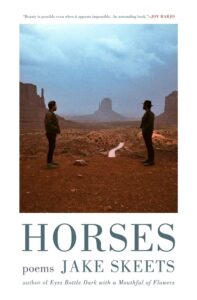
Jake Skeets, Horses (Milkweed Editions)
I don’t judge any poetry book by its cover, I swear. But my ardor for Jake Skeets’s brilliant first book begins with the violence and beauty corralled on its front cover. Most of the cover is given over to a steely portrait of Skeets’s uncle Benson James, who was photographed by Richard Avedon for his series In the American West in 1979, then stabbed to death a year later. Below the portrait, there’s Skeets’s unforgettable ratatat of a title, Eyes Bottle Dark with a Mouthful of Flowers (2019). In one line, it encapsulates the style of the book to follow: surreal configurations of everyday sights and all too real hurts, a way with words that’s a little bit outlaw country, a little bit high-literary punk. (Skeets’s title always reminds me of Lou Reed’s “Vicious,” with its snotty opening accusation, “You hit me with a flower.”)
Horses, Skeets’s second collection, has its own punk pedigree: in his acknowledgement, Skeets credits horse-forward books by fellow Navajo writers Luci Tapahonso, Nia Francisco, and Joy Harjo, as well as Patti Smith’s debut LP Horses (1975). A concept album like Smith’s may be the best analogue for Skeets’s galloping-forward, backtracking sequences—like the twelve-part title poem, which memorializes a drought-stricken landscape and the horses who buried themselves within it, “thigh-deep in mud / clawing for the first world / for something we left behind.”
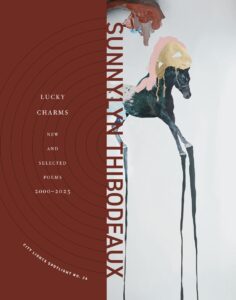
Sunnylyn Thibodeaux, Lucky Charms: New & Selected Poems, 2000–2025 (City Lights Books)
As much a summation of a career to date as a small-press treasure trove, Sunnylyn Thibodeaux’s Lucky Charms collects poems from over a dozen different publications by nearly as many presses. The earliest selections date from right after her move from her hometown of New Orleans to San Francisco, the Gulf Coast’s temperamental weather and her mother’s home cooking fresh in her memory. The latest selections find her back in NOLA decades later, reflecting on Hurricane Katrina with twenty years’ distance and present-tense clarity, recording scenes in the one American city where “Squirrels / won’t leave their / hole for the brioche / torn about,” while “Another ghost / crosses the open / kitchen window.”
In the poems between, you can trace, in vague outline, the autobiography of a mother, a wife to a fellow poet and publisher, a hemisphere-crossing reader, and an openhearted artist who dedicates around one in every four poems to family and friends. More often, you’ll find notes on last night’s dreams, the precise hue and texture of this morning’s clouds, that day’s newly blooming flowers—reports from everyday life that Thibodeaux and few others (Lorine Niedecker, James Schulyer) can word with everlasting clarity: “Gentle bees have come round / perusing mint, sage and thyme / I am lost in the apocalypse.”
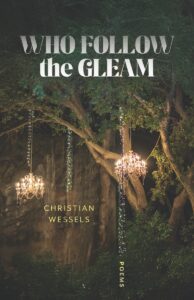
Christian Wessels, Who Follow the Gleam (University of Massachusetts Press)
For the title of his debut collection, Christian Wessels clips out a single cryptic line by the medieval-minded Victorian poet Alfred, Lord Tennyson: Who Follow the Gleam. For an epigraph, Wessels cheekily reproduces the line in context:
I am Merlin,
And I am dying,
I am Merlin
Who follow The Gleam.
The more you read by Wessels, the more you believe these lines: maybe he (or at least the slantwise, quasi-autobiographical I he summons up) really is Merlin, transmuting real life into enchantment, dissolving enchantment back down to real life. He’ll make the simple art of writing and reading poetry sound like witchy ventriloquism—“This voice is an imitation of me, body and voice. / When I speak, your mouth moves”—then, a few lines later, sic the Grim Reaper on poor Robert Frost: “Death yclept // says the scythe, Robert Frost is dead, / Frost is dead because I killed him.”
Wessels catches gleams to follow not only in magical tales but in twinkling memories, sparkling wordplay, the films of silver-screen star Veronica Lake, and his charm of a daughter, the inspiration of a half-dozen poems that take their titles from spells. “Levitation Charm” begins bathetically—the levitation in question is holding a young daughter above a toilet, “suspending her / above the off-white seat,” its plinking sound drowned out by Daft Punk blaring in the kitchen—only to end existentially, with time’s fast-forwarded flow: “the sound is a memory as it happens as it happens / it’s already passed our daughter is fifty // I am dead as I have long been dead.”

Christopher Spaide
Christopher Spaide is an Assistant Professor of English at the University of Southern Mississippi. His academic writing on modern and contemporary poetry (as well as music and comics) appears in American Literary History, The Cambridge Quarterly, College Literature, Contemporary Literature, ELH, The Wallace Stevens Journal, and several edited collections. His essays and reviews and his poems appear in The Boston Globe, Boston Review, Lana Turner, The Nation, The New Yorker, Ploughshares, Poetry, Slate, and The Yale Review, and he has been a poetry columnist for the Poetry Foundation and LitHub. He has received fellowships from the Fox Center for Humanistic Inquiry at Emory University, the Harvard Society of Fellows, the James Merrill House, and the Keasbey Foundation; for his academic writing and criticism, he has received prizes from Post45 and The Sewanee Review. Currently, he serves as the Secretary for The Wallace Stevens Society. He is the literary executor for Helen Vendler.