In Praise of Lost Time: On a Poetics That Subverts Linear Chronology
Laura Kolbe: “Having an intimate, almost sensual relationship to the clock is the derangement.”
In this year’s heteropessimist horror movie Obsession, boyfriend Bear pleads with his possessed girlfriend Nikki, “Stop moving so weird!” It’s a funny, fourth-wall-tapping wink to the audience, noting out loud the film cliché whereby a sense of the demonic (particularly the female demonic) is conveyed by making a character move at a frame rate all her own—a skittering, insect-like effect that makes limbs appear both more mechanical and more repugnant than they otherwise would.
The original term for this special effect was “undercranking,” referring to the manual crank that controlled the frame rate of early movie cameras. Slowing down the number of frames recording per second will make an action appear faster and jerkier when played back at normal speed. The Dadaists used this gleefully and compulsively (see René Clair and Francis Picabia’s wacky Entr’Acte); so, famously, did Hideo Nakata in Y2K hit The Ring and countless imitators.
I think we are inexorably repulsed and fascinated by natural motion made unnatural through subtle changes of speed and timing. The difference between one frame rate and another can be the difference between wanting to ogle a voluptuous demon and wanting to squish her like a bug. So, too, with “unnatural” alterations of natural sound: I remember the prickly feeling of being a teenager on my bedroom carpet, so spooked by the final vocal loop at the end of The Beatles’ “A Day in the Life” that I didn’t dare move for fear that some unspeakable horror would reach out of the Sixties and throttle me. And I remember, in that same summer, on that same carpet, poring endlessly over the garbled hook in Missy Elliott’s “Work It”: the internet being less comprehensive than it is now, it took serious self-study to convince myself that she was not only putting her thing down and flipping it, but yes, in fact, reversing it. The line between dread and pleasure within the realm of the temporally-uncanny is a fine one.
There are many ways to become obsessed with life’s frame rate, with the varying speed of an action and the way that time can be sliced or spun in the presentation.
The earliest experiments with the moving image and with recorded sound knew this; so too have any number of great poets, perhaps particularly those whose lives put them in special touch with cameras, clocks, and calendars. Parent-poets, poets writing on lunchbreak from their punch-clock jobs, poet-filmmakers and poet-photographers, poets who’ve watched the tracing of a fetal heart rate monitor or a cardiac defibrillator—there are many ways to become obsessed with life’s frame rate, with the varying speed of an action and the way that time can be sliced or spun in the presentation.
*
I am writing this essay to explain myself. To explain a stylistic choice I fumbled for with the un-grace of a salmon bucking its way up a waterfall, not quite knowing why. That is, I first wrote a chronological, even diaristic book—an account, in poems, of my life during pregnancy and roughly the first year of parenthood—but found that it only made sense to me, and perhaps became art, when in revision I rearranged the manuscript backwards. Questions and progressions that had seemed so universal to the point of being scarcely worth articulating (should I have a child? am I pregnant? am I visibly pregnant? what is this slither moving inside me? I am hurting, now, and a baby is coming out) could be shocked into defamiliarization through pressing “rewind” or “pause,” altering frame rates, shaking up my sense of the “next.”
Instead of being causality’s passenger—first X happened, then I felt Y way about it—I could unhinge more readily from explication. I could embellish, I could remix, I could make my fish tale bigger and bigger if I chose, until the thing I’d caught (a baby? or had it caught me?) would be, in the retelling, humongous enough to have swallowed the whole hook, line, and sinker of the lexicon I knew.
*
I see a version of this impulse in Frank O’Hara’s famous Lunch Poems, like the one written upon Jackson Pollock’s death which begins,
It’s my lunch hour, so I go
for a walk among the hum-colored
cabs. (“A Step Away From Them”)
Nothing happens quite in its normal order and speed. There are glistening construction workers and disembodied skirts blowing upwards from the convected wind of subway grates and cabs again, a heat-wave dream loop. Suddenly he’s in Times Square. (He started, biographically speaking, north and east at the MoMA.) Figures loom in and out of view. “I look / at bargains in wristwatches.” Then
…Everything
suddenly honks: it is 12:40 of
a Thursday.
We can imagine a dozen reasons why both O’Hara the poet and his first-person alter-ego speaker are so chronologically jumbled and jumpy. It’s a way of representing the city, or being worked over by the city’s own loony temporality. It’s the kind of dissociative choppiness one feels when the hand of death brushes near. (O’Hara and Pollock weren’t friends, but ran in the same circles, and O’Hara vocally admired Pollock’s painting, while frightened by his aggressive homophobia.) It’s an aesthetic debt to his modernist literary forebears. And also, there’s the larger fact that O’Hara the poet is, truly, on the clock. Lunch hour has its beginning and its ending, and somehow the whole teeming chaos of midcentury Midtown must be crammed within it, before the hour slams shut. Under such pressure, time flickers, flashes out, and transforms like a lab-grown diamond.
I tell my students—the MFA ones who work in wine shops, bookstores, publicity, marketing, nannying; the MD ones in their long apprenticeship at clinics and hospitals—that having a job outside of writing is an incomparable boon to their creative work. I say this and believe it, and not only because believing that one’s life is essentially lucky seems to me to be one of the tricks to happiness. I say it not in the sense of the well-known Flaubertian dictum (“be regular and orderly in your life,” etc.) that bourgeois strictures will lead to liberation in the creative work. I say it because having an intimate, almost sensual relationship to the clock is the derangement. The way that you caress, slap, or kick the intransigence of adamantine time is what we call, on the micro level, your meter. On the macro level, it’s your voice, your poetics.
In 1995, Fanny Howe published the quiet minor masterpiece O’Clock with the now-defunct, almost-too-perfectly-named press Reality Street Editions. The book’s conceit is startlingly simple: short poems, nearly all under a page, most with a time stamp for a title. Each poem feels like the blinding-bright perception of one sublime minute. Their endings sometimes rail or exult at time’s sprint. (“Get up, girl. / A sun is running the world” ends “5:47.”) Other times, they stretch for new ways to wriggle out of metered life’s constraints:
…I was streets ahead of love in energy and size
but it impressed me with its legalism:
there was always enough for everyone
depending on the way
each measured pleasure. (from “15:47”)
Howe’s speaker is “impressed” (but still somewhat skeptical, I think) by the idea that sufficiency is mathematically flexible. Change out my hourglass or yardstick and you change what I call “enough.” Spring forward, fall back: measure is always a bit of a fantasy, a matter of convention. And yet the convention frames the real.
Choose a pace and you’ve chosen a good deal of your voice, your intention. Tell me your tempo and I’ll tell you some part of who you are.
*
Many years ago I was in an abbey looking at a statue of St. Benedict, with his Latin motto on the pedestal: Ora et Labora. Labor I could figure out. I knew enough Italian to translate ora to mean either “now” or “the hour.” I knew enough French to think of the word orage, a storm. So was this saint advising people to think about work and time, or to work tempestuously, or possibly both? I realized later that ora meant “pray,” but some part of me feels that a generative mistranslation is never quite wrong. Maybe I wanted this saint to tell me that my mission in poetry was to keep time (that predictable thing) and watch for lightning (that unpredictable thing), trying, perhaps hopelessly, to bend the former and to manufacture the latter. To rewild the even-keeled and stately minute, and to domesticate the electric wild.
This dual imperative, to tame time and to rewild it, reminds me of the poet Paul Valéry’s description of how a poem gets started (which I first discovered in Mary Ruefle’s essay “On Beginnings,” and again in Matthew Zapruder’s Story of a Poem, both brilliant texts in their own right). “A fine line of poetry,” Valéry says, “is a fruit plucked from the tree. But which tree? This leads to the curious point of trying to make the tree whose fruit would be this fruit.” This is a fairly psychedelic, time-tripping sense of what cultivation is: that you are creating a preparation for something that has already happened. You are engaged in paradox from the start: begin at the end, then hit rewind. Flip it and reverse it.
Life does present itself to us at times as a series of already-finished fruits, and finding their predating source becomes the occupying riddle and investigation. This is daily clear to parents and parent-poets, who live in the funhouse-mirror world in cause-and-effect refract not just across their own bodies but over the lives of those closest to them. I think of Brenda Shaughnessy’s gorgeous, aching collection Our Andromeda, parts of which imagine forking pathways of time if a series of misfortunes, choices, and medical inattentions had not attended her son’s birth and disabled him.
You’ll get the chance to walk
without pain, as if such a thing
were a matter of choosing a song….
Choosing a song: possibly among the smallest and most pleasant autonomies. No coincidence, though, that of all life’s minor pleasures, it’s a liberty of rate—do you want something that’ll hop out at you, or that will disclose itself in painstaking degrees? In common parlance, when someone puts on a “slow song” or proposes a “slow dance,” we know what they’re after: an intimacy that exceeds what could be achieved without that soundtrack. Choose a pace and you’ve chosen a good deal of your voice, your intention. Tell me your tempo and I’ll tell you some part of who you are.
*
In his essay Species of Spaces, Georges Perec notes that in French agricultural parlance, a journal means the amount of land a farmer can cultivate in a single day. You know you’ve done your journal if the day is over and you worked straight through it. Over time you get to know how big your particular journal is, how far out you will go, how wide. One of the many things that can make a poem different than a Perequian journal is that the poet—especially a time-flipping poet, fond of the undercrank, the overcrank, the remix—cannot know, would never want to know, how big the piece of work is, nor its rate.
The belief that the poem underway has no fixed or preset space and speed, and that its working velocity can be distorted, twisted, and toyed, is a crucial corollary to the belief that aesthetic play is possible, even in a world that contains punch-clocks and metronomes, calendars and stopwatches and theodolites and pulse monitors. There is no set journal, no best o’clock, and the “step away from them” we take happens at the cadence befitting each idiosyncratic foot. What did I want to say? Let me find it at the end of my speaking. What will I write next? Let me find it in some already accomplished minute, flung way out ahead of me into the past I am facing like a hand-cranked camera or an electric sensor of the shockable heart.
______________________________
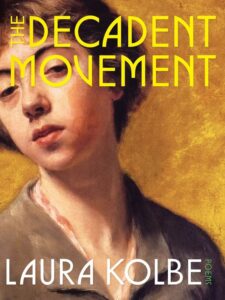
The Decadent Movement by Laura Kolbe is available from University of Pittsburgh Press.

Laura Kolbe
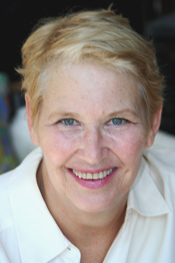
Laura Kolbe is a physician, medical ethicist, and writer. Her poems have appeared in the Best American Poetry series and in American Poetry Review, Conjunctions, Harper’s, The Nation, The New York Review of Books, The New York Times Magazine, The New Yorker, Poetry, The Yale Review, and elsewhere. Her first collection, Little Pharma, won the Agnes Lynch Starrett Prize and was published by the University of Pittsburgh Press. Her chapbook Keeping House: Six Longer Love Poems was selected by Kwame Dawes as the Center for Book Arts annual chapbook contest winner. She teaches and practices medicine in New York City.