9 to 5: Inside The Movement That Inspired the Iconic Film
Jonathan Kaufman on Karen Nussbaum and the Fight For Working Women in 1970s America
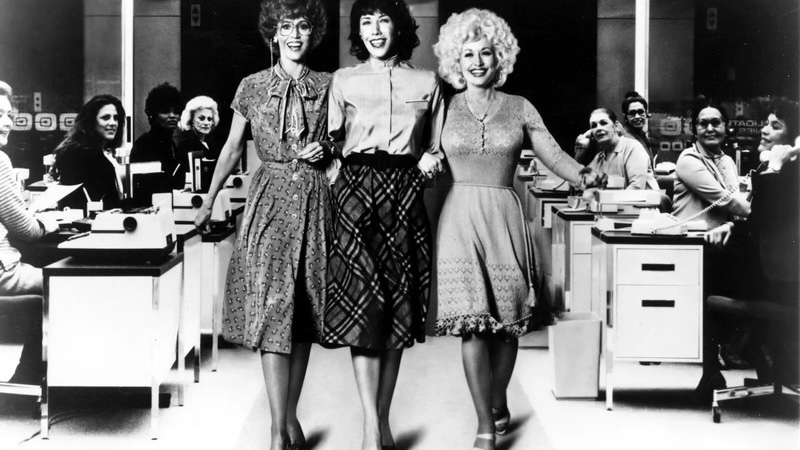
When Dolly Parton died recently, radio stations and music streamers filled our ears with her irresistible anthem, “9 to 5.” The song topped the music charts and was nominated for an Oscar. It transformed Parton, making her movie debut, into a global crossover star. The movie, a pointed comedy about three women—played by Jane Fonda, Lily Tomlin, and Parton—fighting against sexism and inequality in the workforce, was the second most popular movie of 1980, behind only “The Empire Strikes Back.” The real-life story that inspired the film is just as remarkable: How a small group of young women in Boston launched a movement to organize secretaries that transformed how women are treated in the workplace. From Parton’s powerhouse song to the #MeToo movement to the rise of women CEOs and union leaders, Parton caught the spirit of change that rings out today as loudly as it did almost five decades ago.
Karen Nussbaum sat in the back of a darkened movie theater on a winter day in 1980, watching as women in the audience whooped and cheered at the movie up on the screen—her movie. She swayed to the beat as pictures flashed by of women in skirts and carrying coffee cups and newspapers, looking harried and determined, sped along city streets to the infectious beat of Dolly Parton’s song…no, Dolly Parton’s anthem:
Workin’ nine to five, what a way to make a livin’
Barely gettin’ by, it’s all takin’ and no givin’
Over the next ninety minutes, the comedy unfolded. Tired of being summoned to fetch coffee or choose a gift for the boss’s wife, three office workers—played by Jane Fonda, Lily Tomlin, and Dolly Parton—humiliated and harassed by their sexist pig of a boss (played by Dabney Coleman), share a joint of marijuana, kidnap him, and live out their fantasies of revenge, giving their clueless male chauvinist boss a taste of his own medicine. It was a revenge tale for women victimized by workplace harassment. When the boss returns to the office vowing to send them all to jail, he is stunned to see the women have introduced job-sharing, flexible hours, and on-site child care. The head of the company ships a humiliated Coleman to a “special project” in Brazil and makes Tomlin the new head of the office.
These secretaries wanted better pay and benefits. They wanted opportunities to advance….They wanted to be treated with dignity.
The women in the theater cheered as if it were their story. When Fonda struggled with a copy machine, a woman stood up and shouted, “Push the start button!” For many of the indignities up on the screen were true to life. For the previous six years Nussbaum had led one of the most successful grassroots organizations in the country—9to5—fighting for wages for secretaries, better promotions, and dignity, Fonda, whom Nussbaum knew from their days in the anti-war movement, was so impressed when she heard what 9to5 was doing, that she decided to make a movie, enlisting Tomlin and Parton. As the credits rolled and the movie theater lights came up, the audience fell silent. It was as if, Nussbaum thought, the men thought something dangerous might be going on here.
The movie 9 to 5 became the second- highest-grossing film of the year, behind Star Wars: The Empire Strikes Back. Ronald Reagan—who six weeks earlier had been elected president, and who opposed unions and the Equal Rights Amendment and had denounced Fonda as “Hanoi Jane” for her opposition to the Vietnam War—saw a screening with his wife and pronounced it “funny.” Nancy Reagan invited Fonda to sign an Easter egg for the annual White House Easter Egg Roll.
Nussbaum gathered her coat and stepped into the Cleveland cold. She was short and thin with close-cropped hair. If the filmmakers had decided to cast Karen Nussbaum, she would have been the independent, wise, spunky character—Sandra Bullock in Our Brand Is Crisis or Holly Hunter in Broadcast News. Nussbaum was a baby boomer creature of the 1960s. She’d grown up in a liberal home in a conservative Chicago suburb where her mother did public relations for educational institutions and organizations. Her mother would take a young Karen with her while handing out literature for Democratic candidates and serving as a poll watcher during the local elections.
As opposition to the Vietnam War intensified, they joined the weekly silent peace vigil in front of the public library. “You know, it’s time that women cared as much about peace as the PTA,” her mother told the local newspaper. Nussbaum’s older brother became a draft resister. Nussbaum’s family became the target of hate mail from members of the local John Birch Society—postcards with crosshairs on them addressed to Karen’s mother. At the same time, the teenaged Nussbaum yearned to fit in at school, to find the perfect Villager brand outfit, a skirt sweater over a shirt with a Peter Pan collar that (in those pre-hippie days) was sweeping suburban high schools. There weren’t many outlets in the Chicago suburbs for a young middle-class girl who wanted to fight for social justice.
Nussbaum couldn’t wait to leave home and get to college. She was accepted at the University of Chicago. The summer before she started, she got a job as a “gofer” at the 1968 Democratic Convention. Seeing demonstrators gather outside, Nussbaum left the convention and joined the protesters, the air still filled with tear gas. Nussbaum joined the chants: “The whole world is watching.” For Nussbaum, it felt like the entire world was blowing apart.
Soon after starting college, Nussbaum joined students who took over the University of Chicago administration building. Her politics veered increasingly left. The next fall, she dropped out of college and went on a “solidarity” trip to Cuba promoted by the Black Panthers. She attended the 1980 May Day rally at Yale to protest the imprisonment of Black Panthers Bobby Seale and Erica Huggins. She joined a trip to Hanoi to protest the Vietnam War.
Through it all, Nussbaum chafed at the circumscribed role of women. Even as a young radical she saw how the boys, and then the men, dominated meetings, and how many women became obsessed with the tangled romantic relationships inside radical movements. In high school, Nussbaum had run for student council president because people said a girl couldn’t do it. She lost.
By 1973, at twenty-three and with a thickening FBI file, Nussbaum landed in Boston. She moved into a ramshackle house with other women and organized women’s self-defense courses. To support herself, she took a job as a clerk typist at Harvard. Nussbaum was paid two dollars an hour working as a “casual” employee with no benefits. The day-to-day indignity grated on her, especially because she was smart, educated, and worldly. One time a student came into the office, looked at Nussbaum, and asked, “Isn’t anybody here?” When she walking through the halls of Harvard, staggering under a heavy load of loose-leaf notebooks, a male boss walked by and asked, “Why aren’t you smiling, dear?”
Nussbaum had encouraged her best friend, Ellen Cassedy, whom she had met at college, to move to Boston and take a secretarial job at Harvard. Cassedy too had grown up in the suburbs and studied at the University of Chicago, later getting a history degree at Berkeley. One day a Harvard philosophy professor told her to come to his apartment to transcribe a sheaf of handwritten notes—a detailed account of all the blow jobs he’d ever received. He then took off his shirt and stood before her, bare-chested. Frightened and unsure what to do, she kept typing. After work and over breaks for coffee, other secretaries told comparable stories. One related how she’d paused while typing a letter. Her boss asked what she was doing. “I’m thinking,” she replied. “Get back to work, you’re not paid to think,” the boss responded. For Nussbaum and Cassedy, their Harvard jobs were a way station, a gig to pay the rent and support their activism. For their coworkers, it was their life. “We will be called girls until the day we retire without a pension,” one lamented to Nussbaum.
Beyond the Harvard secretarial pool, the 1970s were an intoxicating time of advances for women. In 1972, Congress passed Title IX of the Higher Education Act, which prohibited discrimination based on sex in any educational program receiving funds, forcing schools to open their doors to women athletic programs and sponsor and finance teams in women’s sports like ice hockey, basketball, volleyball and swimming. The Supreme Court issued a cascade of decisions expanding women’s rights. In 1973, the court legalized abortion with the Roe vs. Wade decision. It outlawed separate help-wanted advertisements for men and for women. The next year, women won an equal right to credit cards and mortgages. In 1975, Billie Jean King defeated Bobby Riggs in the widely touted tennis “Battle of the Sexes” as more than fifty million people watched on television. Ms. Magazine published its first issue in 1972, with Wonder Woman on the cover.
Supported by both major political parties and Presidents Richard Nixon, Gerald Ford, and Jimmy Carter, the Equal Rights Amendment was sent to the states for ratification. By the end of the 1970s, a quarter of medical school students and a third of law school students were female, up from just 10 percent in 1970. One of the most popular TV shows—and the winner of the Emmy for Outstanding Comedy Series three years running—was The Mary Tyler Moore Show, featuring a single woman in her thirties working for a TV station. Time magazine devoted its annual 1975 “Man of the Year” issue to “Women of the Year.” “Across the broad range of American life, from suburban tract houses to state legislatures, from church pulpits to Army barracks, women’s lives are profoundly changing, and with them, the traditional relationships between the sexes,” the magazine declared. “1975 was not so much the Year of the Woman as the Year of the Women—an immense variety of women altering their lives, entering new fields, functioning with a new sense of identity, integrity, and confidence….The belief that women are entitled to truly equal social and professional rights has spread far and deep into the country.”
There would be no talk of women’s liberation or feminism. They would not be protesters years ago trying to stop a war or topple a government. They would be organizers trying to build a movement from the ground up.
The one group left out of this transformation, Nussbaum believed, were working-class women. For the first time ever, more than half of women had jobs outside of the home. In offices, where one in three women now worked, women’s pay was less than 60 percent of men’s—a bigger gap than in the 1950s. Men in clerical jobs were paid $5,000 a year more than women. Sexism was rampant. An ad placed by a Cleveland employment agency sought a “Secretary: a raven-haired dynamo!” and an “Engineering secretary: blonde-haired, blue-eyed and charismatic!” Unlike middle-class white women like Nussbaum, women working in offices hadn’t been part of the women’s liberation movement of the 1960s. They hadn’t protested at the Miss America contest in Atlantic City in 1968. They weren’t active in the ongoing campaign for the ratification of the Equal Rights Amendment. “I’m no women’s libber,” one secretary told Nussbaum. “But I believe women should be treated equally on the job.” These secretaries wanted better pay and benefits. They wanted opportunities to advance. They were tired of training men who then advanced in their companies, leaving women employees behind. They wanted to be treated with dignity.
Walking through Harvard Square one afternoon, Nussbaum saw a picket line outside a diner where she sometimes ate. Eight waitresses had declared a strike to demand higher wages. The women’s community had signed up to picket in support of the waitresses, and Nussbaum took picket duty Wednesday nights from 6:00 to 8:00. As she walked around in circles, she began to think about the women’s movement and about the women she was working with—secretaries and other clerical workers. Nussbaum contacted ten of her friends, all of whom were working in clerical jobs around Boston. They began meeting once a week in a “consciousness-raising group”—typical for the early 1970s—and talking about how they got to where they were, what their values were, and whether they wanted form a group to try to change things.
After a year’s discussion, Nussbaum’s group decided to form an organization. They called it “9to5.” In contrast to the 1960s organizations that Nussbaum had joined, with mass protests, all-night meetings, and a fair amount of toxic masculinity, this would be different: activism run by working women. Meetings would have a purpose. The style would be succinct, friendly, and respectful. There would be no talk of women’s liberation or feminism. They would not be the protesters from years ago trying to stop a war or topple a government. They would be organizers trying to build a movement from the ground up.
Nussbaum and her colleagues began passing out leaflets at Boston subway and bus stops to women heading to their jobs at downtown office buildings. They published a newsletter with stories—some wry, some shocking—of how women were being treated. They started getting letters back. Nussbaum advertised a meeting in the newspaper for November 1973 at the downtown Boston YWCA. More than 150 women came. None of them knew one another. Forming a union of women hadn’t occurred to them as an option—that was something for men working construction or in factories. They didn’t identify with the rhetoric of the women’s movement. Nussbaum decided to stay away from words like “feminism” and concentrate on shared concerns about low pay and lack of respect on the job. “Don’t let your words be the enemy of your ideas,” she told colleagues. Then they hit the streets to organize.
____________________________
From When America Roared: How the 1980s Saved, Then Broke, the Country–and Led Us to Today by Jonathan Kaufman, published by Viking, an imprint of Penguin Publishing Group, a division of Penguin Random House, LLC. Copyright © 2026 by Jonathan Kaufman.

Jonathan Kaufman
Jonathan Kaufman is a Pulitzer Prize–winning reporter whose long list of bylines includes The Boston Globe, The Wall Street Journal, and Bloomberg News. His wide-ranging reporting and editing have covered topics such as labor, local activism, racism and job discrimination, and corporate tax dodging, and have been recognized with the Gerald Loeb Award and the George Polk Award, as well as by the Columbia University School of Journalism, among others. He is the author of The Last Kings of Shanghai: The Rival Jewish Dynasties that Helped Create Modern China; A Hole in the Heart of the World: Being Jewish in Eastern Europe; and Broken Alliance: The Turbulent Times Between Blacks and Jews in America, winner of the National Jewish Book Award. He is director of the School of Journalism at Northeastern University in Boston.