I Wish I Didn’t Have to Tell You About My Book
Madeline Vosch on Writing a Memoir About Suicide
I wrote a book about trying to kill myself, about surviving after, about how long I searched for the words to tell the story. When I meet new people, when they discover I wrote a book, when they ask what it’s about, I don’t know how to tell them. I walk on tip toes. I tell them it’s heavy, I tell them it’s intense. I tell them it’s about a bad time in my life. I give them my standard line. “It’s a memoir,” I say. “About being depressed in Boston.”
I make jokes about how, if they want to know more, they’ll have to buy the book. “If I give away the story, no one will buy it,” I say. I don’t know if this is close enough to the truth, or too close, too honest. I think of other lies I could tell, ways to ease a stranger toward the truth without letting it fall like an axe. I know, of course, that the moment they search the internet for the book, they’ll see the truth in the title.
When I wrote a book about trying to kill myself, I was desperate to let this story out of my body. I felt it in my blood, in my gut. I needed to say it, to say all of it. I needed to be unashamed, to declare that suicide was not something that a person had to hide, not something too big to say. But these days, standing next to a soccer field, stretching before a game, if someone asks me about this book, I think it’s better to lie.
I don’t worry, not really, what they will think of me.
Sometimes it’s a friend, sometimes a person I just met, sometimes a person who is in the limbo between friend and stranger, someone I hope to become real friends with. Lacing our cleats, jogging over cheap turf, rubber pellets kicking up into our shoes, practicing goal kicks—in these moments, between passes, between conversations complaining about the ref, who never pays close enough attention, who never calls a foul, the word suicide feels unspeakable, as if it belongs to another timeline, not this one, not this one in the seconds before the whistle is blown.
My book tries to slough the stigma from the words, to say it all aloud without shame. But it is different to write about suicide on a page, when a reader can choose to close the book or put it down and walk away. It is different to speak this and watch a person’s face change beneath the floodlights in the moments before a game. Different to say this out loud to another person as we sweat on the bench at halftime.
I don’t worry, not really, what they will think of me. It’s the word, the word that can slap across a person’s face, the word like the shock of diving into frozen water. I want to ease them in with a splash, just a little, a gesture, it’s about a hard time in my life, to prepare them for the truth of it.
I thought, at first, it might be different with closer friends. When ARCs came in, I showed a friend the book cover before properly warning him what it was about and watched his eyes flood with tears. Months before, one of his friends had died by suicide, and there, unthinking, I waved the book in front of him, the title, the word suicide gleaming up at him. I wanted to shrink into myself, to take the moment back; I had taken away his choice of knowing this story. I had taken his Monday night and thrust suicide into the middle of it.
Recently, a man I was dating was coming to my apartment for the first time. I cleaned more than I normally would. I scrubbed the bathtub, washed the sheets. I disinfected under the mat where I feed my cat, lit a candle so there would be no scent of cat food in the air. I straightened the towers of books on my desk. I paused. There was a stack of six advanced reader copies of my own book. I didn’t know where to move them. If I were to put them in the bookcase next to my bed, he might still see, notice that I had so many copies of the same book, look closer, read the spine. Every other shelf was close enough to the ground that my cat could muss the pages, pull them down, which she does when she wants attention. I flipped the books upside down on my desk, the covers invisible, the spines pushed against the wall. I put another book on top.
I don’t know the right time to mention this to a new friend, a new date, but surely it is not the first time they come to your apartment, surely it is not the first time you hope they spend the night.
When I speak of my suicide, I am pointing to a road that no longer exists.
My memoir ends sometime in 2019, when I was beginning to put myself back together. I started to write it during my MFA program, finished the first draft in January 2022 while I sat outside staring over an apartment pool. The publishing process is long and winding. It’s been four years since the day I closed the laptop on the draft, eight years since the day I tried to end my own life story. When a person asks me about my life, my suicide is not a thing I remember, not a thing I feel the need to mention. It’s not that I want to hide this, not really. It’s just that it doesn’t define my life in the way it used to. With time, with therapy, with growth, this thing has faded into the past, dissolved into other narratives. The book is about a story that I have long since outlived.
During a partial hospitalization program in Boston in first weeks after I tried to kill myself, I told my clinician that I still thought about suicide. A flash in my brain, I said. She nodded. She said I could think of it like this: In my mind, there is a woods. In the woods, there is a place I have walked so many times, I have worn a path in the dirt. I have cleared every tree, every plant. I know exactly what the end of this path looks like. It’s easy, she said, since you know it’s there, this path toward suicide, this one solution to panic and despair, it’s easy to look at it, easy to find. Instead, she said, you need to try to make new paths. You need to find a different way, if you want to live. With time, she said, if you walk in other directions, if you make new paths, plants, trees will begin to grow over this one. When enough time passes, she said, it will be like there was never a path toward suicide at all, only trees and growing things where emptiness used to be.
I didn’t believe her then, but I thought it was a pretty picture. It was only after years, years of trying to find new ways forward, years of work, that now I couldn’t find the way back there if I tried. When I speak of my suicide, I am pointing to a road that no longer exists. When I speak of my suicide, I am pointing to a road that might still exist for someone else.
When I introduce my book to new friends, I am pointing them to a place I have clawed my way out from, a place they might have traveled, a path they might be clawing their way out from. I don’t know if they stand on the path, if they have lost someone to it. And so, I lie.
The thing is, everyone will know the truth, will see through the lie, as soon as they see the book cover. I find myself wishing I could have left the word suicide from the title, although it is still splashed across every page, unavoidable. I find myself wishing I could have it both ways, that the book could declare itself loudly in the world, and that I would never need to mention it to another person unless I chose to.
At a hockey game for a friend’s birthday, someone learned I had a book coming out soon. Everyone in the row turned. Three, four, a group of people looking at me. A group of people I care about. He asked what it was about, where he could preorder it. In front of us, men on the ice, the noise of their sticks hitting the pucks, their bodies slamming into walls, while I tried, again, to know how to say this thing in front of someone, in a context I had never imagined. Above and around us they played Avril Lavigne, Creed. We drank beer in large plastic cups, drank vodka from a mint green flask with Dolly Parton’s image on the front.
It is so much easier to hand someone a book than to look them in the eye and tell the truth, to stand in front of a person and show them who you are.
I had wanted so badly to be able to say this out loud. Now, there are so many moments when I wish I could leave it unsaid.
It’s different when I am among writers, people who are accustomed to the blunt force honesty of nonfiction. It’s different when I am around academics. It’s different when I am in therapy, in spaces where we are expected to speak of the things that weigh us down.
In the book, I wrote of about the desperate need to share this story, so I would not have to hold it alone, in secret. Now, there is no way to unsay it. I don’t regret sharing all of this with you, reader. You, who can close the laptop, walk away. You who can switch to a different tab of memes, maybe, who can find something to laugh at if things get too heavy. It is not you that I worry about. It is the person in front of me, at hockey games, at a friend’s dinner party. It is to this person that I owe two things: the honesty I needed, the honesty that they might need, to know that suicide does not need to be shameful and hidden in shadows, and the intuition and care to know how much to tell in that moment.
Weeks into dating, I tell the man what my book is about. I show him the cover, give him an advance copy, wait for him to say something. He asks me how I feel when other people start to talk about suicide around me. It’s a thing I haven’t considered, really. I have an instinctive reaction. If a person begins to talk about suicide, I come to attention. Years ago, I would be paralyzed with anxiety, with memories, all the fears of what a person would think if they knew about me. Now, I listen, sort through my own experiences, the research and academic papers I read, the statistics and facts and poetry. After living, when a person starts to talk about suicide, my only priority is to find the right things to say for this other person, the things that another person needs to hear in that moment.
He asks to read it. This feels, to me, like I would be taking the coward’s way out. It is so much easier to hand someone a book than to look them in the eye and tell the truth, to stand in front of a person and show them who you are. It’s easy to write about suicide when you are not in front of a person you care about, a person you want to protect. It’s easy to say the hard things when there is no one there to hear them.
I am proud of my book, but a book, however finely wrought, will never be the same as the moment when someone’s arms are around you and you speak the truth of your life.
I tell him not yet.
I tell my friend, as the hockey players slam against the walls, that the memoir is heavy.
When I wrote the book, I wanted other people who had attempted suicide to know that they were not alone. Now, when I speak of the book, I want to hold back the word, keep it in my mouth until I find the right moment. The moment when this word will not be a shock, but an offering. My hand, this part of my life, held out for someone to take in their own. This thing, in those moments, more vulnerable than handing them the book, these words offered as we sit together, we, all of us, together and breathing.
__________________________________
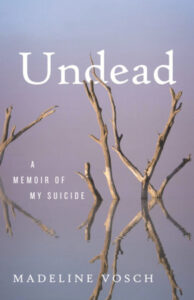
Undead by Madeline Vosch is available from Beacon Press.

Madeline Vosch
Madeline Vosch is a writer, a translator, and a professor. Her work has been published in Ploughshares, the Washington Post, and The Rumpus, among others. She was awarded the Ploughshares Emerging Writer Award for Nonfiction and was an Aspen Words Emerging Writer Fellow.