How the Fanatical Legion of Mary Secreted Young Girls Away to Toil in Ireland’s Magdalene Laundries
From Louise Brangan's Cundill Prize-Shortlisted The Fallen: The Lost Girls of Ireland’s Magdalene Laundries and a Legacy of Silence
Fifteen-year-old Eileen disappeared on a quiet Sunday evening in February 1954. She was at work when it happened. Eileen was a maid at a bed-and-breakfast in a large Georgian townhouse in inner-city Dublin, where she remade the crumpled beds, bundled the laundry into bags, ready to be collected, and smoothed the white linens across the breakfast tables. Each week she was paid ten shillings, and she lived in the small maid’s quarters located in the attic of the B&B. This was not just a handy living arrangement but a necessary one. Dublin was not Eileen’s hometown; she had arrived in the capital the year before as a runaway, escaping a life that she could not bear.
Eileen was born in 1939 at a Mother and Baby Home. These Homes were clandestine institutions run by Catholic nuns, places for women and girls who had had sex outside marriage, and found themselves pregnant, which was a catastrophic social taboo. Ideally, after the baby was born, the mother would leave them behind. She then returned to her normal life carrying her private shame, but with her social standing intact. The nuns then took it upon themselves to make arrangements for the illegitimate child.
Illegitimacy is an ugly word, but in Ireland at the time it was a legal category assigned at birth. For most of the twentieth century, the Irish government counted the number of illegitimate babies and tracked their year-on-year growth or hoped-for decline. They scrutinized this in comparison to the levels of illegitimacy in other countries, particularly their close neighbor, Britain, which was also doing the same dismal demographic calculus. The size of Ireland’s illegitimate population was lamented in government like an ill-gotten under-class. By the time Eileen was born, the matter of illegitimacy was a permanent social anxiety.
Eileen remembered how she adored her mother and loved to see her arrive at the house, but also how quickly she learned that she was expected to contain that feeling.
Eileen’s mother had been working as a live-in domestic maid for a well-heeled family when she found out she was pregnant. The father of her baby was the husband, the man of the house. So this problem—and certainly no one was say-ing that this pregnancy was anything other than a problem—was hers alone.
When Eileen was born, her mother did as was expected and left her at the Mother and Baby institution, where Eileen stayed until she was four years old. Eileen hadn’t been adopted, and so either a family member would have to come and retrieve her, or she would be sent to the industrial school—a dire place for poor orphaned children, also run by religious orders. Eileen’s mother was by then working elsewhere in the country, so in the end it was her married sister, Sheila, who came to collect the little girl. Auntie Sheila said she would raise Eileen alongside her own, older stepson.
Eileen’s mother visited whenever she could get leave from her domestic duties. Eileen remembered how she adored her mother and loved to see her arrive at the house, but also how quickly she learned that she was expected to contain that feeling. During her mother’s infrequent visits, Eileen was to treat her with no more than polite formality. Recalling these years, she said, “I was never allowed to speak to her alone when she came to see me.”
As Eileen was illegitimate and a source of great shame for the family, her aunt tried to muffle signs of her presence. When the family traveled by horse and carriage through the town, Eileen was made to curl up in the footwell, where she was covered by a blanket. She was not allowed to attend the local school and was made to travel to a school in another town where her family was not known.
Home life was where the danger lay for Eileen. Auntie Sheila’s stepson was vicious and sexually predatory. Eileen hardly knew what was happening to her, but she came to dread whenever her aunt announced that she and her husband were heading out, leaving Eileen alone with her step-cousin.
“That cruel life,” as Eileen described it, went on until she was thirteen, when she was taken out of school, her education over. Auntie Sheila had arranged for Eileen to be sent to work as a domestic for a local farmer who had a gaggle of children and endless errands to be done. The life of live-in servitude flummoxed Eileen, who said that her “blood ran into water.” She became lifeless. Within months, she was back with Auntie Sheila, laid out in bed for days on end, trying to recuperate.
What Auntie Sheila seemed to learn from this episode was that the demanding combination of children and the farm had pushed Eileen too far. Once she was upright again, Eileen was sent to one of the nearby big houses, the stately-looking homes of the landed gentry or respectable and monied classes—the doctors, the vets, the big farmers. There, she had no lands to tend to and no children to monitor and feed.
People sometimes gently mocked them and their small intrusions by dismissing them as “Holy Joes.”
Instead, Eileen spent day after day down on her knees scrubbing that grand house until she felt something in her yield; she was fourteen and a half when she ran away to Dublin. She said that she “loved” the bed-and-breakfast; she liked the two other girls who worked there because they were from the country as well, and that the owner, Miss Mullins, was usually milling about the place too. If her dream had been to live a life of her own making, she seemed to have succeeded.
Then, on that Sunday evening in February, Miss Mullins was out. With her gone, the other two girls vanished up the stairs as they hurried to dress for a dance in town that evening, Eileen recalled. Since she wasn’t joining them, Eileen found herself alone in the bed-and-breakfast.
Two unremarkable-looking middle-aged women came in from the street and approached Eileen at the front desk. She did not know them, and they were not guests. Many years later she would find out that they were members of the Legion of Mary, a volunteer organization whose lives were devoted to the veneration and imitation of Mary, the Mother of God and Blessed Virgin, who exemplified purity and a sinless life. The Legion of Mary saw themselves as an army engaged in a perpetual “warfare” against “the world and its evil powers”; their only mission was to guard Ireland’s moral boundaries.
In their self-appointed position as neighborhood apostles, their members pounded the pavements, identifying people who might need to be saved from vice, from sin, from potential proselytism by Protestant charities. They set about “influencing every home, shop, factory, office, and every other place its members might be set by circumstances.” In this wide-reaching role, they sometimes sidled up to young girls on the street whom they suspected of wayward tendencies, who exhibited signs of what they described as “pre-delinquency,” whose downfall seemed dangerously imminent, and to whom they must issue their warnings about evil. People sometimes gently mocked them and their small intrusions by dismissing them as “Holy Joes.”
There were numerous similar groups devoted to the Virgin Mary, but the Legion of Mary was the most prevalent.
From their foundation in 1921, officials in the Irish Catholic Church treated the Legion with caution, but they quickly earned enormous popularity with diehard Catholics. They held public meetings that were attended by ever-increasing crowds, and their membership grew exponentially into a “Legion of Mary frenzy.” One mother had written to the Archbishop in the 1920s, not long after the Legion of Mary was founded. This woman was worried about her daughters who had become swept up in this obsessive new group.
She had kept a secluded schedule, unlike her workmates, Eileen said; as she “never went out and never done anything wrong,” she had nothing to fear.
Despite rearing them as “good Catholics,” this desperate mother wrote, since her daughters had joined the Legion of Mary, they had been treating her and her husband as though they were “no longer good enough Catholics in their estimation.” Their concerns faded into a minority view. By the 1950s, the Legion lived up to their name and had garnered a twenty-five-thousand-strong membership.
The Catholic Church eventually came to share the Legion of Mary’s outlook, and the Pope had declared that 1954 was going to be the Marian year. The Virgin Mary and her immaculate conception were to be celebrated, and perhaps no other nation threw themselves into the veneration of Mary that year quite like the Irish. The post office issued a series of special stamps to mark the occasion, while people painted the entirety of their houses, inside and out, in bright shades of “Marian blue.” A new statue-building craze saw Marian grottos erected across the country, tucking figures of the Mother of God into rockfaces and roadsides.
On desolate rural strips or town squares, Mary is always the same. Hands clasped, head bowed, blank and fair of face. Each statue the perfect epitome of silent, mothering, virginal womanhood that Ireland had come to worship. Apparently, Protestants looked on and thought the Catholics, and maybe the Irish in particular, were hardly Christian at all, as they obsessed so over Mary. In Ireland, Christ sometimes had the appearance of a second-tier messiah in his own religion.
It was this kind of obsequious zeal that possessed the two women now standing before Eileen in 1954—Holy Joes that had been roving the city’s streets in search of women and girls in imminent moral danger, and believed that they had found one in Eileen. They immediately pursued a peculiar, almost personal, line of conversation.
“You are far too good to be working here.”
“And too nice.”
“We could bring you to a nicer place to work, with more money.”
From that moment on she was to be known only as “60.” In the days that followed, everything else was stripped from her.
Eileen was not sure what it was these two women were really talking about, but she did not ask them to clarify. She had been raised in the traditional Irish way, in which deference and obedience to your elders were paramount—she knew that she was not meant to ask questions, especially of people who possessed an air of authority, as these two women did. But even in her silence, Eileen did not feel a warning sense of suspicion, or recognize the sinister edge to this confrontation. She had kept a secluded schedule, unlike her workmates, Eileen said; as she “never went out and never done anything wrong,” she had nothing to fear.
The two women insisted that there was no time to waste, and that Eileen should come with them immediately. “I didn’t know what to do,” Eileen said. “I was reared up very strict, and you didn’t say no in them days. In the fifties you didn’t say no, you’d be afraid to say no. So, I said okay.” Fifteen-year-old Eileen followed them out of the bed-and-breakfast and got into their car, which was parked just outside. Eileen sat in the back seat as they drove her to O’Connell Street, the city’s main thoroughfare. They crossed the bridge over the River Liffey, and went out the other side of town.
Did she begin to wonder if she ought to have waited to tell Miss Mullins? She hadn’t so much as left a note; presumably Eileen believed she would return. It didn’t take long before they were in a part of Dublin Eileen did not know. They passed salubrious redbrick houses with long gravel driveways set in off the road. The car slowed as it reached a lively street, and when the traffic eased, they pulled right and went through a gate with an arched metal sign above it: saint mary magdaLens asyLum. This was not hidden or tucked away; it sat among the row of ordinary local businesses: butcher, dairy, post office, pub, Magdalene Laundry.
They led her up a set of shimmery limestone steps. A nun in pitch-black robes appeared at the door, who showed them through to a parlor, a grand and dignified room where the nuns received guests and hosted events. Whatever task these two women had set out upon was now complete, because they turned to leave. Before they did, one of them paused and looked back at Eileen, who was still standing in obedient silence, and said, “We’re putting you in here for your own safety.”
Finding Eileen gone, the girls she worked with did not call the police. It is likely that the Legion of Mary returned and explained matters to Miss Mullins. Maybe, like Eileen, Miss Mullins knew not to ask questions either. Perhaps privately she felt annoyed about the inconvenience of having to hire another girl, but thanked them nonetheless. We will never know exactly what occurred in the wake of Eileen’s absence. There is no archive for quiet moments of compliance and inaction. Something along these lines must have happened, because no one came looking for Eileen.
Later that evening, the nun took Eileen’s clothes, then cut off her hair and changed her name. She was no longer Eileen; she was to be designated by a number. From that moment on she was to be known only as “60.” In the days that followed, everything else was stripped from her.
Where she was and what was happening would take her weeks to figure out. Why it had happened, that would take decades to be revealed.
__________________________________
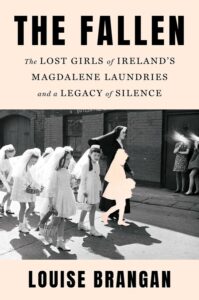
Excerpted from The Fallen: The Lost Girls of Ireland’s Magdalene Laundries and a Legacy of Silence by Louise Brangan. Copyright © 2026 by Louise Brangan. Reprinted by permission of Simon & Schuster, Inc. All Rights Reserved.

Louise Brangan
Dr. Louise Brangan is an Irish academic who researches injustice and punishment. She is a 2023 BBC/AHRC New Generation Thinker, the playwright of The Ireland We Dreamed Of, and winner of the 2024 RSL Giles St Aubyn Award. She lives and works in Scotland.