






How the 23 Oldest Words in Existence Differentiate Us From Our Primate Cousins
Olivia Swarthout on the Origins and Purpose of the Words We Use to Convey Complex Ideas
Where do words live? As a newly initiated word-spotter, you’re probably keen to rush out and start turning over rocks and looking under leaves in search of them. There will be time for that, but you mustn’t get ahead of your self: for as long as words have been found in the world beyond, they have been found within us, too. Here is a list of twenty-three words believed to be the oldest in existence:
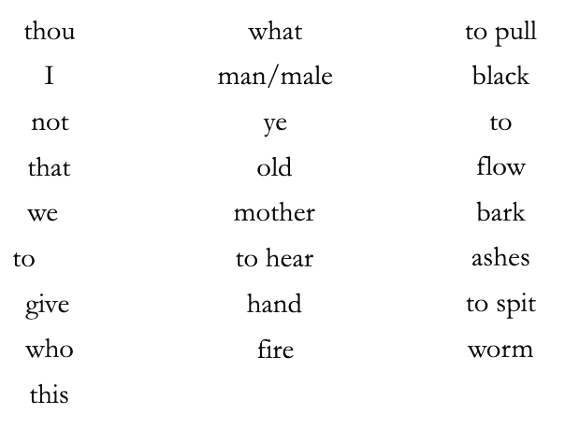 Note that I and we are among them. Thus we can tentatively conclude that our ancient forebears were fairly interested in self-reflection—at least as much as they were in worms, which also make the list. That might not seem too impressive, but ask any of our closest relatives, such as chimpanzees and gorillas, which they care more about, and they’ll say worms every time.
It seems, then, that humans are a uniquely self-aware species. More than any other animal, we think about what we have and what we want, what we know and what we don’t, where we have been and where we will be. Other apes don’t come anywhere near us in that department. In fact, we’ve spent plenty of time looking for evidence to the contrary, though never to any avail.
Language gives us the blessing and the curse of being able to produce and understand an essentially infinite number of messages.
In the 1930s, a couple hypothesized that if they raised an infant chimpanzee, named Gua, alongside their infant human son, named Donald, Gua might acquire the faculties for speech and complex communication. Gua never uttered a single word, though an eighteen-month-old Donald did begin to take on the mannerisms and vocalizations of a chimpanzee, at which point the experiment was quickly terminated. Later research focused on teaching apes sign language. Though the test subjects were able to acquire larger vocabularies, they had only marginally more success catching on to our human ways. One chimpanzee named Nim Chimpsky contracted clinical depression and asked for some marijuana, which at first seemed a good sign. However, precise language always seemed to evade him—after four years of schooling, Nim’s most complex sentence was “Give orange me give eat orange me eat orange give me eat orange give me you.”
Many other primates have undergone similar training with similar results.* They would pick up a vocabulary of a few hundred signs but could create only short messages with no grammar or structure. Though animals have shown some rudimentary ability to describe and ask for things using human language, most scientists tend to conclude that they just aren’t wired to grasp or communicate messages more complex than that. For instance, no other animal seems capable of understanding the concept of a lie. And in decades of researchers teaching dozens of chimps hundreds of sign language words and phrases, not a single one has ever formulated a question.† They think they know it all, those chimps.
Humans are humbler than that, though. We ask questions. We self-scrutinize. Our unique ability to use language helps us out with this. Simple concepts regarding the self are easy enough to communicate without language:
– I want that!
– I like you.
– I see a wolf right behind you!
– I’m scared.
More complex ideas, however, require a more complex system of signs or sounds. I’d like to see a chimpanzee come up with something like:
– I’d love for you to tell me how you managed such a great crop yield this year!
– If I die tomorrow on the mammoth hunt, I’d like you to have my knife as a token of my everlasting love.
– I see a wolf right behind you, but maybe if we share our dinner with him he’ll be our friend.
– I can’t help but feel that this earthquake is being caused by a higher power as punishment for some sort of spiritual shortcoming in our society.
Language gives us the blessing and the curse of being able to produce and understand an essentially infinite number of messages regarding not just what’s right in front of us but also what isn’t. Language gives us the abstract: relationships, possibilities, history and beliefs. And it is from these things that our uniqueness emerges, not just as a species but as individuals. Look within yourself at your memories, personality traits and identity. Your reasons for getting out of bed in the morning, for wearing and eating and doing what you do, your reasons for reading this book. You built all that yourself out of words! For not only do humans give words meaning, but words also give meaning to each human existence. And we do like to feel like our existence means something.
For not only do humans give words meaning, but words also give meaning to each human existence.
No one knows quite what prompted us to become so obsessively self-conscious. What was inside us that was so meaningful, so complex that we needed to invent the entire concept of language just to talk about it? Sure, our new big brains gave us things like society and laws, which are mostly good, but we also wound up with new issues to deal with, like self-doubt and existential dread. And even as we solved some problems, we just invented new ones. Was it really worth it? A chimp has never caught someone else out in a lie, but it has also never had to deal with the emotional ramifications of knowing you’ve been lied to. It just gets on with its day.
There are physical problems, too. To be able to produce the sounds needed for language, our throats have evolved a very particular anatomy. By sheer coincidence, this adaptation has also made us extremely susceptible to choking on small objects. No other animal can be as easily dispatched by a grape, chicken bone or bite of sandwich. So, the age-old adage sticks and stones may break my bones but words can never hurt me isn’t quite true: words have given us the ability to lose our lives in one of the most embarrassing and avoidable ways possible.
All these drawbacks, and yet we continue to talk and talk and talk! We must have had a very good reason to choose speech over being able to swallow huge quantities of meat with a single gulp. In order to better understand the true natures of the words we will meet over the course of this book, we must try to understand the reason for their existence. Perhaps, then, it makes sense to start our language journey where our ancestors started theirs: within the self. It is there, within your own mind and body, that you’ll find some of the oldest and deepest links to the past, living fossils from the days when we had just begun to scratch at the ceiling of our own animal instincts in search of something more. What exactly were we looking for? The answer begins with I and we. The world beyond will wait; the world within beckons.
* In fact, if ape language experimentation has been highly effective at instilling any human trait in its subjects, that trait is clinical depression. After spending extended periods of time living in human society, the chimpanzees would often struggle socially and romantically upon being introduced to fellow apes. One was described as having an “existential crisis” when she realized that she was not the only one of her kind.
† One animal has asked a question, though. Alex the African gray parrot once looked in a mirror and asked, “What color?” He learned shortly thereafter that he was gray.
______________________________
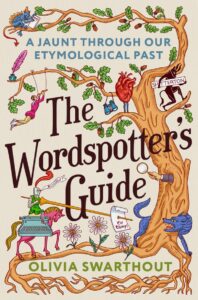
From The Wordspotter’s Guide: A Jaunt Through Our Etymological Past by Olivia Swarthout. Copyright © 2026. Available from Plume, an imprint of Penguin Publishing Group, a division of Penguin Random House, LLC.

Olivia Swarthout
Olivia Swarthout is a chronicler of strange stories from our distant past, especially the Middle Ages. She is the author of Weird Medieval Guys. Her first name is derived from the Latin oliva, meaning “olive,” and her surname is of Middle Dutch origin, roughly corresponding to “black forest.”