When Your Town Needs a Bookstore... Why Not Open One Yourself?
Rachel Pastan on Building Community and Writing a Novel
The morning my life changed, I was sitting in a cafe talking to a student at a writers conference in Southampton. My phone rang, but I didn’t answer it.
When the student left, I saw the missed call was from a woman I had worked with on a task force on housing affordability in Swarthmore, Pennsylvania, where I live. Our kids were the same age, and my daughter used to go to her house for ACT prep classes. That’s the kind of town Swarthmore is: small enough that you often know people a couple of different ways.
When I called Beth back, she too was sitting in a cafe, looking across one of Swarthmore’s main streets at a building she’d just learned was for sale. “Don’t you think Swarthmore needs an independent bookstore?” she asked.
I should tell you that Swarthmore is a very small town. There are only about 7,000 residents, including the students at the local college. We do support a coffee shop, a pizza parlor, and a small grocery store, but just barely. Were we big enough for a bookstore? I wasn’t sure. Still, I didn’t hesitate.
What was Swarthmore becoming, and was it the sort of place I would still want to live?
“Yes,” I said.
“Don’t you think you and I should open it?” she said.
For a while before that phone call, I’d been waiting to see what the universe might offer me. The teaching I’d been doing was starting to dry up, and also, I was feeling I had less to offer as a teacher. Who knows what makes a work of fiction good or bad, let alone more or less likely to be published? There was a time when I thought I did, but over the years I’d grown less confident in my own clarity. I don’t think that’s a bad thing, but I do think it makes it hard to teach.
More importantly, having spent decades doing my novelist’s work alone in a room, I had grown restless. I’d worked for a while as a grant writer, and later as a newspaper editor, but those jobs, too, were solitary. What would be not solitary, pay a salary, and be writing adjacent?
So when Beth asked me that second question, I only hesitated for a moment before saying yes.
Of course, opening a bookstore—working in a bookstore—is kind of a romantic dream. Beth and I knew that. We agreed to take some time, talk to people, sign up for some classes, and decide if we wanted to go ahead.
Meanwhile, I had begun writing a novel that grew out of my interest in housing affordability. I was fascinated and appalled by the ways local zoning laws in towns like mine help keep housing costs high. For example, lots are often required to be large, which drives up the sale price. Most neighborhoods are reserved for single-family homes, no small apartment buildings or even townhouses allowed.
You might wonder what the “family” in a “single-family home” means, exactly. In my town, it means any people related by blood, marriage, or adoption, plus no more than two others.
Yes, “family” is defined in the zoning code.
People will tell you the zoning laws are intended to preserve the “character” of a place, but a lot of the reason these laws exist is that many people in affluent communities don’t want less affluent people moving in. Property values, school class size, traffic, people with different cultural norms that might include louder music or more cars… Some of these concerns are talked about a lot, while others bubble noxiously beneath the surface, only occasionally voiced in angry outbursts at public meetings.
Swarthmore is no longer a place where a writer and her college professor spouse can buy a home. The median home value here in 2000, when I moved to town, was $370,000. By 2022, it was nearly $600,000. What did this shift augur for the future of the place, I wondered? What was Swarthmore becoming, and was it the sort of place I would still want to live?
This issue is, of course, not unique to Swarthmore. In the country as a whole during the same period, the median home price rose from about $119,600 to about $300,000, according to the U.S. Census. Even once you adjust for inflation, the jump is huge.
But there are ways to push back against soaring housing costs, and some towns are doing just that.
Newton, Massachusetts, for example, has legalized accessory dwelling units—aka ADUs, aka granny flats, aka mother-in-law suites: small homes on the same lots as larger houses. ADUs make space for people to live in towns like mine more cheaply, and the income from renting them helps the people in the larger, primary home afford to stay. Some whole states, like Connecticut and California, have legalized ADUs in recent years! But not Swarthmore.
My novelist mind started turning all this over. ADUs… lots of people living together in a house… surely there was a story in there somewhere?
I turned the final draft of my novel in to my editor in August. Celia Bookshop opened its doors in October.
What if someone inherited a house, but she couldn’t afford to live there? What if…she decided to build an ADU to rent out so she could stay…or invited her friends to move in with her? What if she didn’t know that all these things were illegal until her neighbors got mad and tried to stop her?
What if all this happened amidst her grief at the death of her mother, from whom she inherited the house in the first place?
When I think about it now, it seems to me that my own growing desire to be with more people more of the time shaped the main character’s strategy of inviting more and more friends into her spacious, dilapidated, turreted house. I didn’t actually want to live with more people myself—one spouse and one dog were plenty—but I did want more interaction. I applied for a seat on and was appointed to our town’s planning commission, which meant that I now had a voice and vote on zoning issues. But monthly meetings were never going to answer that need.
But a bookstore…
As I worked on the novel, Beth and I decided to move forward with the project. She bought a building and began planning an extensive renovation. I made a giant spreadsheet and plunged into selecting our initial book inventory. We hired staff, opened publisher accounts, and learned to use the point of sale system (not easy!).
I turned the final draft of my novel in to my editor in August. Celia Bookshop opened its doors in October.
Now, I spend my days among my neighbors, who themselves come out of the isolation of their single-family homes not just to shop for books, but also to listen to readings, join classes, and bring their children to storytime. Celia Bookshop is a place where people go because they want to be with other people, to chat, to browse, to exchange book recommendations and ideas.
I haven’t yet heard anyone perusing the Science Fiction & Fantasy section, or standing in front of History & Society (where I stock a bunch of books about housing and zoning), talking about whether we should legalize ADUs, or change the number of unrelated people who can live in a house, or allow small apartment buildings among the single-family homes. But these issues are finally being considered by our local officials. I’m guessing—I’m hoping—it won’t be long before I do.
__________________________________
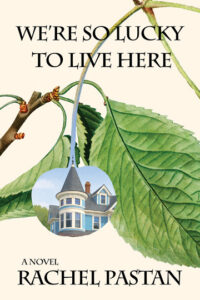
We’re So Lucky to Live Here by Rachel Pastan is available from Delphinium Books.

Rachel Pastan
Rachel Pastan is the author of three previous novels, most recently Alena, which was named an Editors’ Choice in The New York Times Book Review. The daughter of a molecular geneticist and a poet, she has worked as editor at large at the Institute of Contemporary Art in Philadelphia, and taught fiction writing at the Bennington Writing Seminars, Swarthmore College, and elsewhere.