How Navigating the Demands of Academia Helped Me Cope With Terrible Loss
“The research and writing became a path back to life, not without Frances, but through and with her.”
The first summer after my daughter died, I received an email invitation to give a keynote address the next spring. I didn’t know the scholar who invited me, but she’d been told that my daughter had recently died and offered her condolences. The invitation felt confusing. How could someone who knew I’d just lost my daughter think I would be accepting scholarly invitations? How could someone who knew imagine that I would ever think again?
That invitation proved a gift.
I was in shock that summer. My daughter had gone to bed on a Sunday night in late April, a happy, apparently healthy girl. Sometime in the night or early morning hours she suffered a massive stroke. Over the next week in the hospital, she suffered several more strokes. She died that Friday, April 30, 2010. Just weeks before the end of her senior year of high school, she was suddenly, inexplicably, gone.
I responded viscerally to the idea that these professional achievements were relevant to who I was, to “the course of my life,” but the death of my daughter was not.
In the wake of her death, well-meaning friends and colleagues urged me to return to my research, thinking perhaps that I would find escape or solace there or seeking assurance that I was re-engaging with life. But the topic that I had been researching was hardly a refuge for a parent who had just lost a child: children across the United States burned at mid-century when the furry fabric on the chaps of their cowboy playsuits exploded into flame, leaving them horribly, and in many cases fatally, burned. It was Americans’ first reckoning with “flammable fabrics.”
What I came to call the cowboy suit tragedy was itself a fragment of a planned larger project, a sociolegal history of product liability in twentieth-century America. These two projects had been interrupted by a third, a book on law, personhood, and citizenship in the long nineteenth century published in March 2010, Law and the Borders of Belonging in the Long Nineteenth Century United States. Together these projects were the foundation for my promotion to full professor in May 2010.
Frances’s death came in the midst of this research and these professional milestones, the sort that scholars would add to their CVs. I responded viscerally to the idea that these professional achievements were relevant to who I was, to “the course of my life,” but the death of my daughter was not. When the first copy of Law and the Borders of Belonging had arrived, Frances had eagerly turned to the acknowledgments to see if she was there. She did not like what she saw. “Why do I have to share sentences with Wilder [her brother]?” she asked. “Dad gets his own sentences. I want my own sentences.” It was such a sweet moment. I remember laughing, promising that in my next book she would get her own sentences. And then a month later, she was gone.
*
I accepted the invitation. I had no idea of what I might speak about; I was finding it difficult to even be alive when Frances was not. But then, some weeks after saying yes, an idea for the lecture came to me: I would write a braided narrative weaving the cowboy suit tragedy, my experience of loss, and the CV together. It felt like taking a giant gulp of air after not breathing.
Though it would be another five years before I re-engaged in my research on the cowboy suit tragedy, Frances’s death increased the work’s urgency. I found myself asking what might a history that joined the personal and the intellectual, that embraced emotion together with reason, that sought some larger or more fundamental meaning than how the “so what?” question is often framed, allow us to know, to feel?
I had long been reluctant to seek out survivors of the cowboy suit tragedy, fearing that I would dredge up a long-past childhood trauma. Only with the silencing of Frances’s voice did I understand the importance of survivors having the opportunity to speak for themselves. The conversations I later had with some survivors, spouses, siblings, children led me to see that though the injury changed with time it was never past, done. Understanding that changed how I thought about law and its claim to finality. Through the conversations I could see something of the meaning of this event in and for the course of their lives. The original Latin meaning of curriculum vitae led me to imagine writing their history as the course of a life.
I also turned to archival research to trace the history of the curriculum vitae. My hope was that making the vita a subject of historical inquiry might strip some of its power. The history of the vita makes visible how its structure and categories embed, reinforce, and replicate institutional and disciplinary boundaries, privileging and crediting certain kinds of training, experience, and research in the production of knowledge and excluding others. Or put differently, I came to see including a history of the vita in a book that is most centrally about another history as something like wearing a girdle on the outside of one’s clothes to expose the girdle’s construction and unnatural constraint.
Only with the silencing of Frances’s voice did I understand the importance of survivors having the opportunity to speak for themselves.
The idea for the lecture, that giant gulp of air, included a third element: speaking to my experience of losing Frances. But when I finally faced writing my remarks, I could not imagine speaking directly to an audience about my experience of losing my daughter. And so, I turned to letters I began writing her the month after her death. Though I wrote to her every day, often more than once, I did not look back at them. While I drew from those letters for the lecture I gave, I did not look at them again until winter 2020. In the book, I draw on letters I’d written over the first year and a half after her death. Doing so, claims the personal knowledge that disciplinary training and structures like the vita elide and offers a bridge to more fully understand the grief and loss the families in the cowboy suit tragedy experienced.
I gave that lecture, “Telling Stories: A Meditation on Love, Loss, History and Who We Are,” at the annual meeting of the Western Association of Women Historians in April 2011, just weeks before the first anniversary of Frances’s death.
In the years since I have thought often about that invite. There was first the happenstance of timing, the awful convergence of the personal, professional, and intellectual in my life: my daughter’s death; the professional milestones flanking it; a project about grievous, unexpected injury and death to children. Had Carole Srole, having learned that my daughter had recently died, not extended the invitation to give the keynote lecture, I likely would not have had the idea for the braided narrative that in time became the seed for the book Writing with Fire: The Cowboy Suit Tragedy and the Course of a Life. The forum mattered too—an association of women historians founded in the moment women challenged their exclusion from and subordination within academia—an audience, in other words, that might be open to a lecture that spoke personally from loss, breaching the closely guarded boundaries between the personal, the professional, and the intellectual.
And the format mattered: a lecture. The stakes were in one sense horribly high: standing in front of an audience and delivering an intensely personal lecture when I was still deep in grief. But in another sense, the format lowered the stakes: a keynote lecture, yes, but still a one-time event, the words remaining under my control, not a published piece that would circulate. And so, while it was public, in this sense, it remained private. Finally, the response to the lecture mattered: a warm, sustaining embrace, a response that affirmed the potential in both feeling and thinking. Audience members said they hoped I would publish the lecture, something I could not imagine in that moment and would only with time consider.
Incremental steps, each with no plan for the next, enabled me to move forward. I accepted the lecture invitation because it offered something I could point to, a distant date on a calendar, a sort of proof to others that I was re-engaging with life. Its distance meant that I did not have to act immediately. And yet, it did ultimately provide a crucial pathway to re-engage with life, personally, professionally, and intellectually. What I have only understood in finishing the book is that the lecture and then the research and writing became a path back to life, not without Frances, but through and with her.
______________________________
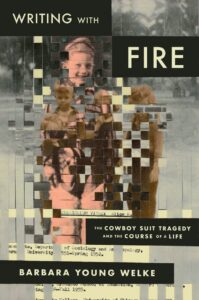
Writing with Fire: The Cowboy Suit Tragedy and the Course of a Life by Barbara Young Welke is available from University of Chicago Press.

Barbara Young Welke
Barbara Young Welke is the Distinguished McKnight University Professor of history and law at the University of Minnesota. She is the author of Law and the Borders of Belonging in the Long Nineteenth Century United States and Recasting American Liberty: Gender, Race, Law, and the Railroad Revolution, 1865–1920. She lives in St. Paul, Minnesota.