Queer Recognition, Estrangement, and the Great Grey Area in Between
Demetris Papadimitropoulos Considers the Books Families We Keep and Families We Lose
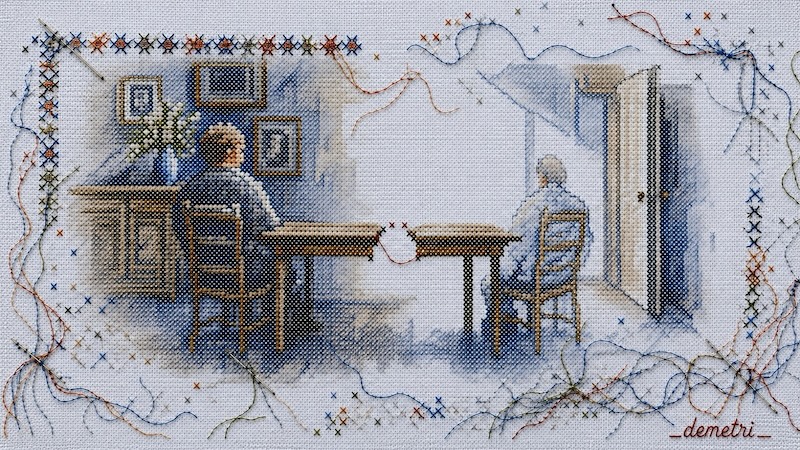
Cross-stitch watercolor by Demetris Papadimitropoulos
When Aly changed hir name, hir mother heard more than a new set of syllables. Margaret told researchers in Rin Reczek and Emma Bosley-Smith’s study that she felt Aly had “divorced the whole family.” Before the change, Margaret and her husband had been sending Aly money every two weeks. Afterward, Margaret stopped. Later, when Aly described the fights over what hir mother should call hir, ze reduced Margaret’s position to something startlingly simple: “she named me, and that’s the most important.” A parent names a baby before the baby can choose a name. The stranger question begins years later, when the child can choose and the parent is not sure that choice outranks the one she made first.
Recognition is the obvious word for this conflict, though it does not quite reach the bottom of it. Margaret struggles with Aly’s trans and genderqueer identity, but she also experiences Aly’s self-definition as something done to her. Hence the startling metaphor of divorce. A new name seems to threaten not only her understanding of Aly but something she believed parenthood had given her. What happens to powers acquired when a child could not yet decide for themself once that child becomes an adult who can?
National Coming Out Day, marked each October 11, gives public attention to a threshold: someone tells, or decides whether to. Current Human Rights Campaign guidance recognizes that disclosure need not happen once, everywhere, or on anyone else’s schedule; its resources emphasize that people should remain in control of whether, how, where, when, and with whom they are open. Disclosure itself is not an obligation. Withholding, delaying, or limiting what particular relatives know can also be an exercise of agency. The harder questions, which two recent books attempt to answer, often begin after disclosure. What do the people receiving that knowledge think it requires of them?
Reczek and Bosley-Smith’s 2022 Families We Keep: LGBTQ People and Their Enduring Bonds with Parents spends much of its time in that aftermath. Tricia cannot identify the grand scene in which she came out to her mother, Charlene. Women simply began appearing in her life. Charlene nevertheless continued to believe that underneath it all her daughter was, really, attracted to men. Asked to describe their relationship, Tricia finds a more exact phrase than either acceptance or rejection: “It’s like we’re close, but not close.” She still turns to Charlene for advice; they spend holidays together and help one another through illness. Their intimacy is neither fake nor complete. Incompleteness is one of its conditions.
The space between knowledge and anything one might confidently call recognition is hardly marginal. In a 2025 Pew survey, 23 percent of LGBTQ adults said none of their parents or the people who raised them knew about their identity. Among those whose parents did know, only 46 percent said all were accepting. But accepting is an elastic endpoint. A family can know and doubt, know and refuse to discuss, know and use an old name, know and love. What interests Reczek and Bosley-Smith is what the information is allowed to disturb.
They call the force sustaining many difficult parent-child ties compulsory kinship, the sociocultural pressure that makes family-of-origin relationships, especially parent-child relationships, seem primary, inevitable, natural, and enduring. More revealingly, they show how much activity hides inside that apparent permanence. Their term conflict work describes the labor of managing serious disagreement while keeping a family functioning: concealing, teaching, accommodating, redirecting, sometimes leaving and returning. What at first looks like endurance begins to resemble maintenance.
Leslie shows how strange that maintenance can become. She comes out as trans to her mother, who largely refuses acknowledgment. Years later, after Leslie experiences severe financial difficulty and is hospitalized, both parents become more present. Her father helps with hospital bills and her car, invites her over, makes dinner, gives her gas money. He also refuses to acknowledge that she is trans. They reach what Leslie calls an “agreement and standstill”: some subjects simply do not get discussed, and being trans is one of them. Leslie says that, given the choice, she prefers this imperfect arrangement to having no relationship at all.
A family can know and doubt, know and refuse to discuss, know and use an old name, know and love. What interests Reczek and Bosley-Smith is what the information is allowed to disturb.
“Partial recognition” is an accurate description, but it can become a verdict too quickly. Leslie deserves more recognition than she receives. Still, her father’s dinner does not erase his refusal to recognize her gender; his refusal does not make the dinner or hospital bill imaginary. Care and recognition have separated. Leslie has decided, at least for now, that the gap between them is one she would rather inhabit than refuse, and lose the relationship entirely.
That is what makes keep an increasingly active word as the book proceeds. Families are kept by discretion, teaching, lowered expectations, hope, money, distance, forgiveness, silence. “We stayed close” begins to need a second sentence. How? Who changed the subject? Who learned? Who yielded? Who kept calling?
Reczek’s 2026 solo Families We Lose: A New Explanation for Family Estrangement starts among people for whom at least one of those calls has stopped. Its 68 interviewees were all currently no contact with at least one parent, although most had previously moved in and out of estrangement. Unlike the earlier project, it is not specifically a study of LGBTQ families. Reczek calls the alternative family logic she finds among many participants democratized kinship, in which inherited status carries less weight on its own while accountability, growth, connection, mutual respect, and safety matter more.
The distinction between the books is useful to keep plain. The earlier one watches people labor to keep a difficult tie functioning. The later one listens to people explain why inherited status was no longer enough to keep one.
Luna gives that second position unusual sharpness. She is estranged from a father who rejects her queerness, but sexuality is only part of how she explains the break. She tells him that she cannot have a relationship without mutual respect. His position, in her account, amounts to this: “I’m the father, you’re the daughters, we do things my way.” The injury is not only that he disapproves of who she is. She understands him to believe that his place in the family gives that disapproval governing force.
Aly’s quarrel begins with a name; Luna’s arrives at the rank implied by father. Neither case proves that parental rejection is fundamentally a desire for control. Religion, fear, prejudice, affection, money, family history, and bewilderment can crowd the same room. The cases expose something narrower: adulthood is supposed to settle who has final say over an adult life, but families do not always receive the memo. What exactly remains for a parent to decide?
The research designs keep the comparison from becoming a progression story. Families We Keep interviewed 76 LGBTQ adults and, with their permission, 44 parents connected to 40 of them. Reczek and Bosley-Smith acknowledge that people with especially conflictual parental relationships were less likely to authorize parent interviews, leaving that parent subsample tilted toward more positive ties. Families We Lose interviewed 68 adults currently estranged from at least one parent, not the relatives from whom they were estranged. One study catches people doing the work of continuation. The other catches people explaining why, at least for now, that work has stopped. The difference between their conclusions may sometimes begin with where the researchers were standing.
Jackie is one reason the earlier book refuses to become a simple brief for more voluntary family. Jackie describes physical abuse by her parents, and she does not feel safe telling them she is trans. The relationship is damaged enough that she says, “If they were just my friends, I wouldn’t speak to them.” Reczek and Bosley-Smith understandably hear compulsory kinship there: behavior that would end a friendship has not ended this family tie.
Yet Jackie’s comparison contains its own objection. Her parents are not her friends. A parent-child relationship carries a history friendship does not: dependency before either party could meet as equal adults, memories and injuries accumulated before adult consent was possible, care given or withheld when the child could not provide it for themself. None of that grants parents permanent jurisdiction. It is not morally weightless either. An adult can know that culture helped teach them to value a parent-child bond and still decide that this particular history leaves them with obligations they want to honor. Knowing where an obligation came from does not settle whether it deserves to survive.
And sometimes equality is not available. An aging parent develops dementia; illness makes recognition intermittent or apology impossible. None of this restores a right to obedience. It does expose a limit in any model that makes relationship quality and continued obligation neatly coincide. Reciprocity can disappear before obligation does.
Families We Lose contains a less theoretical version of the problem. Elena asks both parents for accountability over the failures of her childhood. Her mother does not give it. Her father acknowledges what went wrong, apologizes, asks forgiveness, and changes. “He’s changed a lot,” Elena says. “And now we’re really, really close.” She does not need to discard the category of family to insist that the relationship change. Hope for growth and growth itself are different kinds of evidence.
Money makes all of this less philosophical very quickly. Margaret’s response to Aly’s name change includes stopping the regular payments. When Aly later explains why ze resumed some contact, the answer is strikingly administrative: “I can’t afford my own phone bill, and my health insurance is with my father.” The argument over recognition arrives with paperwork.
Aly cannot stand in for everyone who remains connected to a difficult parent. Love, hope, fear, habit, genuine care, and need cannot be reduced to a household budget. But hir phone and insurance expose the weakness in frictionless talk about choice. A door can be open in principle while the life outside it is unaffordable. Family can be relationship and infrastructure at the same time.
Tabitha is difficult to recruit for either side. In Families We Keep, she describes years of conflict with her parents around sexuality, religion, identity, independence, and a legal name change. Reczek and Bosley-Smith also describe serious mental-health struggles and previous physical conflict between Tabitha and her parents; during the final confrontation, Tabitha says she left partly because she feared the fight could become worse. She moves away, explaining that she loves her parents but will not live her life for them.
Years later, she comes back.
Tabitha tells her mother she is homeless. Deanna hesitates, still wounded by the estrangement, but opens the house again. Deanna says her husband helps facilitate the reconciliation with one of the oldest propositions in Families We Keep: “That’s our daughter.” Material necessity plainly matters, as does the conviction that daughter names something a family cannot simply revoke.
But the old arrangement does not reassemble intact. Tabitha says her parents are “not as parental as they used to be.” At first they remain “mom-and-dad clingy”; eventually, she says, “we’re all adults.” She believes the estrangement made them realize that she was “good either way with or without them.” They remain parents. They no longer occupy quite the same position.
National Coming Out Day understandably centers the person deciding whether and how to say: This is who I am. These books shift the camera toward the people who hear it. What will they relinquish, if anything?
Reczek and Bosley-Smith read the return partly as evidence of compulsory kinship’s durability, and the evidence supports them. Family status pulls. So do family resources. Read beside the estranged adults in Families We Lose, though, Tabitha reveals another possibility. Return is not restoration. The relationship resumes; not every power embedded in its earlier form comes home with it. Tabitha cannot tell us that estrangement generally improves families. She can tell us that once leaving has become real, its possibility may remain in the room after someone returns.
National Coming Out Day understandably centers the person deciding whether and how to say: This is who I am. These books shift the camera toward the people who hear it. What will they relinquish, if anything? An old name? A preferred future? The expectation that parental discomfort should determine the pace of an adult life? What may remain: concern, history, care, obligation, the desire to stay family?
Aly chose a name. Tabitha left a house and later walked back into it. Neither act tells us whether recognition, love, understanding, or reciprocity will follow. The more revealing questions collect around the verbs: who names, who recognizes, who teaches, who pays, who apologizes, who cares, who refuses, who leaves, who can return.
“Parent” is a name too. It may be one of the first we learn for another person and one of the last whose meaning we assume was settled long ago. An adult child can claim authority over the meaning of a life without proving that everything inherited is therefore illegitimate. A parent can lose the right to define a child without becoming a stranger. Obligation can survive scrutiny. Sometimes contact cannot.
When Tabitha returned, her parents were still her parents. They were also, in her precise, peculiar phrase, “not as parental.” The title had survived; some of the hierarchy inside it had not. National Coming Out Day gives us a public language for saying This is who I am. Families We Keep and Families We Lose linger over the answer that may follow: I am your parent. The unsettled part is what that answer still permits anyone to ask.

Demetris Papadimitropoulos
Demetris Papadimitropoulos is a Manhattan based writer and former book publicist who worked for more than a decade at one of the big 5. His criticism and essays focus on literature, queer culture, memory, archives, and the politics of how stories are preserved, revised, and recognized.