March 5, 1933: The Election That Destroyed German Democracy
Timothy Ryback on the Parallels Between the Lead-Up to Hitler’s Electoral Victory and the 2026 Midterms
Recently, President Donald Trump banned three media organizations from the White House because of their negative coverage of him and his administration. “I mean, there’s something wrong with a country that can allow people to write purposely negative stories,” Trump told to a reporter who invoked the first amendment right to free speech. “Now, if they want to write them, that’s fine, but I don’t have to let them into my—into the People’s House.”
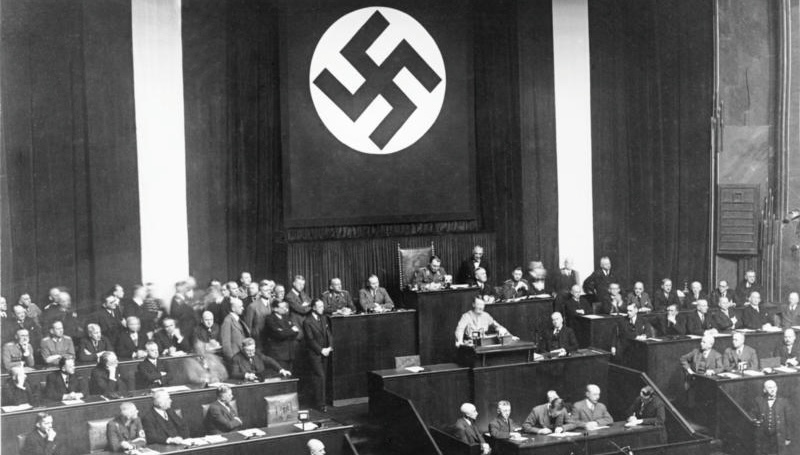
While Trump’s brazen attempt to quash negative press coverage in advance of the November 3 midterm elections failed it nonetheless has striking resonances with Adolf Hitler’s own efforts to game the political system in advance of German legislative elections on March 5, 1933.
Like Trump, Hitler was not on the ballot. Like Trump, Hitler saw the March 5 election as a referendum on his administration. Like Trump, Hitler was polling 33 percent nationally, virtually identical to Reuters’s most recent approval rating for the president. And like Trump, Hitler turned to the courts when he did not like election outcomes.
Amidst all the turmoil, everyone understood that the March 5 election was a make-or-break moment not only for the Hitler chancellorship but for democracy itself.
Before his appointment as chancellor, Hitler had run for the position of Reich president against the incumbent, Paul von Hindenburg. When Hindenburg crushed Hitler at the polls, in spring 1932, Hitler sought to have the results overturned amid claims of voter fraud with mail-in ballots and irregularities by state officials. The judge dismissed the case out of hand, claiming that Hitler’s six million vote loss to Hindenburg, out of the roughly 36.8 million votes cast, was too great a margin for error.
Hitler was subsequently appointed chancellor by Hindenburg, in January 1933, after his party secured in the 1932 legislative elections a relative majority in the 600-seat Reichstag, Germany’s parliament. Hindenburg agreed to dissolve the Reichstag, at Hitler’s urging, and schedule new elections, for March 5, 1933. Hitler intended the legislative elections as a populist referendum on his government, after having been assured by his Gauleiter, his local political operatives, that the national socialists would easily clear 51 percent in elections, allowing Hitler to rule without the constraints and compromises of a coalition government.
Hitler leveraged his executive powers to tilt the elections. An emergency decree, signed by Hitler and Hindenburg, restricted press freedoms and public demonstrations. Newspapers took the government to court to have the bans overturned. Hitler tried to rewrite election laws. He considered mobilizing the army to maintain public order only to be told by his defense minister, in no uncertain terms, that it was unthinkable that a German soldiers would be ordered to shoot at on German citizens in the streets of German cities.
Hitler was even suspected of engineering a pre-election surprise. A week before the March 5 election, the Reichstag erupted in flames, the target of a dramatic arson attack that left the country’s site and symbol of representative democracy a smoldering ruin. Immediately thereafter, Hitler convinced Hindenburg to issue a second executive order, this time suspending constitutionally guaranteed civil liberties and due process.
Amidst all the turmoil, everyone understood that the March 5 election was a make-or-break moment not only for the Hitler chancellorship but for democracy itself. “It may almost be said that it is a referendum on the republican form of government under which Germany has lived since the close of the Great War,” The New York Times wrote on election Sunday, using World War One as a marker, and noting of Hitler. “If he does not get a majority in today’s voting, it will be because an immense popular disapproval of his party and his program made itself felt.”
As it turned out, the March 5 election registered the highest number of voters since parliamentary elections began in Germany in the 1870s, nearly 89 percent of the electorate. Hitler won by a landslide. But not as anticipated. Despite the massive suppression of leftwing parties, the social democrats lost only one seat. The communists, even with their party leaders imprisoned or in hiding, retained 81 out of 100 seats. Meanwhile, centrist conservative parties hemorrhaged support to Hitler, as many as half their voters. Most consequentially, and unexpectedly, a surge of two million new voters, mostly young people, cast their ballots overwhelmingly for national socialism.
Elections are driven by political contingency, not historical inevitability. Prescience is only evidenced in retrospect.
Like Democrats in America following the November 2024 election, German social democrats despaired. They lamented. They recriminated. Emil Gumbel was a leading statistician, and an associate of Albert Einstein. “Why did the youth flee from us in hordes into the enemy camp?” Gumbel wondered in an election postmortem. How did Hitler succeed, Gumbel asked, in transforming “man’s most animalistic nature” into the “highest of human virtues?”
Since Gumbel was a professor, the questions were of course rhetorical. The social democrats had highlighted the threat Hitler posed to democracy, civil liberties and rule of law, Gumbel wrote, while Hitler addressed the peoples’ “everyday concerns”—Alltagssorgen—like housing, inflation, unemployment, public safety, national pride.
Historians have come to view March 5 as essentially a sham election in which Hitler had tipped the odds through political manipulation and voter intimidation, but perceptions at the time, as well as the election statistics, suggest that the outcome was no sure thing. Indeed, The New York Times’ Fred Birchall, who went on to win a Pulitzer Prize for his reporting on Germany, had predicted in mid-February 1933 that an adverse election outcome for Hitler would “consign him and his party into the limbo of forgotten things.”
Elections are driven by political contingency, not historical inevitability. Prescience is only evidenced in retrospect. Like Germans in March 1933, Americans face an election this November that is being framed as a watershed moment for the country in which nothing less than the republican—written with a small “r”—form of government under which the country has lived for the past 250 years appears to be in peril.
Pundits are lining up with predictions, many suggesting a Democratic wave, despite President Trump’s efforts, including proposed $5,000 bribes, to skew the elections in his favor. Ultimately, the decision this coming November lies, as it did in March 1933, in the hands of the voters.
______________________________
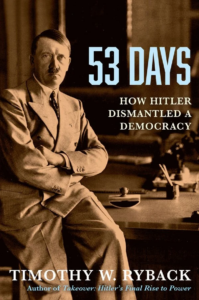
53 Days: How Hitler Dismantled a Democracy by Timothy Ryback is available from Atlantic Monthly Press, an imprint of Grove Atlantic.

Timothy Ryback
Timothy W. Ryback is director of the Institute for Historical Justice and Reconciliation in The Hague. He has written on the legacies of national socialism for The Atlantic, The New Yorker, The New York Times, and The Wall Street Journal. His books on Hitler, most recently Takeover: Hitler’s Final Rise to Power, have been translated into more than 30 languages. He and his wife live in Europe.