How My Mother Made Magic Happen
Perdita Finn Remembers a Childhood of Spectacular Halloween Costumes
My mother could make me anything I wanted to be. As a child she transformed me into a swan, a mermaid, a white Persian cat dressed like an elegant Victorian lady with a porkpie hat and a ruffled bustle to accentuate my tail. She’d trained as a costume designer. At a time when most of the women from her milieu were headed to the Seven Sisters to study French or literature and get a ring on their finger, she was painting nudes at the Art Students League, sleeping with handsome men poised to become actual Hollywood legends, and earning herself a spot at the Yale School of Drama’s design program even though she didn’t have a bachelor’s degree. She could create worlds from paint and cardboard and cloth. Edith Head, who would go on to win countless Oscars for her costumes, wanted my mother to come out to LA and make movies with her. Her teachers wanted her to stay at Yale and teach. Sondheim wanted her in New York on Broadway. Everyone wanted her—but she only had eyes for my father, a handsome Boston doctor with a rough edge and an eye for beautiful things. She imagined she could make a whole different kind of world with him.
By the time I was born—her late, last child—she was living in a small New England town, volunteering with the Garden Club and the League of Women Voters. She no longer commuted to Harvard to design the Hasty Pudding Show for cross-dressing undergrads or to teach the history of fashion at Emerson College. The days of putting on medieval festivals with famous poets in Cambridge were behind her—as were, she hoped, my father’s dalliances with yet another pretty wife of a famous professor.
Our home became her stage, a fantastical world where she coaxed orange and fig trees to bear fruit in our kitchen, where iguanas and boa constrictors wandered among primordial ferns in our living room, where cats were always giving birth in some upstairs closet, and the walls were decorated with giant abstract nudes tangled in ecstasy. The cupboards overflowed with cloth, ribbons, threads, paints, dyes, and watercolors. Everything you needed to make anything was readily available—everywhere you looked something was becoming something else.
But my mother’s great yearly project was my Halloween costume. All of her prodigious talent went into ensuring that I would win best in show at the town parade. “What do you want to be this year?” she would ask me some drowsy summer day out in the garden, daring me to challenge her formidable skills. Sometimes she’d hand me a sketch pad, a box of colored pencils, some pastels, and tell me to draw something that she could make. Sometimes she’d send me inside to browse through her art books and her volumes on the history of costume or the picture books that filled the shelves. But mostly she asked in a slightly disinterested way and went back to whatever she was doing—mulching roses, yanking up weeds, or squishing beetles and slugs between her fingers.
Pots simmered on the stove with paella, fruit rotted in bowls next to the junk mail, and the pantry was full of old rusted cans of strange unearthly edibles—bamboo shoots and snails in sauce and lemons floating in brine. She often muttered under her breath while she worked in a strange, dissatisfied hiss, like she was the snake she had bought for my brother and often wore around her neck until it grew so large the neighbors complained and he had to be given away to a zoo.
To encourage my feats of imagination she read me books about magic: Edith Nesbit, C.S. Lewis, Edward Eager.
Children in these stories, left to their own devices, talked to the animals and the trees, time traveled, made wishes, got into no end of trouble, and eventually arrived back from their enchanted adventures with the resources they needed to fix the miseries of their mixed-up parents who no longer had access to realms of miracles and enchantment. I got the message.
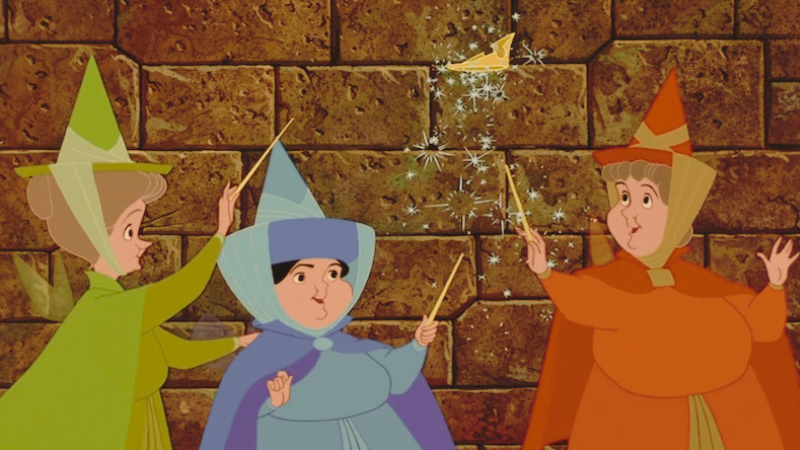
Perhaps that is why, in third grade, I asked my mother to turn me into the blue fairy from Sleeping Beauty. I didn’t want to be the princess. A pretty dress, a jeweled headband—how ordinary and uninspired and boring. No, at ten years old I wanted to be the rotund middle-aged wimple-wearing godmother who waves her wand and keeps the princess safe from the grownups. I didn’t want the magic to happen to me: I wanted to make the magic happen. I wanted a wand. I wanted power. I didn’t want to be a pretty little princess girl. I wanted to be a spell-casting force of a woman. I wanted to be my mother.
My mother never acknowledged any of this. Whatever I wanted, she made. There was no discussion or analysis or judgment. She did some sketches, cut out some patterns from old newspapers, and put me in the car to take me to the fabric warehouses outside Boston. As usual, I was left to my own devices, walking among bolts of cloth and aisles of color, running my hands along velvets and brocades, pressing my cheek against the satins and the silks. Each piece of fabric was a woven world from which other worlds could be created and stepped into. I became fascinated by weaving and embroidery, how threads went back and forth from one side to another, how a single thread entangled itself with so many other threads to make cloth, which could be sewn to other cloth and become something wondrous.
I was not my mother’s apprentice in any of this. I was not expected to do any cutting or sewing. From time to time she put me on a stool in the kitchen to fit a skirt or a sleeve, instructing me not to wiggle or talk. She took her work very seriously and didn’t want distractions. I daydreamed, lost in fantasies that arrived as fully formed visions of places and people beyond my ken. I began filling spiral notebooks with stories and created puppet plays that I put on for my bored classmates. More strangely, I would find myself standing somewhere—a stone archway on a family trip or a mountain field filled with azure butterflies—and know that I had already been there in my reveries.
“Keep still,” my mother muttered, pins in her mouth. She was negotiating the frame for the headdress that I would wear as the blue fairy. The same as in the cartoon movie, it was enormous, almost bigger than my body. It was also heavy and uncomfortable, but I didn’t let my mother know that. I accepted whatever needed to happen for her to transform me.
I wanted to make the magic happen. I wanted a wand. I wanted power. I didn’t want to be a pretty little princess girl. I wanted to be a spell-casting force of a woman. I wanted to be my mother.
On Halloween my best friend was dressed as a tree, a branch cut from her family’s backyard taped to her back, and I waddled down the street, barely able to move with all my heavy petticoats and balancing the enormous, pointed headdress tied under my chin. Later that night, walking down a dark street after stopping by the house of the old lady who always gave out hot doughnuts and apple cider, we ran into a crowd of egg-throwing teenage boys. Squealing, we raced toward home, running so fast we thought we might fly. Maybe we did. Maybe the wire wings covered in blue gauze strapped to my back could lift me into the air. It clearly wasn’t beyond my mother. She could do anything, couldn’t she? Had my mother arranged these dragons to meet the fairy on our path? I would not have put it past her, but of course, I never asked. I knew even then that for the magic to work it could not be discussed, explained, revealed.
When I finally got home, my mother was lying in bed, a mystery novel half open in her lap, a glass of bourbon on her bedside table next to the vial of Valium. She didn’t ask me about who had the best candy bars or what houses we had visited. She didn’t even ask me what anyone had thought, myself included, about my costume. I’d won best in show, and the event was over for the year. The winter stretched before us with dinner parties to host, movies to go to, and fights to be had with my father about this and that.
So many women like my mother channeled their creative impulses into conventional mediums. They hid their magic in small needlepoint pillows or stitched their spells into quilts. They warbled songs to ease the drudgery of housecleaning and tuned their voices to the sleepy-time cries of their tired children. They told stories that were passed down in families for generations. The author Virginia Woolf wrote a famous speculative essay about Shakespeare’s sister Judith—a young woman with all of his talent and none of his opportunities who ended her frustrated life by suicide in a roadside ditch. Gammy, my father’s mother, once told me toward the very end of her life that she had dreamed of running away with a group of traveling players and becoming an actress as a teenager. Instead, she married, raised six children, tended to her numerous grandchildren, and went to mass.
In her eighth decade she took a painting class, accompanied by her unmarried sister, and perhaps, at last, began to dream again of a world that might have been. I have one of her simple oil paintings of a seaside shack at the edge of a marsh. What was it to her—a pretty place or a different life? As for my other grandmother, a depressed and defeated Englishwoman, her only work of art seems to have been my mother—whom she encouraged at seventeen to lie about her age and join the Federal Theatre Project, whose art classes she arranged, whose application to Yale she encouraged. Just like the roses she coaxed into bloom, she nurtured my mother over the years, only to see her settle into a slightly more vibrant replica of her own exhausting housewifery—the clubs, the gardens, the dinner parties.
Nor is it just women who must sacrifice their creativity on the altar of industry and production. My father, the eldest son of an immigrant, felt compelled to go to medical school and become a doctor even though he had spent his undergraduate years under the mentorship of a famous poet. He told himself he would find a way to keep writing but never did. Instead he grew more and more bitter with the passing years. One Easter as we sat around the kitchen table decorating eggs, my mother grew bored and decided to paint my father instead. She had him strip to his shorts and covered him in elaborate spirals and foliage until he was no longer himself but the Green Man, that mythic figure of life and renewal, returned. He, in turn, began to decorate her with a crown of flowers and leaves as if she were his queen. By the end of the evening they had transformed each other, stepping out of ordinary misery and back into the revelries of a people long since gone from the world.
*
The last Halloween costume my mother made for me was Anne Boleyn. On Sunday nights when I was in elementary school we would go over to sit with our ancient neighbors and watch Masterpiece Theater on their color television. That fall they were showing The Six Wives of Henry VIII, and I became entranced by the story of the king’s second wife, who had her head cut off because she was a witch. Did she seduce the king and destroy a country, or was she a woman trapped in a role she did not want and could not escape? I read every book I could about her while my mother refashioned the blue fairy’s petticoats and designed a regal Tudor garment lined in fake fur with heavy sleeves, green satin, and black velvet. I was just beginning to have breasts and the tight corset flattened my chest and pushed my nipples against my bones.
That was the last year I walked in the parade, the last year I won. After that it was all sexy kittens with cute ears and sexy witches in low-cut shirts that might attract the attention of the high school boy who had become the subject of all my fantasies, the only prize I wanted anymore, not even realizing the warning I had given to myself ahead of time about what happened to girls who became too attractive and thought they might wear the crown.
So many women like my mother channeled their creative impulses into conventional mediums. They hid their magic in small needlepoint pillows or stitched their spells into quilts.
To her credit, my mother didn’t miss a beat. If I wanted to be a desirable teenage girl, that is what she would help me become. She took me on shopping trips, arranged makeup lessons, a perm, a subscription to Seventeen magazine, but it was all a losing proposition. Easy, boring, dull. She threw herself into politics, spending hours on the telephone raising money, getting out the vote, and helping the first openly gay candidate get elected to Congress. She redesigned the living room with bamboo wallpaper, which our pride of cats instantly shredded. She cooked mousses and quenelles and ever more demanding delicacies that filled the fridge. She gardened obsessively, creating walls of roses that surrounded our home with blossoms and fragrance. She woke up at dawn and went out in the early morning to mutter strange spells to them that seemed to bring each exotic hybrid into flower.
“What’s your secret?”
She looked at me, as she studied one of the rosebushes climbing up the side of our house, typically distracted, vaguely appalled. “I just put them where they like to be.” She pulled a beetle off a leaf and squished it between her fingers.
“But how do you know where they like to be?”
She turned to me, an expression of disdain on her face that withered my soul. Somehow I’d missed the transmission. I might speak fluent house cat, with a smattering of inbred golden retriever, but I didn’t know how to talk to plants. My mother couldn’t believe it: her own daughter had no idea what the plants were saying.
She would not teach me how to do this. She would offer no instruction. I don’t think she even dared acknowledge what a witch she was. But that was the day I began listening and realizing that all beings were speaking to each other, just not necessarily with words we knew or languages we could study. We could only grow quiet, immerse ourselves in their presence, and begin to accept their guidance.
I wanted to ask her who she was and if she had been planted in the right place, somehow, after all. But I never did. She interrupted my reveries.
“When I die,” she said, “feed me to my roses. Ashes are heavy. Do something useful with mine. Turn me into mulch.”
That moment was a long way away, and when the time came to put her in the ground, her rose gardens were all gone—sold with the house, abandoned by the new owners, forgotten even by her. But I grew because her body had been the mulch for my life, a life of magic where anything could become anything and we could all become who we already are.
____________________________________
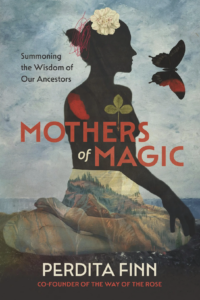
Excerpted from Mothers of Magic by Perdita Finn. Used with the permission of the publisher, Running Press. Copyright © 2026.

Perdita Finn
Perdita Finn is the co-founder, with her husband Clark Strand, of the non-denominational international fellowship The Way of the Rose, which inspired their book The Way of the Rose: The Radical Path of the Divine Feminine Hidden in the Rosary. In addition to extensive study with Zen masters, priests, rabbis, shamans, and healers, she apprenticed with the psychic Susan Saxman, with whom she wrote The Reluctant Psychic. Finn now teaches popular workshops on “Mothers of Magic”, in which she helps students explore how to draw on our Ancestral Mothers for help and healing–of ourselves and our planet. She is the author of Take Back the Magic (Running Press, 2023), and lives with her family in the moss-filled shadows of the Catskill Mountains.