How I Found Myself—and My Next Setting—at the Beach
Angela Brown on Returning to a Beloved Vacation Spot in Her Most Recent Novel
“I kissed a boy on that bench.”
I pointed out the car window and told my eight-year-old daughter this information. The bench sat outside what was currently a breakfast spot, but years ago was a tchotchke store, and at some point in-between a yoga studio. One look and I tumbled backwards in time. The feel of crushed shells under my feet. The smell of baby oil on my skin.
“I was a teenager, by the way.” I smirked at my husband beside me, then checked on my infant son in his car seat. Time sped up. In an instant, the bench was gone—as was an entire era. Suddenly, I was in my forties again. “Don’t get any funny ideas.”
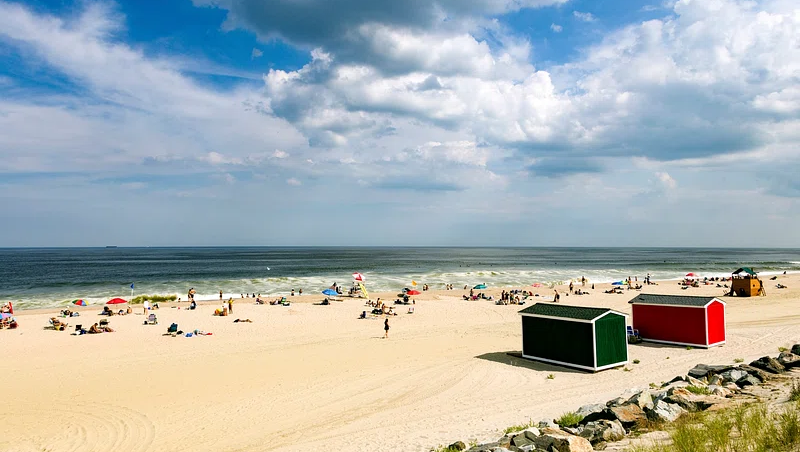
It was a Saturday in mid-spring, and our family cruised down the boulevard of a small barrier island off the coast of New Jersey. To the left, we saw the ocean. To the right, the silver bay winked at us with each new block we passed. As a kid, I used to imagine standing at the island’s center, stretching my arms out like bird’s wings, and feeling water on both sides.
Maybe I’d subconsciously convinced myself the beach wasn’t a serious enough landscape for the narrative I hoped to tell. Or maybe I’d never acknowledged how much certain places can come to mean.
“How old were you when you first came here?” my daughter asked, her chin propped on the edge of the open window frame. She’d recently completed a family tree project at school and had become interested in hearing about everyone’s personal histories. “Were you a baby or my age?”
I knew her inaugural visit was at six months old. I wore a blue-and-white striped rash guard all week because my postpartum skin was still sensitive to the sun. One evening, I strapped her into a chest carrier, and we fell asleep in a beach chair at the edge of a shallow tide pool—only to be woken up an hour later by strangers. The tides had shifted, nearly stranding us.
“I don’t remember,” I admitted. The setting had simply always been part of my life, pieces of it stretching into every corner of my mind like taffy. “It was a long time ago.”
It was typical, now, for our family to occasionally make the two-hour drive to the island in the off-season. A bowl of hot chowder on a crisp autumn afternoon. A frigid winter walk on the dunes, hoping to air ourselves out of our ailments like Victorians. On that particular day, the reason we’d visited was me. I desperately needed a chance to clear my head and a change of scenery.
Weeks prior, I’d met my agent for breakfast at a lovely spot in Manhattan. My debut novel had been released a few months earlier, I’d recently submitted edits for my sophomore book, and so it was time for us to brainstorm what came next.
“Have you ever thought about what it’d be like to meet younger versions of yourself?” I asked, unsure how the idea would land. “I’d like to create a protagonist who experiences that.”
As a deeply nostalgic person, I’m often guilty of looking backward. However, I’d been thinking about the past even more than usual thanks to a particular age-old question I kept getting asked at book events: What advice would you give your younger self?
Prior to my debut, I’d never considered it, at least not in any significant way. Lately, I couldn’t stop thinking about it. What would I say to my younger selves? But more, I wondered what a future version—one who existed ten or twenty years down the line—might say to me.
“I like it,” my agent said. “Do you have a setting in mind that’d make sense?”
Reader: I did not.
After our meal, I walked aimlessly through the city, hoping I’d trip and fall into a big pile of inspiration. Instead, I realized my agent had a point. I had a concept, but no real architecture to hold it up. Even magical realism has rules and at least a suggestion of logic. In order to work, the story required a setting in which I could rationalize having all of a character’s former selves be present.
Every location I considered—New York! A college campus! A childhood home! —came equipped with a giant plot hole. People—and protagonists—are transient. They grow up, move on, spend decades bouncing from place to place. Rarely does one dedicate an entire lifetime to the same coordinates.
For the next week, I holed up in my office, dramatically tossing balled-up sheets of paper on the ground. By the time I could no longer see the floor tiles, I knew I’d hit a wall. The story wasn’t working. The setting required to properly execute it simply did not exist. I needed a break—and possibly some fried food and ice cream. The next morning, the four of us piled into the car.
As our day at the beach progressed and my daughter continued to interview me, the answer became maddeningly obvious. I don’t know why it hadn’t occurred to me earlier. Maybe I’d subconsciously convinced myself the beach wasn’t a serious enough landscape for the narrative I hoped to tell. Or maybe I’d never acknowledged how much certain places can come to mean.
Whatever the reason, the rest of the day, ghosts of my former selves appeared around every sandy corner. The twelve-year-old buying perfume oil at a surf shop. The sixteen-year-old longboarding with a broken heart. The twenty-two-year-old drinking pink cocktails at a waterfront bar. The twenty-eight-year-old watching in disbelief as she received a diamond ring at sunrise. The thirty-something sobbing on the shoreline over another lost pregnancy.
And now this version: the one who still, decades later, ran back here to catch her breath.
It wasn’t the sound of waves or the feel of cool sand that had long brought me back there. It was because the island felt like a homecoming.
In my third novel, Ways to Find Yourself, the setting—a fictional barrier island off the East Coast—comes to serve as more than a pretty backdrop. It’s the place my protagonist revisits after losing everything—her mother, her marriage, her career—hoping to find her way again. However, upon her arrival, what she discovers are past versions of herself, all there to remind her of where she’s been and to help her discover a path forward.
Without realizing it, that’s what my daughter had done for me. Slowly, as our seaside afternoon unfolded, I understood it wasn’t the sound of waves or the feel of cool sand that had long brought me back there. It was because the island felt like a homecoming. A place that I’d been and yet always returned to. Somewhere that never changed, even as I did. A setting where, despite the passing of years, I somehow always managed to fit.
“Do you have any more stories?” my daughter asked later as we headed back toward the bridge and home.
Through the windows, the water shimmered. For a beat, I pictured myself reaching out and touching it, just like I loved to imagine when I was her age.
“Plenty,” I told her as we crossed the causeway, the story I’d struggled to conceptualize finally taking shape in my mind. “I’ll tell you more of them this summer when we come back.”
Because we would.
I would.
Just like I always did.
__________________________________

Ways to Find Yourself by Angela Brown is available from Little A.

Angela Brown
Angela Brown is the author of Some Other Time and Olivia Strauss Is Running Out of Time. In addition to her novels, Angela’s writing has appeared in Oprah Daily, The New York Times, Real Simple, and other publications. She holds an MFA from Fairleigh Dickinson University. Angela lives in New Jersey with her husband and two children. For more information, visit www.angelabrownbooks.com.