How Donald Trump and His Allies Seek to Remake American Schools in Their Own Image
Alison Kinney on the Effects of the Current Right-Wing Rejection of Educational Equity
Trump announced the 1776 Commission in 2020 to promote “patriotic education,” identifying critical race theory as “a Marxist doctrine holding that America is a wicked and racist nation, that even young children are complicit in oppression, and that our entire society must be radically transformed… a form of child abuse in the truest sense of those words.” He’d joined a generations-long war rejecting equity in schools, whether that’s meant subsidized meals, inclusive curricula, access and admission after de facto segregation, teachers’ pay, or the protection of children’s health, safety, and gender expression—not to mention the rejection of all but the weakest gun laws. It’s like kids weren’t already having a hard-enough time being rejected from kickball, cliques, sports teams, prom, and the school musical. Some rejections you can try to overcome with study and a resilient attitude. Some require lobbyists, lawyers, and politicians in your court.
One skirmish occurred in May 2021, when members of Moms for Liberty (M4L) began to target school board meetings in Williamson County, Tennessee. M4L, which calls itself a “grassroots organization of Moms” and self-reports a nationwide membership of 130,000, has targeted more than a thousand school board elections and collaborated on “Don’t Say Gay” legislation in Florida and Alabama. The Southern Poverty Law Center has flagged M4L for its tweet calling gender dysphoria “a mental health disorder that is being normalized by predators across the USA.” M4L also has ties with the Proud Boys and once published a newsletter quoting Hitler: “He alone, who OWNS the youth, GAINS the future.”
School is where some students learn that mercilessly rejecting others is not only permissible but also necessary, to eliminate competition.
In Williamson County the local M4L chapter, led by Robin Steenman, who had no kids in the public schools, protested Wit and Wisdom, a newly adopted curriculum used in states from Louisiana to Massachusetts. A parent had complained that some of the “depressing” second-grade books had damaged her son’s “childhood innocence” and the “no color” bubble in which she’d raised him. Those books were Ruby Bridges Goes to School and The Story of Ruby Bridges, two picture books for children just a bit older than Bridges had been when, in 1960, she became one of the first Black children to enroll in an all-white public elementary school in the South.
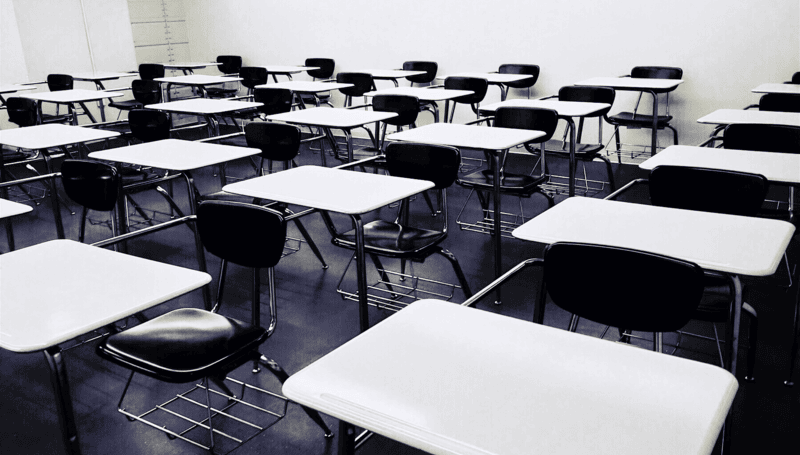
When Bridges started school, she sat amid rows of empty desks, taught by a single white teacher, and wondered where all the other children were. White parents had withdrawn every other child from the school. Each day a mob congregated outside to spit on Bridges; shout slurs and death threats; sing, “Glory, glory segregation, the South will rise again”; and brandish a Black baby doll in a child-sized coffin. Bridges had nightmares about that coffin. Federal marshals escorted her to and from school and checked her lunch in case white rioters had tampered with it.
Meanwhile, her parents lost their jobs; her grandparents, who were sharecroppers, were forced off the land; and the grocery store refused to serve her family. Although her family, community, and teacher tried to shield Bridges from the worst impacts of the experience, it was after white students trickled back into the school that one of them dealt her a devastating rejection. “The light dawned one day when a little boy refused to play with me. ‘I can’t play with you,’ the boy said. ‘My mama said not to because you’re a [N-word].’ At that moment, it all made sense to me….It was all about the color of my skin. I wasn’t angry at the boy, because I understood. His mother had told him not to play with me, and he was obeying her. I would have done the same thing. If my mama said not to do something, I didn’t do it.”
That rejection story appears in Bridges’s memoir for older students, Through My Eyes, not in the picture books. The picture books contain only a few images of the white supremacist mob looking incredibly mild—not spitting, not with N-word placards or the coffin. There are pictures of Bridges’s white teacher, Barbara Henry, and the smiling white children she finally played with.
But it wasn’t objective perusal of the picture books that caused one parent to claim that “they taught hate first.” M4L objected to the vocabulary words “injustice,” “inequality,” “protest,” “marching,” and “segregation” and criticized the books for portraying a “large crowd of angry white people who didn’t want Black children in a white school” and supposedly not offering “redemption.” Which is cute, because, meanwhile, an M4L protester (also with no children in the public schools) attacked a school board member in a parking lot, screaming about pedophilia, masturbation, and his rage that his daughter “comes home and her best friend is Black.” M4L protesters harassed an Asian parent whose kids were suffering from racism at school; in fact, a local psychologist said, “I’m yet to see a child in my practice who’s been traumatized by our county’s curriculum choices.
I have, however, seen many students experiencing trauma due to being discriminated against and bullied within our schools, related to race, religion, gender, and sexuality.” Although M4L tried to take over the Williamson County School Board in 2022, most of their candidates lost. Wit and Wisdom remains the district’s curriculum and the books by and about Bridges remain on the reading list, as of this writing. Yet M4L is still going strong elsewhere.
Education can be one of our greatest tools for generating achievement, personal stability, and the freedom to pursue happiness. We also learn that education is the most powerful leveler of playing fields and the primary solution for inequity, although schools belong to larger, inequitable systems that determine who receives a good education and who’s rejected from educational opportunity. Amid these contradictions, many people want to believe in the magical powers of education to advance themselves and their children.
Many other people reject formal education (for other people, though usually not for their own kids) as unnecessary to attaining the highest ranks of wealth and power. We’re taught to revere the example of Lincoln, growing up in an Indiana backwoods log cabin and cobbling together a year of “defective” schooling to book-strap his way to the White House. “I could read, write, and cipher to the Rule of Three; but that was all. I have not been to school since. The little advance I now have upon this store of education, I have picked up from time to time under the pressure of necessity.” But are we worshipping the power of the little education he got, or his drive to complete his education on his own? Or lauding his attainment of the nation’s highest office without much schooling at all? Or are we denigrating formal education? Do we learn from this to accept or to reject others from opportunities?
(In the 1980s the Native Alaskan First Scout Battalion of the Alaska National Guard tracked Soviet reconnaissance flights and monitored military installations—in winter, at temperatures of sixty below zero Fahrenheit, hunting their own food and building traditional shelters as they snowmobiled vast expanses of northern and western Alaska. They had few Native Alaskan officers, because the National Guard required officers to have sixty credit hours of college. Candidates among the troops were rejected for lacking the right kind of education, which wasn’t the kind that caused scouts to excel at a highly skilled, dangerous job that nobody else could do. Sometimes it feels like the nation’s supposed reverence for self-taught and nontraditional learning applies only to white tech millionaires who skipped college.)
In 2025 the Supreme Court ruled that parents could remove their children from classrooms using LGBTQ-themed books and that Trump could functionally dismantle the entire Department of Education. Trump had claimed his vision of “patriotic” education “would provide children and their families the opportunity to escape a system that is failing them.” But would it? In the absence of educational equity, the “I think I can” of education can dissipate, like the worst kind of self-help, into empty promises, or become something even worse.
*
Educational rejections are coming on too hard and fast to keep up with—the revocations of federal funding for universities, the legal and physical assaults on international students exercising freedom of speech, the targeting of anybody and anything associated with equity or inclusion or diversity, the slashing of financial aid while new ICE recruits are being promised student loan forgiveness—alongside few cheering glimmers of resistance (the front-page news that Harvard “Won’t Obey U.S. Demands”: “it had rejected policy changes requested by the Trump administration”). All these rejections have origins in the historical flaws and faults of our nation’s history and our systems of education. Sometimes the ways we educate and have been educated are broken; sometimes they’re strong yet cannot prevail against onslaughts of violence.
If U.S. higher education were free (as it once was in some systems!) and universal, then millions more people would gain that opportunity to turn their dreams into realities. But college is expensive for all but the most privileged students, and varying degrees of fraught for almost everybody. The admissions process alone is expensive and often more exclusionary than inclusionary. Sometimes a scarcity mindset convinces us that we can achieve only by eliminating our competition rather than by tackling the systems that seek to exclude us all. This all reached a destructive level of perversity in 2023, when the Supreme Court struck down race-based affirmative action in college admissions. The plaintiffs, Students for Fair Admissions, had sued Harvard and the University of North Carolina for, allegedly, deploying affirmative action in ways that discriminated against their applications.
Some of the plaintiffs were Asian American students. Asian American communities had been documenting anti-Asian bias in admissions, for decades, at multiple institutions of higher education. At Harvard the admissions committee had been systemically rejecting Asian American applicants, who surpassed white applicants in academics and extracurriculars, by rating them “busy and bright” and “standard strong”–meaning collegiate yet lacking that Harvard je ne sais quoi. Asian American students were categorically rejected as silent, uncharismatic, charmless grinds without “courage,” “openness to new ideas and people,” or “effervescence.”
But the 2023 decision promulgated the racist myth that the plaintiffs had been rejected in favor of less qualified Black and Brown applicants. In fact, the plaintiffs’ rejections appear to have sprung not from affirmative action (which seeks to admit qualified applicants from historically marginalized U.S. communities, including Asian American groups, and mostly benefits white women) but from straightforward white supremacy and elitism, from which less qualified white students had benefited. Harvard admissions overwhelmingly favored white legacy students, affluent white students, and white students from geographically underrepresented states like North Dakota, who were not subjected to racist, demeaning evaluations, no matter how comparatively underqualified (or noneffervescent) some might have been. Harvard’s acceptances of Black and Brown students were tendered largely to those belonging to privileged international communities, while many worthy Black and Brown applicants from communities that had survived U.S. enslavement, segregation, and other forms of systemic exclusion were also rejected. One might argue that the problem with Harvard admissions wasn’t affirmative action at all, but the lack of it.
At its best, education is a means to freedom, power, and reimagining the possibilities for your life, all of which are the opposite of rejection.
The plaintiffs blamed affirmative action anyway. Their outrage about the legitimate discrimination they’d experienced should have been used to address white supremacy in admissions, not as an insidious divide-and-conquer strategy against imaginary Black and Brown foes, dismantling institutions and policies crucial to all our communities. As Janelle Wong and Viet Thanh Nguyen wrote, “Opportunities are treated as a zero-sum game, divided between a few haves and many have-nots. The lawsuit against Harvard exploits this fear and uses Asian Americans as an argument against affirmative action and against Black, Latino and Indigenous students, rather than drawing attention to the systemic problem of a society that allocates more and more resources to the already advantaged.”
While some plaintiffs who took the bait may have been only grossly ignorant, certainly some were guilty of bad faith, anti-Blackness, and opportunistic collaboration with white supremacy. Led by conservative activist Ed Blum–who’d backed Shelby County v. Holder, which gutted key protections of the Voting Rights Act in 2013, and the previous anti-affirmative action suit Fisher v. University of Texas at Austin (whose plaintiff was deliciously dubbed #BeckyWithTheBadGrades by Lavinia M’Bala)–they helped Blum finally dismantle one of the most important social justice policies in education.
We should learn to do better than that. So should Harvard.
School is where some students learn that mercilessly rejecting others is not only permissible but also necessary, to eliminate competition. School is where some learn to expect rejection by peers, teachers, and bureaucracies–and others don’t. (In 2004 the nephew of George W. Bush appointee Carl Truscott, director of the Bureau of Alcohol, Tobacco, Firearms and Explosives, benefited from his uncle’s allocation of resources, including twenty ATF employees, to assist him with a high school project. He received an A.) Some students, excluded and excluding, learn that rejection is natural and necessary to toughen them up for the so-called real world; others already know that world’s brutality only too well. (In 2015 undocumented Michigan teenagers enrolled in what turned out to be a fake university created by ICE to entrap and arrest them. Lately you can get seized from any college, or K-12 school, targeted by ICE.)
Our beliefs about rejection are inflicted and reinforced so early that sometimes we forget that we were taught to think that way. Even so, “human nature” is not as fixed as we might teach children it is. Rejections don’t exist in vacuums; the devastating, face-to-face playground rejection of a little Black child by a white child in 1961 New Orleans was taught by adults. But acceptance doesn’t exist in vacuums either: Any child can learn to accept and befriend others, love, teach, and change the world. Perhaps that’s why so many forces are arrayed against schools: to control our power to learn, thrive, and create better outcomes for all. At any age we can learn better, if only we first learn that it’s possible. At its best, education is a means to freedom, power, and reimagining the possibilities for your life, all of which are the opposite of rejection.
____________________________
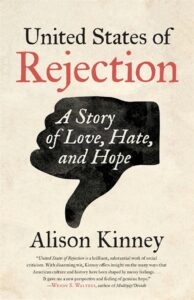
From United States of Rejection: A Story of Love, Hate, and Hope by Alison Kinney. Copyright © 2026. Available from University of Georgia Press.

Alison Kinney
Alison Kinney is the author of United States of Rejection: A Story of Love, Hate, and Hope and two previous books of nonfiction, Hood and Avidly Reads Opera. She’s contributed previously to Literary Hub and to the New Yorker, the New York Times, the Paris Review Daily, and Lapham’s Quarterly. She is an assistant professor at Eugene Lang College, The New School.