How Diet Culture Ruins Lives
Geneen Roth on Learning to Live With (and Love) Her Own Body
“It’s called a diet,” my mother said. “Beginning tomorrow, you will cut out one piece of bread a day. And no more Good Humor Creamsicles or Chips Ahoy! cookies. You’re getting fat.” Age eleven.
Started sucking in my stomach and checking to see how flat it was every day when I got out of bed. Age eleven (still).
Started throwing up to get rid of unwanted food. Age twelve.
Started drinking a gallon of No-Cal diet soda a day for ten years. Age thirteen.
Took hot steamy baths and ate spinach, hard-boiled eggs, and grapefruit for three days before my next physical so that Dr. Modlin wouldn’t yell at me for being fat. Age fourteen.
Limited my daily intake to three prunes, two meatballs, and a six-ounce jar of Mott’s raspberry no-sugar-added applesauce for a month. Age fourteen.
We torture ourselves with food so that one day we will (lose weight and) be able to stop torturing ourselves with food.
Began taking amphetamines (diet pills), twice a day, for four years. Age fifteen.
Ate only hard-boiled eggs for breakfast, lunch, and dinner for two months. Age fifteen.
Took tetracycline, an antibiotic, for a year to get rid of five pimples on my face. Age fifteen.
Consulted with a plastic surgeon about straightening my already-straight nose. Age fifteen.
Ate one hot fudge sundae a day and nothing else for one month. Age sixteen.
Consumed multiple squares of chocolate-flavored Ex-Lax whenever I ate too much. Age sixteen.
Spent three weeks on a self-created all-brown diet (coffee, cigarettes, Shasta Diet Creme Soda). Age nineteen.
Followed the fried chicken diet (only fried chicken, three meals a day); my lanky boyfriend joined me. He lost twenty pounds. I gained ten. Age nineteen.
Spent a month on the all-sugar diet. Age twenty.
Went on the Atkins diet. For five months, ate a pound of turkey with ketchup for breakfast, a scoop of cold ricotta cheese with cold tomato sauce for lunch, a pound of roast beef with ketchup for dinner. Age twenty-one.
Fasted on water for ten days at every change of the season. Age twenty-two.
Fasted on lemon juice, cayenne, and maple syrup for three weeks. Age twenty-three.
Discovered health food stores: granola and yogurt clusters with pistachios. After weighing eighty-eight pounds for a year and a half, gained eighty pounds in two months eating health food. Age twenty-three.
Fasted on beet, carrot, and celery juice for a month. Schlepped it onto a plane, where I spilled it on my white pants, the seats, the trays, and my best friend’s shirt. Age twenty-four.
Read Survival into the 21st Century. Decided to become a breatharian (someone who eats light and drinks air instead of food). Limited my daily intake to a handful of cashews and an apple. Lost fifty pounds in two months. Weighed eighty-eight pounds. Age twenty-four.
Became suicidal when I was fatter than I’d ever been and realized that I’d been on a diet or a binge every day for sixteen years. Age twenty-seven.
Read a few chapters of Fat Is a Feminist Issue while researching ways to kill myself in a bookstore and realized that I’d been using food for good reasons, even though I didn’t yet know what they were. Age twenty-eight.
Ate raw chocolate chip cookie dough for two weeks when I stopped dieting. Switched to pumpkin ice cream after that. Age twenty-eight.
Became a vegetarian because I didn’t want to eat anything that had a mother (but the real reason was that I wanted to lose weight). Age twenty-nine.
Became a vegan because I didn’t want to eat anything that came from an animal with eyes (also, to lose weight). Age thirty.
Ate pounds of oat bran when those who knew said it was good. Stopped eating oat bran when those who knew said it wasn’t. Ate margarine when those who knew said it was healthy. Stopped eating margarine when those who knew said it caused cancer. Age thirty to thirty-five.
Started eating meat when my doctor told me I was tired and weak from not eating enough protein. Age forty-three.
Diagnosed with osteoporosis from what the doctor said was due to a lack of childhood nutrition. Age forty-three.
Ran up and down 150 steps ten times each day for eight years until a masturbating man greeted me at the top. Age forty-five.
Broke two vertebrae from jumping on a trampoline. Age sixty.
Discovered two additional compression fractures in my spine during a DEXA scan. Age sixty-five.
Dropped sugar, alcohol, grains, and processed food. Lost twenty pounds almost immediately. Weighed 102 pounds. Age sixty-six.
Did intermittent fasting for eighteen hours a day when my doctor told me that it would prevent Alzheimer’s and decrease inflammation, which contributes to osteoporosis. Age sixty-seven.
Ceased intermittent fasting after three years because the doctor said it was decreasing bone and muscle mass. She also said I would end up in a wheelchair if I didn’t take immune modulator shots, which might make my teeth fall out but probably wouldn’t. Age sixty-nine.
It occurred to me that I treated my body like a wild animal that could be starved or force-fed or shamed according to my whims, which changed with every passing fad.
Realized I’d been sucking in my stomach for decades, which I’ve now learned leads to 30 percent less oxygen capacity, back and neck problems, and urine leakage while laughing, coughing, or sneezing. Age seventy.
I hear versions of the Body Project from every woman. They tell me about the cotton ball diet, the baby food diet, the all-white diet. They describe banging their hips against walls to make them narrower. Squeezing their thighs into pants that are too tight to compress the cellulite. Taking multiple hot baths a day while eating only spinach and hard-boiled eggs. Anything to be thin. Just as I have, they inflict drastic measures upon their bodies to be lovable because, like me, they believe that having a thinner body will get them closer to love and being at peace.
Pleasure with or from food is never a consideration; we do what we have to do so that one day we will be able to stop doing it. We torture ourselves with food so that one day we will (lose weight and) be able to stop torturing ourselves with food.
If the cost of being thin—which translates to being beautiful, which translates to being loved, which translates to relaxing the meanness and self-rejection with which we treat ourselves—sickens this body, we are willing to pay it.
As I wrote this list, it occurred to me that I treated my body like a wild animal that could be starved or force-fed or shamed according to my whims, which changed with every passing fad.
If I punished and shamed and yelled at my dog, Izzy, the way I punished and shamed and yelled at my body, I would get arrested for animal abuse.
If I treated my body the way I treat Izzy, I would croon at it. I would notice when it was tired and needed rest. I would speak to it kindly when it was sick or hurt. And I would stop confusing my body with all of me. There is so much more to us humans than the physical selves on which we hang our identities.
Despite the ways I’ve knocked my body around, my heart still beats. My lungs still breathe. My legs still walk. My body is still here, giving me chance after chance to treat it as my beloved pet.
__________________________________
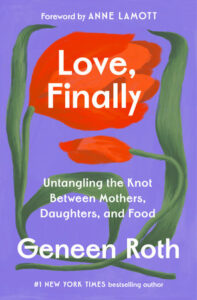
From Love Finally: Untangling the Knot Between Mothers, Daughters, and Food by Geneen Roth. Copyright © 2026 by Geneen Roth. Used by permission of The Dial Press, an imprint of Random House, a division of Penguin Random House LLC, New York. All rights reserved. Cannot be reproduced or reprinted without permission in writing from the publisher.

Geneen Roth
For over forty years, Geneen Roth has worked with thousands of people, helping them transform difficult relationships with food and their body. One of the originators of the intuitive eating movement, her pioneering approach uses food and eating as a doorway to spirituality (and to uncovering our deepest beliefs about being alive) and deeply personal and spiritual issues such as forgiveness and trust in the unseen that go far beyond food, weight and body image. Geneen is the author of ten books, including her newest, This Messy Magnificent Life, and NYT bestsellers Women Food and God, Lost and Found and When Food Is Love. Geneen has appeared on: Super Soul Sunday, The Oprah Show, 20/20, The View, The Today Show, and Good Morning America.