







How Being a Writer Helped Me Navigate the American Health Insurance System—and Get My Hands on “Liquid Gold”
Emma Smith-Stevens on the High Cost of Her Medical Care and the Cruelty of For-Profit Medicine
On December 22nd, 2015, after a couple years of unexplained and fleeting on-and-off symptoms, I woke up with a fever, my joints aflame, the air on my skin feeling like shards of glass. Over the next few months my life shrunk, forcing me to contort into someone I no longer recognized. I had to quit my dream job teaching fiction writing in prison and largely abandon my own creative life. I battled brain fog and headaches that made reading all but impossible for long stretches, and aligned myself with a new life defined by visits to medical doctors, acupuncturists, lymphatic masseuses, Chinese medicine doctors, and a psychic I met in the back of a bookstore whose predictions—that about four months into my illness I’d fully recover—came to naught.
In a matter of a few months, I gained enough weight from high-dose steroids and sugar cravings caused by the opioids I took for pain that I became unrecognizable to many. While I grew larger in one sense, and more aware of my body than ever (it screamed at me every waking moment, it seemed, though what it needed I couldn’t discern), I had disappeared, it seemed, from the world.
First I was diagnosed with Lyme disease and a second tick-borne disease called babesiosis. After a year of treatment certain symptoms had lessened, including “air hunger,” a feeling that one can’t properly breathe, that the lungs are incapable of taking in or retaining enough air, that you’re drowning, somehow, on land. But overall I was worse off than I’d been at the start. Part of that was due to my contraction of a potentially life-threatening intestinal infection called c. Difficile, which I’d likely caught in a hospital, where I’d also caught hepatitis B from an accidental needle stick by a frenzied nurse. Hospitals, it turns out, are very dangerous places, particularly for the immunocompromised.
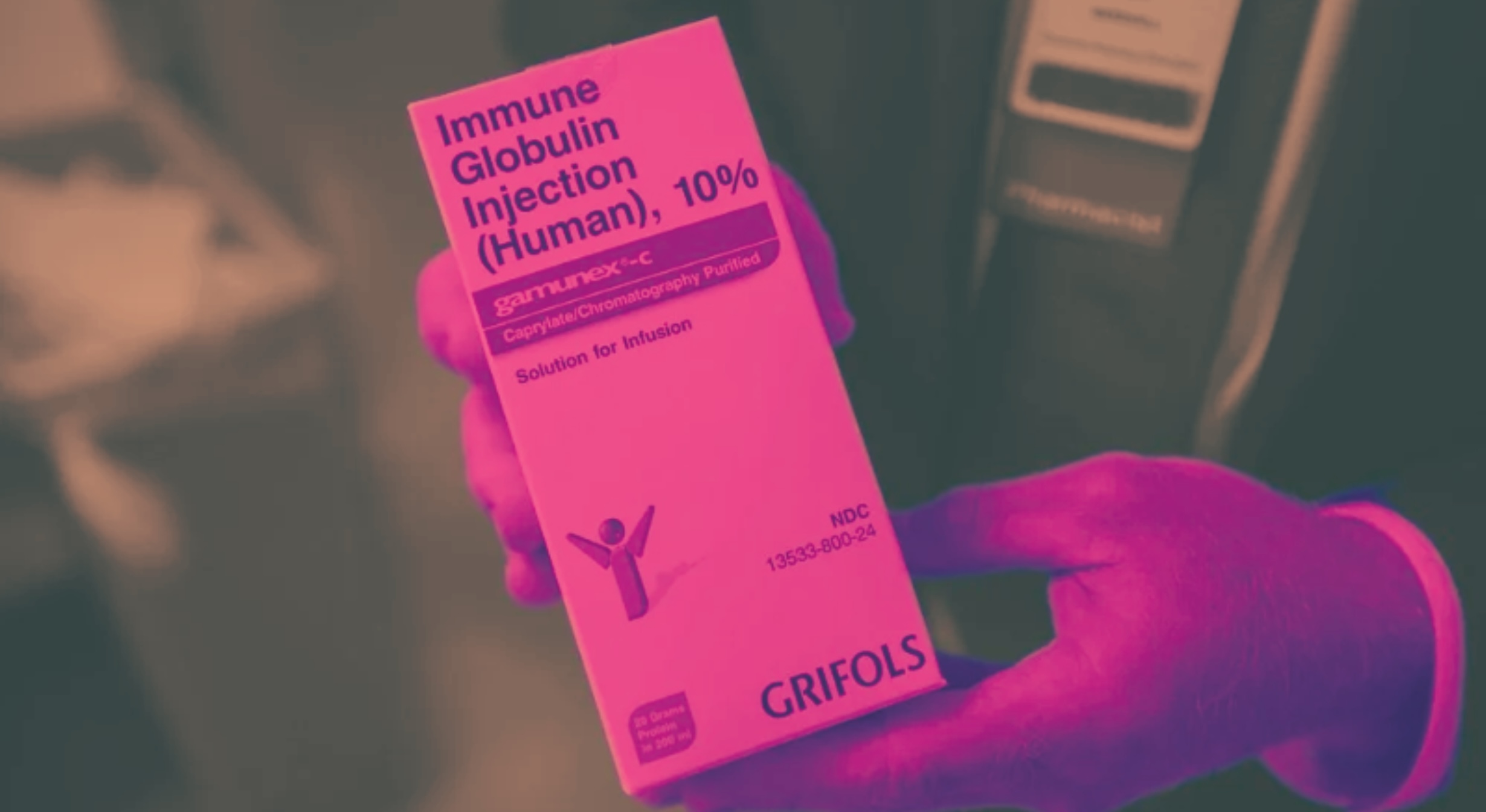
From New York’s Hudson Valley, where I’d long dreamt of making a home, my husband and I moved to New York City, where I’d grown up and where my family lives, and began seeing doctors at major teaching hospitals. The improvement in care was undeniable. I was diagnosed with autonomic small fiber neuropathy, which creates dysfunctions with blood pressure and heart rate, digestion, temperature, and other bodily functions we don’t consciously control. I was told I needed IVIG, intravenous infusions of immune proteins extracted from donor blood that would temper my body’s autoimmune assault on my nerves; in later years, I also needed IVIG to bolster my immunity whilst huge swaths of my immune system were wiped out by medications primarily used for cancer, so my own disease-fighting powers would stop their assaults on me. IVIG was not “the answer” to all facets of my illness in the way that my doctors thought it would be. Still, it saved my life.
Many patients call immune globulin “liquid gold,” because it’s so precious to us—and so costly. Each infusion costs about $9,000-10,000, resulting in an average of about $35,000 per month for regular recipients like me. The neurologist who first prescribed mine ended up fighting my insurer for nearly a year, through every round of appeal, including several “peer-to-peers,” arguments that are bizarrely conducted between your doctor, who is a specialist in a field relevant to your disease and the treatment you need, and a doctor employed by your insurance company, who can be in any specialty—say a dermatologist or an ophthalmologist—about a highly specialized treatment.
Despite years of illness-related atrophy, my writing, literacy, and education (along with other privileges like whiteness, cisgender identity, and coming from a family who could help me financially during this crisis, which continues) has held great power throughout my sickness—as a means of accessing treatment, information, education, helping me to communicate in a way that doctors can hear, and inspiring a willingness on their part to listen, be challenged, to see in me not only my disease but my potential.
Disagreeing with a doctor is frightening.
Above all, I am alive in large part because I can write, because I still have something to say, and because my competency awakens a higher level of awareness in doctors, it seems—of my reality, my personhood, my dreams, what woman I lost, whom I so desperately want to get back. I am able to convey the urgency, illustrate and animate my pain, invoke empathy and compassion when, were I not as articulate and favorably positioned to have my realities acknowledged, my words might simply be skimmed over with half-attention.
This is most true in messages sent via patient portals or email to my doctors and the sheets of information I prepare before my appointments so that I can be concise and maximally direct, in some cases simply handing the sheet to the doctor: current diagnoses, medications, symptoms, duration of those symptoms, pain scale, etc. I’ve carefully studied and learned their language, in part at a job I had right before tumbling into sickness in which I wrote scripts for virtual patients meant to teach nursing students how to effectively and compassionately conduct health history interviews. I have an overflowing basket of skills, apparently.
My rheumatologist often comments on the strength of my writing; he always asks how my writing is going, adding, “So long as you’re writing, that’s all I need to know.” He has joined me in caring about one of my highest priorities and central parts of myself, and in turn it makes me feel cared for, because I am—not only as a case or a disease or a “case,” but as a person.
Of course there are amazing doctors whose compassion extends to patients regardless of their capabilities or comfort levels as communicators, but what remains is the question of how even the most caring doctors can offer the best treatment to patients who are—because of illness, lack of education, absence of family and social support, and so on—unable to articulate the nature of their suffering and symptoms to begin with.
Also, understandably, many patients do not feel entitled to or comfortable with contradicting a medical doctor, say, to correct a misunderstanding, incorrect recollection, or omission, and as a result do not receive adequate or appropriate treatment. The patriarchal, academic, hierarchical setting of hospitals, particularly university hospitals, is overwhelmingly daunting for me. Disagreeing with a doctor is frightening. What if they no longer like me enough to help me? What if they see my history of bipolar disorder and PTSD, the complexity of my illness, and lazily slap me with a diagnosis equivalent, in contemporary parlance, to “hysteria?”
I struggled through school due to poorly managed bipolar disorder, but English class and in college essay-writing in general were my strong suits. I received encouragement, personal and academic, especially from my English teacher; she gave me a belief that I had some measure of talent as a writer, a voice worth sharing. She also brought me the most delicious sandwich I’ve ever had while I was in a mental hospital on Thanksgiving evening. Freshly baked, crusty white bread with all the Thanksgiving fixings—turkey, stuffing, cranberry sauce, gravy—it was, and remains, one of the kindest gestures I’ve ever experienced.
Those deaths, those tragedies, unimaginable losses, became my win.
My voice as a writer was not only encouraged in academic settings. The last story I wrote as an undergraduate student was my first published story and earned my acceptance into a handful of MFA programs, including my top choice. There, I thrived. The matters of status, of money and race, of my largely cis heteronormative identity and gender expression, my conventionally attractive appearance and thinness—I was heard because of these too.
Even now, overweight and over a decade into my illness, doctors don’t struggle much with how to perceive me, how to approach me; they don’t have to put in that kind of effort. I’m easy that way. I’m seen as a highly educated and literate person who relentlessly advocates for herself, even if I’ve also has learned the art of challenging and pushing doctors for more without harming their egos. I’ve learned, too, to throw in a sense of humor, hold in tears that might get me written off, speak to doctors like a peer keeping in mind the power of suggestion, that if I act like we’re a team working on solving a case—me, it’s me, I am the case–I am given something that most patients never receive: collaboration, a receptive ear, a willingness to travel the extra mile (or two).
I’m a woman with a severe mental illness. Things aren’t perfect for me in my rapport with medical professionals. I’ve been told “a psychiatrist is the best person to oversee your care” when in fact I had autoimmune encephalitis and inflammatory arthritis, among other afflictions, and despite labs clearly showing high levels of inflammation and autoimmune antibodies. I have not always been taken seriously. Most of the time, though, I have. I have confidence in communicating with my medical team not only because I put a great amount of labor into how I speak and write to them, but also because of the circumstances of my birth and upbringing and experiences that happen to empower me now—despite feeling the most powerless I ever have. Yes, I’m very fortunate. It is also deeply wrong. The discrepancy between my care and that of most others should not exist.
As a last ditch attempt in my fight to get insurance approval for IVIG, the infusion pharmacy that was assisting my neurologist with the claim called my insurer and said something about me that proved powerful enough to give me a chance, time to keep seeking answers and to get access to “liquid gold.” Specifically, a man working at the infusion pharmacy told an insurance doctor, during a peer-to-peer, that I was an author—“Google her! You’ll see”—poised to write an exposé for the New York Times. The article would shed light on my specific insurance company’s withholding of life-saving treatment—an accusation that several California families had recently made in court against the same company, on behalf of their deceased family members who’d been denied coverage for IVIG.
The plaintiffs prevailed. Those deaths, those tragedies, unimaginable losses, became my win. I live with the knowledge that what saved me, and continues to save me, is something that I didn’t earn from hard work or who I am or how I treat others or any other virtue, but which was paid for by the lives of people just like me—except, chances are, they couldn’t advocate for themselves the way that has become second nature to me. I have the kind of luck that doesn’t feel lucky; it feels bought, its price exactly the value of an inhale and an exhale, which is to say, something we could never claim as our own doing, could never afford to manifest despite any amount of riches—the price not just of good health, but of life itself.
__________________________________

Greyhounds by Emma Smith-Stevens is available from Dzanc.

Emma Smith-Stevens
Emma Smith-Stevens is the author of a novel, The Australian (Dzanc Books), and a short story collection, Greyhounds (Dzanc Books), forthcoming in early 2018. Smith-Stevens' writing has appeared in BOMB Magazine, Subtropics, Conjunctions, Joyland, Day One, Lucky Peach, The Hairpin, and elsewhere. Her short story "An August in the Early 2000's," published in Wigleaf, received a Special Mention in The Pushcart Prize XL: Best of the Small Presses (2016). Her essay, "The Sun," will be published in the anthology Not That Bad: Dispatches From Rape Culture (Eds. Roxane Gay and Ashley C. Ford), forthcoming from Harper Perennial.