Have We Entertained Ourselves Into a State of Emergency?
Megan Garber on Placelessness, Pop Culture, and the Panopticon of Spectacle
Suburbs, those physical settings closely associated with the American dream, remade the world as a set for smaller-scale shows. They were developed as responses to the incorrigible thrums of city life: In place of messy togetherness, they imposed distance. They established the home, for the middle and upper classes, as a single-family castle. People signaled their privilege by surrounding their houses with uniform outdoor carpeting: grass that had to be watered into lushness and then mowed into submission.
Suburban homes, in other words, were safe spaces before the term would become a culture-war anxiety: They rejected the city and its tumult of togetherness, imposing order on the landscape and the people who shared it. They separated people, tract by tract. They segregated people, by class and often by race. They treated both as a selling point. The fantasy on offer, in the end, was a world rid of its strangers. Each tidy homestead promised a life of synthetic ease. The people of suburbia had no need to be exposed to anything that made them uncomfortable. Life, instead, could be molded to the shape of the show. It should be seamless. It should allow you to write the lines, to call the shots, to set the scenes.
Escapism, as a way of life: The premise becomes ever more inescapable. Many of the status symbols enjoyed by the 1 percent and sold to the remaining 99 are also tools of social separation: private planes, private gyms, homes so stridently self-contained that they double as microclimates. Khloé Kardashian, Kim’s sister in life and in influencer-hood, recently posted a “room reveal” on Poosh, her Goop-like lifestyle website; the room being revealed was, she claimed, a pantry.
Wealth as social exceptionalism is in one way a very old idea.
In truth, it was a store, enormous and perma-stocked and resembling a retail space in pretty much every way but the checkout. The message the images sent was not merely that Khloé Kardashian is rich enough to afford a neverending supply of Vlasic Snack’mms pickles; it was, more specifically, that her richness spared her from the indignity of obtaining Vlasic Snack’mms pickles from a public place.
Wealth as social exceptionalism is in one way a very old idea. Those who are rich have long used their money to separate themselves from those who are not; “means” has long meant the possibility of distance, physical and otherwise, from the noises and smells and movements and inconveniences of the hectic world. But as celebrity becomes more democratized, the aspiration does, as well. Everyday influencers now share their versions of Kardashian’s personalized 7-Eleven, sharing massive grocery-store hauls and promoting the organization methods—shelves, bins, label-makers—they use to rein it all into sellable submission.
Why merely replicate stars’ outfits or workouts or skincare routines when we could try to replicate their even greater luxury: the ability to live lives that are thoroughly set-designed? Online environments, even as they replicate cities, also replicate suburbs. The suburban promise—that main character energy could be made immersive—is an organizing principle of the internet. So is the suspicion of strangers. So is the expectation that life itself can be stage-managed into submission. Suburbia was a self-conscious rejection of urban life and its unruliness; to the extent that screens contain both settings, we navigate a place that is divided against itself. Marinate in it all for long enough, and the world begins to look not like the world at all—busy, unruly, teeming with people who deserve to be there precisely as much as you do—and more like a place that owes you its stage. Life: The Movie, as the journalist Neal Gabler called it, becomes Life: The Cinematic Universe.
Fiction creep—the encroachment of the endless stage—can lead people to lose sight of the world as it is. It can make it difficult to process facts through anything except our entertainment. The paradox of the spectacle is that it leads, very often, to boredom. The spectacles do not soothe us; instead, they create the demand for more: more amusement, more drama, more distraction.
Our Panopticon doubles as an endless theater in the round.
Jeremy Bentham’s design for the Panopticon was implemented, in Britain and elsewhere, in the penal context he’d intended. But it was also remade as entertainment. In 1850, construction began on the Royal Panopticon of Science and Art, a museum and exhibition hall and shopping center that soon became, as one magazine put it, the most “delightful lounge in London.” In 1858, the building was repurposed as a theater for music and variety shows. In 1861, it hosted the debut of a trapeze act featuring Jules Léotard and his revolutionary onesie.
So the Panopticon, in Britain, turned “see and be seen” from a carceral threat to a carnivalized promise. And Americans, as is our wont, took things a step further. Visitors to Boston, today, might choose to stay at the Liberty Hotel, which transformed a panoptic prison into luxury accommodations decorated with whimsical reminders of the building’s past. (In addition to a restaurant named Clink and a bar named Alibi, the Liberty promises rooms so luxurious, “we can’t guarantee that you’ll ever want to leave.”)
Through similar trajectories, Big Brother, that ever-timely warning about life under totalitarianism, has morphed into Big Brother, CBS’s ever-campy reality show. The title is apt: It acknowledges the stakes of our split-screen existence. When the comedy and tragedy share the same stage, it becomes ever harder to distinguish between them. Our version is environmental. Our Panopticon doubles as an endless theater in the round.
“Are you not entertained?” Maximus, the hero of the film Gladiator, screams at the Roman throngs who see his suffering as their show. The trouble is: We are.
But the broader promise of a set-designed world is that it requires very little thinking at all. Sets are places of totalizing control. They do not merely allow magical thinking; they demand it. Sooner or later, though, the spell will be broken. And we will be thoroughly unprepared. The blunt realities of the physical world can strike us as shocks—and as betrayals. The indignation can come for us individually (as when we age away from the youth we were told we could purchase for ourselves).
Climatecore, you might call it, arose during the years that found climate change shifting from a threat to a chronic crisis.
It can also arrive as a planetary kind of shock. Storms that grow angrier; seas that grow higher; air that gets hotter; each is a matter of physics, and thus entirely predictable. But each new hurricane or flood or quake can seem like a new kind of crisis: an interruption of the reality rather than reality itself.
A weather app recently sent a push notification offering to fill me in about “interesting storms.” This is the fun fetish in action: I do not need storms to be “interesting.” But when “interesting” is so regularly transformed from a description into a demand, even the weather will fall prey to the mandate.
The show must go on is fine as a principle of theater. In the wider world, though, it can lead us astray. It can limit our vision, and our agency. The planet at large has defied the old scripts; in response, we have been updating our sets. We have been meeting the crisis by turning nature into decor. Natural materials—materials, at least, designed to evoke nature as an aesthetic—have informed many of the latest trends in mass-market home design. Furnishings are constructed of rattan, wicker, jute. Houseplants, both organic and fashioned of plastic, serve as decor. Wallpapers and artwork mimic banana leaves, birds of paradise, and similar icons of botanist chic—images meant to lend even the dullest of spaces the humid lushness of the tropics.
Pop culture channels the disconnect.
The style is mimicked in public spaces, as well. (See: the rise of walls made entirely of plastic greenery, many of them decorated with Instagram-friendly neon light fixtures.) Climatecore, you might call it, arose during the years that found climate change shifting from a threat to a chronic crisis. It recalls the way Americans in the 1950s made sense of the space race, and the atomic bomb, by turning futurism into a design principle. It promises absolution. It hopes that, surrounded by all the manufactured evidence of a lush world, people won’t stop to consider the irony that the plants on display have been constructed of plastic.
Climatecore offers false catharsis. It allows us to do nothing with such dramatic enthusiasm—such commitment to the bit—that we can feel like we’re doing something. Magical thinking, on the stage, is not a delusion. It is all there is. And it is worsened when the stage holds us at a distance. “All politics is local,” the old saying goes; often, though, even the most traditionally place-based elements of American life take their shape from the trickle-down effects of national culture. Arguments at local school-board meetings recite the outrages scripted every day on national talk radio and national cable news. Local newspapers, the outlets that once connected communities to themselves, are dying in droves. Many Americans would be hard-pressed to tell you who their local council members are or who their state legislators are—but able to tell you, in detail, the latest scandals involving the national government.
Pop culture channels the disconnect. Sitcoms have settings, but quite often lack meaningful locations. Placelessness is an abiding joke on The Simpsons: Springfield, that bit of bland suburbia, is anywhere and nowhere at the same time. Parks and Recreation, a sitcom that went out of its way to be specific about its setting (the fictional town of Pawnee, Indiana), was at its heart a show about national politics. Pawnee was, in the end, a microcosm of Obama-era national politics: The town had its own version of a Tea Party. Its city hall election was campaign-managed, on one side, by a savvy national operative.
Pawnee’s form of placelessness is, like Springfield’s, something of a joke. But it is also an insight. The national and the local, the micro lens and the macro—on the screens, they become the same thing. We still have our settings, of course: the places we live, each unique. But we come together, as a collective, in the screen. It is our shared environment. It is our collective architecture. It is a place where words and images have ever more power to shape the pictures we hold, of the world and of one another. The people we encounter, over the distance, can fall prey to similar errors of vision.
At its worst, that expectation of a sanitized world can foreclose empathy. It can trap people in their illusions, driving them to ignore the world as it is in favor of the world as they would prefer it to be. In Regarding the Pain of Others, that book-length meditation on the human cost of spectacle, Susan Sontag describes a conversation she had with a woman who had lived in Sarajevo when the city was in the midst of war. Witnessing an attack on a nearby area, the woman’s first reaction to the horror was not shock or grief. Her impulse, instead, was to change the channel.
The journalist Walter Lippmann observed the importance of media inputs well before “media” was part of the American vernacular. His 1922 classic, Public Opinion, considered the information economy of the time—but managed, along the way, to anticipate the complexities of a world that cedes to its screens. Lippmann was writing not only during the early age of radio but also during a smaller kind of printing revolution: The 1920s contended with the penny press, and the new ubiquity of imagery, and the expanding influence of advertising.
Lippmann was reckoning, a century ago, with the early stages of the world we are navigating today. His fear was that we could not bear the weight of all the distance. His fear, further, was that, as we tried to know one another from afar, we would become reliant on images of the world rather than on the evidence provided by the world itself. We would become addled. We would become ignorant. And we would then become vulnerable—to the images, to the advertisements, to the stories, to the overwhelm itself.
__________________________________
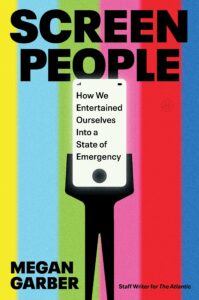
Adapted excerpt from Screen People by Megan Garber and reprinted with permission from HarperOne, an imprint of HarperCollins Publishers. Copyright 2026.

Megan Garber
Megan Garber is a staff writer at The Atlantic. She is the recipient of a Mirror Award for her writing about the media and a fellowship from the New America Foundation, and she previously worked as a reporter for the Nieman Journalism Lab, as well as a critic for the Columbia Journalism Review. She wrote the chap book On Misdirection: Magic, Mayhem, American Politics. She lives in Washington, DC.