Reflections on an Angelheaded Hipster: Celebrating Allen Ginsberg’s 100th Birthday
Ed Simon Rereads Howl, a ”Genuine Masterpiece”
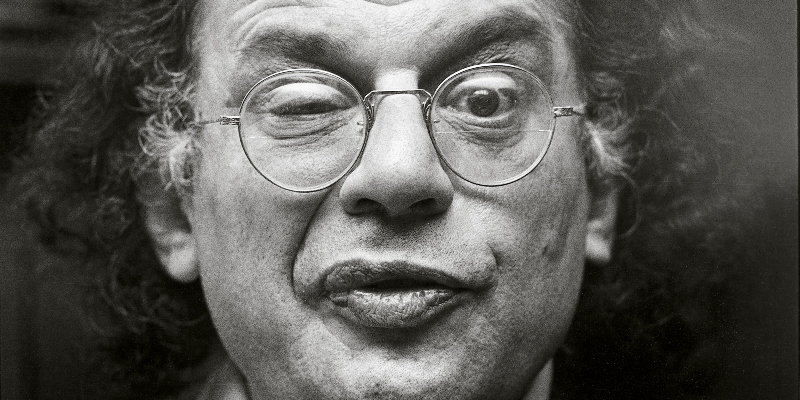
Allen Ginsberg was born in Newark a century ago today. He is totem as much as poet, arguably the most famous American writer of verse in the twentieth-century. There’s the Ginsberg dancing like a shaman in an alleyway behind Bob Dylan in the proto-music video for “Subterranean Homesick Blues,” the Ginsberg chanting alongside John and Yoko on “Give Peace a Chance,” the Ginsberg played by James Franco and Daniel Radcliffe. In the public imagination he was the embodiment of “poet” in the second half of the twentieth-century, an example of “bohemianism at its best” as Jonah Raskin writes in American Scream: Allen Ginsberg’s Howl and the Making of the Beat Generation.
Ginsberg first read the titular entry in Howl and Other Poems at San Francisco’s Six Gallery in 1955, and the work anthologized a year later by fellow poet Lawrence Ferlinghetti as the fourth entry in the City Lights Bookstore imprint with its distinctive slender binding and black-and-white cover. That pot-and-Burgundy-fueled reading was the Cambrian Explosion of the Beats, a coterie which included Jack Kerouac, William S. Burroughs, Diane di Prima, and Neal Cassady, whose very appellation recalled both the beat of bebop and the beatification of the visionary outcasts who constituted the group. By contrast, the New York School, the Black Mountain Poets, felt academic, whereas the Beats, especially Ginsberg (a Columbia graduate who studied with Lionel Trilling) countenanced an ecstatic approach that has resonated with the public – if continually published anthologies are any gauge – in a manner that contemporaneous movements haven’t.
Among the big three of the Beats, Ginsberg remains the most enduring.
Among the big three of the Beats, Ginsberg remains the most enduring. Burroughs, who was a genius, nonetheless wrote in an experimental idiom that’s borderline unreadable, while Kerouac – slurred by Truman Capote as more of a typist than a writer – transformed into a drunken caricature of the working class French Canadian from Lowell that at heart he always was, becoming a pro-war reactionary in the process. Only Ginsberg remained true to himself, Naomi and Lewis’ good Jewish boy from Patterson who inveighed against injustice and for the restorations of tikkun olam.
“America when will we end the human war?” he asks in a short poem included in Howl. “Go fuck yourself with your atom bomb.” That last line, even seventy years later, even after the seeming complete commodification of all dissent under the reign of King Algorithm, still reads as shocking, as liberatory. A reminder that every sick empire requires its own Jeremiah in the wilderness. John Leland in Hip: The History, compares Ginsberg to Henry David Thoreau, Ralph Waldo Emerson, and Walt Whitman, writing that all “engaged the task of being awake, in its full ardor and hellfire.” This was the Ginsberg who was hip with his radically earnest embrace of principles, an aesthetic of subversion.
*
That was the Ginsberg who appealed to me—who still appeals to me. When I was a freshman, with the sort of black-clad pretension only possible to an 18-year-old with a Moleskin notebook, I inscribed with purple pen Howl’s opening salvo of “I saw the best minds of my generation destroyed by madness” around the white rubber rim of my black canvas Converse’s soles. Multiple copies of Howl, Kaddish, and assembled collections of complete verse lined (and still line) my bookshelves. As part of my Beat-inheritance, I had my father’s anecdote of hanging out with Ginsberg for a few hours at a party of antiwar activists in Pittsburgh where the psychedelically-inclined poet was delighted to hear that my father was a chemistry PhD student, teaching my dad how to construct Brion Gysin’s “dream machine,” a device intended to induce hallucinatory trances by using a light-bulb suspended into an empty ice cream container that’s placed on a turntable. My dad said that it sort-of worked, though he was less impressed with Ginsberg’s recommendation of crank French occultists Louis Pauwells and Jacques Bergier’s The Morning of the Magicians: Introduction to Fantastic Realism.
Such was the loopiness of Ginsberg, the Greatest Generation ambassador to the 60s, a Merchant Marine veteran who espoused flower power and Aquarian self-creation, the cymbal-clanging love-in prophet whose lyrics would be echoed in Apple’s 90s “Think Different” campaign and who was the most iconic representative of the literary movement which Burroughs snarked launched a million Gaps. There is, in someways, as much of P.T. Barnum about Ginsberg as there is William Blake, the great PR figure of the Beats, a man attuned to the very American art of self-promotion. Part of what fascinates and frustrates as regards Ginsberg is that for all of those thick anthologies, propriety forces me to concede that many of the poems simply aren’t that good. Among the juvenilia, we have “’I will stay no longer pent!’/Cried my spirit, petulant” from The Book of Martyrdom and Artifice: First Journals and Poems, 1937-1952 and among the mature works we have “Birdbrain runs the world/Birdbrain is the ultimate product of Capitalism/Birdbrain chief bureaucrat of Russian, yawning/Birdbrain ran FBI 30 years appointed by FDR and never chased Cosa Nostra” from 1981 (hold onto the edges of your gowns, hell can get pretty deep).
There is, in someways, as much of P.T. Barnum about Ginsberg as there is William Blake, the great PR figure of the Beats, a man attuned to the very American art of self-promotion.
Then there is the activism at its most mush-brained. Politically, while there may have been the Ginsberg who was the heroic advocate for free expression in a 1956 California State Superior Court obscenity trial concerning Howl, there was also the Ginsberg who was a defender of NAMBLA in the 1980s (on first amendment grounds, but still). That’s a dangerous kind of tolerance, such as when Ginsberg broke bread with the notorious Hell’s Angels after the poet helped broker a tentative “peace” between the motorcycle gang and Bay area hippies. “I assure you,” wrote Ginsberg in a poetic apostrophe to the gang, he venerates their “lonesomeness/& struggle & would rather be peaceful intimates.” For Ginsberg, the reactionary bikers embodied an outsider ethos, which necessitated looking the other way as they regularly committed gang-rapes as part of their initiations. As Hunter S. Thompson reports in Hell’s Angels: A Strange and Terrible Saga, Ginsberg was guilty of a “total misunderstanding” of the gang. In retrospect, when William F. Buckley accused Ginsberg of naivety on Firing Line, it may have been a condemnation, but more generously it’s better interpreted as an apology.
And yet—there is also the Ginsberg who went to Cuba in 1965 to agitate for gay liberation against the homophobic Castro regime, where despite the poet’s own (kind of) Marxism he was expelled. Or the Ginsberg that was elected “King of May” by communist students in Czechoslovakia precisely because of his consistency only to be targeted and persecuted by the secret police. Guileless though he may have been, Ginsberg was nothing if not courageous. Eliot Katz in The Poetry and Politics of Allen Ginsberg writes that he “refused to be conned into accepting dominant Cold War dualities… consistent in his criticisms of U.S. and other Western capitalist exploitation while also vocally opposing authoritarian Soviet-style alternatives,” an activist who was willing to put “my queer shoulder to the wheel” as he put it. For then there is also the poetry that is great, because if it’s easy to cherry pick the worst from an author so prolific (for whom – like all of us – the mantra “First thought, best thought” is bad advice), it must be acknowledged that Ginsberg produced a genuine masterpiece in Howl (which is a masterpiece more than most of us).
It’s easy to cherry pick the worst from an author so prolific (for whom – like all of us – the mantra “First thought, best thought” is bad advice).
So, again—“I saw the best minds of my generation destroyed by madness, starving/hysterical naked, /dragging themselves through the negro streets at dawn looking for an angry/fix.” Those are the celebrated opening lines of the first part of Howl’s three parts and its footnoted coda, with that initial sentence running-on for seventy-eight frenetic lines. For Ginsberg, ever-attuned to the rhythmic physicality of verse, the central atom of poetry wasn’t the line or the foot, but rather the breath, emphasizing that his were longer than his free verse hero Whitman because the good, grey poet probably had smaller lungs. A fecundity to such verse, an overflowing. A master of surreal parataxis, Ginsberg’s Howl fuses arresting, almost Dantean imagery, with an aural sensitivity, such as with “angelheaded hipsters burning out the ancient heavenly connection to the/starry dynamo in the machinery of night,” or those who “bared their brains to Heaven under the El and saw Mohammedean/angels staggering on tenement roofs illuminated.”
There is a bopping, rhythmic assonance to Ginsberg’s unspooling lines, more incantation than poetry. Peter Orlovsky, Ginsberg’s long-term lover, claimed that the title of the poem was inspired by the Hank William’s number “Howlin’ at the Moon,” and it’s appropriate. For Howl contains the music of what Ginsberg enigmatically called the “hydrogen jukebox,” with all those attendant apocalyptic associations, a vernacular that fuses the sacred and the profane, that sees in the debasements of addiction, insanity, and poverty a kind of holiness.
Supposedly the poem was inspired by a peyote-vision where the edifice of San Francisco’s Sir Francis Drake Hotel was transformed into a hideous, twisted, demonic visage, which inspired the beating heart of Howl’s second section. Invoking the horrifying Canaanite bull-headed deity to whom children were once sacrificed, Ginsberg castigated “Moloch! Moloch! Nightmare of Moloch!” Today, supposedly sophisticated moderns have laundered Moloch’s dark faith into militarism, imperialism, and capitalism. When he inveighs against “Moloch the vast stones of war!,” who tellingly has a love of “endless oil,” can we not hear the cries in Ukraine, Iran, Gaza? American streets? When Ginsberg denounces “Moloch whose mind is pure machinery!” do we not think of artificial intelligence? When the poet describes “Moloch whose/factories dream and croak in the fog! Moloch whose smoke-stacks and/antennae crown the cities!” do we not envision those water-hungry data centers crowding the countryside, the flock cameras and Palantir-nightmares which are the Moloch of our necrotic capitalist surveillance state?
If the second section presents the diagnosis, then in the footnote to Howl Ginsberg writes a prescription, because if we’re oppressed by a dark faith then the only antidote is a different one. “The world is holy!” he gushes in his footnote, “Everything is holy! everybody’s holy! everywhere is holy! everyday is in/eternity! Everyman’s an angel!” This exuberance must not be read as navel-gazing, but rather as genuine expression of an immutable law, of how Whitman could understand that “every atom belonging to me as good belongs to you” or Blake perceived that there is a world in a grain of sand, heaven in a wildflower, and infinity in the palm of our hands. Maybe it’s fair to call this mysticism, but it could also be called democracy. Because it acknowledges the fundamental, unnegotiable, and sacred reality of everyone’s inviolate existence. Counted among the Beats, Ginsberg deserves to be included in the canon of devotional poets alongside John Donne and George Herbert. As an American he understood (just like Uncle Walt) that our politics must be grounded in the spirit. This is revolutionary insomuch as that word means a return, radical in that that word is derived from “root.”
When reading Blake in a Harlem apartment in 1948, Ginsberg was struck with a vision of the Romantic poet, intoning his own verse in his own voice. A benediction, the same inspired blessing that connects a Ginsberg to Blake, who saw angels climbing in the trees, and connected Blake to John Milton, who received his blank verse from the muse Urania, and connected Milton to the very father of English verse Caedmon who was initiated into poetry by a heavenly intermediary. A chain of inspiration that goes upward and downward through time like the angels climbing on Jacob’s ladder, where Ginsberg served to remind us that the holy is to be found also amidst the lost, broken, and mad angelheaded hipsters of a broken empire.
Ed Simon
Ed Simon is the Public Humanities Special Faculty in the English Department of Carnegie Mellon University, a staff writer for Lit Hub, and the editor of Belt Magazine. His most recent book is Devil's Contract: The History of the Faustian Bargain, the first comprehensive, popular account of that subject.