They were late to John’s girlfriend’s art show, though apparently his girlfriend didn’t believe in time and claimed she didn’t know what late really meant. According to her, everything was unfolding in its “divine timing.” John’s girlfriend was tedious and infuriating, in ways both like and unlike John, but Maggie had yet to find the parts that were supposed to be endearing. She tried her best to be nice, however, because John thought his girlfriend was “something else.”
And she was something else. She had renounced her name seven years ago and allowed people only to refer to her as the Artist. The woman didn’t have a name, she didn’t believe in time, and for someone with impeccable style and a penchant for high fashion, she didn’t believe in clothes. Maggie didn’t know clothes were something you could believe in. She wondered how John had ever successfully explained any of this to their parents.
Of course, in addition to being perfect by becoming a doctor, John had selected, despite her eccentricities, the perfect mate in their parents’ eyes. John’s girlfriend was independently wealthy — her father had essentially invented oil, as Maggie understood it — she was American, and she was kind to John and Maggie’s parents, always bringing them gifts and writing them handwritten cards.
Beyond that criteria, Maggie’s parents didn’t care that John’s girlfriend’s job was insane and ridiculous. She was allowed to be an artist because she was an American with money to burn.
Maggie’s one success, according to her parents was that she, too, had selected an excellent mate: Rob was rich (just regular rich, not oil rich), American, and dependable. He had a strong body, which would pull the plow, so to speak, though he mostly sat at a desk and typed. And if Maggie had any sense, she would marry him already.
John didn’t have to get married yet, even though he was older. He should get married now, if the metric was time having been together, but he didn’t have to. He had no biological clock and could pick someone else if he wanted. He was also a doctor. Had that been mentioned? John was doing everything right.
John jerked Maggie back by the elbow and stopped her from stepping into the street. He pointed to the red crosswalk symbol.
“You don’t have to be a doctor,” he said, “but you can’t step into oncoming traffic.”
Maggie gave a limp smile, the best she could muster, and they waited for the light to turn.
“What is the show about again?”
“The spectacle of pregnancy.” John spoke as if he were reciting something.
“Like women only get pregnant to be a spectacle?”
“No, like once you’re seen as pregnant, it can’t be unseen, and you become a spectacle.”
Maggie could get behind this idea. She thought of her own, never-had-been-pregnant-body, and how it had been primed as a spectacle already.
“But I don’t really know, I guess,” John said, quick to amend himself. “You’d have to ask the Artist.”
“Ah, yes,” Maggie said. “The Artist.”
It was obvious where the show was, because of the crowd foaming at the entrance. Maggie and John joined the unusually eager attendees and stood at the end of a long, snaking line that brought them to the edge of Tenth Avenue. A woman in front of them was on the phone bemoaning her inability to get reservations for bar seats at a chic restaurant nearby. “Bar seats!” she kept exclaiming. What was next? Reservations to use the bathroom? She flipped her hair and tapped her toe in outrage.
It wasn’t long before the line charged forward, and they were all allowed into the gallery. The woman in front of them hung up the phone and rushed past the small plaque near the entrance, but Maggie insisted to John that they stop to read.
John wasn’t entirely wrong in his summation of the show. The plaque explained that the exhibit was about the spectacle of pregnancy, and how when people know you’re pregnant they look at you differently. They look at you as a belly to place a hand upon, as a vulnerable little thing who needs to put her feet up, but also as a mother. One who takes care of things. How you lose all defining features and become life itself. The description went even further, saying that pregnancy is also perverse and grotesque. Egocentric. A power trip. What began as an eloquent paragraph dissolved into a rant, but Maggie thought it had good bones. She wondered if the Artist was also a writer. She could be so many things, it seemed, because she didn’t have a name.
The show felt alive, inhaling and exhaling guests in a natural rhythm. Maggie and John were swept in with the next inhale, and they waded into the spacious white room as the Artist was sliding a long slice of papaya into her vagina. Being pregnant was Maggie’s worst nightmare, and the Artist’s piece did nothing to alleviate her apprehension.
“She’s really doing it,” Maggie said to the room, both concerned and impressed. Those seeds! she thought.
The Artist was mimicking the the-size-of-your-baby-is-the-size-of-this-fruit comparison, which seemed to have been popular for all of time. Expecting mothers loved to cradle their barely protruding stomachs and coo, “The baby’s the size of a peach.” How darling. Well, now an artist was shoving each type of fruit into her vagina to prove a point. The baby is the size of a slice of papaya.
The Artist had to take some liberties with each fruit. The first trimester, which John and Maggie had missed entirely, mostly consisted of small fruits — a blueberry, a raspberry, a plum. Plopped in and pulled right out. But how was she supposed to fit a grapefruit or a papaya without causing any serious damage? In slices. Maggie was glad to have missed the grapefruit slices. Just imagining the flesh of any citrus coming in contact with her genitals made her body tingle and turned her mouth sour.
“Well . . .” John said, staring straight ahead and not looking at Maggie.
“Yeah . . . ”
Maggie was relieved for the Artist’s sake that a baby is never the size of a jalapeño.
“Did you know — ?”
“Nope.” John began drifting toward the exhibit.
“Will you grab us some wine?” he asked. “I’m going to go to the other side.”
Maggie spotted a table with a cheap black tablecloth stretched over it in the corner of the gallery. A single bartender stood behind the waist-high bar, shaking well drinks and pouring one of two wines. Maggie waited in line to order and watched her brother orbit his girlfriend like he was her moon. She was beautiful; Maggie doubted John was the first man to orbit her. Her brown hair was long and had two distinct creases making it wavy. She had parted it in the middle for the show and let it hang down her bare back. Maggie thought she looked like Eve must have looked in the Garden of Eden. The Artist had a crisp, natural look about her. Like she had just stepped out of a painting and was encountering the physical world for the first time. Maggie felt the urge to reach out and touch her. She got the sense that if she did, she’d leave an ashy handprint on the Artist’s otherwise perfect body.
John looked more at ease in the gallery than he had at Maggie’s studio. Here, his muscles didn’t tense, his weight swayed naturally, as if he somehow understood this work on a base, animal level. Was it because he already knew how to orient his body around hers? Was this the result of the connection they’d built as partners, or was it the medicinal nature of the evening? His girlfriend in stirrups, her assistant slicing the fruit with a scalpel instead of a chef’s knife.
“Something to drink, miss?”
Maggie looked into the expectant eyes of the bartender. Isn’t this bizarre? she wanted to say. That’s my brother’s girlfriend. I never thought I’d see her birth a fruit before I saw her birthing their babies.
She didn’t even think she’d see the Artist birth babies, Maggie realized, shocking herself a little. She figured if there ever were babies, she’d be waiting for them in the waiting room.
The bartender blinked.
“Two white wines, please,” she said.
He gave a terse nod and began pouring the wine. When he’d released the glasses into her hands, he pointed to his right with two fingers, like a flight attendant.
“Complimentary fruit salad over there,” he said, and moved on to the next person in line.
Maggie looked over to where he’d gestured, and, sure enough, there was a bowl of fruit glistening with sugar syrup. Some of the syrup, stained red, had collected on the crystal-looking forceps beside the bowl.
“Clever,” Maggie said, letting herself be impressed.
With the wine cool and heavy in her hands, Maggie searched for her brother. He had migrated to the Artist’s feet. The block she sat on brought her to about chest level of the average viewer, putting John in the perfect position to watch the crowning of the next fruit. Maggie looked to the left of the platform where the Artist’s assistant sat at a small table, each remaining fruit sweating on a silver supply tray before her. Wearing blue latex gloves, she pared each slice down to a manageable size before handing it to the Artist. Up next was pineapple, its spikes thoughtfully sheared smooth and cut into spears. How this was considered a legitimate way to spend an evening was becoming more and more preposterous to Maggie.
All around her, open-mouthed viewers turned to face the Artist. Everyone had their eyes fixed on her body, watching as she braced herself and held her breath. Maggie saw couples pointing, whispering hushed opinions to each other. John had drifted north and was staring at the “piece.” Maggie noticed that he managed to avoid the Artist’s face, his eyes steady on her body. Next to John, a redheaded woman was eating grapes two at a time. Maggie had officially seen the whole world.
She moseyed over to John, who was transfixed as the Artist slid a butternut squash — halved longways, twice — into her vagina.
Maggie nudged him. “Your girlfriend is funny.”
“I don’t think her art is supposed to be funny, but I’m glad you’re enjoying yourself, I guess.”
“No, I mean it,” she said, pointing at the fruit salad. John shook his head, his eyes still on the Artist.
“Whatever.”
Maggie didn’t bother explaining herself. She watched on as the assistant prepped the next fruit, and the next one, and the next one, until Maggie was sure they were going to have to take the Artist to the hospital. Maggie felt removed from her, though she hadn’t looked away. She shut her eyes tight and blinked to bring the Artist into focus and tried to connect with the piece.
It was then that Maggie noticed the Artist was shaking. Maggie could see how the soles of her feet strained against the stirrups, her pale fists grinding into the platform, knuckles first and elbows quivering. Goose bumps covered the entire surface of her skin.
Maggie looked around at the audience. No one with a knotted brow. No one concerned that this woman was clearly writhing in pain. She saw a man toast his glass to another shorter, squatter man. What could they possibly be celebrating?
The exhibit was winding down, and Maggie thanked God under her breath, because she could hardly bear to watch the Artist’s clenched fists redden with each passing fruit. Last and longest endured was the watermelon. Maggie hoped it was cold. She imagined the icy fruit crumbling against her skin and thought it might feel kind of nice. But after forty weeks’ worth of fruit, Maggie was sure nothing felt nice and nothing would feel nice for at least a little while.
__________________________________
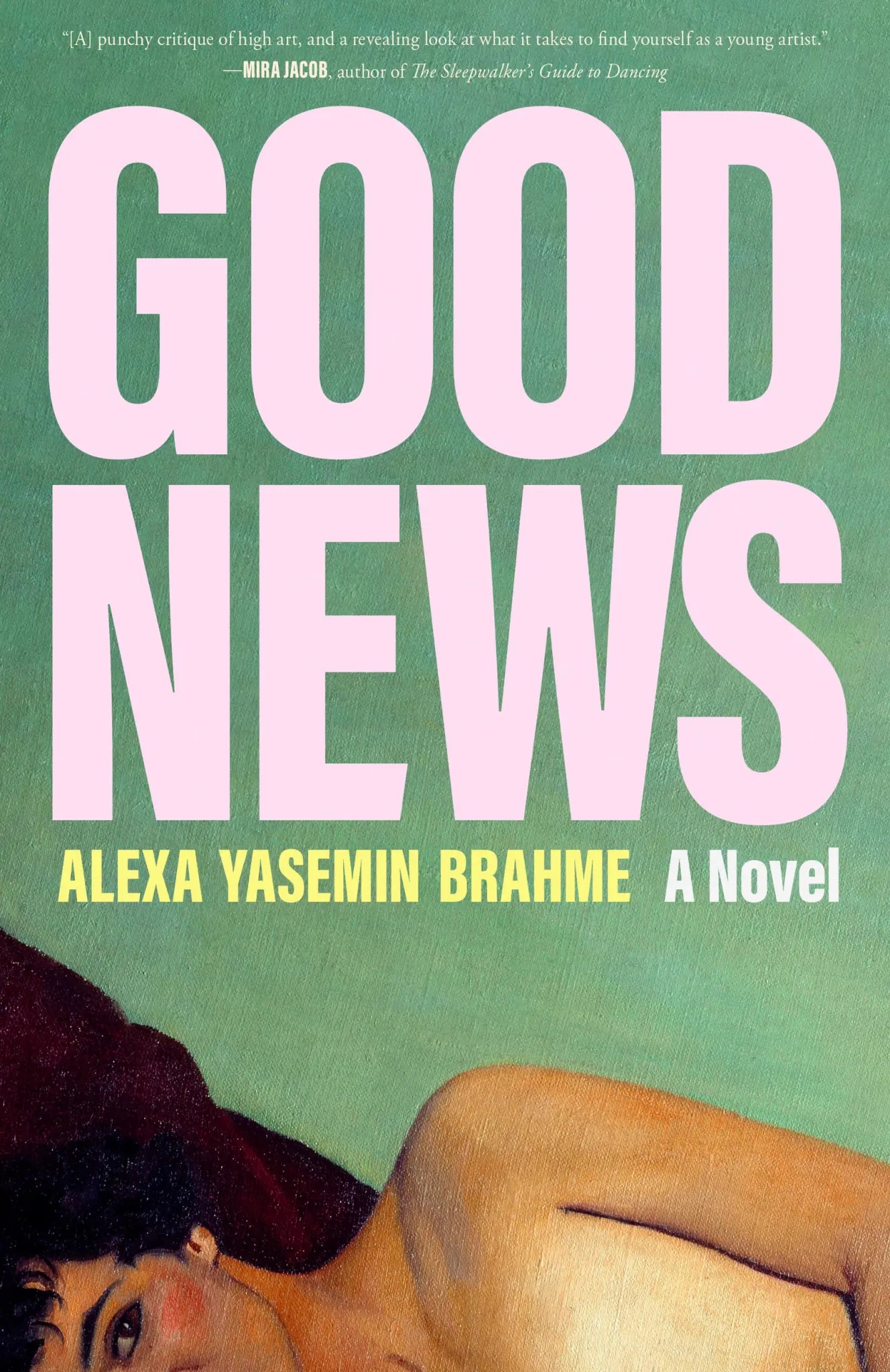
From Good News by Alexa Yasemin Brahme. Used with permission of the publisher, Algonquin Books. Copyright © 2026 by Alexa Yasemin Brahme.