God, Sex, Porn, Art, and Aids: Revisiting the Culture Wars of the 1980s and 90s
A Conversation With Isaac Butler and Rosa Campbell
Isaac Butler and Rosa Campbell are both historians and writers whose latest work focuses on the culture war of the 1980s and 1990s: Butler’s The Perfect Moment: God, Sex, Art and the Birth of America’s Culture Wars chronicles how the battles between the religious right, America’s artists, and the Federal government gave us the political and cultural landscape Americans live in today; Campbell’s The Book that Taught the World to Orgasm and then Disappeared: Shere Hite and the Hite Report tells the story of the best-selling, world-changing 1970’s study on the sex lives of American women, and what both it and its disappearance can teach us about sex and culture today. They recently got together over zoom to discuss their books, censorship, pornography, capitalism, and art.
*
Isaac Butler: I want to start by asking you the simplest of questions, because—look, I love your book, and your book is doing this thing that is like catnip to me, which is reaching back and rescuing this hugely important, paradigm-shifting work from the dustbin of history. I had never heard of Shere Hite or The Hite Report before reading your book. How did you discover them? And how did you come to decide to write a book about it?
Rosa Campbell: I was studying for my PhD in history, focusing on the global history of Australian women’s liberation. I interviewed women who were involved in feminism in the 60s and 70s. Lots of them talked about The Hite Report as an important book to them. Especially women who worked to gain formal equality, but realized that it wasn’t necessarily enough to gain formal rights in law and parliament. Equal rights didn’t really change the sexual politics of the bedroom. And then, as I read and read, I discovered that Shere Hite was really nowhere in any of the books written about women’s liberation history. And yet her books sold fifty million copies! Way more than The Feminist Mystique or The Female Eunuch. Yet she was nowhere so I was really intrigued. Then I looked up her archive and discovered it was vast, expansive, over 300 boxes.
IB: Oh wow.
RC: Then I realized I had read the book when I was ten.
IB: You read a study about women’s sex lives and the politics of the bedroom when you were ten?!
RC: Yes, way too young. I think all agree on that now. But better that entree than internet porn. but also, because my parents were radicals, feminists, trade unionists—they had this open access policy when it came to books. So I just was able to read anything I wanted, and that was a book I plucked off the shelf and read, aged ten. And that floated back into my memory.
IB: Amazing.
RC: How about you?
IB: In a way, this is the most personal of the three books I’ve written in that it’s about events that I lived through. The Culture Wars—which used to refer very specifically to the time my book covers, the 1980s and 1990s—that’s my adolescence. I grew up in Washington, D.C. My mom was very involved in the local art scene, which was very affected by the culture wars. And I was a child professional actor in my tweens and teens. So I met gay adults and people with AIDS for the first time and these issues became real to me as opposed to abstract news stories I heard about on public television. So I was very passionate as a teenager about three things: gay rights, ending the AIDS crisis, and state arts funding. And those are the three things the culture wars of this period were really fought over.
RC: Right.
IB: But the immediate impulse for the book was just this feeling that we were living through a very extreme version of the same story. You have the right using politics of grievance. Claiming that other people expressing their civil rights is oppressing them, and politicizing what are supposed to be non-partisan parts of how the government works on the state and federal level. And then on the left, you have a weird thing going on, and this was true back then, too, where there are some people who are actually kind of skeptical of free expression. They help create a permission structure that helps enable the right to do what it does. And so, I was really interested in exploring that. But I wasn’t interested in directly commenting on today. I was really interested in trying to tell the truth about this time that I lived through and that I have a lot of opinions about. And then let the reader kind of see what echoes for them.
RC: Right.
IB: Being American we have a kind of unique relationship to free expression. In the UK, you don’t have a constitutionally protected right to free speech. But here, that right has also led to a normative idea that for the most part people should have the right to speak their minds without material consequences. And of course, because it’s a norm, that gets renegotiated all the time. You can’t fire me for protesting the Iraq war. But you could fire me for printing a newspaper that is all racial slurs. And then on the other side, you can’t throw me in jail for either of those things.
So I was very passionate as a teenager about three things: gay rights, ending the AIDS crisis, and state arts funding. And those are the three things the culture wars of this period were really fought over.
And I think these are good things! I was surprised about the skepticism I saw about that from many friends on the Left—that many saw this entire issue as being about power, and that we need to control the power to shape the discourse. But, like, the left doesn’t control anything, so beyond the fact that I think that’s morally wrong, it’s also strategically misguided.
RC: That’s interesting because I think there is a real resurgence of really interesting political thought which reconsiders women’s liberation ideas around pornography happening at the moment. And I think I was really seduced when I was pursuing my first degree in the mid 2000s by sex-positive feminism, and by this idea of, like, as women we can learn what our desires are, and then negotiate them in the bedroom. And this idea, particularly, that pornography doesn’t impact people’s sex lives.
IB: Or it could even help you discover what you’re into.
RC: Yes, exactly. There were a lot of arguments like well men might watch very violent porn, but they might imagine themselves as the person who’s having the violence done to them. And that has largely been shown to be well, frankly not true. It’s like the liberal social contract in general. If we don’t believe we can negotiate rights directly with our boss, why would we imagine there aren’t any power dynamics in sex? And Shere Hite came around, eventually, to being anti-porn.
IB: She did?
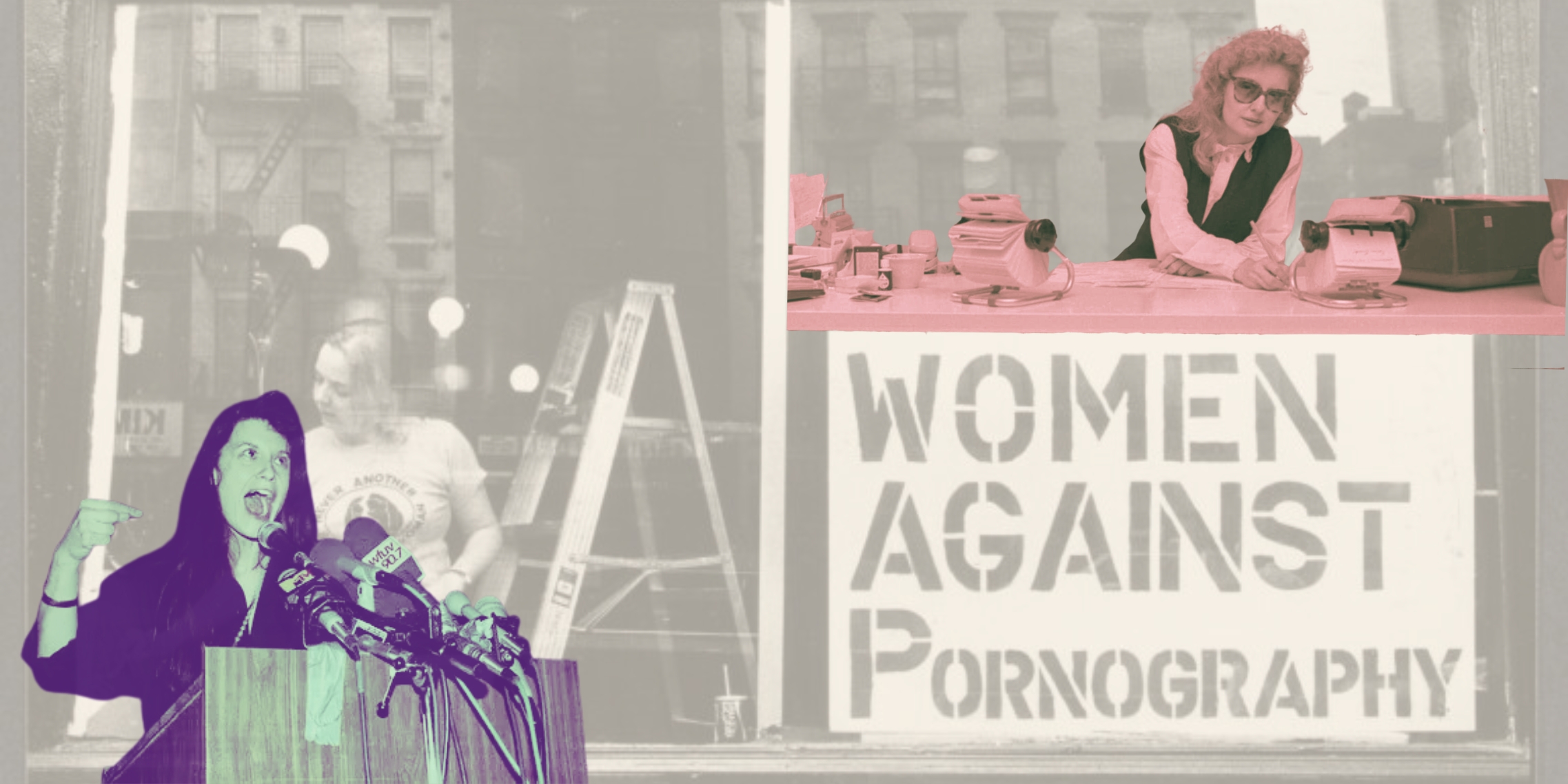
RC: Yes, she helped found the group Women Against Pornography. But she had a different take. She had worked in porn, so she was less moralistic or judgmental. And she also, unlike many other anti-porn feminists did not make an exception of pornography, she also found that other kinds of media representations of women- for example, fashion magazines, advertising- which she also did modelling jobs for were also very harmful.
If free expression is so important, and fundamental right, than it also protects pro-Palestinian protest.
IB: This is so wild to me because the specific left-wingers who are doing the most to enable the right’s war on free expression are anti-porn feminists, especially Andrea Dworkin and Catherine MacKinnon who were openly opposed to free expression rights when it came to pornography, because it was a form of abuse to them. They even worked with the religious right to fight it. They were the strangest of bedfellows of the time.
RC: I see that a lot today with the right and transphobic feminists.
IB: Oh yeah, for sure. So, how did Shere get there? How did she start as an author whose book was attacked as pornographic and become an anti-porn feminist?
RC: That her book was attacked as pornographic really speaks to the practical question of why we on the left can’t be against free expression. Because even if you have sympathy for the anti-porn position—and I do feel some sympathy because I’m interested in what pornography does to people’s sex lives, how it atrophies people’s sex lives, and restricts their fantasies—there is clear evidence that pornography involving for example, rape or choking, those practices do turn up in people’s sex lives. It really does shape desires, it doesn’t just reflect them. But I do think that what you find when you actually try to ban porn is that people ban Toni Morrison and Judy Blume and Our Bodies, Ourselves. They try to ban visual arts. So amazing artists like the ones in your book are the ones who get their lives ruined, not misogynistic pornographers.
IB: Yeah, you know, the funniest part of the research of the book was actually the Supreme Court history of obscenity cases. It’s nine men, and until Thurgood Marshall joins the Court, it’s nine white men, all of whom are uncomfortable talking about sex, trying to figure out what is and is not obscene. How do you define obscenity in such a way that would still allow for Tropic of Cancer or The Well of Loneliness. And what I keep coming back to is, you know… who gets to decide where the border is? That’s a real issue in the UK right now, since you don’t even have a First Amendment.
RC: Yes, and in both countries right now, the Right loves to talk about free expression, and how it is threatened by the “woke agenda” and then as soon as someone gets arrested, or an excessive fine for supporting Palestinian rights, the Right is nowhere to be seen. There’s a specific group whose name I almost cannot even mention in this interview, a direct action group for Palestinian rights that the UK recently labeled a terrorist organization, and they’re arresting 80-years-old vicars for “supporting terrorism” simply for saying they support this group and they oppose Israel’s genocide. And I just keep thinking about the right “well, aren’t you upset about this?” If free expression is so important, and fundamental right, than it also protects pro-Palestinian protest.
And there’s nothing wrong with provocation in art, that’s one of the things it can do!
IB: Yeah, it’s the bad faith nature of it all that is so galling. That’s one of the things that led me to be a bit more opinionated in this book than I was in The Method. Sometimes you just have to point out “actually this person is totally full of shit.” Especially since so many of the people claiming to be offended by the art in my book are also gleefully distributing it far and wide to get their mailing lists angry and engaged. Your willingness to appear in your book and offer your opinion is a thing I really enjoyed about reading it. How did you negotiate that?
RC: It was a really big decision to make, and to figure out what my lines were. In academic history, the politics is often placed in the background, but this is a book for everyone and the stakes needed to be drawn out. I did have limits about how much I would insert myself. One was, I’m not talking about my sex life. And that was something I learned from Shere actually because what she did was afford women anonymity by basing The Hite Report on anonymous questionnaires that allowed women space to talk about their sex lives frankly. I think that puts the book at a specific cultural moment where anonymity was protective.
I have been thinking about our deeply non-anonymous times where our testimonies, confessions and sexual triumphs and traumas are discussed and monetized to build platforms and personal brands, particularly online. The way trauma is used to build the image of a self as a specific individual with an interesting, unique backstory which gives people the right to speak or to be an authority on particular things because of their lived experience. I think that the genealogy of this is in feminist forms of consciousness raising, where women’s experience of sex are shared. But what is different is that women did not share their stories to “be seen” or “feel seen” though that did happen, they shared these stories to build up a collective picture of what life was like as a woman, but also how their lives were impacted on by power. Anonymity can be protective.
IB: Definitely.
RC: I also worked really hard to figure out where to insert myself, because I also really hate it when you read books and the author pops in and the subtext of what they’re saying is really, “look at me and my cool friends and we’re so much cooler than you.”
IB: (Laughs) Yes!
RC: But Shere was so seductive as a subject, the way she curates her papers entices you to have a personal relationship with her, because of how she had curated her papers, including things like napkins, scraps of paper with notes on them, things that most people who aren’t hoarders would consider trash- not worth keeping. I thought it was complete, but then I realized she only kept videos of media appearances where she behaved well, none of the ones where she didn’t. I realized she had curated her archive so that those looking at it would admire her, have a crush on her, write a hagiography, which I didn’t want to do. So inserting myself was a way to show how I’d negotiated with her and her archive on the page, showing that I was wise to the way she wanted me to write her.
IB: Yeah, and one thing that is very clear in your book and the interviews you did for it is just how seductive she could be when she set her mind to it. It’s amazing that she figured out how to do that with an archive! But I’m also interested in the other side of that, when her star stars to fall, and she gets in trouble for, for example, striking a Limo driver and becomes a tabloid subject. Because what was interesting to me in that story is that she was en route to tape Sally Jessy Raphael, a totally bottom-feeding tabloid daytime talk show. So it’s like, if you want to be taken seriously, why the fuck are you going on Sally Jessy Raphael? What did you make of that?
RC: I mean I think she was just so hungry for any attention and she really believed that she could get her ideas out there, which she had. I guess she had been doing bottom-feeding interviews from the beginning, talking to Playboy and other porn mags that really freighted her ideas to men in prison. But she thought the positive media attention would never end and in that way there was a kind of naivety to Shere, and I wonder how that plays out with the NEA-4 in your book?
IB: Right, yes. The second half of The Perfect Moment is really centered on them, these four performance artists who sued the government over decency rules in funding and took it to the Supreme Court. It’s interesting, because they all have different relationships to provocation. And there’s nothing wrong with provocation in art, that’s one of the things it can do!
RC: Right.
IB: But like Karen Finley is a self-described provocateur. She is deliberately transgressing proprieties to shock her audience out of their complacency and confront the parts of themselves that were upset or ashamed or whatever. But, for example, when Tim Miller is talking about gay sex in front of an audience of mostly gay men, I don’t think he’s trying to provoke them. That’s an act of self-expression. And in the meeting where they’re talking about cancelling Holly Hughes’s grant, it’s literally because their work is “lesbian in nature.” That sort of gives the game away, that, right? That, like, part of what was provocative was actually just the existence and self-expression of LGBTQ Americans and people with AIDS and women. And I’d like to think that’s gotten better, but I read your book right after reading Fear of Flying by Erica Jong and Lena Dunham’s Famesick and it seems to me all three of those are in conversation with each other. Maybe I’m just trying to say that if you liked Famesick, you should buy Rosa’s book!
RC: (Laughs)
IB: But one thing all three books have in common is that they demonstrate that there’s nothing more provocative than a woman taking ownership over how her body is used. People go nuts over Karen Finley spreading chocolate sauce on her naked breasts on stage. They go nuts over Erica Jong talking about masturbating. They go nuts over Shere Hite having been a porn actor and talking about sex so frankly.
What I think these women really ask us to do, and queer activists ask of us as well, is to not be dumb about our sex lives.
RC: I recently read Lena Dunham’s memoir, too. I think that when people… sometimes people ask me, who is Shere Hite today? And it’s Lena Dunham.
IB: Absolutely!
RC: People fucking hate her. The vitriol that she experienced, and it was vitriol from the left and the right at the time of Girls, which I think is fantastic, and I think Tiny Furniture is a bloody amazing film.
IB: And it’s funny that we’re decades out from The Hite Report and women having autonomy is still so controversial. Like many of Dunham’s chief adversaries were supposedly feminist writers on Jezebel.
RC: Yes.
IB: And there’s a way I think that ties into both of our books, because my book’s story starts at the end of yours, and one of things I’m tracing in it is how the market and the neoliberal moment transforms even the politics of art and free expression. By the end of the 1990s, everything is described in market terms. That has a huge effect on free expression and the arts because all of a sudden, provocation becomes big business, and if it’s big business, you have to let it happen. It’s wild to think that a decade that starts with the President giving speeches about Bart Simpson being a bad model for children ends with South Park: Bigger, Longer, and Uncut being nominated for an Oscar. I’m wondering how that affected feminism. One way that I really see it is in the way late 1990s sex positive feminism coexists with, like, Girls Gone Wild or t.A.t.U. And I’m wondering how you see neoliberalism affecting feminism after the period of your book.
RC: Yeah—Lorna Bracewell’s book Why We Lost the Sex Wars talks about this, about how neoliberalism and liberalism won the sex wars, and in a way it’s the same for the New Right in your book—the nightmare world of anything goes sex or children watching “terrible, permissive” cartoons and the world the anti-porn feminists had nightmare fantasies about, those worlds both came into being, but not because of the left. Not because of your artists or pro-sex feminists or The Hite Report, but because of the marketplace and capital. It’s not like Karen Finley made Girls Gone Wild come into being!
IB: Right, the big difference is that Finley is trying to protest the very degradation of women that Girls Gone Wild thrived on. Which actually brings me full circle to something you said much earlier. You’re not anti-sex or anti-pornography in your feminist politics, or in the book, but I’d say you have a lot of questions for sex positive feminism, or maybe ambivalences? A dialectic? So having read Shere Hite’s entire archive, and having first read the Hite Report when you were ten, and so on, I’m curious about your thinking about these issues now. Can we ever get to a state of pure, authentic desire in the bedroom? Is that just a utopian fantasy?
RC: This book really changed me. This book and the work that’s out reconsidering the history of women’s liberation and pornography, as well as books like yours, which I think have a slightly different take… What I think these women really ask us to do, and queer activists ask of us as well, is to not be dumb about our sex lives.
IB: Right.
RC: Let’s not be dumb. Let’s not think we walk into the bedroom, and it’s a liberal social contract, and we’re negotiating with our partner from scratch.
RC: I’m curious, did you feel changed by your work on this book?
IB: Yes, definitely. What I didn’t know what I started working on this book was exactly how organized and coordinated the attacks from the Right were. I think like a lot of well-meaning liberals I thought this was an authentic and sincere outpouring of offense—even if I thought that offense was misguided—that Right wing politicians then took advantage of to their own ends. And no, that’s just not the case. While the people writing congress or whatever may have been sincerely offended, that offense was being stoked, shaped, and coordinated behind the scenes by an incredibly sophisticated political organization that was intentionally enraging their constituents and making them feel threatened for political gain.
That’s why there wasn’t a way to reasonably talk our way out of it. I consider myself a firm believer in the bedrock values of liberalism—free expression, open debate, a belief in the common good, that the government shouldn’t pick ideological winners and losers etc.—but while researching this book it just became very clear to me that those same values leave the left writ large at a huge structural disadvantage in these fights. That’s the crisis of today all over the United States, and Europe—and Latin America, too. And I’m not sure how we resolve it.
__________________________________
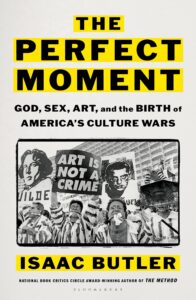
The Perfect Moment by Isaac Butler is available from Bloomsbury.
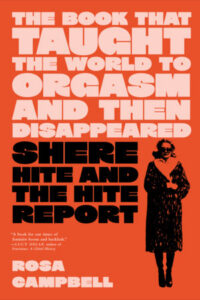
The Book That Taught the World to Orgasm and Then Disappeared by Rosa Campbell is available from Melville House.

Isaac Butler and Rosa Campbell
Isaac Butler is the coauthor of The World Only Spins Forward: The Ascent of Angels in America, which NPR named one of the best books of 2018. Butler’s writing has appeared in New York magazine, Slate, the Guardian, American Theatre, and other publications. For Slate, he created and hosted Lend Me Your Ears, a podcast about Shakespeare and politics, and currently co-hosts Working, a podcast about the creative process. His work as a director has been seen on stages throughout the United States. He is the co-creator, with Darcy James Argue and Peter Nigrini, of Real Enemies, a multimedia exploration of conspiracy theories in the American psyche, which was named one of the best live events of 2015 by the New York Times and has been adapted into a feature-length film. Butler holds an MFA in creative nonfiction from the University of Minnesota and teaches theater history and performance at the New School and elsewhere. He lives in Brooklyn.
Rosa Campbell is a writer and historian based in London.She works on the global history of feminism and is a Leverhulme Early Career Fellow at King's College London. She is the author of The Book that Taught the World to Orgasm and then Disappeared: Shere Hite and The Hite Report. More about Rosa and her work at: rosa-campbell.com.