
God Bless the Pill: Meet the Devout Catholic Who Invented Oral Contraception
Samira K. Mehta Explores the Christian Theological Justifications For Birth Control
Amidst the Food and Drug Administration’s approval of the first oral contraceptive in 1960, an ongoing—if surprising—conversation emerged within the Catholic Church about the morality of birth control. Granted, the institutional Church did not endorse contraception; and American Catholic leadership at times intervened in public debates to attempt to limit contraceptive access.
Catholic objection to birth control, however, was far from universal: Many lay Catholics were very interested in contraception, and many parish priests—and even some high-level theologians—supported their desires. This support for the Pill came from two particularly important kinds of authority: theologians and other religious leaders within the Catholic Church, and the primary front man for the Pill, physician and Catholic John Rock.
Contraception here is not merely acceptable; instead, it is presented as divinely given, a necessary and wholly Christian obligation.
John Rock, the Harvard Medical School professor, researcher, and physician who had, along with Gregory Pincus, developed the birth control pill, was also the doctor primarily responsible for promoting it. This choice was made in part because of his professional reputation. As historian Andrea Tone explains, he was understood to be the best obstetrician in New England. Importantly, Rock was also a devout Catholic with five children, and he attended daily Mass, had a crucifix above the desk in his office, and had long supported contraception despite the position of the Church.
In 1931, he had publicly advocated for the repeal of Massachusetts’s contraceptive bans on the grounds that birth control was at times medically necessary. In 1943, writing in a national medical journal, Rock claimed, “The intelligent American couple is committed to contraception as a means of limiting the number of children to that which can be reared in each family according to the American standard of education and health.” This meant, in part, making sure that a couple could afford to raise children in the resource-intensive style of the midcentury, which increasingly included an expectation of college. But it also meant avoiding giving birth to children whose “known inheritable factors… preclude the likelihood of health and happiness of the offspring, or which promise to make of the child an unwarrantable burden on society.”
Last, Rock was concerned for maternal health. “No wife should be expected to bear children unless she can do so without serious threat to her own health and reason,” he asserted. Rock’s concerns demonstrate the complicated nexus of motivations underscoring the midcentury birth control movement. His comments reflect support for upward mobility, medical if not racial eugenics, and a concern for maternal health, including mental health; but they did not necessarily indicate an awareness of or interest in women having an identity beyond that of wife and mother.
As radical as these practices were, it would be a mistake to see Rock as particularly socially liberal—which in some ways made him the perfect PR man for the Pill. Even as he advocated for birth control, he did not think that contraception should be used by unmarried women. Rock also did not think that married couples should use it lightly, writing that they should not use it for “no good reason.” Each couple should have as many children as they could “properly rear and as society can properly engross.” Rock was motivated by social concerns around the health of families and around population control, but he did not think that couples should reject parenthood or reject a number of children for whom they could responsibly care. But while not a social liberal, the doctor was adamantly in favor of making legalized, medically prescribed contraception available for married couples who looked to implement responsible parenthood.
Rock was also sympathetic to couples overwhelmed by the number of children they had already produced, and by the choice of risking more children or attempting to live together in celibacy—he came, through his practice, to see contraception as potentially good for the health of marriages. For these reasons, he trained his students at Harvard to fit women for diaphragms throughout the 1940s and 1950s, despite the fact that his own church had specifically banned barrier methods of contraception.
Though Rock was willing to provide barrier methods of contraception, part of the appeal of the birth control pill to him was that it would be acceptable to the Catholic Church, or so he believed. This belief was based on the fact that while Pius XI’s 1930 encyclical Casti Connubii had prohibited artificial contraception, calling it an intrinsic evil, by the mid-twentieth century, the Church had acknowledged and even tacitly condoned the idea that Catholics might wish to limit their family size. Indeed, there was much conversation in Catholic circles about how to best employ what was popularly, and at the time not pejoratively, called the “rhythm method.” From Catholic doctors and from Church-provided premarital instruction, couples could receive information about managing fertility through periodic abstinence. Rhythm was popular precisely because it was seen as scientific and reliable.
In many cases, women—as actual people living in actual bodies—are stunningly absent from most of the public conversations about the morality of birth control. The voices of real couples writing about their lives are also largely absent from the historical record. That said, in his role as the Catholic celebrity doctor responsible for the birth control pill, John Rock received both hate mail and fan mail that offer some insight into how the American public understood the Pill. Often, the critical letters were from Catholics who referenced Rock’s own Catholicism.
A typical response came from a woman who chastised Rock for his association with Planned Parenthood. She argued, “As a Catholic—how could you believe that you have a right over life [and] death? God alone has this right [and] by cooperating with an organization that recommends murder through Birth Control you advocate murdering of babies God wills in the world.” Letters like this, though, were in a distinct minority. Most correspondents commented on the Pill as a tool of social good, or on its impact in their own lives. Sometimes religion was mentioned, but only in briefly, as in the case of one woman who wrote a substantial letter asking Rock for medical advice, noting in passing that she and her husband found their family of four children to be sufficient, and stating, “The moral issue has never been a factor here, though we are both Roman Catholics.”
While not all Rock’s laudatory letters came from people who wrote about their Christian faith, many did make specific reference to their religion. One woman wrote in while planning for her marriage. She wanted medical advice about what contraceptive to use, as her husband intended to continue his education for four or five years. “We are Roman Catholics,” she wrote, “but we both know that an education is of primary importance for job security and financial success.” She further wanted to know whether, when they had completed having their hoped-for four or five children, she could return to taking the Pill without an impact on her menopause and long-term health.
Casting contraception as a Christian concept was a remarkable—perhaps even radical—reformulation, and one to which the laity, as much as clergy and theologians, laid claim.
According to the Church’s responsible parenthood theology, both men and women shared the Christian responsibility to practice contraception; but it was women more than men who wrote to Rock thanking him for the role that the Pill played in their lives. These letters of gratitude did not necessarily address responsible parenthood directly, but they implicitly spoke to its tenets. For example, one thankful woman wrote,
As the mother of two boys, thirteen months apart, I wish to express my gratitude to you and your staff for making the oral contraceptive pill. I am not Catholic, but my husband is, and so naturally we used the rhythm method. After the birth of our second child, who was five weeks premature, my husband consulted the priest who married us. He told my husband that by all means we should use the pill and that we should use it until we wanted another child.
For this couple, contraception meant relief. She continued, “The joy and peace that is in our home now is wonderful. Thank you again and may God Bless you and your work.” This mother’s appreciation begins to point us in the direction of contraception as transformative—a message that was strikingly absent from early Protestant arguments for birth control, but that would become increasingly prominent in future conversations.
After appearing on NBC’s Birth Control: How?, hosted by David Brinkley, on January 12, 1964, Rock received many more letters from viewers. Mrs. Alden H. Blake wrote that she and her husband used Envoid, the brand name for the first birth control pill, for the first year and a half of their marriage, as he completed his training at Andover Newton Theological School. She noted that Envoid had allowed them to postpone starting their family while achieving “a more than satisfactory adjustment to the normal initiary problems of a good sex life.” Blake added that they were looking forward “with the happiest anticipation to our first baby sometime next year, God willing.” She concluded:
My admiration must also be expressed for you as you have stood so firmly in the face of adversity. I think that you have shown great courage in doing so, and I too feel that God does not, and will not condemn you for your wonderful work, but rather walks in step with you as you search to help all mankind. As the wife of a Protestant minister, I should also like to say that you, as a staunch Roman Catholic, are to be commended for all that you have done and are doing in the spirit of ecumenicity. It is people like you who will someday reknit the raveled shreds of this world into the whole cloth of true Christendom.
Mrs. Blake’s letter encapsulates much of Protestant thought at the time: She pointed to the need to plan her family, the importance of a good sex life, and the value of ecumenical conversation. To her, Rock’s work was godly both because it aided humanity and because, by supporting contraception as a Catholic, Rock was bridging the Protestant/Catholic divide. A woman who signed herself Sarah L. Barnett (Mrs. G. O.) reiterated the ecumenical point when she wrote, “I feel you are doing a great deal to help unsophisticated Protestants and Jews to be open to, and work with, Catholics in this area. I feel that your example is actively encouraging the common people to actively support work in this field. Thank you for your leadership.”
In another letter, a Mrs. R. Benjamin wrote that she had three children and hoped to adopt a child in need, adding, “Without your pills, I would have 8, and no hope of taking in and educating an extra one.” She echoed the godly point, writing, “The envoid pill you have discovered and perfected cannot do anything but good. Goodness is God-ness and so you are right in your position. If you must answer to God and you are wrong, may I suffer for you.”
Contraception here is not merely acceptable; instead, it is presented as divinely given, a necessary and wholly Christian obligation. By explicitly divorcing birth control from the language of women’s rights, these women made contraception a religious right. While the assertion that birth control was antithetical to a divine concept of the creation of human life was certainly present, casting contraception as a Christian concept was a remarkable—perhaps even radical—reformulation, and one to which the laity, as much as clergy and theologians, laid claim. In addition, the voices of some of these women foreshadow the transformative feminist impact that the birth control pill, and other forms of contraception, would ultimately have.
__________________________________
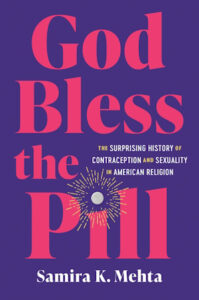
Adapted from God Bless the Pill: The Surprising History of Contraception and Sexuality in American Religion by Samira K. Mehta. Copyright © 2026 by The University of North Carolina Press. Used by permission of The University of North Carolina Press.

Samira K. Mehta
Samira K. Mehta is associate professor of women and gender studies at the University of Colorado Boulder, where she also serves as the director of the Program in Jewish Studies.