Emily McBride on Maternal Mental Health and the Lindsay Clancy Trial
In Conversation with Whitney Terrell and V.V. Ganeshananthan on Fiction/Non/Fiction
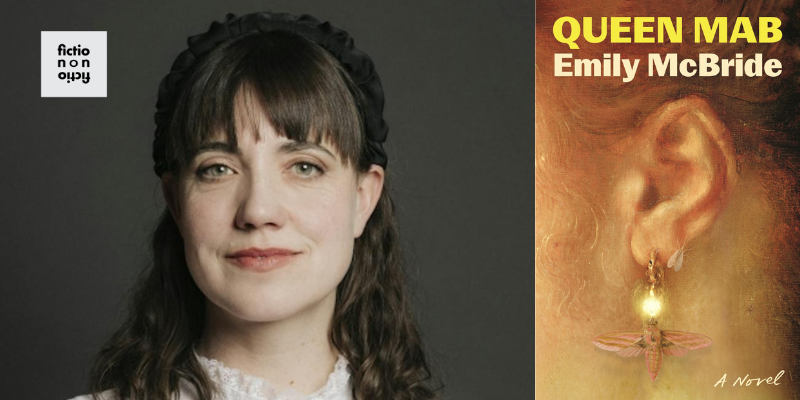
Fiction writer Emily McBride joins co-hosts V.V. Ganeshananthan and Whitney Terrell to discuss her debut novel, Queen Mab, and maternal mental health. McBride talks about the media frenzy around the trial of Lindsay Clancy, a Massachusetts woman charged with killing her three children, and considers how Clancy’s insanity defense has seized the public imagination, prompting new conversation about postpartum psychosis. McBride reflects on Queen Mab’s protagonist, a 23-year-old graduate student of Victorian and modernist literature, who struggles to bond with her baby and begins to fear that her child is a changeling. McBride explains the narrative shifts she uses to portray the character’s fluctuating reality and why literary allusions to changelings and fairies make sense in the context of the pressures of new motherhood. She also discusses how the most infamous “bad mothers” in folklore have skewed society’s perception of postnatal depression. She reads from Queen Mab.
To hear the full episode, subscribe through iTunes, Google Play, Stitcher, Spotify, or your favorite podcast app (include the forward slashes when searching). You can also listen by streaming from the player below. Check out video versions of our interviews on the Fiction/Non/Fiction Instagram account, the Fiction/Non/Fiction YouTube Channel, and our show website: https://www.fnfpodcast.net/ This podcast is produced by Whitney Terrell, V.V. Ganeshananthan, Emily Farris, Sydney Perkins, and Emma Ware.
Others
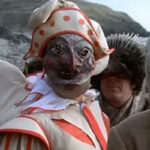
Inferno by Catherine Cho • Lucky Jim By Kingsley Amis • Romeo and Juliet by Shakespeare • The Yellow Wallpaper by Charlotte Perkins Gilman • Madame Bovary by Gustave Flaubert • Medea by Euripides • Labyrinth (1986) dir. by Jim Henson • Cottingley Fairies: How Sherlock Holmes’s creator was fooled by hoax | BBC (2020)
EXCERPT FROM A CONVERSATION WITH EMILY MCBRIDE
V.V. Ganeshananthan: Another complexity of Madeleine’s backstory is that she’s adopted. She makes an unsuccessful attempt to learn the identity of her birth parents, and that changes her relationship to her mother Carol, and she explains this out loud one night to her infant daughter. I wonder if you could talk a little bit about the role Carol plays in the book.
Emily McBride: By the time I was writing this book I had two children myself, and I was aware that there was a lot of conversation happening among my age group about motherhood and whether it was something people wanted to do or needed to do. I wanted to expand the canvas a little bit to include other experiences and not just people who have decided to have children, and have them. So in this book, there’s people that wish to have children and don’t, people who don’t wish to have children and do, people who don’t want and don’t have, and all the combinations basically.
And so Carol is the second face of the coin that is Madeleine. Carol was not able to have children biologically herself and was always desperate to, and as a result, really idealizes the baby as something very special, which puts her in conflict with Madeleine, who has naturally had a child and then finds herself completely unequal to the task of of feeling the mother love for it. So Carol’s a contrast to Madeleine, and also just another look into the world of different kinds of families and parenthood.
Whitney Terrell: But doesn’t Carol say to her that, “It would have been okay, you could have had [a child] later, it wasn’t that big of a deal to me”? And that really makes Madeleine quite fierce. I think Madeleine says, “I had this baby for you.” At least in her head. Am I remembering that correctly?
EM: Yeah, by the time the book starts, they already have poor communication, and so Madeleine has taken away from some prior conversation that Carol is just desperate for the family to continue. And now, and then Carol later is saying, “You know, I think [when I said that] I had too much to drink at that funeral.” So the whole thing is a misunderstanding, and Madeleine takes it extremely badly.
WT: We talked a little bit earlier about the medical and psychological underpinnings of postpartum depression and psychosis, but fairy tales and folklore ventured into this territory long before there was such a thing as psychology. And the book’s title and Madeleine’s nickname, Queen Mab, comes from a fairy referred to by Mercutio in Shakespeare’s Romeo and Juliet. As a podcast that covers literature and politics, we would be failing our audience if we didn’t ask you to talk about the role that literature plays in this book and in Madeleine’s consciousness and the way her mind creates or uses these ideas of fairies in the possible hallucinations that she has throughout the book.
EM: I was really fascinated about how people from the past have understood processes they were going through, and that we still continue to go through. And changeling stories—which I remembered when I became a mother myself from reading fairy tales—seemed like an explanation, to some extent, for some of the feelings that I was feeling, which were like: slight darkness, not complete recognition, either of my new role or of the baby as something belonging to me. These were passing difficulties in my case, but in general, I’ve always been really interested in how people have seen what they’re going through. In the past, we had folklore and religion, and now we have science. And potentially in some of our societies, going back to superstition again. We have literature, which is like our insider view into the minds of people of the past. And so both the changeling stories, which do offer some kind of explanation—even if it’s not one that we would recognize now, that we would have a medical explanation for what’s going on now—they do offer answers of some kind to Madeleine. She’s basically seeking a story or a narrative that makes sense to her.
WT: Why do I feel dissociated from this child? Why am I not feeling the way that I should?
EM: Exactly. Why does everybody expect me to feel a certain way, and I don’t?
WT: Did you feel some lesser degree of that after having a child?
EM: Yeah, in my case, I felt sort of studiously neutral. I would say I just didn’t feel anything, which is also a symptom of postnatal depression. And I was finally told five years after the fact that that is what I had had. In the case of Madeleine, it’s a stronger feeling, obviously, and I wanted to push it to its limits to explore these kinds of feelings and darknesses, and things that aren’t always spoken about on this topic. And then also in terms of literature, I had Madeleine be a literature scholar in part so that she would reach for explanations like changeling stories. But then it just became this wonderful way to explore how other people have talked about crisis in our lives, because it is surprising that there was this massive gap in so much of literature relating to motherhood specifically.
Of course, we have had people all through the years talking about other kinds of catastrophes, and so Madeleine is a specialist in the modernists. I found the modernists really interesting because they were so formally experimental, and in part it’s considered a reaction to the certainties that had broken in the last generation before them. They had lost religion with Darwin, they had lost nature with industrialization and mechanization, and then there was a huge loss of life with the First World War. And they wrote this literature in response to it. Very broken, very different to what came before. And I felt—although I’m not trying to say that having a baby is the equivalent of the First World War—I was trying to think about how you write about things when nothing makes sense anymore, when all the old certainties are in the past, and you no longer recognize what once was.
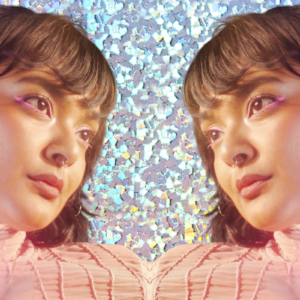
Transcribed by Otter.ai. Condensed and edited by Sydney Perkins and Emily Farris. Photograph of Emily McBride by Silvia Poch.

Fiction Non Fiction
Hosted by Whitney Terrell and V.V. Ganeshananthan, Fiction/Non/Fiction interprets current events through the lens of literature, and features conversations with writers of all stripes, from novelists and poets to journalists and essayists.