We were at my cousin Channing’s house, in the woods of a New England town, when our grandfather told us the Korean story of Chunhyang and Mongryong. With the distant sound of the Atlantic Ocean’s surf crashing into the rocks behind us, we sat in a clearing on tree stumps. It was late morning in the summer. The sun filtered down through the green leaves above our heads. Channing and I were nine years old.
My cousin had asked for a love story. She said, “Harabeoji, tell us the one my mother started before she died. She called it the most famous love story in all the land.”
“Ah!” Our grandfather exclaimed. “ ‘Chunhyangjeon’!”
Channing and I called our grandfather Harabeoji. Four syllables. A long word but it suited him because he was so tall to me. The tallest person in our family. And he taught us how to break it into parts so we could write it in Hangeul, the name for the Korean alphabet: 할아버지, pronounced HAH-RAH-BUH-JEE.
When you’re born in one country and grow up in another, the ground can sometimes feel uncertain beneath your feet. I felt the influence of both Korean and American cultures, but I didn’t know what came from where. Harabeoji tried to link our worlds with stories. He said they were the same in every country: a saga in which someone leaves home for adventure; a legend of a hero who steals from the rich to give to the poor; a tragic romance where lovers fight against the rules of society to be together.
Harabeoji drummed his fingers on his knees. He said, “‘The Tale of Chunhyang’ is a pansori. That’s the Korean name for a story you sing. But I’ll spare you my singing voice.” He let out a laugh. I told him I wouldn’t mind if he sang. Channing said to just get started however way he wanted to tell it. He nodded and began. Our grandfather’s voice was deep and gentle. He started with the setting rather than once upon a time. “The same story happened over and over again,” he said. “But the place — the place changes.”
In Namwon, the soil was rich, the fields lush. The famous Jiri mountains offered delicate herbs and the water was always clean. Love was food, was life, was how we gathered around the brightest yellow bean sprouts with the largest heads, was the mudfish stew called chueotang, the deafening song of crickets that quiet when you walk past, the flash of koi swimming — broader than the ducks that paddled above them in a clear pond under the arches of a stone bridge.
And in this town, there lived a girl and a boy who fell in love but, because they were born into two different groups of Korean society, could never be together. Her name was Chunhyang, which meant “scent of spring” and his name was Mongryong which meant “dream dragon.” Everything was against them.
“What does ‘group’ mean?” I asked.
“Let him finish,” Channing said.
“People in Korea were grouped by their jobs,” Harabeoji explained.
“Mongryong’s parents were in the government job group while Chunhyang came from two groups. Her mother was an artist. She played musical instruments, sang, and danced. Her father was like Mongryong’s parents, in the government job group. This meant that Chunhyang and Mongryong could never marry each other.”
“But what about Chunhyang’s parents? How did they marry if they were from two groups?” Channing asked.
Harabeoji shook his head. “They couldn’t stay together. They weren’t allowed.”
“Huh?” I said.
“That’s why Chunhyang and Mongryong’s love story is famous. They weren’t like everyone else,” he said.
I decided right then that I didn’t like this story. Channing on the other hand urged our grandfather to continue the tale.
The day Chunhyang and Mongryong met each other for the first time was exceptionally pleasant. It was the fifth day of the fifth month and everyone was out enjoying the warm breeze. Mongryong set off for beautiful Gwanghallu Pavilion with his servant. This grand pavilion was built to resemble the Palace of the Moon in Jade City in the heavenly realm. It had beautiful bright colors painted on the curved roof in green, blue, yellow, and red.
Meanwhile, Chunhyang and her servant decided to spend the afternoon on the hillside on a swing with other young people enjoying the weather. In this land, swings were different than the ones here in America. You stood instead of sat on a wooden board tied to a branch of a tall tree. The ropes were long, at least thirty feet or more.
“Someone must have climbed the tree to tie the ropes,” I said.
“It would be Chunhyang,” my cousin replied.
“She was a young lady in a hanbok, which you know is a long skirt and a short jacket,” Harabeoji said.
We nodded.
“Probably one of the servants tied the rope. Chunhyang’s servant, Hyangdan, went with her everywhere and helped her,” he continued.
“If Chunhyang and Mongryong have servants, why aren’t they in the same group?” Channing asked.
“Chunhyang’s mother had enough money to pay a servant but was still not allowed to let her daughter marry someone of a different group,” Harabeoji explained.
I shook my head at this.
“It was a long time ago,” he said. “Korea is different now.”
“Then why is this story still famous?” I asked.
“Because Chunhyang didn’t think the rules applied to her,” our grandfather replied.
“Go on, Harabeoji,” Channing said.
Chunhyang was bolder than all the others on the hill that day. When it was her turn on the swing, she dared to soar to great heights. No one else was as brave. She wanted to see everything possible.
Across the lush gardens of Gwanghallu, from far away, Mongryong saw a flash of color. Bright yellow and red silk blazed through the green leaves of the trees in the distance. It was Chunhyang! He caught a glimpse of her as she swung high into the air and then lost sight of her as she retreated. Again and again she burst into view before disappearing. What kind of girl was this? He wanted to meet her, so he wrote a note and sent his servant to deliver it.
“What did it say?” I asked.
“Clever words about Chunhyang’s beauty,” Harabeoji said.
“He’s so far, how does he know what she looks like?” I leaned in.
Channing said to me, “Stop. You’re ruining the story.” Then to Harabeoji, she asked, “What happened next?”
Chunhyang read Mongryong’s note and dashed off a wittier reply because she had studied all the same books he had. Remember her father had a government job, too? He had taught her how to read and write. She said no to meeting Mongryong right away and had her servant deliver it to him. She was a very independent girl.
“So am I,” Channing said.
“Me too,” I added.
But Chunhyang was curious. After a few more notes back and forth, she agreed to see Mongryong and instantly liked him so much that she let him come to her house that very night so she could introduce him to her mother.
“What about her father?” Channing asked.
“He died when she was very young, which was many years ago,” our grandfather said in a quiet voice.
“Oh,” Channing said.
I hated this story for sure now.
“You mean Chunhyang was like a teenager when she met Mongryong?” my cousin continued.
Harabeoji nodded.
“Go on,” Channing said.
Chunhyang’s mother loved her daughter and agreed to help Chunhyang and Mongryong get to know each other in secret so that they could overcome these old rules. This is how Chunhyang and Mongryong were able to hide their relationship from the whole town. They were together all the time without Mongryong’s parents knowing because if they found out, then they wouldn’t allow Chunhyang and Mongryong to be together at all.
“How could his parents not know?” I asked. Mongryong seemed very sneaky to me. Clever and sneaky.
“He hid it from them by going over at night while his parents were asleep. And during the day, he told them he was studying in Gwanghallu Pavilion though he was at Chunhyang’s house,” Harabeoji said.
“He’s a liar,” I announced.
“They wouldn’t understand and they’d keep them apart,” Channing said. “He had to lie. That doesn’t make him a liar.”
“Those were the rules back then,” Harabeoji answered.
This story was getting worse by the minute. I kicked at the dirt at my feet, but I was listening for what happened next.
“So then?” Channing asked. “They lived happily ever after?”
“Not yet,” Harabeoji said.
“I knew it,” I exclaimed. “If you’re lying, you can’t be happy. You’ll always get caught.”
“You’ve lied,” Channing said.
“You too,” I snapped back.
“That’s what I’m saying,” Channing returned.
She made no sense sometimes and confused me completely. “Let’s get back to the story,” Harabeoji said.
A whole year passed with Chunhyang and Mongryong falling more and more in love each day. They read books together and sang and danced. They were very happy. But that happiness didn’t last. There came a time when Mongryong’s father got a better job. His parents celebrated this good fortune, but Mongryong was very sad because he and his whole family now had to move far away from Namwon to the central city to serve the king.
To stay together, Chunhyang and Mongryong tried to figure out how to hide her on the journey to the capital. And then once in the new city, they’d have to find a place for her to live without anyone knowing. It was very risky. She couldn’t live with him in his parents’ house and Chunhyang’s mother couldn’t move to this new city.
Chunhyang decided she’d wait for him in Namwon. Mongryong promised to come back as soon as he could. He hoped to study hard and get a powerful job in the government someday and return to Namwon for her. They cried a lot and said their farewells.
Time passed and Chunhyang got older and was very sad. Everyone said she had a beautiful singing voice, but she would only sing for her true love, Mongryong. By now, a new magistrate had arrived in Namwon. A magistrate is like the mayor of a town. This man’s name was Magistrate Byeon, and he was a mean man. He had heard of how beautiful Chunhyang was and how good she was at singing and dancing. He wanted her to sing and dance for him.
She refused. She said she only did those things for Mongryong.
Magistrate Byeon became very angry. He offered her all kinds of gifts. When that didn’t work, he threatened her with all kinds of punishment unless she obeyed him. But Chunhyang still said no. So Magistrate Byeon locked her away in prison to make her change her mind.
Channing and I gasped. “Prison?” we said together.
“Don’t worry,” Harabeoji said. “Magistrate Byeon can’t force Chunhyang to do things she doesn’t want to do.”
“But why doesn’t she sing for him, so she doesn’t have to be in jail?” I asked. “Singing isn’t hard.”
Harabeoji didn’t go into details. Channing was just as confused as I was until our grandfather said, “Chunhyang’s song and dance were only for those she loved, and she loved Mongryong. Magistrate Byeon wanted Chunhyang to love him instead of Mongryong.”
Channing and I both said, “Oh!” Even at nine years old we knew what love was, in our limited way. You liked who you liked, you couldn’t help it.
So Chunhyang was held in jail for a long time. Meanwhile, Mongryong was studying really hard and didn’t know what had happened to her. Chunhyang tried to get a message to him through servants, but the messages never reached him.
More time passed and people told Chunhyang to give up her love for Mongryong. But Chunhyang never wavered. She stayed in prison, true to her feelings. People were in awe of her unbreakable will. She became famous throughout Korea. Soon even Mongryong heard about her and the terrible Magistrate Byeon. The whole kingdom now knew. It was just in time, too, because Mongryong had done well on the national exams and had received a very powerful job from the king to find people in the country who were greedy.
His first job brought him back to Namwon in disguise. No one knew he was a high-level government official who worked directly for the king himself. He rewarded those who treated him with kindness and made plans to tell the king of their good deeds.
The day came when he reached the prison where Chunhyang was confined, and she didn’t recognize him because of his disguise. When he asked her if she still loved Mongryong, she said she did without hesitation. And of course, Mongryong still loved Chunhyang.
“Just get her out already,” I said. “Why is he giving her a test?”
“Good point. But it’s part of the story,” Harabeoji replied.
With the full force of the king’s army, Mongryong revealed his true identity to Magistrate Byeon, and Byeon never got to hurt anyone the way he had hurt Chunhyang again. At long last, Mongryong freed Chunhyang from prison and they were reunited. Chunhyang was overjoyed. So was her mother! Everyone in all of Korea agreed Chunhyang and Mongryong should be married because no two people loved each other more. There was a great big wedding celebration and Chunhyang and Mongryong were together for all the years to come. The end.
Channing let out a sigh. “Chunhyang and Mongryong made their own rules and lived happily ever after,” she said. “That’s the story my mother wanted to tell me. Love wins out over everything. I want a love like Chunhyang’s and Mongryong’s.”
“I don’t,” I said, and got to my feet. I turned away from my cousin and my grandfather and ran to an ancient maple that offered long low branches. I climbed up the shoulders of the tree to the very top. The blue-green ocean glittered on the horizon. Channing called to me from below.
This story of Chunhyang will not be ours, I thought. I told the ocean I refused it.
“We’ll both have a better story,” I shouted.
*
I was never sure where danger might lie, but I was on the lookout for it. I had just bought a small pouch of compostable dental floss at Duane Reade pharmacy on Sixth Avenue and Thirty-Third Street in New York City at five o’clock and walked outside to discover a white child in a green sweatshirt and jeans, with black-rimmed square glasses on his face. His hand gripped the side bar of an umbrella stroller that had a toddler kicking her legs up, dressed in daisy-print overalls. The boy was no more than four years old. I knew this because I had worked as a teacher’s aide in a preschool once. He and the toddler were directly beside the automatic glass doors. I looked around for an adult. Surely one was nearby. Maybe they had gone to the corner to throw out an item in the trash receptacle; maybe they had dashed up the street to pay for parking.
I couldn’t walk away from those children. People passed us. Some looked at me because I looked at them. The palms of my hands tingled when I got nervous. I wiped my hands on my skirt. To get rid of that feeling, I had to do something, take some sort of action. What should I do? I couldn’t just leave them there.
I asked the little boy about his parents’ whereabouts, but he didn’t answer. He’d probably been told not to speak to strangers. Inside the store, an Asian security guard stood with his back to the window. I wanted to ask him to keep an eye on the children. Anyone could walk off with them at any time. But something stopped me. What if he arrested their parent? Did I want to cause that kind of harm to someone who had stepped away for a second?
Questioning what’s usual was familiar to me. I didn’t know if I could trust my first reaction. I’d emigrated from Seoul with my parents when I was five years old, and we’d moved frequently in the United States so that I’d never been able to establish a solid sense of home. My understanding of what was commonplace and “normal” felt in constant flux. Even my sense of danger was sometimes murky, like right there on the street in the city. What to pay attention to? What to dismiss? Follow the majority of the crowd and leave those children like that or be in the minority and help them?
While I hesitated, out of the groups of people walking by me on the sidewalk that day, a white man in a business suit emerged. For a second, I thought he was the children’s father, but he walked straight toward me. He said, “They’re alone?” As if it was obvious to him that they needed help. He confirmed these children were at risk. I was relieved on the one hand, though now more anxious. I wondered if he had some designs on the children, but he seemed perfectly kind. He offered to go inside and ask the security guard, which I told him might jeopardize the parents.
He nodded. “Good point. I’ll just look around.”
I told him I’d stay there, standing closer to the children now that I had reinforcements. A few seconds later a white woman walked out of the store, met my eyes, and headed straight for the stroller without hesitation. “Your kids?” I asked. She didn’t reply and wheeled the stroller, with the little boy trailing, away so fast no one would have heard the children protest.
I could have left, but I waited for the man. What might he think if he walked out and saw all of us gone? When he finally exited the store, I told him the mother had come and taken the kids with her. He shook his head, mirroring how I felt. Oh well, that was that. We went our separate ways.
I was still thinking about those kids when I reached my apartment. It was a rectangular studio with the bedroom and living area divided by a bookcase. I wished it were at least an L-shape. I didn’t dare hope for a one-bedroom in Manhattan on my teacher’s salary. My upstairs neighbor was dragging something across the floor. That dull heavy sound coming from the ceiling made me go into my tiny bathroom, sit on the toilet seat cover, and phone my cousin Channing.
We were the same age, born hours apart, and today we turned thirty years old.
“Hey, happy birthday!” I said as soon as she answered. “Did you eat noodles yet?”
Noodles signified long life in Korean culture, I was told. In addition to noodles, Channing grew up eating miyeok guk on her birthday. My parents didn’t follow that tradition. I had lived in rural areas of the States where it had been impossible to find ingredients for this soup.
“Happy birthday, Dahee!” she replied. “I’ll have jjajangmyeon delivered later. You?”
“Same,” I replied.
“Good.” She paused. “I was about to call you. How’s your day going?” Over the years, Channing and I had tried to spend our birthday together, but this year, she was babysitting two boys in East End for the month of August while their parents were away in Europe. She was halfway through the job now.
“You won’t believe someone left two kids alone on the sidewalk — ” I said.
“Dahee, was it really that bad?” she said.
“Anything could have happened. It was rush hour. Those kids were scared, I could tell.” This last bit was added for emphasis. Those children hadn’t seemed frightened to me, not visibly anyway. But I knew you couldn’t always tell how stressed a child might be on the inside. I offered her proof I wasn’t the only one concerned. “A man stopped to help. He agreed they shouldn’t have been left alone like that,” I said.
“Parents also need a break, just a few minutes without those kids — ”
“Have you done that? Left Edison and Austin by themselves?” Those were the names of the children in her care.
“No, I’m talking about their parents. They needed a break, which is why they hired me.”
“Okay, but you do know you can’t leave those boys alone somewhere, right?” I had to ask because Channing had never had a job like this before, had never been responsible for children.
“How can you even say that?” she said. “You teach little kids at school, but at the end of the day you get to leave. I’m here with them twenty-four seven.” Her voice dropped. “Anyway, I need to talk to you about someone. Let me close the door.”
I waited and then she was back. “I’m having problems with a guy here. I don’t know what to do.”
Channing got approached by men a lot and usually handled them with ease. I was surprised at how rattled she sounded by this one.
“What happened?” I said now.
“Yesterday this man let himself in and was drinking coffee in the kitchen at eight o’clock in the morning.”
“Wait, what?” The palms of my hands tingled. “The night before, he was in the living room.”
“I don’t understand. Did you leave the door unlocked?”
“No — yes, it’s more complicated than that.”
“Wait, are you going on dates while you’re babysitting the boys?” I asked.
“What? No!”
“Then he’s a random stranger? Did you call the police?”
“That’s the thing, I can’t. He’s close with the boys’ parents. He’s their friend. They gave him the code to the door for emergencies. Everyone knows him; he works for the mayor,” she said.
I was speechless, and then a thought occurred to me. “Do you think the parents told him to check up on you? I deal with parents all the time, and they worry — ”
“I doubt it. They talk to the kids every day,” she said.
“What if you changed the code? You know all that tech stuff. You could figure it out.”
“It’s not my house, I wouldn’t do that. There could be a real emergency.” The tingling in my hands increased. I rubbed my free hand on my shirt. The bathroom floor seemed to tilt. I focused on a single corner of a black tile in the diamond pattern. “Have you told Harabeoji about him?” I asked. Thinking of my grandfather often helped me. At eighty-eight years old, he was younger in spirit than my parents and didn’t make me doubt myself. The sensation in my palms dissipated. The bathroom came back into balance.
“I’ve been meaning to call him. Dad’s in rehab again, so Harabeoji’s alone.”
The phone line went silent, so I wondered if we’d gotten disconnected. “Channing? Are you — ” I said. I heard muffled voices before she returned to the phone. “I have to go. He’s here again.”
“Who’s there?”
“Kent Cho, the guy I’ve been talking about.”
“Do you think he could be dangerous? I can be there in four hours if I leave right now,” I said.
“No, no, it’s fine. It’s more annoying than anything.” There was another pause. “Maybe you’re right. Just to be safe.”
“I’m calling Harabeoji. We’ll come for a few days. If I leave in the morning — ” I began.
“I have to go,” she repeated. “Dahee, thank you. You have my location, right?”
I checked my phone and told her I did. Besides attending a few nonessential meetings and setting up my classroom, I had nothing urgent on my to-do list before my teaching job started in September.
A calm settled over me, then I felt a flicker of excitement. I’d always idealized East End. Unlike my nomadic parents, who moved every few years, Channing’s family had settled in this town with a large Korean community and put down roots. Her father was my dad’s older brother, so they’d arrived in the United States first and then helped us when we came. Channing had lived in East End until eleventh grade when she’d been forced to move to Boston. Now she was back after fourteen years for this temporary job. If I had a home base anywhere, it was this place.
“Don’t worry, we’ll be there soon,” I told her.
__________________________________
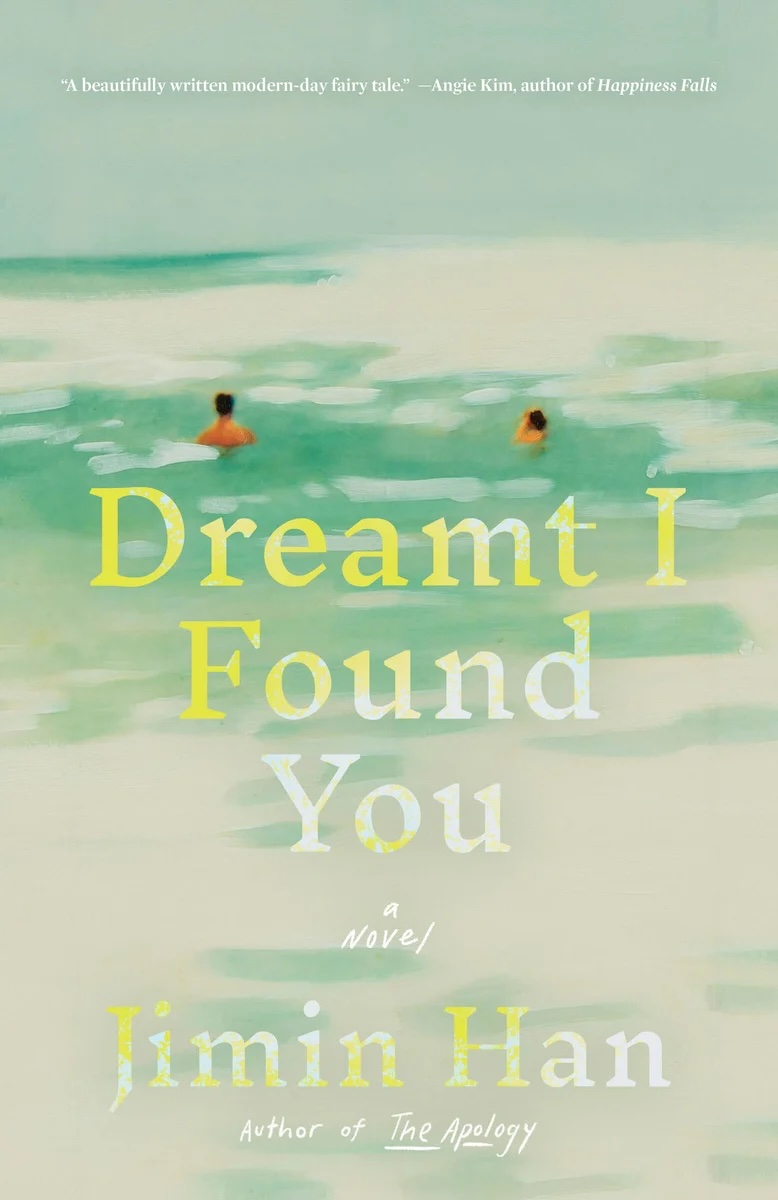
From Dreamt I Found You by Jimin Han. Used with permission of the publisher, Little Brown and Company. Copyright © 2026.